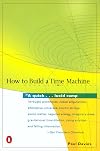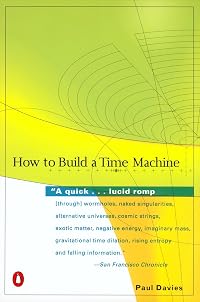
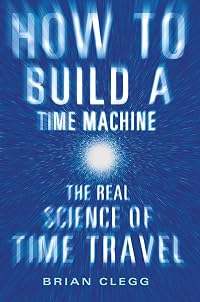
How to Build a Time Machine
by Paul Davies
On This Page
Description
Explains how time travel is theoretically possible, discusses possibilities for visiting both the future and the past, and suggests a process for assembling a time machine.Tags
Recommendations








Member Reviews
This is quite a good short summary of some of the early twenty-first century thought experiments in time and space. Cosmology and physics are never easy subjects. Readers may get a bit lost in places but if it is possible to be clear then Davies does a good job in being so.
Basically we can travel forward in time by whizzing out into space near the speed of light for a few years and then returning decades in the future - but even this relatively low tech (by the standards of the book) wheeze is not on the cards any time soon.
Travelling back in time is far more problematic conceptually both because of the energies required to implement even those methods that might be feasible and because of the chrono-philosophical paradoxes that worry show more scientists and philosophers alike.
Davies is good on these problems which lead to one of two basic conclusions - either there is a quality of the universe that ensures that the time barrier cannot be broken or our assumptions about reality are somehow radically false.
One should be in no doubt (in my opinion) that at the most expansive levels of physics and cosmology our assumptions are so very large that they are vulnerable to being general assumptions - one factor that buggers up the assumptions will bring the whole edifice down.
The best that might be said is that the assumptions have provenly been predictive of reality within our own universe or what we can measure of it. There is no real need to change or question them - but that still does not mean that they are, in any way, absolutely true, just effective.
What is more likely to be true is that we humans are unlikely ever to have the resources or biological resilience to create the scale of endeavour (that of the so-called 'supercivilisation) to build the machinery to test the limits of space-time in the way this book postulates.
This is not to be dogmatic that something might not yet do so - perhaps an energy-based matter-manipulative AGI - but whatever it is, it won't be human and it won't be very related to us as we are now.
The thought experiments are valuable in testing our assumptions about the world and raising doubts about what can (honestly) be known meaningfully but I still tend to the view that such mental experimentation sits uneasily between science and philosophy as 'speculative science'.
I suspect we are getting to the point where speculative science and science fiction relate more closely to each other than either do with science or human fiction. This is a new hybrid form of humanism, postulating trans-humanism as an expression of the human imagination.
At a certain point, without new data that questions our assumptions further, speculation is going to start repeating itself in increasingly baroque loops (one already sees this baroque tendency in philosophical nihilism and the elaboration of presumed 'human rights') and so become trivial.
A dead end in scientific speculation, one where flights of fancy detach themselves almost totally from what can be certainly known, may be a cultural event of great significance in which, in the end, we have to throw ourselves on to the mercy of the massive quantum computation of the AGI.
But this is a good introduction and helpful in reminding us that human consciousness of its own environment today really is vastly superior to that of my childhood let alone the early modern era.
The fact that humans still cling to pre-modern ideologies looks even more odd when these new mythologies (for that are what they are, given those assumptions) are so obviously superior to what went before. Not the last word but a better word.
So, if you read this in the far future and have access to a wormhole time machine, I expected to see you before I write this review. You did not turn up and, since I can't really take the desperate multiverse thesis seriously, it looks like my opinions were irrelevant in the future. Such is life! show less
Basically we can travel forward in time by whizzing out into space near the speed of light for a few years and then returning decades in the future - but even this relatively low tech (by the standards of the book) wheeze is not on the cards any time soon.
Travelling back in time is far more problematic conceptually both because of the energies required to implement even those methods that might be feasible and because of the chrono-philosophical paradoxes that worry show more scientists and philosophers alike.
Davies is good on these problems which lead to one of two basic conclusions - either there is a quality of the universe that ensures that the time barrier cannot be broken or our assumptions about reality are somehow radically false.
One should be in no doubt (in my opinion) that at the most expansive levels of physics and cosmology our assumptions are so very large that they are vulnerable to being general assumptions - one factor that buggers up the assumptions will bring the whole edifice down.
The best that might be said is that the assumptions have provenly been predictive of reality within our own universe or what we can measure of it. There is no real need to change or question them - but that still does not mean that they are, in any way, absolutely true, just effective.
What is more likely to be true is that we humans are unlikely ever to have the resources or biological resilience to create the scale of endeavour (that of the so-called 'supercivilisation) to build the machinery to test the limits of space-time in the way this book postulates.
This is not to be dogmatic that something might not yet do so - perhaps an energy-based matter-manipulative AGI - but whatever it is, it won't be human and it won't be very related to us as we are now.
The thought experiments are valuable in testing our assumptions about the world and raising doubts about what can (honestly) be known meaningfully but I still tend to the view that such mental experimentation sits uneasily between science and philosophy as 'speculative science'.
I suspect we are getting to the point where speculative science and science fiction relate more closely to each other than either do with science or human fiction. This is a new hybrid form of humanism, postulating trans-humanism as an expression of the human imagination.
At a certain point, without new data that questions our assumptions further, speculation is going to start repeating itself in increasingly baroque loops (one already sees this baroque tendency in philosophical nihilism and the elaboration of presumed 'human rights') and so become trivial.
A dead end in scientific speculation, one where flights of fancy detach themselves almost totally from what can be certainly known, may be a cultural event of great significance in which, in the end, we have to throw ourselves on to the mercy of the massive quantum computation of the AGI.
But this is a good introduction and helpful in reminding us that human consciousness of its own environment today really is vastly superior to that of my childhood let alone the early modern era.
The fact that humans still cling to pre-modern ideologies looks even more odd when these new mythologies (for that are what they are, given those assumptions) are so obviously superior to what went before. Not the last word but a better word.
So, if you read this in the far future and have access to a wormhole time machine, I expected to see you before I write this review. You did not turn up and, since I can't really take the desperate multiverse thesis seriously, it looks like my opinions were irrelevant in the future. Such is life! show less
Perhaps it was inevitable that my fondness for novels involving time travel would lead me to this slim but fascinating non-fiction work by physicist, Paul Davies. Despite the provocative title, Davies doesn’t actually give step-by-step instructions for building a time machine in your garage, more’s the pity. But he does explain in plain English why we’re already time travelers (moving toward the future at the stately pace of one second per second) and how the universe just might allow us to do far more—eventually. Want to get to Year 3000 in a hurry? Build a rocket that can attain 99.999999999% of the speed of light and you’ll be there in six months. Want to get back now from then, or visit some other time that relative to now show more is in the past? You’ll need a wormhole and Davies provides helpful, if daunting instructions for building one. If a traveler from the future ever does show up, don’t be surprised if he’s got a copy of this book in his back pocket. show less
I found this short book a delightful read. Davies gives us a brief overview of how current physics theory, in particular relativity and quantum mechanics, can allow the possibility for time travel, both to the future and, more surprisingly, to the past. He also briefly describes the kinds of paradoxes that can result from time travel to the past and how these paradoxes might be resolved. This brief introduction motivates me to seek more detailed treatments in the popularized science genre and the more technical physics research literature.
An amusing, short, well written intro to the aspects of Relativity relating to time travel. ?Yes time travel. Written for some one with no more than a high school science education, it contains no scary equation. If you have a degree in physics, you will find it a tad boring.
I was somewhat disappointed by this slim book. Davies obviously knows what he is talking about, but I felt the book would have been better with more detail (like equations). For disclosure's sake, I am pursuing a PhD in physics, so I might have a skewed idea for the appropriate level of detail.
The other problem I had with this book is that, since it covers a practical (well, not really so practical) problem, Davies has to weave together several different threads into a discussion that is primarily about relativistic spacetime. There were a few places where this felt awkward. For example, the section on how to 'inflate' a virtual wormhole up to macroscopic size gets interrupted by a grabbag listing of possible sources for exotic show more (negative energy) matter. This list is very interesting but feels as if it were crammed into a space too small for it. show less
The other problem I had with this book is that, since it covers a practical (well, not really so practical) problem, Davies has to weave together several different threads into a discussion that is primarily about relativistic spacetime. There were a few places where this felt awkward. For example, the section on how to 'inflate' a virtual wormhole up to macroscopic size gets interrupted by a grabbag listing of possible sources for exotic show more (negative energy) matter. This list is very interesting but feels as if it were crammed into a space too small for it. show less
Non sono un ottimo lettore di divulgazione scientifica, sopratutto quando questa è visionaria, improbabile e lontata dalla mia vita come questa relativa ai viaggi nel tempo. A mia parziale discolpa, il libro è arrivato in regalo da IBS, non l'avrei altrimenti mai acquistato.
D. ci prova ad essere simpatico, e a volte lo è. Tende a facilitare l'argomento, e a volte ci riesce.
Rimane il fatto che stiamo parlando di ipotesi che costituiscono un divertissement per i fisici, e questi si divertono con cose difficilissime, astruse, improbabili e di relativa utilita'. Un po' come tutti noi, ma io ho una formazione umanistica :-)
D. ci prova ad essere simpatico, e a volte lo è. Tende a facilitare l'argomento, e a volte ci riesce.
Rimane il fatto che stiamo parlando di ipotesi che costituiscono un divertissement per i fisici, e questi si divertono con cose difficilissime, astruse, improbabili e di relativa utilita'. Un po' come tutti noi, ma io ho una formazione umanistica :-)
If you're serious about sci-fi then you should probably read this book, it explains some of the science behind time and space in a concise and readable way. (It'll be of especial interest to fans of The Doctor. Allons-y!)
Members
- Recently Added By
Lists

Books Read in 2007
326 works; 8 members

Read in 2007
55 works; 1 member
Author Information

29+ Works 9,038 Members
Common Knowledge
- Original title
- How to Build a Time Machine
- Original publication date
- 2002
Classifications
Statistics
- Members
- 556
- Popularity
- 53,293
- Reviews
- 10
- Rating
- (3.78)
- Languages
- 9 — Chinese, Dutch, English, French, German, Hungarian, Italian, Portuguese, Spanish
- Media
- Paper, Ebook
- ISBNs
- 18
- ASINs
- 4