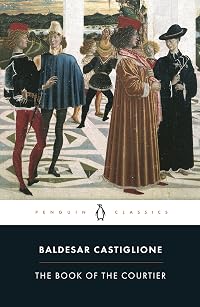
The Book of the Courtier
by Baldassare Castiglione
On This Page
Description
Set in the court of Urbino in 1507, Castiglione's The Book of the Courtier presents an invaluable look at court life and culture during the Renaissance. Over four nights of dialogue, the book explores the key question, 'What should a courtier be like?' and presents a deep and timeless discussion that is reminiscent of Plato's Symposium and Aristotle's Nicomachean Ethics, and invites comparisons with Machiavelli's The Prince. It is absorbing and enlightening, and encompasses a wide range of show more topics that include dancing, fencing, war, religion, culture, courtly and corporeal love and gender relations, with a surprisingly modern defense of women and equal rights. show lessTags
Recommendations





























Member Recommendations

Member Reviews
The Book of the Courtier
There really was a Camelot. But it was in Italy, Urbino in northern Italy to be exact, in the 1500s. Perched on top of a couple of hills in the region Le Marche, Urbino was ruled by the Montefeltro family. From 1444 to 1482 Federigo de Montefeltro skillfully steered his tiny domain through the rough storms of Italian Renaissance realpolitik. Federigo was a successful soldier of fortune yet maintained one of the largest libraries in Italy, spoke Latin, read Aristotle, helped orphans and in general earned the love of his people. He built a beautiful fairy-tale palace and had Paolo Uccello and Piero della Francesca decorate it.
His less fortunate son Guidobaldo inherited this charming and well-run dukedom. show more Guidobaldo married the cultivated Elisabetta of the Gonzaga family from Mantua. He was an invalid and not made of his father’s stern military stuff. A victim of the brilliant military campaigns of Cesare Borgia that so enchanted Machiavelli, Guidobaldo was temporarily deposed. When the Borgias (Cesare and his father Pope Alexander VI) died, the people of Urbino rose up, drove out Borgia’s soldiers and cheered Guidobaldo and Elisabetta upon their return.
For the next few years the court of Elisabetta and Guidobaldo was the most beautiful, enlightened, genteel place on earth. They attracted musicians, scholars and artists. Conversation was honed into a fine art. Into this paradise strode our Lancelot, Baldasare Castiglione, a diplomat descended from minor Italian nobility. He loved Elisabetta, but as far as we know the devotion remained platonic
It is because of Castiglione that we believe we have a sense of what the court of Montefeltro was like, or at least how they would have like to have been remembered. His “The Book of the Courtier” (Il Cortigiano) painstakingly analyzes the attributes of a gentleman through conversations (probably highly idealized) of refined visitors to Urbino.
It’s a long, slow, but thoroughly enjoyable book. It is a window into the renaissance mind. It does not describe how the Italians of the sixteenth century were, Machiavelli and Cellini are probably more useful there. But it tells how they wanted to be. The book was read and studied by nobility all over Europe.
It’s also how I wanted them to be. Urbino is one of my favorite places. It’s a crowded student city now. But on a quiet morning when only a few people are about and the sun has made its way over the hills from the Adriatic, I can imagine that I can see the ghosts of Elisabetta and Guidobaldo walking on the cobbled streets outside their beautiful palace. Fussy, snobbish, yet kind and gentle Castiglione and his wonderful book help make that fantasy more real. show less
There really was a Camelot. But it was in Italy, Urbino in northern Italy to be exact, in the 1500s. Perched on top of a couple of hills in the region Le Marche, Urbino was ruled by the Montefeltro family. From 1444 to 1482 Federigo de Montefeltro skillfully steered his tiny domain through the rough storms of Italian Renaissance realpolitik. Federigo was a successful soldier of fortune yet maintained one of the largest libraries in Italy, spoke Latin, read Aristotle, helped orphans and in general earned the love of his people. He built a beautiful fairy-tale palace and had Paolo Uccello and Piero della Francesca decorate it.
His less fortunate son Guidobaldo inherited this charming and well-run dukedom. show more Guidobaldo married the cultivated Elisabetta of the Gonzaga family from Mantua. He was an invalid and not made of his father’s stern military stuff. A victim of the brilliant military campaigns of Cesare Borgia that so enchanted Machiavelli, Guidobaldo was temporarily deposed. When the Borgias (Cesare and his father Pope Alexander VI) died, the people of Urbino rose up, drove out Borgia’s soldiers and cheered Guidobaldo and Elisabetta upon their return.
For the next few years the court of Elisabetta and Guidobaldo was the most beautiful, enlightened, genteel place on earth. They attracted musicians, scholars and artists. Conversation was honed into a fine art. Into this paradise strode our Lancelot, Baldasare Castiglione, a diplomat descended from minor Italian nobility. He loved Elisabetta, but as far as we know the devotion remained platonic
It is because of Castiglione that we believe we have a sense of what the court of Montefeltro was like, or at least how they would have like to have been remembered. His “The Book of the Courtier” (Il Cortigiano) painstakingly analyzes the attributes of a gentleman through conversations (probably highly idealized) of refined visitors to Urbino.
It’s a long, slow, but thoroughly enjoyable book. It is a window into the renaissance mind. It does not describe how the Italians of the sixteenth century were, Machiavelli and Cellini are probably more useful there. But it tells how they wanted to be. The book was read and studied by nobility all over Europe.
It’s also how I wanted them to be. Urbino is one of my favorite places. It’s a crowded student city now. But on a quiet morning when only a few people are about and the sun has made its way over the hills from the Adriatic, I can imagine that I can see the ghosts of Elisabetta and Guidobaldo walking on the cobbled streets outside their beautiful palace. Fussy, snobbish, yet kind and gentle Castiglione and his wonderful book help make that fantasy more real. show less
It's difficult to read because the sentences are excessively elegant and artificially pleasing. After several failed attempts I began to read aloud and then I was able to break through to the style and demeanor of the author and subject.
It is divided into 4 books were members of the court of Urbino discuss the qualities that make for a successful courtier.
Some, but not all of the qualities are ability to dance, play an instrument, give good advice to the Prince, compete in mock battles, and compete in real battles.
The second book is full of short entertaining stories that they find amusing. Occasionally they are funny and the stories are a good representation of comedy in the 1500s.
There are many examples of poor behavior and what the show more courtier should avoid.
There are examples of a successful female in court and how she should behave. One gentleman criticises women. His criticisms are valid and and he is fiercely scolded. I suspect the author included the excoriation in order to please his female readers.
The last book concerns love and raises the discourse to a lofty level concerning the value of love. show less
It is divided into 4 books were members of the court of Urbino discuss the qualities that make for a successful courtier.
Some, but not all of the qualities are ability to dance, play an instrument, give good advice to the Prince, compete in mock battles, and compete in real battles.
The second book is full of short entertaining stories that they find amusing. Occasionally they are funny and the stories are a good representation of comedy in the 1500s.
There are many examples of poor behavior and what the show more courtier should avoid.
There are examples of a successful female in court and how she should behave. One gentleman criticises women. His criticisms are valid and and he is fiercely scolded. I suspect the author included the excoriation in order to please his female readers.
The last book concerns love and raises the discourse to a lofty level concerning the value of love. show less
Etwas altmodisch und in der Dialogform deshalb schwer zu lesen, aber dafür, dass das Original erstmalig 1528 veröffentlicht wurde, ist es teilweise immer noch erstaunlich aktuell. Zum Beispiel gibt es ein interessantes Zwiegespräch zur Gleichberechtigung der Frau, dass erstaunlicherweise pro Gleichberechtigung endet. Dass Tjostieren heute nicht mehr so wichtig ist, überrascht stattdessen kaum.
Kurzum - alles was man schon immer über Grandezza wissen sollte! "Dort sei man die wahre Kunst, wo man die Kunst nicht sieht!"
Kurzum - alles was man schon immer über Grandezza wissen sollte! "Dort sei man die wahre Kunst, wo man die Kunst nicht sieht!"
Several centuries ago, writing was simpler and more direct. Even though the sentences were longer, the word choice and meaning were always precise. This book is a Socratic exploration about greatness, framed as the recollection of a discussion held at court sometime in the early 1400's. Various characters discuss what traits are most important for those who would comprise a prince's court. Included in these virtues are grace, health, knowledge of arms, candor, trust, and beauty. All of these are explained through clever dialogue that invokes a sense of the 15th century and their appreciation of the classics. My favorite excerpt: "I have discovered a universal rule which seems to apply more than any other in all human actions or words: show more namely, to steer away from affectation at all costs, as if it were a rough and dangerous reef, and (to use perhaps a novel word for it) to practice in all things a certain nonchalance which conceals all artistry and makes whatever one says or does seem uncontrived and effortless." show less
For an early 16th century creation, this work seems remarkably progressive to me at times. Like, the merit of the individual rather than their class:
Of the first four "books" making up this work, early numbered sections have lots about proper use of humor and a need for respectful politeness. Later sections shaping up the courtier:
18 modesty
20,22 physically fit, athletic, and "worthy in arms"
29 eloquent good writing
30-33 Good conversationalist, eloquent, and social
36 Make a good first impression
51 Humorous without being cruel
Book III returns to the third night of discussions at Urbino. Duchess Elisabetta Gonzaga insists Magnifico Giuliano de' Medici describe the ideal court woman, though Gaspare Pallavicino and Federico Fregoso try to change the subject. Cesare Gonzaga points out that women inspire men to chivalrous deeds. Mixed in is some real "Battle of Sexes" type material":
As well as some aggressive equality arguments:
Among the witty and intelligent women here is one Emilia Pia. Mary Augusta Scott first suggested in 1901 that Beatrice in Much Ado About Nothing is modelled on Baldassare Castiglione's Emilia Pia from The Book of the Courtier.
Making this a nice pairing with The Prince, this directs such rulers to encourage peace:
Book IV going to extreme lengths to extol a "divine love" which is a higher, spiritual love for the mature courtier whose youthful skirt-chasing is long behind him. show less
...signor Gaspar Pallavicino said: "So that our game may have the form prescribed and that we may not appear to esteem little that privilege of opposing which has been allowed us, I say that to me this nobility of birth does not seem so essential. And if I thought I was uttering anything not already known to us all, I would adduce many instances of persons born of the noblest blood who have been ridden by vices; and, on the contrary, many persons of humble birth who, through their virtue, have made their posterity illustrious. And if what you said just now is true, that there is in allshow more
things that hidden force of the first seed, then we should all be of the same condition through having the same source, nor would one man be more noble than another. But I believe that there are many other causes of the differences and the various degrees of elevation and lowliness among us.
Of the first four "books" making up this work, early numbered sections have lots about proper use of humor and a need for respectful politeness. Later sections shaping up the courtier:
18 modesty
20,22 physically fit, athletic, and "worthy in arms"
29 eloquent good writing
30-33 Good conversationalist, eloquent, and social
36 Make a good first impression
51 Humorous without being cruel
Book III returns to the third night of discussions at Urbino. Duchess Elisabetta Gonzaga insists Magnifico Giuliano de' Medici describe the ideal court woman, though Gaspare Pallavicino and Federico Fregoso try to change the subject. Cesare Gonzaga points out that women inspire men to chivalrous deeds. Mixed in is some real "Battle of Sexes" type material":
[35] Here signor Gaspar Pallavicino replied, laughing: "As reasons to support your opinion, you cite me the doings of women, who for the most part are quite beyond the pale of reason. And if you would tell the whole truth, this man who was favored by so many women must have been a simpleton and practically worthless. For it is the way of women always to favor the worst, and like sheep to do what they see the first one do, be that for good or ill. Moreover, they are so jealous among themselves that this man could have been a monster and they would still have tried to steal him away from one another."
Here many began to speak, and nearly everyone wanted to contradict signor Gasparo; but the Duchess imposed silence on all, and then said, laughing: "If the evil you speak of women were not so far from the truth that the uttering of it casts blame and shame on him who speaks it rather than on them, I should allow you to be answered. But I do not wish you to be cured of this bad habit by the many reasons that could be adduced to refute you, so that you may incur the direst punishment for your sin, which punishment shall be the bad opinion in which all will hold you who hear you argue so."
Then messer Federico replied: "Signor Gasparo, do not say that women are so beyond the pale of reason, even if sometimes they are more moved to love by others' judgment than by their own; for gentlemen and many wise men often do the same. And if I may be allowed to speak the truth, you yourself, and all the rest of us here, do often and even now rely more on the opinion of others than on our own. And in proof of this, it is not long ago that certain verses were presented here as being Sannazaro's
As well as some aggressive equality arguments:
The Magnifico laughed and said: "Signor Gasparo, you cannot help showing your ill will toward women. But, truly, I thought I had said quite enough and especially to such an audience as this; for I think there is none here who does not recognize that, as for bodily exercises, it is not seemly for a woman to handle weapons, ride, play tennis, wrestle, and do many other things that are suited to men."
Then the Unico Aretino said: "With the ancients it was the custom for women to wrestle naked with men, but we have lost that good practice, along with many others." Messer Cesare Gonzaga added: "And, in my time, I have seen women play tennis, handle weapons, ride, hunt, and engage in nearly all the exercises that a cavalier can."
Among the witty and intelligent women here is one Emilia Pia. Mary Augusta Scott first suggested in 1901 that Beatrice in Much Ado About Nothing is modelled on Baldassare Castiglione's Emilia Pia from The Book of the Courtier.
Making this a nice pairing with The Prince, this directs such rulers to encourage peace:
For there have often been many republics and princes most prosperous and great in war; but then, as soon as they achieved peace, they came to ruin and lost their greatness and splendor, like iron in disuse. And this happened from no cause other than from not having been well trained to live in peace, and not knowing how to enjoy the good of repose. And to be always at war, without seeking to achieve the end which is peace, is not right: although some princes think that their chief aim must be to dominate their neighbors, and therefore they incite their people to a warlike ferocity in despoiling, killing, and the like, and dispense rewards to encourage this, and call it virtue. Thus, it was once a custom among the Scythians that whoever had not slain an enemy might not drink from the bowl that was passed around at solemn feasts. In other places it was the custom to set up about a man's tomb as many obelisks as he who was buried there had slain enemies; and all these and like things were done in order to make men warlike, solely with the aim of dominating others: which was well-nigh impossible, since such an undertaking could never end short of subjugating the entire world; and wanting in reason according to the law of nature which will not let us be pleased with that in others which displeases us in ourselves.
"Hence, princes ought not to make their people warlike out of a desire to dominate, but in order to defend them- selves and their people against anyone who might try to bring them into bondage or do them wrong in any way; or in order to drive out tyrants and govern well those people who are badly treated; or in order to subject those who by nature deserve to become slaves, with the aim of giving them good government, ease, repose, and peace. To this end also the laws and all the ordinances of justice ought to be directed, by punishing the wicked, not out of hatred, but in order that they may no longer be wicked and to the end that they may not disturb the peace of the good. For truly it is a monstrous thing and
For there have often been many republics and princes most prosperous and great in war; but then, as soon as they achieved peace, they came to ruin and lost their greatness and splendor, like iron in disuse. And this happened from no cause other than from not having been well trained to live in peace, and not knowing how to enjoy the good of repose. And to be always at war, without seeking to achieve the end which is peace, is not right: although some princes think that their chief aim must be to dominate their neighbors, and therefore they incite their people to a warlike ferocity in despoiling, killing, and the like, and dispense rewards to encourage this, and call it virtue. Thus, it was once a custom among the Scythians that whoever had not slain an enemy might not drink from the bowl that was passed around at solemn feasts. In other places it was the custom to set up about a man's tomb as many obelisks as he who was buried there had slain enemies; and all these and like things were done in order to make men warlike, solely with the aim of dominating others: which was well-nigh impossible, since such an undertaking could never end short of subjugating the entire world; and wanting in reason according to the law of nature which will not let us be pleased with that in others
which displeases us in ourselves. "Hence, princes ought not to make their people warlike out of a desire to dominate, but in order to defend them- selves and their people against anyone who might try to bring them into bondage or do them wrong in any way; or in order to drive out tyrants and govern well those people who are badly treated; or in order to subject those who by nature deserve to become slaves, with the aim of giving them good government, ease, repose, and peace. To this end also the laws and all the ordinances of justice ought to be directed, by punishing the wicked, not out of hatred, but in order that they may no longer be wicked and to the end that they may not disturb the peace of the good. For truly it is a monstrous thing and
Book IV going to extreme lengths to extol a "divine love" which is a higher, spiritual love for the mature courtier whose youthful skirt-chasing is long behind him. show less
I had to read this for a graduate class. Some of it was interesting, but the Renaissance style of rhetoric is just so drawn out. It gets old fast. It's a great resource for teaching students about the values of the court system, though.
REENACTORS NOTES: 367 pages: A handbook for young gentlmen from the period. Shameless opportunism, melancholy about the state of the human condition and the traping of court life abound. Italian but more global in it's scope as it deals with the proper courting of power by those who seek it anywhiere. Maybe, if you are playing a high ranking officer you might have even read it if you had done your 'finishing' in Italy.
Members
- Recently Added By
Published Reviews
In the Cinquecento a genre of courtesy literature developed and resulted in the publication of a number of books of advice on the behaviour of men and women. The best-known book of this genre is Il Libro del Cortegiano by Count Baldassare Castiglione(1478–1529). The book consists of a series of fictional conversations by courtiers of Guidobaldo da Montefeltro, Duke of Urbino, that took place show more in 1507, while Castiglione was himself serving as attaché to the Duke. Castiglione, who was painted by Raphael, was an Italian diplomat and writer who throughout his life held a number of posts in the great courts of Italy and Spain It was upon his observations of courtly life that he based his book, first published in Italian in 1528, and translated into English as The Courtier by Sir Thomas Hoby in 1561. It is written in the form of a dialogue, and is a treatise on the accomplishments and code of behaviour essential for the ideal male and female courtier. The book was translated into several European languages and became a primer of aristocratic manners, influencing Renaissance nobility and writers throughout Europe, including, notably, the English courtier-poet Sir Philip Sidney. Apart from its importance as a practical book of etiquette, Cortegiano is a record of an important period in Renaissance civilization. show less
added by KayCliff
Lists

Renacimiento
24 works; 1 member

Italian Literature
558 works; 43 members

Books Set in Italy
167 works; 19 members

Philip Ward's Lifetime Reading Plan
592 works; 22 members

Harold Bloom - The Western Canon: B. The Aristocratic Age
231 works; 13 members

Mustich's 1000 Books to Read Before You Die: A Life Changing List
1,001 works; 20 members
Author Information

Baldassare Castiglione is chiefly known for his prose dialogues titled The Book of the Courtier, which passed through more than 40 editions in the century after its original publication in 1528. Written in Italian based on Dante's Tuscan, it helped to establish Tuscan as the national literary language. The book was celebrated throughout Europe as show more a manual of courtly manners. However, the attentive reader senses the peculiarly Italian atmosphere that envelops the four main participants in the dialogue as they avoid talking of the political realities that had prompted Machiavelli to write The Prince just a few years before. (Bowker Author Biography) show less
Some Editions
Awards and Honors
Series
Belongs to Publisher Series
Work Relationships
Common Knowledge
- Canonical title
- The Book of the Courtier
- Original title
- Il Libro Del Cortegiano
- Alternate titles*
- Il cortegiano
- Original publication date
- 1528
- Important places
- Urbino, Marche, Italy
- Dedication
- To the Reverend and Illustrious Signor Don Michel de Silva, Bishop of Viseu
- First words
- I have a long time douted with my self (moste loving M. Alphonsus) whiche of the two were harder for me, either to denie you the thing that you have with such instance many times required of me, or to take it in hand ...
- Last words
- (Click to show. Warning: May contain spoilers.)Signora Emilia replied: "On condition that if signor Gasparo wishes to accuse and slander women further, as is his wont, let him give bond to stand trial, for I cite him as a suspect and fugutive."
- Original language
- Italian
*Some information comes from Common Knowledge in other languages. Click "Edit" for more information.
Classifications
Statistics
- Members
- 2,344
- Popularity
- 8,436
- Reviews
- 14
- Rating
- (3.49)
- Languages
- 14 — Dutch, English, Finnish, French, German, Greek, Hungarian, Italian, Norwegian (Bokmål), Polish, Portuguese, Croatian, Spanish, Swedish
- Media
- Paper, Audiobook, Ebook
- ISBNs
- 84
- UPCs
- 1
- ASINs
- 62