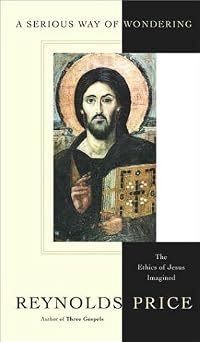
A Serious Way of Wondering: The Ethics of Jesus Imagined
by Reynolds Price
On This Page
Description
When novelist and poet Reynolds Price was invited to deliver the annual Peabody Lecture at Harvard University Memorial Church in 2001, he chose to explore a subject that has produced fierce debate and is still intensely relevant today: the ethics of Jesus. In two succeeding lectures at the National Cathedral and at Auburn Seminary, he continued the theme, exploring not only the apparently contradictory ethics that Jesus articulates in the Gospels but also constructing scenes that present show more Jesus with urgent dilemmas he never confronts there. In A serious way of wondering, Price greatly expands those lectures and imagines Jesus in moments of confrontation with three problems of burning moral concern--suicide, homosexuality, and the plight of women in male-dominated cultures and faiths. show lessTags
Recommendations








Member Reviews
Reynolds Price is not best known for his writing on religion, but most people familiar with his fiction will recognize the importance of Christianity within it – an importance that looms just as large as it does in O’Connor, McCullers, or Faulkner. This very short volume is just one more that Price has dedicated to a several-decades-long quest to understanding what he believes to be the historical Jesus, and his continuing legacy in the tradition to which Jesus gave his name.
Price tetchily but accurately points out that today it seems like everyone (at least most Christians) fervently know what Christ would have done in any number of ethical dilemmas which we were not recounted in the Gospels. As he repeatedly reminds the reader show more here, he finds himself stuck between the rank theological illiteracy of the “What Would Jesus Do?” tribe (replete with their conspicuous, ubiquitous bracelets, almost always worn by people much too young to even understand how serious these questions are) and, on the other hand, the archliteracy of the Jesus Seminar, with whom Price has major methodological quibbles. Price’s lack of presumption is appreciated. As a Christian, though an admittedly unorthodox one, he begins here: that Jesus Christ really lived, and really rose from the dead. According to some scholars, because of this he has already gone too far. But we must all begin with axiomatic assumptions and if that’s where a self-professed Christian wants to begin, I wouldn’t necessarily begrudge the point.
Unfortunately, what follows is the worst of milquetoast ethics from the dregs of bland, uninspiring, twentieth-century Christianity: Jesus never would have condemned homosexuality and the essence of Christianity is “God loved us; we must love one another.” I wouldn’t necessarily disagree with either one of these assertions – except for the fact that Price happens to be a homosexual himself, and his own celerity to exonerate himself in the eyes of his Jesus smacks of the same Christian presumption which I mentioned above.
Price doesn’t contend to be a religious scholar or have any formal training in anything he’s talking about here. To his credit, quite the opposite is true. He’s just a passionate Christian trying to make sense out of his world. And who can hold this against him? If I’m going to subscribe to theological, it can’t be as toothless and lovey-dovey as this. You end up getting a Heaven that resembles something like “Charlie and the Chocolate Factory,” where everyone has a golden ticket. Universal grace and forgiveness rest at the heart of the most attractive kinds of Christianity. Yet just as central to the religion is a body of proscribed behaviors transgressions against which we must be punished for. Where does the stress fall? Now this is a question that can be taken up in one of hundreds of different denominations and, ultimately, only in the human heart.
Price’s attempt to provide answers will satisfy some readers (most likely those who identify as liberal Christians), but it was less appealing to me – an open-minded atheist with a longstanding interest in Christian history, ethics, and Christology. show less
Price tetchily but accurately points out that today it seems like everyone (at least most Christians) fervently know what Christ would have done in any number of ethical dilemmas which we were not recounted in the Gospels. As he repeatedly reminds the reader show more here, he finds himself stuck between the rank theological illiteracy of the “What Would Jesus Do?” tribe (replete with their conspicuous, ubiquitous bracelets, almost always worn by people much too young to even understand how serious these questions are) and, on the other hand, the archliteracy of the Jesus Seminar, with whom Price has major methodological quibbles. Price’s lack of presumption is appreciated. As a Christian, though an admittedly unorthodox one, he begins here: that Jesus Christ really lived, and really rose from the dead. According to some scholars, because of this he has already gone too far. But we must all begin with axiomatic assumptions and if that’s where a self-professed Christian wants to begin, I wouldn’t necessarily begrudge the point.
Unfortunately, what follows is the worst of milquetoast ethics from the dregs of bland, uninspiring, twentieth-century Christianity: Jesus never would have condemned homosexuality and the essence of Christianity is “God loved us; we must love one another.” I wouldn’t necessarily disagree with either one of these assertions – except for the fact that Price happens to be a homosexual himself, and his own celerity to exonerate himself in the eyes of his Jesus smacks of the same Christian presumption which I mentioned above.
Price doesn’t contend to be a religious scholar or have any formal training in anything he’s talking about here. To his credit, quite the opposite is true. He’s just a passionate Christian trying to make sense out of his world. And who can hold this against him? If I’m going to subscribe to theological, it can’t be as toothless and lovey-dovey as this. You end up getting a Heaven that resembles something like “Charlie and the Chocolate Factory,” where everyone has a golden ticket. Universal grace and forgiveness rest at the heart of the most attractive kinds of Christianity. Yet just as central to the religion is a body of proscribed behaviors transgressions against which we must be punished for. Where does the stress fall? Now this is a question that can be taken up in one of hundreds of different denominations and, ultimately, only in the human heart.
Price’s attempt to provide answers will satisfy some readers (most likely those who identify as liberal Christians), but it was less appealing to me – an open-minded atheist with a longstanding interest in Christian history, ethics, and Christology. show less
Ratings
Members
- Recently Added By
Author Information

67+ Works 4,548 Members
Reynolds Price (February 1, 1933 - January 20, 2011), born Edward Reynolds Price in Macon, North Carolina, was an American poet, novelist, dramatist, essayist and James B. Duke Professor of English at Duke University. After graduating from Duke University in 1955, he won a Rhodes scholarship to study at Oxford University. Despite being living as a show more paraplegic after receiving radiation treatment for a spinal tumor since the mid-1980s, he produced approximately one book a year. His first novel, A Long and Happy Life (1962) won the William Faulkner Award. His other works include The Names and Faces of Heroes, Clear Pictures: First Loves, First Guides, A Whole New Life, and The Good Priest's Son. Kate Vaiden won the National Books Critics Circle Award. His plays have been produced on stage and on PBS's American Playhouse. He died due to complications of a heart attack on January 20, 2011 at the age of 77. (Bowker Author Biography) Reynolds Price, the author of numerous volumes of fiction, poetry, memoir, plays, essays, & translation, has won the National Book Critics Circle Award, the William Faulkner Award, & the Levinson, Blumenthal, & Tietjans poetry awards. A member of the American Academy of Arts & Letters & a regular commentator on National Public Radio's "All Things Considered", he lives in Durham, North Carolina. (Publisher Provided) show less
Classifications
Statistics
- Members
- 125
- Popularity
- 260,109
- Reviews
- 1
- Rating
- (3.89)
- Languages
- English
- Media
- Paper, Ebook
- ISBNs
- 3
- ASINs
- 1