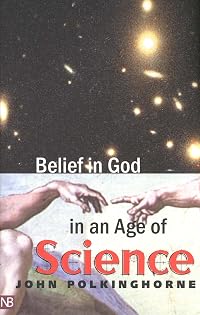
Belief in God in an Age of Science
by John Polkinghorne
On This Page
Description
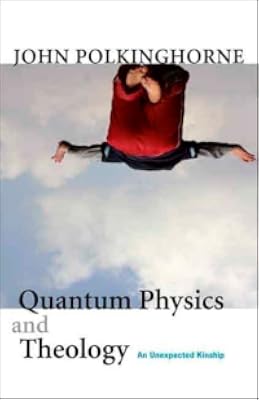
In this book, the author focuses on the collegiality between science and theology, contending that these "intellectual cousins" are both concerned with interpreted experience and with the quest for truth about reality. He argues eloquently that scientific and theological enquiries are parallel.Tags
Recommendations












Member Reviews
Religious belief and science are often put at odds with each other in contemporary society and popular culture. One needs only to listen to fundamentalist preachers or read newspapers about anti-vaccine protestors to think that these groups are forever at odds. Further, the histories of religious wars and persecutions turn many educated, reality-based citizens off of the religious path. To this situation, Polkinghorne offers a detente by suggesting that the two fields are cousins in their common search for truth and the unity of all knowledge. Now knighted, he is an eminent physicist and theologian at Cambridge University and offered these thoughts as part of a prestigious lecture series at Yale University in 1998.
Polkinghorne seeks to show more establish a common philosophy that he calls “critical realism” to unite these two disciplines. He acknowledges that not all religious discussion resides under this intellectual umbrella, such as those who make religious reflection a solely personal matter. Nonetheless, frequently citing Polyani’s Personal Knowledge and other recent scientist authors, he finds much in common with these disciplines. Indeed, he cites the development of Christian doctrines like Chalcedonian Christology and the Trinity in the first five centuries of the Common Era as similar to scientific reflection and debate about atoms and quantum theory in the twentieth century.
Especially in the mainstream press, many present caricatures that science stands up to short-sighted religious doctrines. Polkinghorne shows, at least at the highest levels, that these presentations fall short when tested against reality. Going back to Newton (himself devout), there exists nothing inherently adversarial in science to religion. They share a common interest in understanding the true nature of things. Perhaps some difficulty lies in that both disciplines require high and lengthy standards of training. One cannot fully surmount either.
In these five lectures, Polkinghorne calls for increased interdisciplinary dialogue between science and religion. Given the amount of interest in this topic by recent physicists, he particularly identifies biologists, social scientists, and theologians as needed in this common venture. The mathematics endemic in physics often make it a starting point in the search for beauty, but these other disciplines can contribute through their end-point of alleviating human suffering. Both science and theology are niche fields that often take practitioners away from commercial business, but they have too much in common to eschew each other. This short book reminds us of their mutual reliance as they seek ultimate knowledge. show less
Polkinghorne seeks to show more establish a common philosophy that he calls “critical realism” to unite these two disciplines. He acknowledges that not all religious discussion resides under this intellectual umbrella, such as those who make religious reflection a solely personal matter. Nonetheless, frequently citing Polyani’s Personal Knowledge and other recent scientist authors, he finds much in common with these disciplines. Indeed, he cites the development of Christian doctrines like Chalcedonian Christology and the Trinity in the first five centuries of the Common Era as similar to scientific reflection and debate about atoms and quantum theory in the twentieth century.
Especially in the mainstream press, many present caricatures that science stands up to short-sighted religious doctrines. Polkinghorne shows, at least at the highest levels, that these presentations fall short when tested against reality. Going back to Newton (himself devout), there exists nothing inherently adversarial in science to religion. They share a common interest in understanding the true nature of things. Perhaps some difficulty lies in that both disciplines require high and lengthy standards of training. One cannot fully surmount either.
In these five lectures, Polkinghorne calls for increased interdisciplinary dialogue between science and religion. Given the amount of interest in this topic by recent physicists, he particularly identifies biologists, social scientists, and theologians as needed in this common venture. The mathematics endemic in physics often make it a starting point in the search for beauty, but these other disciplines can contribute through their end-point of alleviating human suffering. Both science and theology are niche fields that often take practitioners away from commercial business, but they have too much in common to eschew each other. This short book reminds us of their mutual reliance as they seek ultimate knowledge. show less
I have had many debates with people in recent years about science and belief, and I have often wished for a book that could enlighten me about what science means to the faithful. I have read a lot of Dawkins and Hitchens, so the scientific and atheistic sides are well-represented, but I have not come across so much for the other side. Perhaps I've not looked hard enough.
So what of Polkinghorne's book? I had high hopes for it. The chapter headings sounded very interesting and would help to further the debate, but unfortunately the text is so thick with academic language that I was unable to get much out of it at all. I will have to read it all again one day, more slowly and with a lot of other textbooks to hand to help me.
However, there show more was one area that I don't think the author addresses, which I think is a key difference between science and theology. It has always been my understanding that when a scientist researches a topic they should be as disinterested as possible: they must not want their thesis to be true or false, only to patiently see what the results reveal. Theology, on the other hand, approaches any situation, any challenge to a belief with the hope and the wish that their belief remains untouched, or is strengthened by what they hand. There is not that same intellectual distance that one finds in science. show less
So what of Polkinghorne's book? I had high hopes for it. The chapter headings sounded very interesting and would help to further the debate, but unfortunately the text is so thick with academic language that I was unable to get much out of it at all. I will have to read it all again one day, more slowly and with a lot of other textbooks to hand to help me.
However, there show more was one area that I don't think the author addresses, which I think is a key difference between science and theology. It has always been my understanding that when a scientist researches a topic they should be as disinterested as possible: they must not want their thesis to be true or false, only to patiently see what the results reveal. Theology, on the other hand, approaches any situation, any challenge to a belief with the hope and the wish that their belief remains untouched, or is strengthened by what they hand. There is not that same intellectual distance that one finds in science. show less
Ratings
Members
- Recently Added By
Lists

Ideas for "Science, Religion, and History" group reads
29 works; 9 members
Author Information

49+ Works 4,304 Members
John Polkinghorne, K.B.E., F.R.S., is past president and now fellow of Queens' College, Cambridge, and Canon Theologian of Liverpool, England. (Bowker Author Biography)
Awards and Honors
Series
Belongs to Publisher Series
Terry Lectures (1996-1997)
Common Knowledge
- Canonical title
- Belief in God in an Age of Science
Classifications
- Genres
- Religion & Spirituality, Nonfiction, General Nonfiction, Philosophy
- DDC/MDS
- 261.5 — Religion Christian organization, social work & worship Social theology and interreligious relations and attitudes Christianity and secular disciplines
- LCC
- BL241 .P56 — Philosophy, Psychology and Religion Religions. Mythology. Rationalism Religions. Mythology. Rationalism Natural theology Religion and science
- BISAC
Statistics
- Members
- 428
- Popularity
- 71,783
- Reviews
- 2
- Rating
- (3.27)
- Languages
- Chinese, English, German, Italian
- Media
- Paper, Audiobook, Ebook
- ISBNs
- 9
- ASINs
- 4