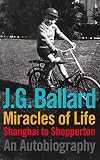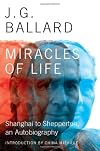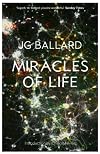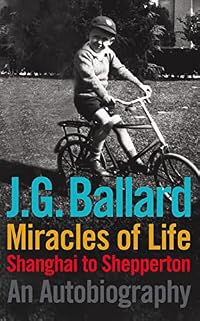
Miracles of Life
by J. G. Ballard
On This Page
Description
J.G. Ballard has been, for over fifty years, one of this country's most significant writers. Beginning with the events that inspired his classic novel, "Empire of the Sun", in this revelatory autobiography he charts the course of his astonishing life. "Miracles of Life" takes us from the vibrant surroundings of pre-war Shanghai, to the deprivations and unexpected freedoms of Lunghua Camp, to Ballard's arrival in a devastated Britain. Ballard recounts his first attempts at fiction and his show more part in the social and artistic revolutions of the 60s. He describes his friendships with figures as diverse as Kingsley Amis, Michael Moorcock and Eduardo Paolozzi alongside recollections of his domestic life in Shepperton -- raising three children as a single father following the unexpected and premature death of his wife. show lessTags
Recommendations







Member Recommendations
Member Reviews
This proved to be an excellent follow-up to Empire of the Sun, documenting many additional details of young Jim's childhood in Shanghai and later in life. Frankly I wish the book was longer. Here Ballard gives us additional details before the Japanese takeover and the initial 1937 invasion and to me it was a fascinating picture in addition to giving me a broader look at this crucial period in Asia. It was also interesting to see where Ballard had rearranged and omitted experiences to craft the semi-true story of Empire of the Sun. What was most surprising to me was how much the internment camp material was fictionalized. Ballard assigned to himself many things that had happened to people around him. The biggest change, he notes here, is show more that he decided to fictionalize being in a different camp from his parents. This was actually a friend of his at the camp in that situation. To me the other big change was that in real life Ballard and his family (he had a sister also in real life who is not in Empire of the Sun) were among the last of the families interred and it was a very simple and orderly process, unlike the descriptions in the book which were incredibly horrific. I also really was moved by the passages here where Ballard revisits China and the internment camp about 45 years after he left, and some of the ghosts were finally able to rest.
Equally interesting here was Ballard trying to find his way in post-war Britain, a place he knew only from books since he had been born and lived in China his entire life. Ballard gave us glimpses of the various events and forces around his life that eventually shaped his writing.
Ballard wrote this while he was dying of prostate cancer - I think of it as gift to readers and history. Absolutely recommended for anyone who is a fan of Empire of the Sun or other Ballard novels. I was quite affected by this book. Now I need to get to his novel "The Kindness of Women" before too long.
A thought that frequently came to me while reading this and 'Empire of the Sun' was how readable Ballard's prose was. I had read some of his short fiction decades ago and frequently disliked it.
Review written in 2016 show less
Equally interesting here was Ballard trying to find his way in post-war Britain, a place he knew only from books since he had been born and lived in China his entire life. Ballard gave us glimpses of the various events and forces around his life that eventually shaped his writing.
Ballard wrote this while he was dying of prostate cancer - I think of it as gift to readers and history. Absolutely recommended for anyone who is a fan of Empire of the Sun or other Ballard novels. I was quite affected by this book. Now I need to get to his novel "The Kindness of Women" before too long.
A thought that frequently came to me while reading this and 'Empire of the Sun' was how readable Ballard's prose was. I had read some of his short fiction decades ago and frequently disliked it.
Review written in 2016 show less
http://nwhyte.livejournal.com/2117885.html
This is a brilliant book - passionate, opinionated, reflective, sometimes angry and occasionally self-critical; fascinating on the details of life in Shanghai before and during WW2 (a fifth of his life, which takes up almost half of the book).
Empire of the Sun comes back towards the end, with an account of how Spielberg made the film of Ballard's book about his wartime experiences, but apart from that there is a lot of interesting reflection on how he became a writer, why in particular he chose science fiction - shown as a fairly calculated choice rather than instinct - and the rewards of being a parent to three children. It's rare I would say this of a book, but I actually wished it had been show more twice as long. show less
This is a brilliant book - passionate, opinionated, reflective, sometimes angry and occasionally self-critical; fascinating on the details of life in Shanghai before and during WW2 (a fifth of his life, which takes up almost half of the book).
Empire of the Sun comes back towards the end, with an account of how Spielberg made the film of Ballard's book about his wartime experiences, but apart from that there is a lot of interesting reflection on how he became a writer, why in particular he chose science fiction - shown as a fairly calculated choice rather than instinct - and the rewards of being a parent to three children. It's rare I would say this of a book, but I actually wished it had been show more twice as long. show less
This short, concise, brilliantly sharp commentary on Ballard's own life from childhood to the moments before his own death in his home is probably the most shocking and tear-jerking autobiographies I've ever read.
He doesn't embellish anything. He plainly tells us that his life as Jim in Empire of the Sun is true as far as it goes, made into a more fantastic story that is then later turned into the movie, but more than that, he briefly outlines the rest of his science-fiction career.
Not the what-if SF of his contemporaries, but the what-next.
I really appreciate the idea. I've read some of his novels and really enjoyed them. Very imaginative works. But, like the author himself, I'm surprised to have liked his closer-to-home work about show more his childhood in Shanghai during WWII best.
This is not to say I am going to stop here. I'm a big SF fan and I've just decided, after reading such a sharp history, that his writing should never be forgotten. I am going to read everything of his I can get my hands on.
It's important. He may be repeating the same themes in variations, but there is nothing about them that isn't NECESSARY. Rebirth, hope, dream-like calculation, intense connections between sexuality and violence, and, of course, WHAT COMES NEXT.
He was an author who should never be forgotten. show less
He doesn't embellish anything. He plainly tells us that his life as Jim in Empire of the Sun is true as far as it goes, made into a more fantastic story that is then later turned into the movie, but more than that, he briefly outlines the rest of his science-fiction career.
Not the what-if SF of his contemporaries, but the what-next.
I really appreciate the idea. I've read some of his novels and really enjoyed them. Very imaginative works. But, like the author himself, I'm surprised to have liked his closer-to-home work about show more his childhood in Shanghai during WWII best.
This is not to say I am going to stop here. I'm a big SF fan and I've just decided, after reading such a sharp history, that his writing should never be forgotten. I am going to read everything of his I can get my hands on.
It's important. He may be repeating the same themes in variations, but there is nothing about them that isn't NECESSARY. Rebirth, hope, dream-like calculation, intense connections between sexuality and violence, and, of course, WHAT COMES NEXT.
He was an author who should never be forgotten. show less
This is JG Ballard's autobiography, including a significant chunk that tells the true story on which "Empire of the Sun" is based.
The Chinese aspect was the main draw for me, but in fact his contact, experience and knowledge of Chinese people, food and culture was negligible. Nevertheless, I enjoyed the book and found some of his descriptions of pre-war Shanghai remarkably resonant with my experiences there in 1992 and 2008.
EARLY YEARS IN CHINA
Ballard was born in Shanghai in 1930 and grew up in the International Settlement, i.e. amongst Europeans, albeit with Chinese staff. "My insulation from Chinese life was almost complete. I lived in Shanghai for fifteen years and never learned a word of Chinese" nor tasted any Chinese food till show more decades later in England. This sounds like a slight exaggeration, especially given the amount of time he spent at the Kendall-Ward's house (where the mother spoke fluent Chinese to the servants) and his own father's interest in Chinese history and culture.
Nevertheless, Ballard did cycle alone around the city alone, and his memories are vivid and reflected in his adult work, "a large part of my fiction has been an attempt to evoke it by means other than memory". Shanghai was a frantic city, lacking "everyday reality", and it and its people "live above all, on the street" so there was plenty to see. "In Shanghai the fantastic, which for most people lies inside their heads, lay all around me and I think now my main effort as a boy was to find the reality in all this make-believe." After WW2, England was "a world that was almost too real. As a writer, I've treated England as if it were a strange fiction".
Ballard was not just cut off from the Chinese; from the opening sentence, you assume a distant relationship with his mother, and their parenting was very hands off. "Children were an appendage to their parents, somewhere between the servants and an obedient Labrador, and they were never seen as a significant measure of a family's health or the centre of its life. My mother claimed not to have known of my dangerous cycle trips around Shanghai, but many of her friends recognised me and waved from their cars. Perhaps they too felt it was scarcely worth mentioning." It is no surprise that his own approach to parenting was very different.
As a writer, Ballard of course mentions aspects of his life that are reflected in his writing, but it is odd how few questions he asked his parents about them and their lives (e.g. why they went to China, and why they left for good in 1951) - even when he was writing Empire of the Sun.
SURREAL FREEDOMS
As a young man, Ballard became interested in surrealism (and Freud and psychoanalysis), but his first taste was shortly before internment: "Seeing everything displaced and rearranged in haphazard ways gave me m y first taste of the surrealism of everyday life, though Shanghai was already surrealist enough."
"Linghua Camp may have been a prison of a kind, but it was a prison where I found freedom." (Amelie Nothomb's experience in a Peking diplomatic compound in the 1970s was similar: http://www.goodreads.com/review/show/342140589). The famous two and a half years in the internment camp were, unlike in Empire, spent with his parents, and he views that time as incredibly happy (less so for the heaving-drinking adult expats, who had to go cold turkey). For the first time in his life, he was with his parents most of the time - so different from the traditional 1950s professional families where people "hung their clothes in private wardrobes, along with their emotions, hopes and dreams". On the other hand, in some ways, his parents were now more passive in their parenting because "they had none of the usual levers to pull", they were "unable to warn, chide, praise or promise".
PAIN OF PEACE
After such freedom, the end of the war was a shock. "Peace, I realised, was more threatening because the rules that sustained war, however evil, were suspended." Going to England to live with grandparents was "the lowest point in my life... several miles at least below the sea level of mental health", an all the more startling comment in the light of an event that occurs a few years later.
Post war England was depressing. "The English talked as if they had won the war, but acted as if they had lost it... hope itself was rationed... the indirect rationing of unavailability, and the far more dangerous rationing of any kind of belief in a better life."
Although colonial China was very hierarchical, the reality of the English class system came as a shock. "Middle class people in the late 1940s and 1950s saw the working classes as almost another species and fenced themselves off behind a complex system of social codes... Everything about English middle class life revolved around codes of behaviour that unconsciously cultivated second rateness and low expectations." But it wasn't deference that won the war.
Unsurprisingly, Ballard didn't really fit in; he was drawn to international friends, literature and films. Consequently, "I read far too much, far too early", including big names when he was still learning about life and writing. Nevertheless, he began to fit in a bit. "The camouflage always imitates the target", so he was mortified when his mother turned up at school in an American car, in the latest New York fashions.
CAREER OPTIONS
He wanted to be a painter, but opted for medicine so he could become a psychiatrist, though he "knew that I already had my first patient - myself". Obviously, he became none of those things, and although he loved the modernity of the Cambridge labs, he hated the old-fashioned gentlemen's club atmosphere of college. "My two years of anatomy were amongst the most important of my life... because they taught me that though death was the end, the human imagination and the human spirit could triumph over our own dissolution" (and he had seen a lot of death in China). Furthermore, it may have been "an unconscious way of keeping Shanghai alive by other means".
He came to sci-fi relatively late (in his twenties), and was always more interested in a "what now?" approach than a "what if?", i.e. inner space, rather than outer space - coming back to his interest in Freud and surrealism. These interests were epitomised by his controversial book, "The Atrocity Exhibition"(http://www.goodreads.com/review/show/493008844), shortly after which, he did actually put on an atrocity exhibition of crashed cars (with no explanatory text). In many ways, it was a psychological experiment to see if there was a connection between crashes and sexuality, testing the ideas put forward in "The Atrocity Exhibition", which he then presented in a more conventional narrative structure in his novel, "Crash".
FATHERHOOD
A pervading passion in the later sections is for his children. That means their adulthood was a mixed blessing: "Infancy and childhood seem to last for ever. Then adolescence arrives... and one is sharing the family home with likeable young adults who are more intelligent, better company and in many ways wiser than oneself."
CHINESE IMPRINTS
Although Shanghai unconsciously seeped into many of his writings, it was 40 years after he left China before he deliberately wrote about it, and slightly longer before he revisited.
In 1991 he was struck by how a city built by Europeans now had no trace of Roman script, English signs or American cars, and attributed that to the facts that "the Chinese are uninterested in the past" (what about their reverence for their ancestors?) and that "there are only two words in the Chinese bible: make money".
I'm not sure I agree with him. I first visited China a year after him and even then it wasn't entirely true. When I went back in 2008, Roman script (Pinyin), signs, adverts and more are sadly ubiquitous.
Sadly, advertisers now sell un-Chineseness to eager Chinese consumers. show less
The Chinese aspect was the main draw for me, but in fact his contact, experience and knowledge of Chinese people, food and culture was negligible. Nevertheless, I enjoyed the book and found some of his descriptions of pre-war Shanghai remarkably resonant with my experiences there in 1992 and 2008.
EARLY YEARS IN CHINA
Ballard was born in Shanghai in 1930 and grew up in the International Settlement, i.e. amongst Europeans, albeit with Chinese staff. "My insulation from Chinese life was almost complete. I lived in Shanghai for fifteen years and never learned a word of Chinese" nor tasted any Chinese food till show more decades later in England. This sounds like a slight exaggeration, especially given the amount of time he spent at the Kendall-Ward's house (where the mother spoke fluent Chinese to the servants) and his own father's interest in Chinese history and culture.
Nevertheless, Ballard did cycle alone around the city alone, and his memories are vivid and reflected in his adult work, "a large part of my fiction has been an attempt to evoke it by means other than memory". Shanghai was a frantic city, lacking "everyday reality", and it and its people "live above all, on the street" so there was plenty to see. "In Shanghai the fantastic, which for most people lies inside their heads, lay all around me and I think now my main effort as a boy was to find the reality in all this make-believe." After WW2, England was "a world that was almost too real. As a writer, I've treated England as if it were a strange fiction".
Ballard was not just cut off from the Chinese; from the opening sentence, you assume a distant relationship with his mother, and their parenting was very hands off. "Children were an appendage to their parents, somewhere between the servants and an obedient Labrador, and they were never seen as a significant measure of a family's health or the centre of its life. My mother claimed not to have known of my dangerous cycle trips around Shanghai, but many of her friends recognised me and waved from their cars. Perhaps they too felt it was scarcely worth mentioning." It is no surprise that his own approach to parenting was very different.
As a writer, Ballard of course mentions aspects of his life that are reflected in his writing, but it is odd how few questions he asked his parents about them and their lives (e.g. why they went to China, and why they left for good in 1951) - even when he was writing Empire of the Sun.
SURREAL FREEDOMS
As a young man, Ballard became interested in surrealism (and Freud and psychoanalysis), but his first taste was shortly before internment: "Seeing everything displaced and rearranged in haphazard ways gave me m y first taste of the surrealism of everyday life, though Shanghai was already surrealist enough."
"Linghua Camp may have been a prison of a kind, but it was a prison where I found freedom." (Amelie Nothomb's experience in a Peking diplomatic compound in the 1970s was similar: http://www.goodreads.com/review/show/342140589). The famous two and a half years in the internment camp were, unlike in Empire, spent with his parents, and he views that time as incredibly happy (less so for the heaving-drinking adult expats, who had to go cold turkey). For the first time in his life, he was with his parents most of the time - so different from the traditional 1950s professional families where people "hung their clothes in private wardrobes, along with their emotions, hopes and dreams". On the other hand, in some ways, his parents were now more passive in their parenting because "they had none of the usual levers to pull", they were "unable to warn, chide, praise or promise".
PAIN OF PEACE
After such freedom, the end of the war was a shock. "Peace, I realised, was more threatening because the rules that sustained war, however evil, were suspended." Going to England to live with grandparents was "the lowest point in my life... several miles at least below the sea level of mental health", an all the more startling comment in the light of an event that occurs a few years later.
Post war England was depressing. "The English talked as if they had won the war, but acted as if they had lost it... hope itself was rationed... the indirect rationing of unavailability, and the far more dangerous rationing of any kind of belief in a better life."
Although colonial China was very hierarchical, the reality of the English class system came as a shock. "Middle class people in the late 1940s and 1950s saw the working classes as almost another species and fenced themselves off behind a complex system of social codes... Everything about English middle class life revolved around codes of behaviour that unconsciously cultivated second rateness and low expectations." But it wasn't deference that won the war.
Unsurprisingly, Ballard didn't really fit in; he was drawn to international friends, literature and films. Consequently, "I read far too much, far too early", including big names when he was still learning about life and writing. Nevertheless, he began to fit in a bit. "The camouflage always imitates the target", so he was mortified when his mother turned up at school in an American car, in the latest New York fashions.
CAREER OPTIONS
He wanted to be a painter, but opted for medicine so he could become a psychiatrist, though he "knew that I already had my first patient - myself". Obviously, he became none of those things, and although he loved the modernity of the Cambridge labs, he hated the old-fashioned gentlemen's club atmosphere of college. "My two years of anatomy were amongst the most important of my life... because they taught me that though death was the end, the human imagination and the human spirit could triumph over our own dissolution" (and he had seen a lot of death in China). Furthermore, it may have been "an unconscious way of keeping Shanghai alive by other means".
He came to sci-fi relatively late (in his twenties), and was always more interested in a "what now?" approach than a "what if?", i.e. inner space, rather than outer space - coming back to his interest in Freud and surrealism. These interests were epitomised by his controversial book, "The Atrocity Exhibition"(http://www.goodreads.com/review/show/493008844), shortly after which, he did actually put on an atrocity exhibition of crashed cars (with no explanatory text). In many ways, it was a psychological experiment to see if there was a connection between crashes and sexuality, testing the ideas put forward in "The Atrocity Exhibition", which he then presented in a more conventional narrative structure in his novel, "Crash".
FATHERHOOD
A pervading passion in the later sections is for his children. That means their adulthood was a mixed blessing: "Infancy and childhood seem to last for ever. Then adolescence arrives... and one is sharing the family home with likeable young adults who are more intelligent, better company and in many ways wiser than oneself."
CHINESE IMPRINTS
Although Shanghai unconsciously seeped into many of his writings, it was 40 years after he left China before he deliberately wrote about it, and slightly longer before he revisited.
In 1991 he was struck by how a city built by Europeans now had no trace of Roman script, English signs or American cars, and attributed that to the facts that "the Chinese are uninterested in the past" (what about their reverence for their ancestors?) and that "there are only two words in the Chinese bible: make money".
I'm not sure I agree with him. I first visited China a year after him and even then it wasn't entirely true. When I went back in 2008, Roman script (Pinyin), signs, adverts and more are sadly ubiquitous.
Sadly, advertisers now sell un-Chineseness to eager Chinese consumers. show less
Ballard wrote this after being diagnosed with the cancer that killed him. And, it shows. He is quite forthcoming and very frank with his remembrances: early life spent in Shanghai with its mini nationalistic enclaves, his family internment by the Japanese, his move to an England he really knew little of, attempts at finding a career, his seduction by science fiction, and his family (his love for his children inspired the title). His description of his introduction to and falling in love with science fiction encapsulates my own feelings. Bravo, Mr. Ballard!
Modest and sparing, I found this telling of his remarkable life even more powerful and moving than his fictionalised accounts – Empire of the Sun and The Kindness of Women. A great deal of the material is already familiar from those novels, but one of the fascinating aspects of this book is his willingness to discuss his inspiration and techniques for writing.
His training as a doctor at Cambridge (where he was fascinated by dissection), his early working life selling encyclopedias, training in the RAF and as deputy editor at Chemistry & Industry along with his interest in psychoanalysis all led him to create a unique genre of writing in which the characters 'inner-spaces' are the focus instead of science fiction's usual preoccupations show more at that time.
I loved his delightful inversion of Cyril Connolly's quote – "my greatest ally was the pram in the hall" – and his belief in the importance of providing a happy and stable childhood for his family after his wife died suddenly in 1964. It is quite a leap of imagination to go from writing books like The Atrocity Exhibition during the day to picking the kids up from school, watching Blue Peter and preparing dinner. As he admits himself 'my children brought me up, perhaps as an incidental activity to rearing themselves', but also rightly points out he was incredibly lucky to be able to observe the process of his children growing from infancy into fully formed human beings so closely and how often fathers miss out on this. His joy in being a parent, the time spent as the sole parent of young children and the 'miracles of life' that he observed all added much to my understanding of him and his books.
It saddened me greatly to learn in the final chapter that he is suffering from advanced prostate cancer and that this may be the last thing he writes. It would be sad if this is the case, but when you look at the life he has led and the work he will leave behind I can't help but feeling that there isn't really any need to say anything else. show less
His training as a doctor at Cambridge (where he was fascinated by dissection), his early working life selling encyclopedias, training in the RAF and as deputy editor at Chemistry & Industry along with his interest in psychoanalysis all led him to create a unique genre of writing in which the characters 'inner-spaces' are the focus instead of science fiction's usual preoccupations show more at that time.
I loved his delightful inversion of Cyril Connolly's quote – "my greatest ally was the pram in the hall" – and his belief in the importance of providing a happy and stable childhood for his family after his wife died suddenly in 1964. It is quite a leap of imagination to go from writing books like The Atrocity Exhibition during the day to picking the kids up from school, watching Blue Peter and preparing dinner. As he admits himself 'my children brought me up, perhaps as an incidental activity to rearing themselves', but also rightly points out he was incredibly lucky to be able to observe the process of his children growing from infancy into fully formed human beings so closely and how often fathers miss out on this. His joy in being a parent, the time spent as the sole parent of young children and the 'miracles of life' that he observed all added much to my understanding of him and his books.
It saddened me greatly to learn in the final chapter that he is suffering from advanced prostate cancer and that this may be the last thing he writes. It would be sad if this is the case, but when you look at the life he has led and the work he will leave behind I can't help but feeling that there isn't really any need to say anything else. show less
This is an interesting, well-written and thoughtful autobiography starting with Ballard’s life in Shanghai (he was born there in 1930), through his experience in the Japanese internment camp (outside Shanghai at Lunghua….at least, outside 1943-1945, but now well within the city of Shanghai) with his parents, sister and other foreigners (the Shanghai experiences recounted in his novel Empire of the Sun), through to his return to a post-war England that he could never quite grasp with its strata of haves and have-nots (more important, in his view than any “class” distinctions), worn out from the war but with too many trying to hang on to faded and exhausted glories of the British empire, through his brief stint as a medical show more student, his early efforts as a writer, trying to find his voice and his genre, his brief experience in Canada as an RAF pilot in training, his return to England and the beginnings of a writing career always on the edge of “mainstream” literature with his own particular type of science fiction.
The book is interesting for Ballard’s views on society, for his thoughts on literature and what is important in writing, and what led him to develop his writing in the field of science fiction. In the latter, he was greatly influenced by psychoanalysis (particularly Freud) and surrealism: “I strongly felt, and still do, that psychoanalysis and surrealism were the key to the truth about existence and human personality, and also a key to myself”. His search for a new style and content of ficiton was very much driven by a desire to explore these “truths” through writing. As he says: “…surrealism and psychoanalysis offered an escape route, a secret corridor into a more real and more meaningful world, where shifting psychological roles are more important than the ‘character’ so admired by English school-masters and literary critics, and where the deep revolutions of the psyche matter more than the social dramas of everyday life, as trivial as a tempest in a tea cosy.”
Ballard’s experiences in Shanghai strongly shaped his life and approach to his writing, or what he considered should be important and explored in writing. He describes wandering through a deserted casino in the late 1930s when Shanghai was under Japanese occupation:
“Everywhere gold glimmered in the half-light, transforming this derelict casino into a magical cavern from the Arabian Nights tales. But it held a deeper meaning for me, the sense that reality itself was a stage set that could be dismantled at any moment, and that no matter how magnificent anything appeared, it could be swept aside into the debris of the past.
I also felt that the ruined casino, like the city and the world beyond it, was more real and more meaningful than it had been when it was thronged with gambles and dancers. Abandoned houses and office buildings held a special magic and on my way home from school I often paused outside an empty apartment block. Seeing everything displaced and rearranged in a haphazard way gave me my first taste of the surrealism of everyday life, hough Shanghai was already surrealist enough.”
I think this sums up nicely Ballard’s approaches in his novels, his eye for extrapolating from the ordinary into the extraordinary and even the horrific, inventiveness firmly rooted in elements of present social and economic “realities” as we understand them, everyday connections that seem commonplace until they are explored or stood on their heads, and with social commentaries and criticisms swathed in the extreme. The quote above about the ruined casino resonates perfectly with his description of the mad world of an artificially maintained Las Vegas in the midst of an abandoned USA in Hello America show less
The book is interesting for Ballard’s views on society, for his thoughts on literature and what is important in writing, and what led him to develop his writing in the field of science fiction. In the latter, he was greatly influenced by psychoanalysis (particularly Freud) and surrealism: “I strongly felt, and still do, that psychoanalysis and surrealism were the key to the truth about existence and human personality, and also a key to myself”. His search for a new style and content of ficiton was very much driven by a desire to explore these “truths” through writing. As he says: “…surrealism and psychoanalysis offered an escape route, a secret corridor into a more real and more meaningful world, where shifting psychological roles are more important than the ‘character’ so admired by English school-masters and literary critics, and where the deep revolutions of the psyche matter more than the social dramas of everyday life, as trivial as a tempest in a tea cosy.”
Ballard’s experiences in Shanghai strongly shaped his life and approach to his writing, or what he considered should be important and explored in writing. He describes wandering through a deserted casino in the late 1930s when Shanghai was under Japanese occupation:
“Everywhere gold glimmered in the half-light, transforming this derelict casino into a magical cavern from the Arabian Nights tales. But it held a deeper meaning for me, the sense that reality itself was a stage set that could be dismantled at any moment, and that no matter how magnificent anything appeared, it could be swept aside into the debris of the past.
I also felt that the ruined casino, like the city and the world beyond it, was more real and more meaningful than it had been when it was thronged with gambles and dancers. Abandoned houses and office buildings held a special magic and on my way home from school I often paused outside an empty apartment block. Seeing everything displaced and rearranged in a haphazard way gave me my first taste of the surrealism of everyday life, hough Shanghai was already surrealist enough.”
I think this sums up nicely Ballard’s approaches in his novels, his eye for extrapolating from the ordinary into the extraordinary and even the horrific, inventiveness firmly rooted in elements of present social and economic “realities” as we understand them, everyday connections that seem commonplace until they are explored or stood on their heads, and with social commentaries and criticisms swathed in the extreme. The quote above about the ruined casino resonates perfectly with his description of the mad world of an artificially maintained Las Vegas in the midst of an abandoned USA in Hello America show less
Members
- Recently Added By
Published Reviews
ThingScore 100
Ballard’s memoir, “Miracles of Life,” was written in his final years, when he knew he was dying from advanced prostate cancer. It’s warmer, plainer and more elegiac than his admirers may have foreseen. (The title is a reference to his three children, whom he raised as a single father after the death of his wife.) But his weird old fire remains lighted. “I admired anyone,” he show more remarks about himself as a child, “who could unsettle people.” show less
added by Diabolical_DrZ
Lists

Best Biographies, Autobiographies and Memoirs
464 works; 156 members

Science Fiction and Fantasy Autobiographies
38 works; 3 members
Author Information

J. G. Ballard was born to British parents in Shanghai, China on November 15, 1930. While a child during World War II, he spent four years in a Japanese POW camp. This experience was the basis for the emotionally moving novel Empire of the Sun, which he adapted into a successful movie, directed by Steven Spielberg. Before becoming a full-time show more writer, he studied medicine at Cambridge University and served as a pilot in the British Royal Air Force. Ballard is best known for his science fiction writings. His early works were heavily influenced by surrealism. Most of his novels deal with death and destruction of the human spirit. Novels such as Crash, Concrete Island, and High Rise portray a society that is devolving into barbaric chaos. Crash was made into a movie by David Cronenberg in 1996. The Drowned World describes an apocalyptic society, with a hero that ushers in the destruction of the world. His novel Empire of the Sun was shortlisted for the Booker Prize and awarded the Guardian Fiction Prize and James Tait Black Memorial Prize for fiction. Empire of the Sun was filmed by Steven Spielberg in 1987, starring a young Christian Bale as Jim (Ballard). Ballard moved away from science fiction, but he is still considered one of the leading authors of the genre. He died on April 19, 2009 at the age of 78. (Bowker Author Biography) show less
Awards and Honors
Awards
Distinctions
Series
Belongs to Publisher Series
Common Knowledge
- Canonical title
- Miracles of Life
- Original title
- Miracles of Life
- Important places
- Shanghai, China
- Dedication
- To Fay, Bea and Jim
- First words
- I was born in Shanghai General Hospital on 15 November 1930, after a difficult delivery that my mother, who was slightly built and slim-hipped liked to describe to me in later years, as if this revealed something about the la... (show all)rger thoughtlessness of the world
Classifications
Statistics
- Members
- 621
- Popularity
- 46,718
- Reviews
- 19
- Rating
- (3.98)
- Languages
- 6 — English, French, German, Italian, Portuguese, Spanish
- Media
- Paper, Audiobook, Ebook
- ISBNs
- 22
- ASINs
- 7