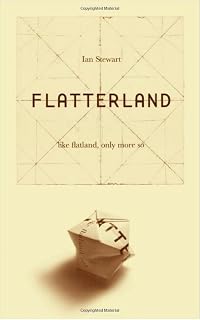
Flatterland
by Ian Stewart
On This Page
Description
First there was Edwin A. Abbott's remarkable Flatland, published in 1884, and one of the all-time classics of popular mathematics. Now, from mathematician and accomplished science writer Ian Stewart, comes what Nature calls "a superb sequel." Through larger-than-life characters and an inspired story line, Flatterland explores our present understanding of the shape and origins of the universe, the nature of space, time, and matter, as well as modern geometries and their applications. The show more journey begins when our heroine, Victoria Line, comes upon her great-great-grandfather A. Square's diary, hidden in the attic. The writings help her to contact the Space Hopper, who tempts her away from her home and family in Flatland and becomes her guide and mentor through ten dimensions. In the tradition of Alice in Wonderland and The Phantom Toll Booth, this magnificent investigation into the nature of reality is destined to become a modern classic. show lessTags
Recommendations






Member Recommendations
Member Reviews
Ian Stewart's one-century-on sequel to Edwin Abbott's Flatland is far longer and in many ways more wide-ranging than its Victorian original. Almost taking hypergeometry for granted, it also treats qualitative dimensionality, fractals, topology, projective geometry, and an assortment of geometric issues implicated in theoretical physics: relativistic cosmology, quantum physics, and M-theory. These last topics may have aged a bit, but my own physics understanding is still back around the 2001 date of this book, so nothing put me off there, and the mathematical issues haven't changed at any rate.
Protagonist Vikki Line's psychopomp is the Space Hopper, inspired by a UK-model hippity-hop bouncing toy, and he equips her with a "Virtual show more Unreality Engine" that allows her (if not always the reader) to visualize and operate in all of the exotic geometries treated in the story. There is a rather comical Faust and Mephistopheles air to the relationship here.
Flatterland is full of nods to Lewis Carroll, with Vikki clearly taking the role of Alice in a "mathiversal" wonderland. This homage reaches its peak in Chapter 6 "The Topologist's Tea Party." The book is thick with puns and dadjokery. I am glad that I was already sufficiently well-read mathematically to perceive the conventional names of the topics and concepts sometimes screened behind layers of wordplay. Humans are "Planiturthians," whose proper names are given without breaks, like Ianstewart.
Stewart recognizes and praises the social satire in Abbott's original Flatland, but his own version of it is a feminism that was hardly daring at the turn of the millennium. As the book progressed into more diverse mathematical topics, I thought he had even left the social commentary behind, but he did return to it in a mildly satisfying manner at the end. The text makes it clear that "Flatterland" doesn't have anything to do with flattery; or does it? show less
Protagonist Vikki Line's psychopomp is the Space Hopper, inspired by a UK-model hippity-hop bouncing toy, and he equips her with a "Virtual show more Unreality Engine" that allows her (if not always the reader) to visualize and operate in all of the exotic geometries treated in the story. There is a rather comical Faust and Mephistopheles air to the relationship here.
Flatterland is full of nods to Lewis Carroll, with Vikki clearly taking the role of Alice in a "mathiversal" wonderland. This homage reaches its peak in Chapter 6 "The Topologist's Tea Party." The book is thick with puns and dadjokery. I am glad that I was already sufficiently well-read mathematically to perceive the conventional names of the topics and concepts sometimes screened behind layers of wordplay. Humans are "Planiturthians," whose proper names are given without breaks, like Ianstewart.
Stewart recognizes and praises the social satire in Abbott's original Flatland, but his own version of it is a feminism that was hardly daring at the turn of the millennium. As the book progressed into more diverse mathematical topics, I thought he had even left the social commentary behind, but he did return to it in a mildly satisfying manner at the end. The text makes it clear that "Flatterland" doesn't have anything to do with flattery; or does it? show less
Whimsical, pun-laden (e.g. Moobius the one-sided cow) tale touching on extradimensionality, fractals, topology, non-Euclidean geometry, quantum physics, relativity, time travel, cosmology, string theory. A delight.
The main issue I have with this book is that, in relation to the concepts presented, I found it 'too much, too soon'. While the themes themselves were extremely interesting, half of it flew over my head - there were just too many concepts, too many 'spaces', and too many theories to take in at once if you don't have some background knowledge on these topics already.
As far as the story telling goes, the main character is A. Square's granddaughter, which will continue his journey many years later. The story was really just a setting for presenting the topics at hand though, and for me it is one of the weakest points in the book. Story-wise, I found it pretty poor - it's really just Victoria Line and her guide travelling through the show more several universes/topologies. They doget stuck in a black hole near the end , but apart from that it was pretty uneventful overall.
In hindsight, I think I would have liked (and understood) this book a lot better if it was only just a 'story book', or a science book. The way it's done, while remarkable for the attempt, leaves the presentation of both 'parts' sub par. show less
As far as the story telling goes, the main character is A. Square's granddaughter, which will continue his journey many years later. The story was really just a setting for presenting the topics at hand though, and for me it is one of the weakest points in the book. Story-wise, I found it pretty poor - it's really just Victoria Line and her guide travelling through the show more several universes/topologies. They do
In hindsight, I think I would have liked (and understood) this book a lot better if it was only just a 'story book', or a science book. The way it's done, while remarkable for the attempt, leaves the presentation of both 'parts' sub par. show less
About 220 pages in, the math got too complicated for me to keep following, but I think I still got some of it. A very interesting story!
I heard about this book from a friend who is a freelance proof reader. She'd read it and admitted that most of it had gone straight over her head. However she did recommend it highly.I picked up a copy at the same time as [book:Flatland] and read the two books one after the other.Whereas the first book was about a flat being being shown life in three dimensions, Flatterland shows the adventures of a person being taken into a world of many non-euclidian dimensions. The space it talks about is often well understood by mathematicians, but because they bear no resemblance to normal space they are completely mysterious to the uninitiated. And they have strange properties! A flat plane where parallel lines converge (despite the definition of show more a pair of parallel lines is that they don't do that!) and a myriad of other oddities.In reality the stories told in this book are not as striking as those of Flatland. This is at least in part because as people in a three dimensional universe we understand almost instinctively the nature of that reality. That means we understand the original story more strongly than those strange worlds that this book talks of. But it is still a magnificent book, and the ideal thought provoker for those interested in geometry and maths. show less
Flatterland is an extension of Flatland only on subjects of mathematics (from the elementary to the Hawk King). It fails to expand in the areas of politics, spirituality, and equality - only hinting at them as though they were afterthoughts - that made Flatland such a well-rounded read. Flatterland is nonetheless entertaining and informative, and is recommended.
This and Flatland are books even the mathematically-challenged should read to help them understand not just math, but their prespective of life.
Members
- Recently Added By
Lists

HS Mathematics class library
79 works; 6 members

Fiction for Readers Who Love Science and Math
57 works; 15 members

Books Read in 2014
2,343 works; 86 members
Author Information

89+ Works 20,241 Members
Ian Stewart is a professor emeritus of mathematics at the University of Warwick. The author of numerous books on math, he has written for New Scientist, Discover, and Scientific American, among other publications in the United Kingdom and the United States. He lives in Coventry, England.
Awards and Honors
Distinctions
Series
Belongs to Publisher Series
Work Relationships
Is a (non-series) sequel to
Common Knowledge
- Canonical title
- Flatterland
- Original publication date
- 2001
- People/Characters
- A. Square (Albert Square); Victoria Line; Spacehopper
- First words
- Seen from space, it was a strange world, with the austere beauty of a page from Euclid.
- Last words
- (Click to show. Warning: May contain spoilers.)But times (and spaces) were changing in Spacetimeland...
Classifications
Statistics
- Members
- 1,143
- Popularity
- 22,046
- Reviews
- 13
- Rating
- (3.59)
- Languages
- 5 — English, German, Greek, Italian, Portuguese
- Media
- Paper, Ebook
- ISBNs
- 11
- ASINs
- 2