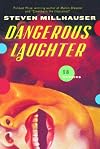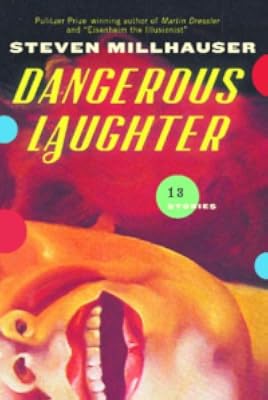
Dangerous Laughter: Thirteen Stories
by Steven Millhauser
On This Page
Description
A collection of darkly comic stories united by their obsession with obsession.Tags
Recommendations

























Member Reviews
I really enjoyed this book.
The first story, "The Disappearance of Elaine Coleman," borders on perfection. A well-crafted locked room mystery, this story has themes and characters that transcend the pages of the book. It had me thinking (and still has me thinking) about what happens when people stop noticing other people.
The other three stories in the first section (entitled "Vanishing Acts") were good, but as a friend mentioned in her review, they were somewhat repetitive. A couple of specific images reappeared often enough that I found them a little annoying (eg, the image of the pocket torn from the back of a pair of jeans, a character looking as though they were coming down with something). I found it satisfying, however, to watch show more Millhauser explore his theme through different characters and situations. It inspired to me to do some more experimenting with my own writing.
The other two sections, "Impossible Architectures" and "Heretical Histories," are pleasant all the way through. There's a Tower of Babel story followed to its possible conclusion had God not intervened and changed everyone's languages ("The Tower"). There's the story of the craftsman of miniatures who pushes his art to see how far he can move the limits ("In the Reign of Harad IV"). Then there's my favorite of the latter half of the book, the story of a painter experimenting with the properties of paints and unleashing unexpected forces ("A Precursor of the Cinema").
When I was a child, I would get a thrill imagining things that were infinitely large and infinitely small. The sensation of letting my mind expand beyond the boundaries of the physical world as I could perceive it with my senses was exhilarating and terrifying all at once. Millhauser's stories reawakened this sensation in me. show less
The first story, "The Disappearance of Elaine Coleman," borders on perfection. A well-crafted locked room mystery, this story has themes and characters that transcend the pages of the book. It had me thinking (and still has me thinking) about what happens when people stop noticing other people.
The other three stories in the first section (entitled "Vanishing Acts") were good, but as a friend mentioned in her review, they were somewhat repetitive. A couple of specific images reappeared often enough that I found them a little annoying (eg, the image of the pocket torn from the back of a pair of jeans, a character looking as though they were coming down with something). I found it satisfying, however, to watch show more Millhauser explore his theme through different characters and situations. It inspired to me to do some more experimenting with my own writing.
The other two sections, "Impossible Architectures" and "Heretical Histories," are pleasant all the way through. There's a Tower of Babel story followed to its possible conclusion had God not intervened and changed everyone's languages ("The Tower"). There's the story of the craftsman of miniatures who pushes his art to see how far he can move the limits ("In the Reign of Harad IV"). Then there's my favorite of the latter half of the book, the story of a painter experimenting with the properties of paints and unleashing unexpected forces ("A Precursor of the Cinema").
When I was a child, I would get a thrill imagining things that were infinitely large and infinitely small. The sensation of letting my mind expand beyond the boundaries of the physical world as I could perceive it with my senses was exhilarating and terrifying all at once. Millhauser's stories reawakened this sensation in me. show less
Really, this collection of stories should not work. 1) Many are in a style that I can only describe as “Essays on things that have happened” (heck, the essay is hard to pull off when it is based on something real – how much harder when the writer is making it up), 2) many explore themes that have been mined to death in effective science fiction stories, and 3) many start so mundanely that the reader is tempted to think there will be nothing within.
Which just goes to show that Millhauser is a powerful and talented writer (and reminds all of us that any writing rule can be broken – but only if you really know what you’re doing.). There is not a story in here that did not leave me thinking – wondering about the insights I had show more just seen and also wondering how Millhauser took that simple subject and brought it new depth. 1) The “essay of what happened stories” (again, just a term I made up) could easily become nothing more than a dry recitation of facts built on an interesting theme. But Millhauser takes his kernel of an idea (the tower of Babel was real, a historical society that recognizes today as tomorrow’s history, an exact copy of a town) and, by reciting the facts of their development (the essay), leads us to a better understanding of how we react to real-world situations. 2) There is not a story here that would not be at home in an SF or Fantasy collection. The concepts are familiar. As one example, the great story by Ted Chiang – “Tower of Babylon” – posits that the Tower of Babel was real. The minute an author takes on a subject done so well by another author, they are facing a significant challenge. But these similar concepts are written to a different depth that, again, sheds new light on who people are and what they do. 3) Yes, it is easy to think these stories will go nowhere. But, within a few pages, you will find that you have moved into new and different territory. You won’t be able to say when it happened – you will just know you are there.
The perfect example of this is “The Dome”. In this short 8-page story, Milllhauser describes the history of how the fad of using domes to cover houses eventually spreads to towns, and to countries, and to the world. Standard SF fare and, in describing this as history through essay form, two strikes to completing a successful story. Yet, as he describes these changes, he describes the people that are making (and fighting) the changes. And he makes us ask questions about ourselves and what the domes really mean. Two strikes that lead to a home run.
They are all fabulous stories, each of which deserves a separate description and discussion, but I’ll only bring up one more – the first story “Cat ‘N’ Mouse”. As I’ve said, it is easy to dismiss these stories in the first chapter or two because you think you know where they are going. In this story, Millhauser seems to be doing nothing more than describing scenes from a Tom and Jerry cartoon. An interesting approach, but it feels like a writer’s exercise rather than a story. Soon, he starts to explore what is really going on with the cat and mouse and the reader thinks, “Okay, that is interesting”, but may not expect much more. Yet, at the end, the exploration is new, different, and worth every word.
I had never read Millhauser’s work before and did not know what to expect. I was surprised, thrilled, and sorry the journey ended. If his other works are anything close, it is no wonder he is a Pulitzer Prize winner. Jump in and enjoy this collection. show less
Which just goes to show that Millhauser is a powerful and talented writer (and reminds all of us that any writing rule can be broken – but only if you really know what you’re doing.). There is not a story in here that did not leave me thinking – wondering about the insights I had show more just seen and also wondering how Millhauser took that simple subject and brought it new depth. 1) The “essay of what happened stories” (again, just a term I made up) could easily become nothing more than a dry recitation of facts built on an interesting theme. But Millhauser takes his kernel of an idea (the tower of Babel was real, a historical society that recognizes today as tomorrow’s history, an exact copy of a town) and, by reciting the facts of their development (the essay), leads us to a better understanding of how we react to real-world situations. 2) There is not a story here that would not be at home in an SF or Fantasy collection. The concepts are familiar. As one example, the great story by Ted Chiang – “Tower of Babylon” – posits that the Tower of Babel was real. The minute an author takes on a subject done so well by another author, they are facing a significant challenge. But these similar concepts are written to a different depth that, again, sheds new light on who people are and what they do. 3) Yes, it is easy to think these stories will go nowhere. But, within a few pages, you will find that you have moved into new and different territory. You won’t be able to say when it happened – you will just know you are there.
The perfect example of this is “The Dome”. In this short 8-page story, Milllhauser describes the history of how the fad of using domes to cover houses eventually spreads to towns, and to countries, and to the world. Standard SF fare and, in describing this as history through essay form, two strikes to completing a successful story. Yet, as he describes these changes, he describes the people that are making (and fighting) the changes. And he makes us ask questions about ourselves and what the domes really mean. Two strikes that lead to a home run.
They are all fabulous stories, each of which deserves a separate description and discussion, but I’ll only bring up one more – the first story “Cat ‘N’ Mouse”. As I’ve said, it is easy to dismiss these stories in the first chapter or two because you think you know where they are going. In this story, Millhauser seems to be doing nothing more than describing scenes from a Tom and Jerry cartoon. An interesting approach, but it feels like a writer’s exercise rather than a story. Soon, he starts to explore what is really going on with the cat and mouse and the reader thinks, “Okay, that is interesting”, but may not expect much more. Yet, at the end, the exploration is new, different, and worth every word.
I had never read Millhauser’s work before and did not know what to expect. I was surprised, thrilled, and sorry the journey ended. If his other works are anything close, it is no wonder he is a Pulitzer Prize winner. Jump in and enjoy this collection. show less
Disappointed with it, only 3 of the 13 stories get a 4 or 5 rating for me. Millhauser is an imaginative writer who excels at describing very specific details in a certain dryly whimsical way, and I find his style quite appealing. But too many of the ideas in this book didn't match that appeal for me. Others did, but then the result was unaffecting. Only 'In the Reign of Harad IV' really gets me excited from this collection, a story that marries Millhauser's style, plot, and human being to create wonderment and feeling.
Merged review:
All time favorite short story.
Merged review:
All time favorite short story.
The stories in Millhauser’s collection unfold with a inspired simplicity and precision that imparts utter believability to the satirical and often absurd events described. Often feeling more like essays than fiction, these stories train an shrewd eye on contemporary society, pushing fads and fashions to their logical—and ridiculous—extremes, before slowly and almost ruefully backing away.
Stand-outs in the collection include the first story, “Cat ‘n’ Mouse,” chronicling the violent adventures and reflective inner lives of two familiar cartoon icons; “The Disappearance of Elaine Coleman,” which discusses the alienation of modern society and lays blame squarely at the feet of the culprits; and the highly entertaining show more satire “Here at the Historical Society,” in which historical researches devote their time not to the distant past but to past times as recent as a few seconds ago—the present, in other words. show less
Stand-outs in the collection include the first story, “Cat ‘n’ Mouse,” chronicling the violent adventures and reflective inner lives of two familiar cartoon icons; “The Disappearance of Elaine Coleman,” which discusses the alienation of modern society and lays blame squarely at the feet of the culprits; and the highly entertaining show more satire “Here at the Historical Society,” in which historical researches devote their time not to the distant past but to past times as recent as a few seconds ago—the present, in other words. show less
Very rarely do I find a short story collection in which I like every story, but this is one such collection. Divided into three sections with four stories each, and adding an introductory tale to make a baker's dozen, this collection holds together better than any I can remember reading. This is even more amazing considering these previously published stories first appeared separately in various literary periodicals. Each story takes a simple idea which could be described in a short paragraph and pulls the string to look at consequences or look beneath the surface of events. Shared themes and ideas, such as the dangers of obsession or the human tendency to pursue transient fads, provide connecting threads that bind the stories together show more into a unified whole. Different narrative techniques are used. "The Wizard of West Orange" is written as the diary of the librarian at Thomas Edison's laboratory who gets to be the human "guinea pig" in testing a new invention. "History of a disturbance" is written as a somewhat apologetic letter from a husband to his wife explaining why he has felt compelled to take a vow of silence despite the consequent strains it has placed on their marriage. Other stories are written in first person, third person, or omniscient narrator, providing a variety of narrative styles. Overall, the best short story collection I have read in a long time, and I'm not surprised to see it on many critics' "Best of 2008" list. show less
Millhauser's stories each have a central conceit - a tower built to heaven, a suit that replicates touch sensations (built in a facility resembling Edison's Menlo Park), a friendship only conducted in the dark, "laughing parties". These ideas veer towards science fiction, but Millhauser grounds them in enough detail to give the illusion of possibility. If you are looking for typical narrative structure, look elsewhere - instead these stories are snapshots of the author's fertile imagination. The end result is a book that feels self-indulgent, with ideas that the author finds fascinating; too bad the reader is left on the periphery of this fascination.
One thing about Steven Millhauser. He writes a damn good first sentence. The kind where you snuggle down in your chair a little deeper, ready to settle in for the tale.
His story collection Dangerous Laughter starts like you’ve sat down at an old style neighborhood movie theater - with an “Opening Cartoon” - this one called Cat ‘N’ Mouse. It’s unlikely you’ll ever read a more visual short story. His powers of observation and description are uncannily precise. Close your eyes and if you could listen to this story, it would be as if you were watching the cartoon in living, saturated color.
After the “Opening Cartoon”, Millhauser gives us three ‘featurettes’ of four thematically related shorts each. The first on show more “Vanishing Acts” has characters at various stages of disappearance or non-existence, including the story whose title names the collection.
The four stories contained in “Impossible Architectures” all relate to just that - ways in which Millhauser envisioned societies strive to makeover or preserve or interpret their relationship with nature or the heavens. The Dome and The Other Town both are slyly funny and creepy at the same time. And eerily familiar.
Speaking of eerily familiar, I could swear I’ve read a story somewhere very similar to The Tower. The building of a tower that inevitably must come crashing down…in Yourcenar? or maybe it just has a Pynchon Chumps feel to it.
During the course f many generations the Tower grew higher and higher until one day it pierced the floor of heaven.
Finally in “Heretical Histories” Millhauser takes a look at fashion, the penchant for historical preservation, imagined ways in which ‘the cinema’ may have evolved differently, and a manic look at Thomas Edison in The Wizard of West Orange.
Overall an uneven collection, with mostly interesting stories - but a few throw aways. In the end, I’d have to say I really prefer Millhauser’s longer fiction. show less
His story collection Dangerous Laughter starts like you’ve sat down at an old style neighborhood movie theater - with an “Opening Cartoon” - this one called Cat ‘N’ Mouse. It’s unlikely you’ll ever read a more visual short story. His powers of observation and description are uncannily precise. Close your eyes and if you could listen to this story, it would be as if you were watching the cartoon in living, saturated color.
After the “Opening Cartoon”, Millhauser gives us three ‘featurettes’ of four thematically related shorts each. The first on show more “Vanishing Acts” has characters at various stages of disappearance or non-existence, including the story whose title names the collection.
The four stories contained in “Impossible Architectures” all relate to just that - ways in which Millhauser envisioned societies strive to makeover or preserve or interpret their relationship with nature or the heavens. The Dome and The Other Town both are slyly funny and creepy at the same time. And eerily familiar.
Speaking of eerily familiar, I could swear I’ve read a story somewhere very similar to The Tower. The building of a tower that inevitably must come crashing down…in Yourcenar? or maybe it just has a Pynchon Chumps feel to it.
During the course f many generations the Tower grew higher and higher until one day it pierced the floor of heaven.
Finally in “Heretical Histories” Millhauser takes a look at fashion, the penchant for historical preservation, imagined ways in which ‘the cinema’ may have evolved differently, and a manic look at Thomas Edison in The Wizard of West Orange.
Overall an uneven collection, with mostly interesting stories - but a few throw aways. In the end, I’d have to say I really prefer Millhauser’s longer fiction. show less
Members
- Recently Added By
Lists

Favorite Short Fiction
228 works; 99 members

2008-2012 Notable Books for Adults
127 works; 10 members

Books for Fans of Stranger Things
84 works; 7 members
Author Information

45+ Works 5,690 Members
Awards and Honors
Awards
Work Relationships
Common Knowledge
- Canonical title
- Dangerous Laughter: Thirteen Stories
- Original publication date
- 2008-02-15
- People/Characters
- Elaine Coleman; Cat; Mouse; John Wolfson; Isabel Wolfson; David (show all 9); Clara Schuler; Hyperion; Harlan Crane
- Dedication
- To Anna and Jonathan
Classifications
Statistics
- Members
- 625
- Popularity
- 46,799
- Reviews
- 29
- Rating
- (3.76)
- Languages
- Chinese, English
- Media
- Paper, Audiobook, Ebook
- ISBNs
- 8
- ASINs
- 4