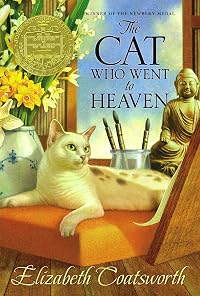
The Cat Who Went to Heaven
by Elizabeth Jane Coatsworth
On This Page
Description
A little cat comes to the home of a poor Japanese artist and, by humility and devotion, brings him good fortune.Tags
Recommendations




















Member Recommendations
Member Reviews
Originally published in 1930, Elizabeth Coatsworth's The Cat Who Went to Heaven was the Newbery Medal winner in 1931, and relates the story of a poor Japanese artist, his devoted housekeeper, and the gentle cat that comes into their lives. Angry at first, when his housekeeper brings home a little white kitten, rather than the dinner he had been expecting, the artist is reconciled to his new pet - soon named "Good Fortune" - by her quiet good manners, and by her obvious devotion to him, to the housekeeper, and to the Buddha. When the village priest commissions a painting of the Buddha for the temple, the artist immerses himself in the life of his subject, "living" the Enlightened One's life, and becoming each animal that visited him upon show more his deathbed. But although Good Fortune keeps faithful watch with him, as he begins his great work, and obviously longs to be included, the artist can not include her in the painting. After all, the cat was the only animal to refuse the Buddha's teaching, and the only animal not blessed by him...
This brief chapter-book (sixty-three pages, in my edition), which alternates between the main prose narrative, and short poems ostensibly written by the housekeeper, has the feeling of folklore to it. The author references the classic Japanese tale of The Boy Who Drew Cats in her text, as well as many different stories about the life of the Buddha, and his reincarnated lives in various animal forms. I found myself wondering how accurate Coatsworth's depiction was of some of these traditions, particularly as it related to Buddhist beliefs about cats. Are they really considered the only animal that is barred from heaven? Did the Japanese truly regard them as demonic? What about the lucky Beckoning Cat? Leaving this issue aside, I found the story itself very engaging, and I think young readers who enjoy animal stories will as well.
There is an incredibly poignant quality to this story, and while Good Fortune's death from pure joy, when the artist relents, and includes her in the painting, sets up the concluding miracle very well - from a storytelling perspective, happy endings often work best when they follow upon terrible tragedy - this aspect of the tale is still troubling. Troubling in a good way... a haunting way. I am reminded of Tomi DePaola's The Clown of God, which was a childhood favorite of mine, and which also tells the story of a miracle. A miracle that, like this one, requires a joyful sacrifice. Perhaps all miracles do? Something I'll have to think about... show less
This brief chapter-book (sixty-three pages, in my edition), which alternates between the main prose narrative, and short poems ostensibly written by the housekeeper, has the feeling of folklore to it. The author references the classic Japanese tale of The Boy Who Drew Cats in her text, as well as many different stories about the life of the Buddha, and his reincarnated lives in various animal forms. I found myself wondering how accurate Coatsworth's depiction was of some of these traditions, particularly as it related to Buddhist beliefs about cats. Are they really considered the only animal that is barred from heaven? Did the Japanese truly regard them as demonic? What about the lucky Beckoning Cat? Leaving this issue aside, I found the story itself very engaging, and I think young readers who enjoy animal stories will as well.
There is an incredibly poignant quality to this story, and while Good Fortune's death from pure joy, when the artist relents, and includes her in the painting, sets up the concluding miracle very well - from a storytelling perspective, happy endings often work best when they follow upon terrible tragedy - this aspect of the tale is still troubling. Troubling in a good way... a haunting way. I am reminded of Tomi DePaola's The Clown of God, which was a childhood favorite of mine, and which also tells the story of a miracle. A miracle that, like this one, requires a joyful sacrifice. Perhaps all miracles do? Something I'll have to think about... show less
A poor artist's housekeeper comes home one day with a little cat. Against his better judgment, the artist keeps her, calling her "Good Fortune". When he is chosen to paint a scroll of the death of Buddha for the temple, Good Fortune sits with him as he paints all the animals who were blessed by Buddha, finding the Buddha-nature in each, (though she doesn't think much of the dog). But the artist cannot include a cat in his painting, because cats, being independent creatures, had refused homage to Buddha. Nevertheless, in the end, he risks it, and a miracle occurs.
I don't mind saying I cried at the end of this book.
I don't mind saying I cried at the end of this book.
Very cute. It's a fairy tale, pretty much - the characters are symbols rather than people. But it's a lovely little story, about faith and kindness; it also tells the story of the Buddha very elegantly. I was crying at the end.
This is one of the books that has always captured my mind since I was a child and it will always rate high on my reading list even for its age.
I have been blessed to have come across a Great Britain first edition whose pictures are more charming and beautiful than the one that I grew up with. Its the beauty of these pictures that emphasizes the story while adding to it a refreshing depth although the old housekeeper probably could have been drawn better.
The story is vintage and being set in an exotic background can be somewhat hard to relate with while bringing a sweetly unique flavor to this book. Otherwise Elizabeth's superb writing talent, her beautiful prose and emotional talent in weaving her masterpiece shows why this book has show more been a lasting story for mostly any people who have gotten a chance to read it.
What makes this book special to me is the fact that even though the religion isn't Christian it searches rather sweetly the concepts of sacrifice, love and compassion while making you question your own limits. Would you love so fiercely like the tiger that you would be willing to make the ultimate sacrifice? Are you able to open yourself to making others happy even if it could mean the loss of everything? And is there such a thing as never being able to forgive? Of having to always live under the same stereotypes since of what someone else has done?
And to make the story so much sweeter you have the additional stories of Buddha that adds a bit of flavor while examining these moral trials. Altogether it's an unforgettable introduction to a little known world that still faces the roughest questions that we ask ourselves..... show less
I have been blessed to have come across a Great Britain first edition whose pictures are more charming and beautiful than the one that I grew up with. Its the beauty of these pictures that emphasizes the story while adding to it a refreshing depth although the old housekeeper probably could have been drawn better.
The story is vintage and being set in an exotic background can be somewhat hard to relate with while bringing a sweetly unique flavor to this book. Otherwise Elizabeth's superb writing talent, her beautiful prose and emotional talent in weaving her masterpiece shows why this book has show more been a lasting story for mostly any people who have gotten a chance to read it.
What makes this book special to me is the fact that even though the religion isn't Christian it searches rather sweetly the concepts of sacrifice, love and compassion while making you question your own limits. Would you love so fiercely like the tiger that you would be willing to make the ultimate sacrifice? Are you able to open yourself to making others happy even if it could mean the loss of everything? And is there such a thing as never being able to forgive? Of having to always live under the same stereotypes since of what someone else has done?
And to make the story so much sweeter you have the additional stories of Buddha that adds a bit of flavor while examining these moral trials. Altogether it's an unforgettable introduction to a little known world that still faces the roughest questions that we ask ourselves..... show less
This is one of the books that has always captured my mind since I was a child and it will always rate high on my reading list even for its age.
I have been blessed to have come across a Great Britain first edition whose pictures are more charming and beautiful than the one that I grew up with. Its the beauty of these pictures that emphasizes the story while adding to it a refreshing depth although the old housekeeper probably could have been drawn better.
The story is vintage and being set in an exotic background can be somewhat hard to relate with while bringing a sweetly unique flavor to this book. Otherwise Elizabeth's superb writing talent, her beautiful prose and emotional talent in weaving her masterpiece shows why this book has show more been a lasting story for mostly any people who have gotten a chance to read it.
What makes this book special to me is the fact that even though the religion isn't Christian it searches rather sweetly the concepts of sacrifice, love and compassion while making you question your own limits. Would you love so fiercely like the tiger that you would be willing to make the ultimate sacrifice? Are you able to open yourself to making others happy even if it could mean the loss of everything? And is there such a thing as never being able to forgive? Of having to always live under the same stereotypes since of what someone else has done?
And to make the story so much sweeter you have the additional stories of Buddha that adds a bit of flavor while examining these moral trials. Altogether it's an unforgettable introduction to a little known world that still faces the roughest questions that we ask ourselves..... show less
I have been blessed to have come across a Great Britain first edition whose pictures are more charming and beautiful than the one that I grew up with. Its the beauty of these pictures that emphasizes the story while adding to it a refreshing depth although the old housekeeper probably could have been drawn better.
The story is vintage and being set in an exotic background can be somewhat hard to relate with while bringing a sweetly unique flavor to this book. Otherwise Elizabeth's superb writing talent, her beautiful prose and emotional talent in weaving her masterpiece shows why this book has show more been a lasting story for mostly any people who have gotten a chance to read it.
What makes this book special to me is the fact that even though the religion isn't Christian it searches rather sweetly the concepts of sacrifice, love and compassion while making you question your own limits. Would you love so fiercely like the tiger that you would be willing to make the ultimate sacrifice? Are you able to open yourself to making others happy even if it could mean the loss of everything? And is there such a thing as never being able to forgive? Of having to always live under the same stereotypes since of what someone else has done?
And to make the story so much sweeter you have the additional stories of Buddha that adds a bit of flavor while examining these moral trials. Altogether it's an unforgettable introduction to a little known world that still faces the roughest questions that we ask ourselves..... show less
This story was a lovely little folk tale that reminded me of all the best of the Newbery books. A young man has been commissioned by the temple to paint a picture of Buddha as he blesses the animals. He slowly adds animals, telling the tale and the strength of each. Then the artist comes to the cat, an animal which had, by tradition, rejected the Buddha and thus was excluded from heaven. But it is the artist's cat that has inspired him in his work and the artist knows it is the cat's greatest wish to be included in the painting. At last, the artist makes the difficult decision to include the cat in the painting. The ending is surprising and lovely.
A bit of a morality play about Buddhism, but sweetly and serenely told in just 57 pages with black and white paintings of animals interspersed. There are only three characters - the artist, the housekeeper, and the cat "Good Fortune". After the cat arrives, the Japanese artist is commissioned to paint the death of the Buddha. He reflects on the Buddha's life, and the lives of the animals his spirit inhabited or who helped him on his journeys and on the legend of the cat - the only animal not to enter heaven because of her own independence. There are interesting discussions out there about gender roles in the story, but as a story of the time, the culture and the Buddha, it is quite well done and a nice easy read that might still be show more appreciated by children today - especially those who are fond of the cat. show less
Members
- Recently Added By
Published Reviews
ThingScore 75
From all this, I would say Coatsworth’s book is well-researched and true to the cultures it is trying to portray, blending Buddhist folklore and Japanese legend she first learned about on her own travels. Perhaps calling it “The Cat Who Went to Nirvana” would have been more politically correct, but I believe the book is more accessible to children with its present title.
added by private library
Cat Heaven sounds like paradise. A rhyming text describes a realm in which felines are fed from God's countertop, a place where they no longer get stuck in trees because now they can fly. There are thousands of toys, and soft angel laps in which to cuddle. There is even a quiet time to look back on former homes and loving people. The primitive, childlike painting style is similar to Rylant's show more work in Dog Heaven (Scholastic, 1995). Both books serve the same purpose of comforting anyone mourning a lost pet, but the writing flows more easily and the pictures are more mature in Cat Heaven. The story has spiritualism and reverence but not in a traditional manner. God is depicted as a kindly older man who washes the cats' bowls and "walks in His garden with a good black book and a kitty asleep on His head." His coloring varies from pink to brown to yellowish tan. The visual impact of the book is stunning. Cats of all colors frolic through the exuberantly hued pages. Vibrant yellows, blues, reds, purples, and greens create a feast for the eyes. Even the color of the text changes to contrast with the background. Whether read as a story to younger children or used in a discussion of the nature of heaven with older ones, this deceptively simple, sweet book is rewarding. show less
added by ReneHohls
Most of Coatsworth's stories are quiet tales, some of them disappointingly flat to today's children, and others are filled with mystery and a sense of mythic time. Her prizewinning story, The Cat Who Went to Heaven , captures the mystery and the compassion of the Buddha--a figure being painted by the artist in the book. As the artist recalls traditional Buddhist stories about the sacrifices of show more the snail and the elephant, the heroism of the horse, the dreamlike beauty of the swan, the honesty and dignity of the buffalo, the compassion of the monkey, and the petitions for mercy spoken by the doe, he paints them all into his picture. Because, of all the animals, the cat had refused homage to Buddha, tradition requires the artist to omit the cat. However, since the artist had so often seen his cat praying to Buddha, he violates this tradition. Offended by the presence of the cat in the picture, the priests take the artist's picture to burn it. Overnight, however, a miraculous change in the picture occurs: "the Buddha whom he had painted ... had stretched out an arm in blessing, and under the holy hand-knelt the figure of a tiny cat, with pretty white head bowed in adoration." The interweaving of Buddhist myth and legend with observations of the cat and the artist creates a story with mystery and reverence for all life. The story's strength lies in its economy and its mythic power. show less
added by ReneHohls
Lists

Best Newbery Medal Winners
94 works; 54 members

Best Books About Animals
143 works; 48 members

Sonlight Books
1,487 works; 25 members

100 Best Books by American Women During the Past 100 Years, 1833-1933
27 works; 5 members

Cats in Fiction
209 works; 9 members

Newbery Medal Winners - By Year
105 works; 7 members

Romalda Spalding's Writing Road To Reading
213 works; 3 members

Books Read in 2019
4,052 works; 108 members

The Story of the World: Activity Book Three: Early Modern Times
191 works; 3 members

Books That Made Us Cry
278 works; 145 members
Author Information

128+ Works 5,745 Members
Some Editions
Awards and Honors
Series
Belongs to Publisher Series
Common Knowledge
- Canonical title
- The Cat Who Went to Heaven
- Original publication date
- 1930
- People/Characters
- The artist; The housekeeper; Good Fortune (cat); Buddha; Siddhartha Gautama, the Buddha; Yasodhara (show all 7); Shippeitaro (dog)
- Important places
- Japan
- Dedication
- To Cyra Thomas
- First words
- Once upon a time, far away in Japan, poor young artist sat alone in his little house, waiting for his dinner.
- Last words
- (Click to show. Warning: May contain spoilers.)This is too beautiful a thing
To understand:
His garments touch the furthest
Grain of sand. - Original language
- English US
Classifications
Statistics
- Members
- 2,455
- Popularity
- 7,904
- Reviews
- 52
- Rating
- (3.74)
- Languages
- Chinese, Dutch, English, Spanish
- Media
- Paper, Audiobook, Ebook
- ISBNs
- 27
- ASINs
- 25