

Lynd Ward (1905–1985)
Author of The Biggest Bear
About the Author
Image credit: babelio.com
Works by Lynd Ward
Mad Man's Drum: A Novel in Woodcuts (Dover Fine Art, History of Art) by Ward, Lynd (2005) Paperback 1 copy
americas mark twain 1 copy
RIGHTS OF MAN Easton Press 1 copy
Six Novels in Woodcuts 1 copy
Bibliognost: The Book Collector's Little Magazine: Special Lynd Ward Issue (1976) — Illustrator — 1 copy
Associated Works
Johnny Tremain: A Story of Boston in Revolt (1943) — Illustrator, some editions — 10,855 copies, 90 reviews
My Friend Mac: The Story of Little Baptiste and the Moose (1960) — Illustrator — 132 copies, 2 reviews
Runner of the Mountain Tops: The Life of Louis Agassiz (1939) — Illustrator, some editions — 33 copies, 1 review
On Conciliation with the Colonies, and Other Papers on the American Revolution (1975) — Illustrator — 24 copies
Tagged
Common Knowledge
- Legal name
- Ward, Lynd Kendall
- Birthdate
- 1905-06-26
- Date of death
- 1985-06-28
- Gender
- male
- Education
- Columbia University (BA|1926)
National Academy of Graphic Arts in Leipzig - Occupations
- graphic artist
illustrator
novelist
children's book author
printmaker
painter - Awards and honors
- Caldecott Medal
Eisner Award (Hall of Fame ∙ 2011)
Regina Medal (1975) - Relationships
- Ward, Harry F. (father)
McNeer, May (wife) - Nationality
- USA (birth)
- Birthplace
- Chicago, Illinois, USA
- Places of residence
- Chicago, Illinois, USA (birthplace)
Massachusetts, USA
New Jersey, USA
Lonely Lake, Ontario, Canada
Leipzig, Germany - Place of death
- Reston, Virginia, USA
- Associated Place (for map)
- USA
Members
Reviews

Ward's woodcuts are unexpectedly precise and sophisticated. A blurb from Will Eisner claims Ward's Vertigo as "the forerunner of the modern graphic novel" -- and his woodcuts look familiar precisely because unacquainted readers easily could assume they're drawn. But Ward didn't rely entirely on technical craft. His stories are innovative in depicting scenes, and they had to be: his novels have no speech balloons, no captions or other narrative boxes, no sound effects, no words at all show more excepting as part of the scene (for instance a billboard or newspaper held by a character). Like the very best graphic novels I've read, not everything in Vertigo is evident from a single reading.
The three novels here (two shorter novels precede Vertigo) are supplemented with essays by Ward on each novel, his publishing collective Equinox, and the art of woodblocks. Art Spiegelman contributes an introduction, which mentions the three novels of Volume I. I was pleasantly surprised to read Ward was inspired specifically by Masereel's woodcuts and by German Expressionism generally, as my interest in each prompted me to read Ward.
//
This LOA edition, the second of two volumes, is a handsome book: orange cloth binding paired with an orange & white jacket (not the typical LOA design), and the endpapers adapted from Ward's board design for the Equinox edition of Prelude to a Million Years. Unlike most LOA books, this edition includes both a jacket and a choice of slipcase (for subscribers) or a custom orange box.
All but a small handful of the woodcuts are sharp and glossy black; these very few are slightly washed out, uncertain why that is (all are from Vertigo). show less
The three novels here (two shorter novels precede Vertigo) are supplemented with essays by Ward on each novel, his publishing collective Equinox, and the art of woodblocks. Art Spiegelman contributes an introduction, which mentions the three novels of Volume I. I was pleasantly surprised to read Ward was inspired specifically by Masereel's woodcuts and by German Expressionism generally, as my interest in each prompted me to read Ward.
//
This LOA edition, the second of two volumes, is a handsome book: orange cloth binding paired with an orange & white jacket (not the typical LOA design), and the endpapers adapted from Ward's board design for the Equinox edition of Prelude to a Million Years. Unlike most LOA books, this edition includes both a jacket and a choice of slipcase (for subscribers) or a custom orange box.
All but a small handful of the woodcuts are sharp and glossy black; these very few are slightly washed out, uncertain why that is (all are from Vertigo). show less
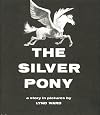
A boy minding grazing cows on a farm sees a surprising sight: a winged horse flying down from the sky near an apple tree. The boy runs to get his father, but the silver pony is gone by the time they return; the father believes he was lying and spanks him. But when the boy returns alone, the silver pony is there again. The boy gives it an apple, and climbs aboard, and together they soar through the sky and perform rescues and random acts of kindness, until at last they travel too high, and show more fall. The parents discover the boy on the ground outside their house, and call the doctor. The horse seems gone for good, but in the paddock is a dappled foal.
Gorgeous, evocative illustrations make it easy to follow the action in this wordless fantasy story. I loved the detail of the pattern on the boy's pajamas matching the silver pony's dappled coat. show less
Gorgeous, evocative illustrations make it easy to follow the action in this wordless fantasy story. I loved the detail of the pattern on the boy's pajamas matching the silver pony's dappled coat. show less
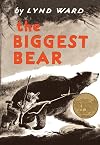
Ward won the Caldecott for the detailed, sepia-toned, drawings that accompany this story.
Johnny Orchard lives on a farm at the far end of the valley, near a big woods. Whenever he walks down the road he notices that other barns have bear skins drying on their walls; he’s embarrassed that his family’s barn doesn’t have a bear skin. So he heads into the woods one day, with his rifle, determined to get the biggest bear.
What he finds, though is an orphaned bear cub, which he befriends show more with a piece of maple sugar candy. But when he brings the cub home, problems begin; and they only get worse when the bear grows B*I*G.
I think children might be intrigued by the adventure of the story, but I hope they wouldn’t feel encouraged to try to tame a wild animal. I was also somewhat dismayed bya scene where Johnny has to take his bear to the woods to kill it because it has become a nuisance. Don’t worry, he doesn’t ever actually do this, but he has every intention of doing so, and I find that disturbing in a children’s book.
The illustrations are wonderfully detailed. I kept looking at them, absorbing the farmhouse, barnyard, woods, etc. If I were rating the illustrations alone, I’d give the book 4****. show less
Johnny Orchard lives on a farm at the far end of the valley, near a big woods. Whenever he walks down the road he notices that other barns have bear skins drying on their walls; he’s embarrassed that his family’s barn doesn’t have a bear skin. So he heads into the woods one day, with his rifle, determined to get the biggest bear.
What he finds, though is an orphaned bear cub, which he befriends show more with a piece of maple sugar candy. But when he brings the cub home, problems begin; and they only get worse when the bear grows B*I*G.
I think children might be intrigued by the adventure of the story, but I hope they wouldn’t feel encouraged to try to tame a wild animal. I was also somewhat dismayed by
The illustrations are wonderfully detailed. I kept looking at them, absorbing the farmhouse, barnyard, woods, etc. If I were rating the illustrations alone, I’d give the book 4****. show less
This may be Lynd Ward's masterpiece. No words, just his amazing drawings. A young farm boy, resting from his chores, sees (or dreams?) a silvery white winged pony. His father doesn't buy his story, and doesn't approve of daydreaming (or tall tales?). The boy eventually rides the marvelous winged creature around the world, doing good deeds. The ending has a twist, and as in other Ward children’s works, the Father has a surprise for his Son. Open to a lot of interpretation, this book would show more be a great discussion topic for bright imaginative children. Billed as for the 4-7 age group, I think it might work better for children older than 7. Although younger kids could probably make a good enough story out of the pictures, they might get bogged down by the end. Lynd Ward is sort of the father of the graphic novel, having produced six wordless novels comprised solely of woodcuts in the 1930’s. He also illustrated many juvenile books including the first edition of Johnny Tremain. show less
Lists
Wordless Books (2)
Awards


You May Also Like


Associated Authors
Statistics
- Works
- 31
- Also by
- 63
- Members
- 4,198
- Popularity
- #5,987
- Rating
- 4.0
- Reviews
- 56
- ISBNs
- 69
- Languages
- 2
- Favorited
- 2
