On This Page
Description
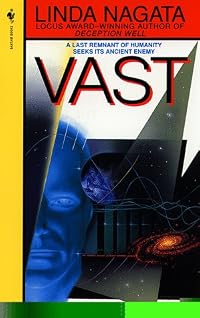
Aboard Null Boundary, a giant starship thousands of years old, four survivors of an ancient alien war are making a desperate journey: Lot, son of a fiery prophet and carrier of an insidious virus that spreads a cult-like religious mania among those it infects; Urban, Lot's boyhood friend from the city of Silk, and a man in search of challenge and adventure; Clemantine, cast adrift when her world was destroyed and yearning for revenge; and Nikko, sometimes a living man, but always, the ship's show more disembodied mind.They are bound into unknown territory. Ahead of them loom vast, lightless clouds of dustand gas where stars are born, and where the alien Chenzeme are believed to live. The Chenzeme are an enigmatic race, whose automated warships have ravaged the living worlds of the galaxy's Orion arm for millions of years... but why? Null Boundary's crew is driven to find out -- though in their quest to discover the source of the Chenzeme, they must also explore the terrible truth of their own past, the meaning of revenge, and the price each one of them is willing to pay for survival. show lessTags
Recommendations





Member Reviews
‘Vast’ is that rare thing, a character-driven hard sci-fi novel. I would describe much hard sci-fi as plot and/or technology driven, which is by no means a bad thing but lends itself to a certain kind of narrative. ‘Vast’ combines the huge scope of interstellar space with the small world of a few people living together on a spaceship. Events are pushed forward by decisions made by the characters, almost always by consensus. I appreciate this form of narrative propulsion. ‘Vast’ is also convincingly strange. The inhabitants of the Null Boundary (as their spaceship is called) are being pursued by a mysterious, implacable, apparently very hostile alien ship. They assume other human colonies are out there but don’t know of any show more specifically, while knowing for certain that Earth and the solar system have been destroyed. The alien Chenzeme make a fascinating antagonist as the characters know so little about them at the start and are forced to keep adjusting their hypotheses throughout. Their journey towards greater knowledge and their literal journey across the vastness of space are very well told. The biotech weirdness was also memorable, notably philosopher cells, kisheers, the cult virus, and spaceship communication by means of dust. I have many questions about how the characters ended up in a spaceship together, which I assume are answered in previous books in the series. This one stands alone, though. It built a unique, interesting world and peopled it with a small cast of appealing, enigmatic characters. I especially liked the central three, Lot, Urban, and Clemantine.
Finally, if you’ve read this novel, I’d be interested to know how you interpreted Lot’s ‘sensory tears’. Until about halfway through the book I assumed they were tears in the sense of salty water that leaks from your eyes. Thus I visualised Lot with a pierrot-style eye motif. Then I realised that tears could also mean apertures torn into his face, something like gills. I think you could argue for either interpretation. Which did you think it was? show less
Finally, if you’ve read this novel, I’d be interested to know how you interpreted Lot’s ‘sensory tears’. Until about halfway through the book I assumed they were tears in the sense of salty water that leaks from your eyes. Thus I visualised Lot with a pierrot-style eye motif. Then I realised that tears could also mean apertures torn into his face, something like gills. I think you could argue for either interpretation. Which did you think it was? show less
I picked up Vast after a few commentors on Charlie Stross' blog recommended Linda Nagata's work, and while epic post-humanity fiction isn't exactly my sweet spot, Nagata writes so forcefully and clearly that I finished the book right away.
Nagata's characters are lively and flawed (making them recognizable as people), and the technology at work is interesting and (at times) surprising, but not so odd that it became difficult to follow.
My only complaint is the convenience of a couple plot points; a crew member boards an alien ship and somehow picks up warp-drive nanobots by accident, and in all the vastness of a nebulae, the crew stumbles on the radio emissions of a human civilization, despite the fact they're a bazillion light years show more from a now-defunct earth.
Otherwise, I really enjoyed Nagata's Vast, and plan to buy a few other novels. If you're a hard sci-fi fan, Vast is well worth a look. show less
Nagata's characters are lively and flawed (making them recognizable as people), and the technology at work is interesting and (at times) surprising, but not so odd that it became difficult to follow.
My only complaint is the convenience of a couple plot points; a crew member boards an alien ship and somehow picks up warp-drive nanobots by accident, and in all the vastness of a nebulae, the crew stumbles on the radio emissions of a human civilization, despite the fact they're a bazillion light years show more from a now-defunct earth.
Otherwise, I really enjoyed Nagata's Vast, and plan to buy a few other novels. If you're a hard sci-fi fan, Vast is well worth a look. show less
The final novel of Nagata’s Nantoech Succession is somewhat disappointing.
Nagata’s strengths are again on display here. There is her clever combining of information science and theory with a technology of an often organic sort. With the former, we get recorded and edited and copied personalities which operate in a matrix ranging from computers to something approaching a standard issue homo sapiens body. So-called “cells” – automata running in living matter and, sometimes, the dust scattered throughout solar systems to form a vast processing system – are the organic element.
Her language, particularly in the last four pages, can rise to an astringent poignancy, a clear-eyed look at life and man’s place in the cosmos that show more somehow doesn’t descend into nihilism or a sense of cosmic horror.
Nagata presents her plot and explanations for her mysteries much more forthrightly than in the preceding novel, Deception Well. That includes an opening prologue which brings the reader quickly up to speed. And, yes, we do get the answers to some of the bigger mysteries of the series.
The plot starts up on the heels of that novel and spans many light years and centuries. We start out with four characters from the end of that book: Lot – carrier of a charismatic plague which has destroyed many human settlements as they became “communions” and dropped out of the human race and, perhaps, existence; Urban – Lot’s friend, one of the few people immune to his charisma; Clemantine – sometime lover of both Urban and Lot but deeply suspicious of the latter’s charisma since she once was under the sway of his similarly cursed father; and Nikko – a minor character in Deception Well and the major character in the earlier The Bohr Maker and not desirous of connecting with memories of his past. These four undertake a quest to uncover the motives and power of the alien Chenzeme whose automated weapons still prowl the cosmos and destroy human settlements. Nikko and Clemantine pursue the Chenzeme out of revenge for injuries they have suffered by them. Lot hopes to discover the secret of the Chenzeme designed plague that is his charismatic ability, and Urban wants the secret of the Chenzeme stardrive. All are aboard the starship Null Boundary.
And there are plenty of interesting concepts and ideas. But things begin to drag in the middle of the novel. I think the problem starts when Nagata not only continues her detailed and logical unraveling of Chenzeme mysteries and technology but also gives us new characters aboard the Null Boundary. Some are resurrected form personalities in the ship’s libraries. Others are “children” though not in the traditional sense. Their presence and the complications they bring into the lives of the four main characters do not sustain the novel’s initial pace. For about eighty pages, the novel slows before another major event happens which puts things in motion for the climax.
Still, if you’ve read the other books in the series, you will want to read this one despite its faults because, again, Nagata gives some answers to her mysteries and some closure in the lives of her characters. It is most definitely not an entry point to the series. show less
Nagata’s strengths are again on display here. There is her clever combining of information science and theory with a technology of an often organic sort. With the former, we get recorded and edited and copied personalities which operate in a matrix ranging from computers to something approaching a standard issue homo sapiens body. So-called “cells” – automata running in living matter and, sometimes, the dust scattered throughout solar systems to form a vast processing system – are the organic element.
Her language, particularly in the last four pages, can rise to an astringent poignancy, a clear-eyed look at life and man’s place in the cosmos that show more somehow doesn’t descend into nihilism or a sense of cosmic horror.
Nagata presents her plot and explanations for her mysteries much more forthrightly than in the preceding novel, Deception Well. That includes an opening prologue which brings the reader quickly up to speed. And, yes, we do get the answers to some of the bigger mysteries of the series.
The plot starts up on the heels of that novel and spans many light years and centuries. We start out with four characters from the end of that book: Lot – carrier of a charismatic plague which has destroyed many human settlements as they became “communions” and dropped out of the human race and, perhaps, existence; Urban – Lot’s friend, one of the few people immune to his charisma; Clemantine – sometime lover of both Urban and Lot but deeply suspicious of the latter’s charisma since she once was under the sway of his similarly cursed father; and Nikko – a minor character in Deception Well and the major character in the earlier The Bohr Maker and not desirous of connecting with memories of his past. These four undertake a quest to uncover the motives and power of the alien Chenzeme whose automated weapons still prowl the cosmos and destroy human settlements. Nikko and Clemantine pursue the Chenzeme out of revenge for injuries they have suffered by them. Lot hopes to discover the secret of the Chenzeme designed plague that is his charismatic ability, and Urban wants the secret of the Chenzeme stardrive. All are aboard the starship Null Boundary.
And there are plenty of interesting concepts and ideas. But things begin to drag in the middle of the novel. I think the problem starts when Nagata not only continues her detailed and logical unraveling of Chenzeme mysteries and technology but also gives us new characters aboard the Null Boundary. Some are resurrected form personalities in the ship’s libraries. Others are “children” though not in the traditional sense. Their presence and the complications they bring into the lives of the four main characters do not sustain the novel’s initial pace. For about eighty pages, the novel slows before another major event happens which puts things in motion for the climax.
Still, if you’ve read the other books in the series, you will want to read this one despite its faults because, again, Nagata gives some answers to her mysteries and some closure in the lives of her characters. It is most definitely not an entry point to the series. show less
I just now figured out the [Vast] is the fourth book in a four-book series! Oh well, that makes sense of a few things I guess, but on the whole, I didn't struggle to understand references to previous events too much so I suppose while I would recommend reading the earlier books first (I know I want to seek them out now that I know of their existence) one can still get a great deal out of this if it is read as a stand-alone.
This is wide, wide, wide-screen SF. This is the hardest of the hard SF. This is space opera that makes one's head spin - real big concept science fiction wrapped in a tension-filled chase through space. I suppose if I had to make comparisons some of the authors who come to mind are Alastair Reynolds and Stephen show more Baxter. Great stuff. show less
This is wide, wide, wide-screen SF. This is the hardest of the hard SF. This is space opera that makes one's head spin - real big concept science fiction wrapped in a tension-filled chase through space. I suppose if I had to make comparisons some of the authors who come to mind are Alastair Reynolds and Stephen show more Baxter. Great stuff. show less
Far future, weird technologies/biology, and an endless slower than light pursuit across centuries and parsecs. When I read it, I didn't even know it was one of a series. I'd just read the references in the book to past events as background and scene setting.
So, from my experience, it works very well as a standalone. But now I know, I'll definitely be getting the others.
So, from my experience, it works very well as a standalone. But now I know, I'll definitely be getting the others.
Members
- Recently Added By
Lists

Favorite Science Fiction by Women Authors
737 works; 202 members

Broderick and Di Filippo's Science Fiction: The 101 Best Novels 1985-2010
103 works; 7 members
Author Information

43+ Works 3,272 Members

Linda Nagata is a LibraryThing Author, an author who lists their personal library on LibraryThing.
Some Editions
Series

The Nanotech Succession (Book 3)
Common Knowledge
- Canonical title
- Vast
- Original publication date
- 1998-08
- Blurbers
- Asaro, Catherine; Halperin, James L.
Classifications
Statistics
- Members
- 355
- Popularity
- 88,066
- Reviews
- 7
- Rating
- (3.70)
- Languages
- English
- Media
- Paper, Ebook
- ISBNs
- 5
- UPCs
- 1
- ASINs
- 4