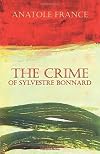
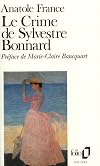
The Crime of Sylvestre Bonnard
by Anatole France
On This Page
Description
In 1881, French novelist Anatole France burst onto the European literary landscape with his first novel, The Crime of Sylvestre Bonnard. Protagonist Bonnard is a refined academic who has long lived at a remove from the tumult and tribulation of the real world. But when a chance encounter plunges him into the midst of a dramatic domestic dispute, he springs into action..
Tags
Recommendations

































Member Recommendations

Member Reviews
I acquired this gorgeous edition of the book having no idea what the story was about or who the author was. I couldn't help but start reading it and instantly fell in love with M. Bonnard and laughed out loud many times as he went on his adventures.
For me, the best part was his interactions and disbelief at seeing a fairy.
Although this story isn't a crime/mystery adventure as the title originally suggested to me, I was thoroughly entertained by this 19th century French literature told in diary form by an academic that just happens to love books more than life until he discovers something worth living for.
For me, the best part was his interactions and disbelief at seeing a fairy.
Although this story isn't a crime/mystery adventure as the title originally suggested to me, I was thoroughly entertained by this 19th century French literature told in diary form by an academic that just happens to love books more than life until he discovers something worth living for.
I enjoyed this a great deal. A reminder of the “genteel” times of the 19th century. While I wouldn't mistake it for life-changing literature, it was certainly a wonderful story, wonderfully told. I was particularly taken with the translation (by Lafcadio Hearn!)
The book is divided into two separate stories. The first is called "The Log" and the second "The Daughter of Clementine". Bonnard is the central character in both books, but it takes a little while to understand the other connections between the stories. Bonnard is an academic bibliophile who lives in an apartment in Paris surrounded by his books. He has never married. His closest companions are his cat Hamilcar and his world wise, but joyless housekeeper Therese.
In "The Log", Bonnard takes pity on a neighbouring young impoverishered couple and child and gives them wood to put on the fire for Christmas. This little act of kindness is repaid years later. The father dies and the widow remarries a rich aristocrat. A book, which Bonnard has show more long coverted, is given to him by Madame Trepof, his former neighbour, as a gratitude.
The next section of the book is entitled "The Daughter of Clementine". We learn more of Bonnard's background. In his youth he had fallen in love with Clementine, the daughter of one of his father's friends. The friendship between the father and friend broke down over a matter of politics, and Bonnard never saw Clementine again. She married a banker and they had a daughter Jeanne. Although once rich, Clementine and her husband die impoverished while Jeanne is still a child. By chance Bonnard meets Jeanne at the estate of the de Gabry's where he is to catalogue the library. Bonnard becomes determined to take an interest in the child and arranges to make regular visits to the school where she boards.
During these visits it becomes apparent that Jeanne is treated more as a servant than a pupil. Eventually Bonnard's vists are stopped after he rebuffs attempts by the Mme Prefere, the head of the school, to marry. He later learns that Jeanne is being treated badly and Bonnard rescues her from the school. However this is a crime because Jeanne is underage according to the laws of the time and he would be liable to be charged with abduction and corruption of a minor. Fortunately for Bonnard, Jeanne's legal guardian has suddenly left France after defrauding his clients, and no charges are laid.
Bonnard becomes her legal guardian and she lives with him in Paris. There she becomes reaquainted with a young man whom Bonnard was mentoring. Their love grows and they become betrothed. To give Jeanne a dowry, Bonnard decides to sell all his books, barring those given to him as souvenirs, including the book given to him by Madame Trepof as a mark of gratitude for his kindness when she was a new mother. However, while the rest of the household is asleep, he adds another rare volume to his already sequestered keepsakes, thus committing another "crime" by reducing the value of the dowry.
The book ends with the death of his young godson but with Jeanne and her husband still much in love and old Bonnard's wishes for God's blessings blessing upon them and their children and their children's children. show less
In "The Log", Bonnard takes pity on a neighbouring young impoverishered couple and child and gives them wood to put on the fire for Christmas. This little act of kindness is repaid years later. The father dies and the widow remarries a rich aristocrat. A book, which Bonnard has show more long coverted, is given to him by Madame Trepof, his former neighbour, as a gratitude.
The next section of the book is entitled "The Daughter of Clementine". We learn more of Bonnard's background. In his youth he had fallen in love with Clementine, the daughter of one of his father's friends. The friendship between the father and friend broke down over a matter of politics, and Bonnard never saw Clementine again. She married a banker and they had a daughter Jeanne. Although once rich, Clementine and her husband die impoverished while Jeanne is still a child. By chance Bonnard meets Jeanne at the estate of the de Gabry's where he is to catalogue the library. Bonnard becomes determined to take an interest in the child and arranges to make regular visits to the school where she boards.
During these visits it becomes apparent that Jeanne is treated more as a servant than a pupil. Eventually Bonnard's vists are stopped after he rebuffs attempts by the Mme Prefere, the head of the school, to marry. He later learns that Jeanne is being treated badly and Bonnard rescues her from the school. However this is a crime because Jeanne is underage according to the laws of the time and he would be liable to be charged with abduction and corruption of a minor. Fortunately for Bonnard, Jeanne's legal guardian has suddenly left France after defrauding his clients, and no charges are laid.
Bonnard becomes her legal guardian and she lives with him in Paris. There she becomes reaquainted with a young man whom Bonnard was mentoring. Their love grows and they become betrothed. To give Jeanne a dowry, Bonnard decides to sell all his books, barring those given to him as souvenirs, including the book given to him by Madame Trepof as a mark of gratitude for his kindness when she was a new mother. However, while the rest of the household is asleep, he adds another rare volume to his already sequestered keepsakes, thus committing another "crime" by reducing the value of the dowry.
The book ends with the death of his young godson but with Jeanne and her husband still much in love and old Bonnard's wishes for God's blessings blessing upon them and their children and their children's children. show less
http://www.gutenberg.org/files/2123/2123-h/2123-h.htm
This is a classic 19th century novel about a professor of archaeology who tries to do a good deed for his poor neighbor by sending her a Yule log for Christmas one year. Magically he receives the Yule log back again later on Christmas. But he finds that a part of the log has been hollowed out and inside is a manusccript entitled The Golden Legend, a rare work that he has been searching for years for unsuccessfully. His neighbor in the attic turns out to have been the Princess Trepof. This initial story is by way of prologue and the actual plot opens with Prof Bonnard cataloguing some ancient manuscripts for Mons. de Gabry at his chateau. In the pursuit of his work, he meets a winsome show more young girl named Jeanne who turns out to be the abandoned daughter of his first and only love. He and the girl become close friends and he eventually 'kidnaps' her, with her approval of course, so he can provide a home for her himself. This is his 'crime' and he would have been prosecuted except that the woman who has been acting as guardian for Jeanne absconds with all the money from the boarding school where she has been staying. Bonnard becomes her legal guardian, and after Jeanne marries, he retires to a cottage in the country to be near her and her children. It is a good, old, simple, sentimental story with a happy ending, which proves that not all French writers are as gloomy as Balzac. show less
This is a classic 19th century novel about a professor of archaeology who tries to do a good deed for his poor neighbor by sending her a Yule log for Christmas one year. Magically he receives the Yule log back again later on Christmas. But he finds that a part of the log has been hollowed out and inside is a manusccript entitled The Golden Legend, a rare work that he has been searching for years for unsuccessfully. His neighbor in the attic turns out to have been the Princess Trepof. This initial story is by way of prologue and the actual plot opens with Prof Bonnard cataloguing some ancient manuscripts for Mons. de Gabry at his chateau. In the pursuit of his work, he meets a winsome show more young girl named Jeanne who turns out to be the abandoned daughter of his first and only love. He and the girl become close friends and he eventually 'kidnaps' her, with her approval of course, so he can provide a home for her himself. This is his 'crime' and he would have been prosecuted except that the woman who has been acting as guardian for Jeanne absconds with all the money from the boarding school where she has been staying. Bonnard becomes her legal guardian, and after Jeanne marries, he retires to a cottage in the country to be near her and her children. It is a good, old, simple, sentimental story with a happy ending, which proves that not all French writers are as gloomy as Balzac. show less
marchbanks press
581/1500
581/1500
http://www.anobii.com/forum_thread?topicId=3157660#new_thread Calendario: sett. 1: I parte sett. 2: II parte, cap. 1. - 2. - 3. sett. 3: III parte, cap. 4 fino a settembre-dicembre (escluso) sett. 4: cap. 4, da settembre-dicembre alla fine. In lettura epub in lingua inglese tratto dal Progetto Gutenberg: http://www.gutenberg.org/ebooks/2123
O crime de Sylvestre Bonnard' não é apenas um romance, mas dois, ligados pelo mesmo personagem, presente em ambos os textos - Sylvestre Bonnard, um acadêmico solitário, simpático, filólogo e pesquisador erudito. Com este livro, Anatole France começou a tornar-se famoso. O romance permaneceu por toda a sua vida - e mesmo depois dela - como sua obra de maior repercussão.
Jul 27, 2010Portuguese (Brazil)
Members
- Recently Added By
Lists

Nobel Price Winners
222 works; 20 members

Trinity College Booklist (1951): Class Nine, Foreign Literatures
161 works; 3 members

French Fiction of the 18th and 19th Centuries in English Translation
169 works; 3 members
Talk Discussions
Past Discussions
Is It Just My Copy? Blurry Illustration in LEC's "The Crime of Sylvestre Bonnard" by Anatole France in George Macy devotees (January 2023)
Author Information

Anatole France was the pen name of Jacques Anatole Francois Thibault, who was born in Paris in 1844. The son of a bookseller, Thibault had a lifelong interest in literature. He worked as a schoolteacher, as a reader and editor for publishing houses, and as an assistant librarian in Paris' Senate Library, in addition to writing fiction, plays, show more poetry, criticism, and autobiographical stories. In his lifetime, Thibault was considered one of France's most beloved authors, and he received the Nobel Prize for literature in 1921. France's first novel was The Famished Cat, published in 1879. France's best-known novels include Monsieur Bergeret in Paris, The Crime of Sylvestre Bonnard, Member of the Institute (for which he received an award from the French Academy in 1881), At the Sign of the Reine Pedauque, Penguin Island, Thais (which became the basis for an opera), The Gods Are Athirst, and The Revolt of the Angels. During the late 1890s Thibault became very involved in political and social issues. He was especially committed to socialism and to the fight against anti-Semitism, mainly as a result of the Dreyfuss affair. This new awareness was reflected in his writing, particularly in books such as Penguin Island, which criticized contemporary French society, and The Revolt of the Angels, which parodied the Catholic Church. He also became the literary advisor to l'Humanitie, an influential socialist newspaper, and frequently contributed articles to it until, dissatisfied with the Communist party that had eventually evolved, he renounced all political ties to the left just before his death in 1924. (Bowker Author Biography) show less
Some Editions
Awards and Honors
Series
Belongs to Publisher Series
Nobelpreisträger Coron-Verlag (weiß) (1921 (Frankreich))
Gallimard, Folio Classique (2267)
The Folio Society ((10) 1948)
Modern Library (22.1)
Reclams Universal-Bibliothek (5279)
Gallimard, Folio (2267)
Work Relationships
Is contained in
Анатол Франс - избрани творби (Престъплението на Силвестр Бонар ; Таис ; Островът на пингвините ; Боговете са жадни) by Анатол Франс
Oeuvres Complètes Illustrées de Anatole France, Tome II: Jocaste suivi de Le chat maigre et de Le crime de Sylvestre Bonnard by Anatole France
Common Knowledge
- Canonical title
- The Crime of Sylvestre Bonnard
- Original title
- Le crime de Sylvestre Bonnard
- Original publication date
- 1881
- Related movies
- Le crime de Sylvestre Bonnard (1929 | IMDb); Chasing Yesterday (1935 | IMDb); The Crime of Sylvester Bonnard (1953 | IMDb | TV episode)
- First words
- I had put on my slippers and my dressing-gown.
- Original language*
- Frans
*Some information comes from Common Knowledge in other languages. Click "Edit" for more information.
Classifications
Statistics
- Members
- 457
- Popularity
- 66,960
- Reviews
- 8
- Rating
- (3.80)
- Languages
- 17 — Albanian, Danish, Dutch, English, Finnish, French, German, Greek, Hebrew, Hungarian, Italian, Japanese, Polish, Portuguese, Romanian, Spanish, Swedish
- Media
- Paper, Audiobook, Ebook
- ISBNs
- 67
- ASINs
- 62