The Demons
by Heimito von Doderer
On This Page
Description
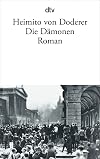
"Die Da?monen" ist einer der bedeutendsten Großstadtromane dieses Jahrhunderts. Gestalten des Wiener Großbu?rgertums und des Adels, Arbeiter und Intellektuelle, aber auch Typen der Halb- und Unterwelt sind zu einem schillernden gesellschaftlichen Gewebe verflochten. Hinter dem eleganten Charme der Fu?nfuhrtees und Tennisturniere werden Unsicherheit, politische Fragwu?rdigkeiten und sexuelle Ausschweifung sichtbar. Die Handlung la?uft von Anfang an auf den Brand des Wiener Justizpalastes am show more 15. Juli 1927 zu, den Doderer als "Cannae der o?sterreichischen Freiheit" begreift: Im Verlauf der Auseinandersetzungen zwischen "Frontka?mpfern" und Republikanischem Schutzbund waren mehrere Arbeiter umgebracht worden. Nach dem Freispruch der Mo?rder durch die Justiz brachen Arbeiterunruhen aus, die von der Polizei blutig niedergeschlagen wurden. Obwohl die Schicksale der Figuren meist nur indirekt mit diesem historischen Ereignis verknu?pft sind, geho?rt es zu Doderers kunstvoller Komposition, daß sich zahlreiche ihrer Lebensprobleme an diesem Tag kla?ren. show lessTags
Recommendations





























Member Reviews
Published in 1956, "The Demons" (original German title: "Die Dämonen") is a notable work by Austrian author Heimito von Doderer. This novel is often regarded as one of the most important Austrian novels of its era, providing a panoramic portrayal of Viennese society during the late 1920s.
The novel follows a plethora of characters whose lives intersect in Vienna, capturing the social and political turmoil of the period. It explores themes of the decline of European civilization, with a backdrop of the fall of the Austrian monarchy and its subsequent effects. The narrative structure is symphonic, drawing comparisons to the works of Dostoyevsky, Proust, and Musil, with a detailed reconstruction of Vienna through architectural drawings and show more historical documents.
Narrated by Georg von Geyrenhoff, a retired civil servant, "The Demons" uses a chronicle-like format to depict events from different social strata of Vienna. The novel's structure includes a nod to Dostoyevsky's "Demons" through its subtitle, focusing on the chronicle of the Section Council Geyrenhoff. Doderer's language is noted for its humor, irony, and satirical elements, creating a rich tapestry of human interactions and societal critique.
The novel reflects on the interwar period in Austria, culminating in the historical event of the burning of the Palace of Justice in 1927. It examines the ideological fractures and the superficial peace of post-World War I Europe, hinting at the despair and decline that would lead to World War II.
I enjoyed its epic scope and detailed character development, reminding me of Dante, Tolstoy, and Balzac. It was a candidate for the Nobel Prize in Literature, showcasing Doderer's status as a significant author in the post-war Austrian literary scene.
Availability: For those interested in reading "The Demons," it has been translated into English by Richard and Clara Winston. It's available in various editions, including a notable two-volume set by Wiseblood Books, which includes additional scholarly material like introductions and lectures by Doderer himself.
This novel not only provides a deep dive into the cultural and social life of Vienna in the 1920s but also stands as a testament to Doderer's literary prowess in capturing the complexity of human experience within the context of historical and ideological shifts. show less
The novel follows a plethora of characters whose lives intersect in Vienna, capturing the social and political turmoil of the period. It explores themes of the decline of European civilization, with a backdrop of the fall of the Austrian monarchy and its subsequent effects. The narrative structure is symphonic, drawing comparisons to the works of Dostoyevsky, Proust, and Musil, with a detailed reconstruction of Vienna through architectural drawings and show more historical documents.
Narrated by Georg von Geyrenhoff, a retired civil servant, "The Demons" uses a chronicle-like format to depict events from different social strata of Vienna. The novel's structure includes a nod to Dostoyevsky's "Demons" through its subtitle, focusing on the chronicle of the Section Council Geyrenhoff. Doderer's language is noted for its humor, irony, and satirical elements, creating a rich tapestry of human interactions and societal critique.
The novel reflects on the interwar period in Austria, culminating in the historical event of the burning of the Palace of Justice in 1927. It examines the ideological fractures and the superficial peace of post-World War I Europe, hinting at the despair and decline that would lead to World War II.
I enjoyed its epic scope and detailed character development, reminding me of Dante, Tolstoy, and Balzac. It was a candidate for the Nobel Prize in Literature, showcasing Doderer's status as a significant author in the post-war Austrian literary scene.
Availability: For those interested in reading "The Demons," it has been translated into English by Richard and Clara Winston. It's available in various editions, including a notable two-volume set by Wiseblood Books, which includes additional scholarly material like introductions and lectures by Doderer himself.
This novel not only provides a deep dive into the cultural and social life of Vienna in the 1920s but also stands as a testament to Doderer's literary prowess in capturing the complexity of human experience within the context of historical and ideological shifts. show less
An enormous novel ostensibly written along the lines of Dostoevsky's own Demons. As with other Doderer novels, a huge canvas filled with multitudes of characters. It's on my list for a reread soon; notes on structure and theme forthcoming.
Ratings
Members
- Recently Added By
Lists

German Literature
518 works; 55 members

Blue Pyramid 1,276 Best Books of All Time
1,248 works; 32 members

Canon de la narrativa universal del s. XX (cicutadry)
499 works; 3 members
Author Information

70+ Works 1,348 Members
Awards and Honors
Distinctions
Series
Belongs to Publisher Series
Work Relationships
Common Knowledge
- Canonical title*
- Die Dämonen
- Original title
- Die Dämonen. Nach der Chronik des Sektionsrates Geyrenhoff
- Original publication date
- 1956
*Some information comes from Common Knowledge in other languages. Click "Edit" for more information.
Classifications
- Genres
- General Fiction, Fiction and Literature
- DDC/MDS
- 833.914 — Literature & rhetoric German & related literatures German fiction 1900- 1900-1990 1945-1990
- LCC
- PT2607 .O3 .D413 — Language and Literature German, Dutch and Scandinavian literatures German literature Individual authors or works 1860/70-1960
Statistics
- Members
- 231
- Popularity
- 141,052
- Reviews
- 2
- Rating
- (4.31)
- Languages
- 6 — English, Finnish, French, German, Polish, Spanish
- Media
- Paper, Ebook
- ISBNs
- 10
- ASINs
- 14