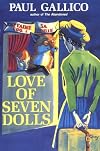
Love of Seven Dolls
by Paul Gallico
On This Page
Tags
Recommendations

























Member Reviews
1955. This is basically a sentimental tale about a Brettonaise girl who goes to Paris to try to make it on the Stage. When she finally ends up as a stripper and gets fired from that for not being sexy enough, she intends to throw herself into the Seine. A mad puppeteer captures her interest with his puppets and invites her to travel with his show as a sort of front person. She talks to the puppets. He is verbally abusive to her and then one night he rapes her. Naturally they fall in love, after some more rough patches and she stays with him and the puppets she has come to love. The puppets are amazing, but there is no logical reason to think the man is going to become less abusive, so it's really kind of sad. I think you were supposed show more to accept his behaviour as within some range of okayness, which I just couldn't. But that's the fifties for you, I guess. show less
I discovered Paul Gallico when I was young, and when I read this, I was enthralled. I remember my Mom being uncomfortable with me reading this book, and it might have been because the main character, who is a young woman, is abused. But I was swept away by the story, with the puppets and how they interacted with people, the depth in which the main character would fall into conversing with them and they became real. Many years later, well into adulthood, I read it again. I was afraid that the abuse would offend me, but surprisingly, it didn't. I was still swept away, but now I understand psychology and play therapy. I had a very different perspective, and I enjoyed it all over again.
I read this many years ago but still remember it. The Wikipedia articles I just read about the movie Lili and Paul Gallico said that the movie is ultimately based on a short story, "The Man Who Hated People," by Gallico, who then wrote this novella "after the film's success." (Different versions of the story differ)
Some quick thoughts: Rape is much less a forgivable sin these days. (Some other stories with less-than-consensual sex are Bernard Malamud's The Assistant and Ayn Rand's The Fountainhead). The puppets represent different aspects of the puppeteer's personality. Like the narrator in Daphne du Maurier's Rebecca---another story with a difficult male lead---, Mouche grows up.
Some quick thoughts: Rape is much less a forgivable sin these days. (Some other stories with less-than-consensual sex are Bernard Malamud's The Assistant and Ayn Rand's The Fountainhead). The puppets represent different aspects of the puppeteer's personality. Like the narrator in Daphne du Maurier's Rebecca---another story with a difficult male lead---, Mouche grows up.
A completely old-fashioned but beautiful story about a french girl who joins a puppet show and makes a succes of it. The 'master' of the puppet is very cruel to her, and rapes her several times. However, she loves her puppets so much, that she doesn't leave them. And in the end they all live happily ever after.
Musical "Carnival" and movie "Lili" were based on this.
maakte veel indruk toen ik dit als 19?-jarige las
Een geweldig goed boek over wanhoop en hoop, mensen en poppenkastpoppen. Soms is het makkelijker om in de goedheid van de poppen dan van de mensen te geloven.
Nov 23, 2008Dutch
Members
- Recently Added By
Lists


Author Information

112+ Works 9,570 Members
Work Relationships
Is contained in
Common Knowledge
Classifications
Statistics
- Members
- 249
- Popularity
- 130,299
- Reviews
- 7
- Rating
- (4.09)
- Languages
- Dutch, English, German, Swedish
- Media
- Paper, Ebook
- ISBNs
- 10
- ASINs
- 16