On This Page
Description
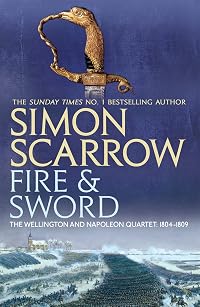
The third in this epic quartet of novels focusing on two giants of European history, Wellington and Napoleon. In the early years of the nineteenth century, Arthur Wellesley (elevated to Viscount Wellington in the course of the novel) and Napoleon Bonaparte are well-established as men of military genius. Wellesley has returned from India, where his skill and bravery made a remarkable impression on his superiors. He faces trials and tribulations on the political scene before becoming embroiled show more militarily in Copenhagen, then Portugal and finally Spain. Napoleon, established as Emperor, is cementing his control on Europe, intending finally to crush his hated foe across the Channel: Britain. The time is fast approaching when Wellington and Napoleon will come face to face in confrontation and only one man can emerge victorious... show lessTags
Recommendations











Member Reviews
Although I didn't find ‘Fire and Sword’ as absorbing as the first book in the quadrilogy, I prefer it to 'The Generals’ and rate all three as top-quality novels.
The book features two third-person specific narratives. It alternates between blocks of chapters focusing on Napoleon Bonaparte and on Arthur Wellesley.
The battles featuring Arthur engaged me more than those featuring Napoleon. This is down to Napoleon not being a participant, only an observer. The problem in such cases is that narrative sometimes reads more like non-fiction history. With Arthur, however, we ‘see’ the fighting up close, which is much more exciting.
In the previous two books, I liked the girl-meets-boy storylines in both narratives, particularly show more Arthur’s, yet in ‘Fire and Sword’, the romance is burning out, most notably in Arthur’s case, which is a shame. I felt sorry for his paramour Kitty.
Only things I can criticise in this compelling story are certain style issues, with ‘telling’, not ‘showing’, being the biggest offence. Things like, ‘He swallowed nervously’ is such an example. This is an oft-repeated phrase the author uses in this novel and several other titles I’ve read by him. If the context is obvious to the reader, ‘swallowed’ is enough to ‘show’ the reader that the character is nervous. No need to use an adverb to ‘tell’. Adverbs should be cut wherever possible or replaced with a strong verb.
The repetition of ‘swallowed nervously’ has taken second place, however, to ‘cleared his/her throat.’ I couldn’t fail to notice during this and the previous books, along with the author’s Roman series, that he overuses this phrase to the extent that it’s predictable when it’s about to crop up. It’s purpose is to locate a character so that you know who’s about speak without the need of dialogue attribution, which I’m in full favour of, but with countless other lead-ins available, it becomes laughable at times, and tedious at others. ‘Napoleon cleared his throat.’ ‘Arthur cleared his throat.’ ‘He cleared his throat.’ It’s probable that the author doesn’t realise he’s doing it. People do have traits that they’re unaware of. The Scarrow books I’ve read so far are fifteen to twenty years old now, however, so I’m hoping someone’s pointed it out to him by now if he hasn’t realised himself.
In most reviews, I deduct a star for style issues or repetition, but not in this case. It’s too good in terms of content. Napoleon and Arthur’s contrasting personalities provide a good change of pace whenever the third-person specific viewpoints swap from one to the other. In this novel, I found Arthur’s chapters the most entertaining.
I look forward to reading the last one in the series. show less
The book features two third-person specific narratives. It alternates between blocks of chapters focusing on Napoleon Bonaparte and on Arthur Wellesley.
The battles featuring Arthur engaged me more than those featuring Napoleon. This is down to Napoleon not being a participant, only an observer. The problem in such cases is that narrative sometimes reads more like non-fiction history. With Arthur, however, we ‘see’ the fighting up close, which is much more exciting.
In the previous two books, I liked the girl-meets-boy storylines in both narratives, particularly show more Arthur’s, yet in ‘Fire and Sword’, the romance is burning out, most notably in Arthur’s case, which is a shame. I felt sorry for his paramour Kitty.
Only things I can criticise in this compelling story are certain style issues, with ‘telling’, not ‘showing’, being the biggest offence. Things like, ‘He swallowed nervously’ is such an example. This is an oft-repeated phrase the author uses in this novel and several other titles I’ve read by him. If the context is obvious to the reader, ‘swallowed’ is enough to ‘show’ the reader that the character is nervous. No need to use an adverb to ‘tell’. Adverbs should be cut wherever possible or replaced with a strong verb.
The repetition of ‘swallowed nervously’ has taken second place, however, to ‘cleared his/her throat.’ I couldn’t fail to notice during this and the previous books, along with the author’s Roman series, that he overuses this phrase to the extent that it’s predictable when it’s about to crop up. It’s purpose is to locate a character so that you know who’s about speak without the need of dialogue attribution, which I’m in full favour of, but with countless other lead-ins available, it becomes laughable at times, and tedious at others. ‘Napoleon cleared his throat.’ ‘Arthur cleared his throat.’ ‘He cleared his throat.’ It’s probable that the author doesn’t realise he’s doing it. People do have traits that they’re unaware of. The Scarrow books I’ve read so far are fifteen to twenty years old now, however, so I’m hoping someone’s pointed it out to him by now if he hasn’t realised himself.
In most reviews, I deduct a star for style issues or repetition, but not in this case. It’s too good in terms of content. Napoleon and Arthur’s contrasting personalities provide a good change of pace whenever the third-person specific viewpoints swap from one to the other. In this novel, I found Arthur’s chapters the most entertaining.
I look forward to reading the last one in the series. show less
I must admit to being horrified when this was chosen as my book club book but not one to be deterred I ploughed on. I do love history but have never really been interested in battles. Although I did find some of the battle scenes a bit too lengthy in the descriptions I found myself becoming more and more interested and feeling quite tense as the book came to an end. I was disappointed that there was no real ending to the story, I know that there are sequels and that in history there is no real ending but although it surpassed my expectations I can't see myself being interested enough to carry on reading more. I found the descriptions of Napolean's character really interesting and now have a true sense of him as a man and not just a name show more in history. I'm sure that Mr Scarrow has done an enormous amount of research but I wonder how much of his personality is written about or is it just imagined? show less
Very good book but quite long and it comes across as a bit of a history lesson. Fascinating period of history and very interesting seeing it from the viewpoints of Napoleon and Wellington. It is not like Sharp novels but it certainly fills some of the gaps.
A finales de 1804, Napoleón y Wellington intentan cada uno de distinta forma de escapar de sus respectivas mujeres (Josefina y Kitty Pakenham respectivamente) y, curiosamente, ambos dirigen su mirada a la península Ibérica: Napoleón con el objetivo de poner a uno de sus hermanos al frente de un país en el que la política y la religión se han convertido en grandes campos de batalla entre aristocracia, clero y pueblo llano; Wellington, con la intención de huir del politiqueo de baja estofa que se ha adueñado de Lóndres y con el deseo de eclipsar la aureola que rodea al héroe del momento, el capitán Nelson.
Jan 24, 2023Spanish
Ratings
Members
- Recently Added By
Lists

Books Read in 2016
4,666 works; 199 members

Kindle Historical Re-Read
69 works; 1 member
Author Information

Series

Common Knowledge
- Canonical title
- Fire and Sword
- Original publication date
- 2009-06-11
- People/Characters
- Napoleon Bonaparte; Arthur Wellesley, 1st Duke of Wellington
- Important events
- Napoleonic Wars (1803 | 1815)
Classifications
Statistics
- Members
- 236
- Popularity
- 138,743
- Reviews
- 4
- Rating
- (3.86)
- Languages
- English, German, Portuguese, Spanish
- Media
- Paper, Audiobook, Ebook
- ISBNs
- 13
- ASINs
- 6