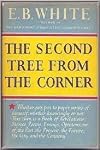
The Second Tree from the Corner
by E. B. White
On This Page
Description
Bestselling author Susan Wiggs literally wrote the book on happily-ever-after love. But orchestrating her daughter Elizabeth's real-world wedding turned into a different story altogether, and one that takes two to tellthe mother and the bride. Here is the all-too-true tale of a mother and daughter collaborating on life's ultimate celebrationa dream wedding. Often poignant, sometimes irreverent and always hilarious, this charming book is also packed with useful advice from both ends of the show more cupcake-tasting table. Join mother and daughter as they wade through the trenches of flowers and favors, grueling gown decisionsand the cold, cruel realities of a budget. With luck, love and loads of patience, they come out on the other side, bloodied but unbowed, replete with life lessonsand closer than ever before. " show lessTags
Recommendations




























Member Reviews
I had no idea that this writer of charming children's books wrote prolifically for adults too. He was a newspaper man and one of the things that stands out in this collection is his discussion of the way in which newspapers have to fill their pages and the consequent lowering of the standards of what is written. Like now, except that newspapers were not a bottomless internet pit. His credentials to be this critic? Well, he was the rewriter of The Elements of Style, which might be the most famous of its genre.
He writes of war, of sport, of the nuclear threat, of robots, of cheating at chess. He writes of many things in ways that speak now. Amazing!
He is humorous like this, from a section called 'Answers to Hard Questions' where he show more harvests questions to newspapers searching for advice and gives his own take.
There it is, that fabulous juxtaposition where he kicks you in the gut, no warning, just kapow. Fantastic. Brilliant line. Brilliant timing. I've read it two dozen times now and it still makes my insides curl up.
This is what you got when you read The New Yorker and The Atlantic Monthly between 1935 and 1955, the time span of the chosen pieces.
Mrs Wienckus
If, like me, you don't know the reference to Rufus Rastus Johnson Brown, pancocojams discusses it here. It's a song about paying rent.
I challenge the reader not to be moved by this, surely every bit as pertinent now as when it was written.
The Dream of the American Male
Fantastic. He's a genius hidden away in the ephemeral nature of the daily (or weekly, or monthly) press.
This book came my way because a stranger died. She left behind a lifetime's reading, a lifetime's observation of the world as reported by the novelist, the poet, the children's writer, the essayist. A history you can see and touch - I simply cannot understand how a USB stick can possibly have the meaning of a room of books. This is one of those I kept and I regard it as a complete treasure, falling apart paperback with cheap yellowing paper. A couple of the pieces in it puzzle me as to their presence. But mostly, oh wow. Sheer bliss.
What about this one?
rest here: https://alittleteaalittlechat.wordpress.com/2016/09/26/the-second-tree-from-the-... show less
He writes of war, of sport, of the nuclear threat, of robots, of cheating at chess. He writes of many things in ways that speak now. Amazing!
He is humorous like this, from a section called 'Answers to Hard Questions' where he show more harvests questions to newspapers searching for advice and gives his own take.
L.D. writes: Is there any likelihood that the temporary physical condition a man is in would have an effect on his offspring? In other words, should a man hesitate about becoming a father during the time he is suffering from hay fever? - Health column in the Chicago Tribune.
This is a question many a man has had to face, alone with his God. Sensitivity to pollen, the male element of flowers, is at once an exalted and a pitiable condition and inevitably suggests to a prospective progenitor the disquieting potentialities inherent in all propagation. Like father like son is the familiar saying: big sneeze, little sneeze. There is little doubt that allergy to hay, so deep-seated, so shattering, is inheritable; and it is just as certain that a sensitive man, during the season of his great distress, is as eager for life and love as in the periods when his mucosae are relaxed. We cannot conscientiously advise any man to abstain from fatherhood on a seasonal, or foliage, basis. The time not to become a father is eighteen years before a world war.
There it is, that fabulous juxtaposition where he kicks you in the gut, no warning, just kapow. Fantastic. Brilliant line. Brilliant timing. I've read it two dozen times now and it still makes my insides curl up.
This is what you got when you read The New Yorker and The Atlantic Monthly between 1935 and 1955, the time span of the chosen pieces.
Mrs Wienckus
The Newark police arrested a very interesting woman the other day - a Mrs Sophie Wienckus - and she is now on probation after being arraigned as disorderly. Mrs Wienckus interests us because her 'disorderliness' was simply her capacity to live a far more self-contained life that most of us can manage. The police complained that she was asleep in two empty cartons in a hallway. This was her preferred method of bedding down. All the clothes she possessed she had on - several layers of coats and sweaters. On her person were bankbooks showing that she was ahead of the game to the amount of $19,799.09. She was a working woman - a domestic - and, on the evidence, a thrifty one. Her fault, the Court held, was that she lacked a habitation.
'Why didn't you rent a room?' asked the magistrate. But he should have added parenthetically '(and the coat hangers in the closet and the cord that pulls the light and the dish that holds the soap and the mirror that conceals the cabinet where lives the aspirin that kills the pain).' Why didn't you rent a room '(with the rug that collects the dirt and the vacuum that sucks the dirt and the man that fixes the vacuum and the fringe that adorns the shade that dims the lamp and the desk that holds the bill for the installment on the television set that tells of the wars)?' We feel that the magistrate oversimplified his question.
Mrs Wienckus may be disorderly, but one pauses to wonder where the essential disorder really lies. All of us are instructed to seek hallways these days (except school children, who crawl under desks), [The US expectation of nuclear attack against them colours much of White's writing in this sort of way] and it was in a hallway that they found Mrs Wienckus, all compact. We read recently that the only hope of avoiding inflation is through ever increasing production of goods. This to us always a terrifying conception of the social order - a theory of the good life through accumulation of objects. We lean toward the order of Mrs Wienckus, who has eliminated everything except what she can conveniently carry, whose financial position is solid, and who can smile at Rufus Rastus Johnson Brown. We salute a woman whose affairs are in such excellent order in a world untidy beyond all believe.
If, like me, you don't know the reference to Rufus Rastus Johnson Brown, pancocojams discusses it here. It's a song about paying rent.
I challenge the reader not to be moved by this, surely every bit as pertinent now as when it was written.
The Dream of the American Male
Dorothy Lamour is the girl above all others desired by the men in Army camps. This fact was turned up by Life in a routine study of the unlimited national emergency. It is a fact which illuminates the war, the national dream, and our common unfulfillment. If you know what a soldier wants, you know what Man wants, for a soldier is young, sexually vigorous, and is caught in a line of work which leads towards a distant and tragic conclusion. He personifies Man. His dream of a woman can be said to be Everyman's dream of a woman. In desiring Lamour, obviously his longing is for a female creature encountered under primitive conditions and in a setting of great natural beauty and mystery. He does not want this woman to make any sudden or nervous movement. She should be in a glade, a swale, a grove, or a pool below a waterfall. This is the setting in which every American youth first encountered Miss Lamour. They were in a forest; she had walked slowly out of the pool and stood dripping in the ferns.
The dream of the American male is for a female who has an essential languor which is not laziness, who is unaccompanied except by himself, and who does not let him down. He desires a beautiful, but comprehensible, creature who does not destroy a perfect situation by forming a complete sentence. She is compounded of moonlight and shadows, and has a slightly husky voice, which she uses only in song or in an attempt to pick up a word or two that he teachers her. Her body, if concealed at all, is concealed by a water lily, a frond, a fern, a bit of moss, or by a sarong - which is a simple garment carrying the implicit promise that it will not long stay in place. For millions of years men everywhere have longed for Dorothy Lamour. Now in the final complexity of an age which has reached its highest expression in the instrument panel of a long-range bomber, it is a good idea to remember that Man's most persistent dream is of a forest pool and a girl coming out of it unashamed, walking toward him with a wary motion, childlike in her wonder, a girl exquisitely untroubled, as quiet and accommodating and beautiful as a young green tree. That's all he really wants. He sometimes wonders how this other stuff got in - the instrument panel, the night sky, the full load, the moment of exultation over the blackened city below....
Fantastic. He's a genius hidden away in the ephemeral nature of the daily (or weekly, or monthly) press.
This book came my way because a stranger died. She left behind a lifetime's reading, a lifetime's observation of the world as reported by the novelist, the poet, the children's writer, the essayist. A history you can see and touch - I simply cannot understand how a USB stick can possibly have the meaning of a room of books. This is one of those I kept and I regard it as a complete treasure, falling apart paperback with cheap yellowing paper. A couple of the pieces in it puzzle me as to their presence. But mostly, oh wow. Sheer bliss.
What about this one?
rest here: https://alittleteaalittlechat.wordpress.com/2016/09/26/the-second-tree-from-the-... show less
This is a collection of essays and poems, most of which appeared in The New Yorker between the 1930s and the 1950s. Most of them address somewhat serious issues with a subtle sense of humor.
One of my favorite pieces was about a reading ease calculator that the manufacturer sent to White. It would calculate how easy or hard to read your writing was based on the total number of words and syllables. The manual suggested that the majority of contemporary readers needed the difficulty level to be either easy or very easy. When White used the calculator to find the difficulty level of the manual, it was ranked as very hard. I wonder why that product didn’t catch on.
White’s outlook on the world is unique, entertaining, and thoughtful. show more After reading him, I end up looking at the common things in a totally different way. This is a book that needs to be read slowly and a little at a time in order to fully enjoy and process everything it contains. I would recommend any of White’s collections of essays to anyone who hasn’t read them. show less
One of my favorite pieces was about a reading ease calculator that the manufacturer sent to White. It would calculate how easy or hard to read your writing was based on the total number of words and syllables. The manual suggested that the majority of contemporary readers needed the difficulty level to be either easy or very easy. When White used the calculator to find the difficulty level of the manual, it was ranked as very hard. I wonder why that product didn’t catch on.
White’s outlook on the world is unique, entertaining, and thoughtful. show more After reading him, I end up looking at the common things in a totally different way. This is a book that needs to be read slowly and a little at a time in order to fully enjoy and process everything it contains. I would recommend any of White’s collections of essays to anyone who hasn’t read them. show less
Humor doesn't travel through time well. What I read I found more interesting for the insights into everyday life of the 30s and 40s than for the cleverness of the story.
Prophetic, funny, and sad at times. Made me feel nostalgia for a time before I was born.
White knows how to tell the heart of a story. I need to read more of his collections of columns, and more of what he wrote.
A collection of essays and short stories, of which the best known is the title story: The Second Tree from the Corner. White was a writer of grace and humor; I particularly enjoy the essays in this volume about New York City.
Ratings
Members
- Recently Added By
Lists

Must-Read Maine
146 works; 91 members

Newbery Adjacent
747 works; 3 members
Author Information

81+ Works 111,795 Members
Born in Mount Vernon, New York, E. B. White was educated at Cornell University and served as a private in World War I. After several years as a journalist, he joined the staff of the New Yorker, then in its infancy. For 11 years he wrote most of the "Talk of the Town" columns, and it was White and James Thurber who can be credited with setting the show more style and attitude of the magazine. In 1938 he retired to a saltwater farm in Maine, where he wrote essays regularly for Harper's Magazine under the title "One Man's Meat." Like Thoreau, White preferred the woods; he also resembled Thoreau in his impatience and indignation. White received several prizes: in 1960, the gold medal of the American Academy of Arts and Letters; in 1963, the Presidential Medal of Freedom, the nation's highest civilian award (he was honored along with Thornton Wilder and Edmund Wilson); and in 1978, a special Pulitzer Prize. His verse is original and witty but with serious undertones. His friend James Thurber described him as "a poet who loves to live half-hidden from the eye." Three of his books have become children's classics: Stuart Little (1945), about a mouse born into a human family, Charlotte's Web (1952), about a spider who befriends a lonely pig, and The Trumpet of the Swan (1970). Among his best-known and most widely used books is The Elements of Style (1959), a guide to grammar and rhetoric based on a text written by one of his professors at Cornell, William Strunk, which White revised and expanded. White was married to Katherine Angell, the first fiction editor of the New Yorker. (Bowker Author Biography) Elwyn Brooks White was born on July 11, 1899, in Mt. Vernon, New York. After graduating from Cornell University, he worked briefly for an advertising agency and as a newspaper reporter before joining the staff of The New Yorker magazine in 1927. As a columnist for The New Yorker and a contributor to Harper's Magazine, White established a reputation as a prose stylist of exceptional elegance, clarity and wit. His interests, as reflected in his writing, were numerous and varied; his essays touched on such wide-ranging subjects as politics, farm animals, and life in New York City. White married Katharine S. Angell in 1929. They had one son, and in 1957 the family left New York for a farm in North Brookline, Maine. Writings from The New Yorker, 1927-1976 is a compilation of columns and essays produced during White's long relationship with the magazine. One Man's Meat, published in 1942, is a collection of his writings for Harper's. White adapted a short guide to English grammar and usage, The Elements of Style, from a college text written by one of his professors at Cornell, William Strunk Jr. It has sold millions of copies since it was first published in 1959 and has become a cherished resource for guidance in writing. White also co-authored Is Sex Necessary? with the humorist James Thurber, a fellow staff member at The New Yorker. E.B. White died on October 1, 1985 after succumbing to Alzheimer's. His diverse legacy also includes three children's books: Stuart Little, Charlotte's Web, and The Trumpet of the Swan. In 1970 the American Library Association presented White the Laura Ingalls Wilder Award in recognition of his "substantial and lasting contribution to literature for children." He was also awarded the Presidential Medal of Freedom in 1963 and received a special Pulitzer Prize citation for his body of work in 1970. (Bowker Author Biography) show less
Awards and Honors
Awards
Distinctions
Notable Lists
Work Relationships
Is contained in
Common Knowledge
- Original publication date
- 1954
- First words
- One of the advantages of surgery, to a man at loose ends in Boston, is that it entitles him to a night at a hospital in advance of the operation.
- Last words
- (Click to show. Warning: May contain spoilers.)The grave in the woods is unmarked, but Fred can direct the mourner to it unerringly and with immense good will, and I know he and I shall often revisit it, singly and together, in seasons of reflection and despair, on flagless memorial days of our own choosing.
Classifications
Statistics
- Members
- 489
- Popularity
- 62,021
- Reviews
- 6
- Rating
- (4.05)
- Languages
- English
- Media
- Paper, Ebook
- ISBNs
- 4
- ASINs
- 13