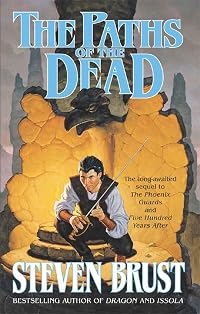
The Paths of the Dead
by Steven Brust
Viscount of Adrilankha (1), Dragaera: Khaavren Romances (3a), Dragaera
On This Page
Description
The long-awaited sequel to The Phoenix Guards and Five Hundred Years AfterTwo hundred years after Adron's Disaster, in which Dragaera City was accidentally reduced to an ocean of chaos by an experiment in wizardry gone wrong, the Empire isn't what it used to be. Deprived at a single blow of their Emperor, of the Orb that is the focus of the Empire's power, of their capital city with its Impe-rial bureaucracy, and of a great many of their late fellow citizens, the surviving Dragaerans have show more been limping through a long Interregnum, bereft even of the simple magic and sorcery they were accustomed to use in everyday life.
Now the descendants and successors of the great ad-venturers Khaavren, Pel, Aerich, and Tazendra are growing up in this seemingly diminished world, con-vinced, like their elders, that the age of adventures is over and nothing interesting will ever happen to them. They are, of course, wrong . . . .
For even deprived of magic, Dragaerans fight, plot, and conspire as they breathe, and so do their still-powerful gods. The enemies of the Empire prowl at its edges, in-scrutable doings are up at Dzur Mountain...and, unex-pectedly, a surviving Phoenix Heir, young Zerika, is discovered—setting off a chain of swashbuckling events that will remake the world yet again.
The Khaavren Romances, set in the world of Vlad Taltos's Dragaera:
1. The Phoenix Guards
2. Five Hundred Years After
3. The Paths of the Dead (The Viscount of Adrilankha, Vol. 1)
4. The Lord of Castle Black (The Viscount of Adrilankha, Vol. 2)
5. Sethra Lavode (The Viscount of Adrilankha, Vol. 3)
The Baron of Magister Valley [standalone]
At the Publisher's request, this title is being sold without Digital Rights Management Software (DRM) applied.
. show less
Tags
Recommendations











Member Reviews
The children of the heroes of Phoenix Guards set out to have adventures, and along the way discover new kinds of sorcery, all sorts of plots, and end up helping put the new Empress on the throne. At the same time, a 'young' Morrolan starts his career as a warlock.
Typical Brust, with a lot of sarcasm (did I say a lot?) and long running jokes and what passes for wit when you're on the road adventuring. Good stuff, if you like that sort of thing. Not excessively violent or face paced. Very dry at times, but that's part of the beauty of it.
Typical Brust, with a lot of sarcasm (did I say a lot?) and long running jokes and what passes for wit when you're on the road adventuring. Good stuff, if you like that sort of thing. Not excessively violent or face paced. Very dry at times, but that's part of the beauty of it.
I picked this one up somewhat on a lark based on the blurb, and found it wasn’t quite as expected. The book was written with classic sounding language, which might come as a bit of a shock if you’re used to more straightforward contemporary prose. Basically, the *prose* is the point of the story, rather than characters and plot. If you can get into the way it’s written, it’s fun to read, and the round-about way dialog and description are handled add to the enjoyment. But if you’re there for the plot and characters, you may be frustrated.
What do I mean by round-about? A typical contemporary fantasy novel might have the following exchange:
A rider approached the gate, “I bring news.”
The guard responded, “What show more news?”
“Bandits gather at the north bridge!”
In this book that exchange would be more like:
A rider approached the gate, “I bring news.”
The guard responded, “Indeed you do?”
“It is as I said, for I am forthright in such things.”
“That is an admirable trait indeed.”
“Thank you for your assessment, my good sir.”
“And do you intend to tell us this news?”
“You have, in fact, ascertained the purpose of my visit.”
“Excellent, than I shall await the telling with much anticipation.”
“And I appreciate your anticipation, for as a courier, such things bring great satisfaction to me.”
“Splendid, now what is this news?”
“Bandits gather at the north bridge!”
This isn’t an exaggeration. If anything, it’s an understatement. So if you’re itching to hear what the news is, you might be frustrated. But if you’re able to delight in the prose, then the more roundabout things are, the better. show less
What do I mean by round-about? A typical contemporary fantasy novel might have the following exchange:
A rider approached the gate, “I bring news.”
The guard responded, “What show more news?”
“Bandits gather at the north bridge!”
In this book that exchange would be more like:
A rider approached the gate, “I bring news.”
The guard responded, “Indeed you do?”
“It is as I said, for I am forthright in such things.”
“That is an admirable trait indeed.”
“Thank you for your assessment, my good sir.”
“And do you intend to tell us this news?”
“You have, in fact, ascertained the purpose of my visit.”
“Excellent, than I shall await the telling with much anticipation.”
“And I appreciate your anticipation, for as a courier, such things bring great satisfaction to me.”
“Splendid, now what is this news?”
“Bandits gather at the north bridge!”
This isn’t an exaggeration. If anything, it’s an understatement. So if you’re itching to hear what the news is, you might be frustrated. But if you’re able to delight in the prose, then the more roundabout things are, the better. show less
Written as pseudo-history, this is an interesting story of the next generation in Brust's complicated and involved world. With people trying to find their place in this world and several people vying for power and the position of emperor the next generation are poised to be heroes.
I liked this story, I'm only sorry that I haven't kept up reading in this series but this re-established my interest.
I liked this story, I'm only sorry that I haven't kept up reading in this series but this re-established my interest.
This is one of those where the style can throw you - Written as a pastiche to Alexander Dumas, this book follows Young Piro, on his way to help Zivra regain her birthright and regain the orb, bringing back sorcery to Dragaera. There is a emperor remaking the empire by force, old foes upset about past doings, and Sethra, who is scheming in her mountain. As for books in this series, I found the book to be more generic, outside of the language. Its pushes along the narrative, but for the most part, its unremarkable.
It's all about the writing style. I mean, how can I resist a book that contains such exchanges as: "Well, there is a question I would wish to ask you, if it is no trouble. Do you know a place where a traveler such as myself might secure lodgings in this charming village?"
"How, lodgings?"
"Yes,. That is, a place where I might spend the night, enjoying more or less of comfort."
"Ah, yes, I see. Well, I must consider this question."
"Yes, I understand that. You, then, consider the question, and I will wait while you do so."
"And you are right to wait," said Erik promptly, "for I have even now begun considering."
"And I," said the young warlock, "have begun waiting."
!! The whole book is like this. Just wonderful.
I've got to add Steven Brust's show more First Theory here: "All literature consists of whatever the writer thinks is cool. The reader will like the book to the degree that he agrees with the writer about what's cool." And I agree very much with what Steven Brust thinks is cool in this book. show less
"How, lodgings?"
"Yes,. That is, a place where I might spend the night, enjoying more or less of comfort."
"Ah, yes, I see. Well, I must consider this question."
"Yes, I understand that. You, then, consider the question, and I will wait while you do so."
"And you are right to wait," said Erik promptly, "for I have even now begun considering."
"And I," said the young warlock, "have begun waiting."
!! The whole book is like this. Just wonderful.
I've got to add Steven Brust's show more First Theory here: "All literature consists of whatever the writer thinks is cool. The reader will like the book to the degree that he agrees with the writer about what's cool." And I agree very much with what Steven Brust thinks is cool in this book. show less
(Amy) Beginning some two centuries after the end of the Phoenix Guards books, this trilogy-opener tells of the beginning of the end of the Interregnum, details the adventures of our beloved heroes from earlier books as well as their children, and introduces us to new characters (some of whom are only new in internal chronology, having been integral in works set considerably later in the timeline). Aside from a tendency to require one to fight valiantly against the temptation to write like Paarfi while one is reading it, there really are no drawbacks whatsoever to this book or the others surrounding it.
(Alistair) I always have trouble booklogging Brust, for some reason.
Anyway. To proceed; I had, of course, tremendously high expectations show more for this book in terms of writing, given my delight in the Khaavren Romances; and to learn more about the backgrounds, now we have moved some 250 years down the timeline into the Interregnum, of some of the characters we are familiar with from the Vlad Taltos series; and, also of course, as a worldbuilding geek, to learn more about the fascinating historical period that was the Interregnum and the restoration of the Empire.
I am delighted to report that The Paths of the Dead proved most satisfactory on all three counts, in addition to being a deliciously devourable book in its own right.
(And for those familiar with our esteemed narrator, Paarfi of Roundwood, both the preface and the "How to Write like Paarfi of Roundwood" section appended are absolute treasures.)
I am, however, very glad that I am reading it considerably after publication, inasmuch as while still delayed in reading them by dedication to my reading list and my accelerated pre-Gathering Storm Jordan catch-up, having both the remaining volumes of The Viscount of Adrilankha, namely The Lord of Castle Black and Sethra Lavode on my bookshelves already does wonders to stop me from gnawing my own liver out in sheer frustration. Trilogies with dangling plot threads are like that.
Recommended, but have all three on hand before you start.
( http://weblog.siliconcerebrate.com/cerebrate/2009/09/the_paths_of_the_dead_steve... ) show less
(Alistair) I always have trouble booklogging Brust, for some reason.
Anyway. To proceed; I had, of course, tremendously high expectations show more for this book in terms of writing, given my delight in the Khaavren Romances; and to learn more about the backgrounds, now we have moved some 250 years down the timeline into the Interregnum, of some of the characters we are familiar with from the Vlad Taltos series; and, also of course, as a worldbuilding geek, to learn more about the fascinating historical period that was the Interregnum and the restoration of the Empire.
I am delighted to report that The Paths of the Dead proved most satisfactory on all three counts, in addition to being a deliciously devourable book in its own right.
(And for those familiar with our esteemed narrator, Paarfi of Roundwood, both the preface and the "How to Write like Paarfi of Roundwood" section appended are absolute treasures.)
I am, however, very glad that I am reading it considerably after publication, inasmuch as while still delayed in reading them by dedication to my reading list and my accelerated pre-Gathering Storm Jordan catch-up, having both the remaining volumes of The Viscount of Adrilankha, namely The Lord of Castle Black and Sethra Lavode on my bookshelves already does wonders to stop me from gnawing my own liver out in sheer frustration. Trilogies with dangling plot threads are like that.
Recommended, but have all three on hand before you start.
( http://weblog.siliconcerebrate.com/cerebrate/2009/09/the_paths_of_the_dead_steve... ) show less
Maybe I'm just getting tired of the writing style, but I had a lot more trouble paying attention to this one and caring enough to keep the characters straight (there are a lot in this one and not really enough time to get to know any of them). Maybe it will get better with the next two, I gather these three are really just one book broken into 3 for publication.
Members
- Recently Added By
Lists

What Makes This Book So Great
102 works; 16 members
Author Information

72+ Works 35,621 Members
Steven Karl Zoltan Brust is a writer and musician. He was born on November 23, 1955. Brust has worked as a systems programmer for a computer company and played guitar, drums, and banjo in such bands as Cats Laughing, Morrigan, and Boiled in Lead. Brust writes science fiction, including the Vlad Taltos series, The Pheonix Guards, 500 Years After, show more and Brokedown Palace. He has written "choose-your-own-adventure" books for Tor and published several short stories in a series. Brust also released a solo album, A Rose for Iconoclastes, on the SteelDragon label. (Bowker Author Biography) show less
All Editions
Some Editions
Series


Common Knowledge
- Canonical title
- The Paths of the Dead
- Original title
- The Paths of the Dead
- Original publication date
- 2002
- Dedication
- For Betsy
- First words
- It was on a Homeday in the early summer of the 156th year of the Interregnum that a traveler entered a small village in the East.
- Last words
- (Click to show. Warning: May contain spoilers.)In this way, then, it happened that by early evening of the sixth day they had passed the Collier Hills, and, riding down in the twilight, Khaavren at last was able to see, with a pleasure that can hardly be described, the lights of Brachington's Moor twinkling in the deepening gloom ahead.
- Publisher's editor
- Nielsen Hayden, Teresa
Classifications
Statistics
- Members
- 1,185
- Popularity
- 21,130
- Reviews
- 14
- Rating
- (3.74)
- Languages
- English
- Media
- Paper, Audiobook, Ebook
- ISBNs
- 6
- UPCs
- 1
- ASINs
- 5