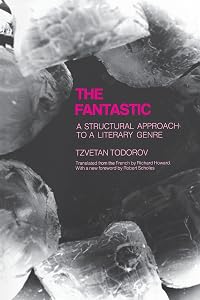
The Fantastic: A Structural Approach to a Literary Genre
by Tzvetan Todorov
On This Page
Description
In The Fantastic, Tzvetan Todorov seeks to examine both generic theory and a particular genre, moving back and forth between a poetics of the fantastic itself and a metapoetics or theory of theorizing, even as he suggest that one must, as a critic, move back and forth between theory and history, between idea and fact. His work on the fantastic is indeed about a historical phenomenon that we recognize, about specific works that we may read, but it is also about the use and abuse of generic show more theory. As an essay in fictional poetics, The Fantastic is consciously structuralist in its approach to the generic subject. Todorov seeks linguistic bases for the structural features he notes in a variety of fantastic texts, including Potocki's The Sargasso Manuscript, Nerval's Aurélia, Balzac's The Magic Skin, the Arabian Nights, Cazotte's Le Diable Amoureux, Kafka's The Metamorphosis, and tales by E. T. A. Hoffman, Charles Perrault, Guy de Maupassant, Nicolai Gogol, and Edgar A. Poe. show lessTags
Recommendations
















Member Reviews
I drew up some thoughts re: one of this book's assertions on the nonrelationship between poetry and fantasy: https://zwieblein.bearblog.dev/in-defense-of-poetic-fantasy/
Do Manuscrito de Saragoça de Potocki a Kafka, das Mil e uma Noites a Poe ou Nerval, a literatura fantástica nos oferece as atrações insólitas de um gênero específico cuja particularidade, no entanto, não foi ainda definida. Mas no atual estado da poética, o exame dessa questão tornou-se tão inevitável quanto o da questão do agrupamento sistemático de diferentes propriedades do discurso, ou seja, precisamente, a de gênero. Procurando os elementos que o definem no caso do fantástico, Tzvetan Todorov mostra que sua determinação deve passar pelo leitor implícito do texto: trata-se apenas da hesitação preservada (desse leitor) entre uma explicação natural (o estranho) e uma explicação sobrenatural (o maravilhoso).Por show more outro lado, não é possível conceituar a literatura fantástica sem efetua rum estudo dos temas cuja rede a constitui. O fantástico, nos termos em que a poética analisa sua organização (que nada tem a ver com a interpretação), é elaborado a partir de uma ou outra de suas séries: relação com o mundo, percepção, olhar, relação com o outro, inconsciente, linguagem. Fazendo-o, Introdução à Literatura Fantástica se constitui em obra de referência, e não apenas por seu objeto, pois, pela primeira vez, os estudos literários logram, por seu intermédio, delimitar um gênero a partir de um tipo de escritura muitas vezes estigmatizado como "menor". Esse feito é o de um estudioso cuja contribuição marca o debate teórico da contemporaneidade. Mais ainda, Tzvetan Todorov leva à frente, na crítica do fenômeno literário, a tradição de um humanismo vanguardista e ilustrado, que abarca desde os formalistas russos e a abordagem estrutural da narratividade até o conceito de alteridade, sempre com o mesmo rigor de pesquisador e originalidade de perspectiva. show less
Mar 3, 2025Portuguese (Brazil)
Situando a la literatura fantástica como el punto de vacilación del lector -identificado con el personaje de la lectura- ante un acontecimiento extraño, punto de vacilación que será finalmente resuelto mediante un retorno a la realidad cotidiana o atribuyendo el fenómeno a la imaginación o a la ilusión, Tzvetan Todorov, apoyándose en una deslumbrante erudición y aplicando una brillantísima metodología, no sólo logra elaborar un trabajo clásico sobre la literatura fantástica sino que también elabora un marco general en el que podrían incluirse tipos similares de estudios concretos sobre aspectos de los géneros literarios.
Jun 24, 2025Spanish
Ratings
Members
- Recently Added By
Lists

Literary Theory and Criticism: What Happens and Why
37 works; 5 members
Author Information

106+ Works 4,187 Members
Tzvetan Todorov was born in Sofia, Bulgaria on March 1, 1939. He did his undergraduate studies at the University of Sofia and then moved to France to pursue postgraduate work. He completed his doctorate at the School for Advanced Studies in the Social Sciences in 1966 and he began teaching at the National Center for Scientific Research in 1968. In show more 1983, he helped found the Center for Arts and Language Research, involving scholars from both institutions. He was a literary theorist and historian. He wrote numerous books including The Fantastic: A Structural Approach to a Literary Genre, The Conquest of America: The Question of the Other, On Human Diversity, Facing the Extreme: Moral Life in the Concentration Camps, A French Tragedy: Scenes of Civil War Summer 1944, The New World Disorder: Reflections of a European, and Fear of the Barbarians: Beyond the Clash of Civilizations. He died of multiple system atrophy, a progressive brain disorder, on February 7, 2017 at the age of 77. (Bowker Author Biography) show less
Some Editions
Series
Belongs to Publisher Series
Points (73)
Argomenti [Garzanti] (29)
Work Relationships
Has as a reference guide/companion
Common Knowledge
- Canonical title
- The Fantastic: A Structural Approach to a Literary Genre
- Original title
- Introduction à la littérature fantastique
- Original publication date
- 1970
Classifications
- Genres
- Literature Studies and Criticism, Nonfiction
- DDC/MDS
- 809.915 — Literature & rhetoric Literature, rhetoric & criticism History, description, critical appraisal of more than two literatures Literature displaying specific features, miscellaneous writings Literature displaying specific qualities of style, mood, viewpoint Symbolism, allegory, fantasy, myth
- LCC
- PN3435 .T613 — Language and Literature Literature (General) Literature (General) Prose. Prose fiction Special kinds of fiction. Fiction genres
- BISAC
Statistics
- Members
- 507
- Popularity
- 59,438
- Reviews
- 3
- Rating
- (3.56)
- Languages
- 10 — Czech, Danish, English, French, German, Italian, Portuguese, Serbian, Spanish, Turkish
- Media
- Paper, Ebook
- ISBNs
- 27
- ASINs
- 7