
Robert Scholes
Author of The Nature of Narrative
About the Author
Robert Scholes is Research Professor of Modern Culture and Media at Brown University. He is the author of many books of literary theory. (Bowker Author Biography)
Image credit: Brown University
Works by Robert Scholes
Bridges to Fantasy: Essays from the Eaton Conference on Science Fiction and Fantasy Literature (Alternatives) (1982) — Editor — 9 copies
The Workshop of Daedalus: James Joyce and the Raw Materials for A Portrait of the Artist as a Young Man (1965) 6 copies
Learners and discerners, a newer criticism. Discussions of modern literature (1964) 1 copy, 1 review
A natureza da narrativa 1 copy
Associated Works
Literature: An Introduction to Fiction, Poetry, and Drama (1995) — Contributor, some editions — 1,011 copies, 7 reviews
The Fantastic: A Structural Approach to a Literary Genre (1970) — Introduction, some editions — 506 copies, 3 reviews
Studies in Bibliography (Vol. 17) — Contributor — 2 copies
Studies in Bibliography (Vol. 15) — Contributor — 2 copies
Tagged
Common Knowledge
- Other names
- Scholes, Robert Edward
- Birthdate
- 1929-05-19
- Gender
- male
- Education
- Cornell University (PhD|1959)
Yale University - Occupations
- literary critic
professor - Organizations
- Brown University
- Nationality
- USA
- Birthplace
- Brooklyn, New York, USA
- Associated Place (for map)
- New York, USA
Members
Reviews
Education reform doesn’t really happen. It’s talked about again and again: plans, promises, proposals. But “talk, talk, talk” seldom gets beyond itself. Ideas – no matter how beneficial or valuable they seem – rarely get implemented in actual practice. Chairs are rearranged in the classroom; rooms are rearranged in pods; new names are given to the same old things: lectures become Power Point presentations, exams become criterion-referenced assessments.
However, Departments of show more English in colleges and universities have not changed all that much in the last hundred years or so: they still give preferences to literature over language study or rhetoric; they still define the canon of “literary” texts, ignoring most informative and discursive prose. The New Critics did achieve a genuine change of emphasis, from philological analysis of “sources and analogues” to close textual analysis (explication de texte). However, this happened back in the 1940’s and 1950’s, and, in spite of the incursions of deconstructionism and post-modernism, has not been surpassed as yet.
At the high-school level, change has been even less apparent. The English of today is not all that different from the English I studied in the early 1950’s, which was not all that different from the English instituted by the Committee of Ten in 1894. Oh, of course the canon has been expanding (more women writers, more African Americans, more contemporary works, sometimes even “popular” and “young adult” novels); furthermore, the New Criticism has become the basic approach to texts in high schools as well, but literature still dominates. Composition doesn’t go far beyond topic sentences, three-level outlines, and the old favorite “five-paragraph essay.” The study of grammar is pretty much limited to traditional (Latinate) grammar. Other approaches to language study as well as improvement of oral language and public speaking have been relegated to speech departments, hardly ever required of all students, if offered at all.
Then, if you step down to the middle schools or junior-high schools, you are still likely to get “grammar, grammar, grammar” and “readers” that hang somewhere between the familiar basal readers of elementary schools and the hefty literature anthologies of high schools.
For the past two decades, Robert Scholes of Brown University has been an ardent advocate of sweeping changes in the English curriculum, particularly at the college level. Especially with his seminal books, Textual Power and The Rise and Fall of English, he has envisioned a complete revamping of English studies. His department at Brown, for example, is called the Department of Modern Media and Culture. A college text which he edited with Nancy Conley and Greg Ulmer, called simply Text Book, exemplifies the emphasis on “textuality” (or intertextuality) that Scholes promotes. His thinking has had a wide influence on the thinking of his colleagues across the nation, but in actual practice, his curricular reform has been implemented sporadically and timidly.
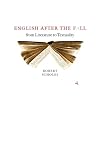
Literature After the Fall: From Literature to Textuality (University of Iowa Press, 2011) is a sequel, of sorts, to The Rise and Fall of English. Chapters 2 and 3, in fact, are basically restatements of ideas from his earlier work – with new examples and illustrations, but otherwise the same. The heart of this book is an exploration of specific, personal, even idiosyncratic, approaches: sacred reading (religious scripture and political documents like the Declaration of Independence) and profane reading (especially film, with particular attention to films that have been adapted from literary texts and/or rewritten as literary texts). In an appendix, he briefly outlines a sample program in textuality for colleges and universities: two required basic courses (writing about reading, and sacred reading) and three intermediate courses (ancient culture, comparative textuality, and understanding modernism. Though I would have welcomed a more detailed consideration of these five courses, I must admit that I cannot see them being adopted (or adapted) at the major Midwestern and Southern universities with which I have been associated.
I find the course on comparative textuality especially intriguing. It uses what I have called “classics and their cousins”; that is, literary classics and their transformations into other languages, other media, other genres, and various levels of adaptations, from modern retellings to outright parodies. An example is Shakespeare’s Othello and Verdi’s opera Otello, or Christopher Isherwood’s stories from Berlin in the 1930’s, which were adapted by John Van Druten into the stage play I Am a Camera, which then gave rise to the musical Cabaret (both the Broadway production and the Hollywood film).
Likewise I am stimulated by Scholes’ understanding that students need experience with so-called “non-literary” texts: the essay, journalism, documents of various kinds. I would personally insist that much more attention be given to the careful critical analysis of informative and persuasive prose (say, newspaper articles and editorials, investigative reporting, nonfiction books on current affairs (social, political, and psychological) as well as mediated “texts” (television, documentary films, multi-media presentations, the Internet). Scholes, however, is still primarily concerned with the literary language and values of such texts (essays, New Journalism, the popular magazine). Tradition En glish departments are labeling these texts, and courses centering on them, as “creative nonfiction.” Scholes insists that professors be allowed to develop courses addressing their own unique personal interests; and his own interests in recent years clearly have been reading the sacred scriptures, analyzing the historical development of popular magazines, and literary interpretation of contemporary films. I figure that Scholes is now in his eighties, and still active as scholar, writer, and even teacher. His memoir, or a biography, would itself be fascinating. Therefore, his personal eccentricities reflected in this current book are interesting in and of themselves.
However, I suspect that if the manuscript for this book had been submitted by an unknown, or a young, unpublished assistant professor, it would not have been considered for publication. It would have required tightening; it would have necessitated more persuasive arguments; editors would have demanded that it be less idiosyncratic and more generally adaptable in current academic settings I’m glad the UI press published the text as it is. I hope they will follow up with more extensive treatments of the kinds of reform Scholes has so ably introduced.
I cannot conclude this review, however, without sharing an example of Scholes’ “readings,” many of which are peppered throughout the work. It is, indeed, these “readings” that illustrate his definition of “textuality” in intriguing and provocative ways. They make for delightful reading; one simply wants them to go on and on.
For example, his Chapter 3, “Textuality and the Teaching of Reading,” focuses on the old Jimmy Stewart western The Man Who Shot Liberty Valance, directed by John Ford. I hadn’t thought of this one in years and years, but immediately it went to the top of my Netflix request list. Why? In the first place, the Jimmy Stewart character, Ransom Stoddard, becomes a teacher on the western frontier. His texts, he realizes, must connect with the lives of his students. So he uses the local newspaper and – are you ready for this? – the Declaration of Independence.
Furthermore, the script of the film gives Scholes a chance to examine transformative texts. It was based on a short story published in Cosmopolitan magazine (the author of which, by the way, also wrote “A Man Called Horse”). Dorothy Marie Johnson’s stories were collected in a volume entitled Indian Country in 1953. When this came out in paperback, a note to teachers suggested that the story would be perfect for a Hollywood movie: “it would make a fine class exercise to turn it into one.” Of course, John Ford did exactly that in 1962. One of the scriptwriters, John Warner Bellah, then converted the story into a novelization. (Scholes’ connections go on and on: Bellah also wrote stories for a number of other westerns, including Fort Apache, She Wore a Yellow Ribbon, and Rio Grande; the producer Jack Warner wrote a preface for Indian Country and another one for the novel Shane by Jack Schaefer -- you see what I mean?)
Perhaps the most appealing of Scholes’ examinations of textuality in the film, however, arises from the fact that the climactic incident in the story is told in two versions: a false one, which becomes the legend of Liberty Vallance, and the true one, a fact revealed in a twist at the end of the film. This is a pure denouement in the original sense of the word: an unknotting of the story line.
But what Scholes emphasizes is that the film grew out of a story published in a magazine, and in the film Stoddard teaches stories from a newspaper. Together these two dimensions of the text provide him a clear-cut example of the importance of journalism. “By giving the world of journalism such prominence,” he insists, “this film can serve as a reminder of the importance of all those journalistic texts usually left out of the English curriculum, though they have a long history in our culture” (p43).
Other such intertextual readings in this book include
some of the writings of the Apostle Paul (he emphasizes Saul/Paul’s shift, with his conversion on the road to Damascus, from force to rhetoric as a means of communicating and effecting his purposes)
the NRA’s reading of the second amendment of the US Constitution (which ignores the context that associates the “right to bear arms” with a “well-regulated militia”)
various versions of Porgy and Bess
the use of music in such movies as Al Jolson’s autobiographical Jazz Singer, Marlene Dietrich’s The Blue Angel (a movie from the early 1930’s in which she plays a cabaret singer – not unlike Liza Minelli’s role in Cabaret), and the comedy Some Like It Hot (featuring Marilyn Monroe as the cabaret singer, and Tony Curtis and Jack Lemmon disguised as women)
and
strong women in opera, particularly Brunnhilde in Wagner’s Ring des Nibelungen and Isolde in Tristan and Isolde
As you can see, the list is quite diverse, and I have mentioned only a few of the most prominent examples. His study of clowns in literature and music takes him from Stephen Sondheim to Ingmar Bergman to Woody Allen to Shakespeare to Enrico Caruso to the Marx brothers. His last subheading in the last chapter is “It ain’t over till the fat lady sings.”
And with that classic “text,” I shall conclude this review. Robert Scholes is not the fat lady, but he’s still singing, and I doubt that he will stop anytime soon. For which we should be grateful. show less
However, Departments of show more English in colleges and universities have not changed all that much in the last hundred years or so: they still give preferences to literature over language study or rhetoric; they still define the canon of “literary” texts, ignoring most informative and discursive prose. The New Critics did achieve a genuine change of emphasis, from philological analysis of “sources and analogues” to close textual analysis (explication de texte). However, this happened back in the 1940’s and 1950’s, and, in spite of the incursions of deconstructionism and post-modernism, has not been surpassed as yet.
At the high-school level, change has been even less apparent. The English of today is not all that different from the English I studied in the early 1950’s, which was not all that different from the English instituted by the Committee of Ten in 1894. Oh, of course the canon has been expanding (more women writers, more African Americans, more contemporary works, sometimes even “popular” and “young adult” novels); furthermore, the New Criticism has become the basic approach to texts in high schools as well, but literature still dominates. Composition doesn’t go far beyond topic sentences, three-level outlines, and the old favorite “five-paragraph essay.” The study of grammar is pretty much limited to traditional (Latinate) grammar. Other approaches to language study as well as improvement of oral language and public speaking have been relegated to speech departments, hardly ever required of all students, if offered at all.
Then, if you step down to the middle schools or junior-high schools, you are still likely to get “grammar, grammar, grammar” and “readers” that hang somewhere between the familiar basal readers of elementary schools and the hefty literature anthologies of high schools.
For the past two decades, Robert Scholes of Brown University has been an ardent advocate of sweeping changes in the English curriculum, particularly at the college level. Especially with his seminal books, Textual Power and The Rise and Fall of English, he has envisioned a complete revamping of English studies. His department at Brown, for example, is called the Department of Modern Media and Culture. A college text which he edited with Nancy Conley and Greg Ulmer, called simply Text Book, exemplifies the emphasis on “textuality” (or intertextuality) that Scholes promotes. His thinking has had a wide influence on the thinking of his colleagues across the nation, but in actual practice, his curricular reform has been implemented sporadically and timidly.
Literature After the Fall: From Literature to Textuality (University of Iowa Press, 2011) is a sequel, of sorts, to The Rise and Fall of English. Chapters 2 and 3, in fact, are basically restatements of ideas from his earlier work – with new examples and illustrations, but otherwise the same. The heart of this book is an exploration of specific, personal, even idiosyncratic, approaches: sacred reading (religious scripture and political documents like the Declaration of Independence) and profane reading (especially film, with particular attention to films that have been adapted from literary texts and/or rewritten as literary texts). In an appendix, he briefly outlines a sample program in textuality for colleges and universities: two required basic courses (writing about reading, and sacred reading) and three intermediate courses (ancient culture, comparative textuality, and understanding modernism. Though I would have welcomed a more detailed consideration of these five courses, I must admit that I cannot see them being adopted (or adapted) at the major Midwestern and Southern universities with which I have been associated.
I find the course on comparative textuality especially intriguing. It uses what I have called “classics and their cousins”; that is, literary classics and their transformations into other languages, other media, other genres, and various levels of adaptations, from modern retellings to outright parodies. An example is Shakespeare’s Othello and Verdi’s opera Otello, or Christopher Isherwood’s stories from Berlin in the 1930’s, which were adapted by John Van Druten into the stage play I Am a Camera, which then gave rise to the musical Cabaret (both the Broadway production and the Hollywood film).
Likewise I am stimulated by Scholes’ understanding that students need experience with so-called “non-literary” texts: the essay, journalism, documents of various kinds. I would personally insist that much more attention be given to the careful critical analysis of informative and persuasive prose (say, newspaper articles and editorials, investigative reporting, nonfiction books on current affairs (social, political, and psychological) as well as mediated “texts” (television, documentary films, multi-media presentations, the Internet). Scholes, however, is still primarily concerned with the literary language and values of such texts (essays, New Journalism, the popular magazine). Tradition En glish departments are labeling these texts, and courses centering on them, as “creative nonfiction.” Scholes insists that professors be allowed to develop courses addressing their own unique personal interests; and his own interests in recent years clearly have been reading the sacred scriptures, analyzing the historical development of popular magazines, and literary interpretation of contemporary films. I figure that Scholes is now in his eighties, and still active as scholar, writer, and even teacher. His memoir, or a biography, would itself be fascinating. Therefore, his personal eccentricities reflected in this current book are interesting in and of themselves.
However, I suspect that if the manuscript for this book had been submitted by an unknown, or a young, unpublished assistant professor, it would not have been considered for publication. It would have required tightening; it would have necessitated more persuasive arguments; editors would have demanded that it be less idiosyncratic and more generally adaptable in current academic settings I’m glad the UI press published the text as it is. I hope they will follow up with more extensive treatments of the kinds of reform Scholes has so ably introduced.
I cannot conclude this review, however, without sharing an example of Scholes’ “readings,” many of which are peppered throughout the work. It is, indeed, these “readings” that illustrate his definition of “textuality” in intriguing and provocative ways. They make for delightful reading; one simply wants them to go on and on.
For example, his Chapter 3, “Textuality and the Teaching of Reading,” focuses on the old Jimmy Stewart western The Man Who Shot Liberty Valance, directed by John Ford. I hadn’t thought of this one in years and years, but immediately it went to the top of my Netflix request list. Why? In the first place, the Jimmy Stewart character, Ransom Stoddard, becomes a teacher on the western frontier. His texts, he realizes, must connect with the lives of his students. So he uses the local newspaper and – are you ready for this? – the Declaration of Independence.
Furthermore, the script of the film gives Scholes a chance to examine transformative texts. It was based on a short story published in Cosmopolitan magazine (the author of which, by the way, also wrote “A Man Called Horse”). Dorothy Marie Johnson’s stories were collected in a volume entitled Indian Country in 1953. When this came out in paperback, a note to teachers suggested that the story would be perfect for a Hollywood movie: “it would make a fine class exercise to turn it into one.” Of course, John Ford did exactly that in 1962. One of the scriptwriters, John Warner Bellah, then converted the story into a novelization. (Scholes’ connections go on and on: Bellah also wrote stories for a number of other westerns, including Fort Apache, She Wore a Yellow Ribbon, and Rio Grande; the producer Jack Warner wrote a preface for Indian Country and another one for the novel Shane by Jack Schaefer -- you see what I mean?)
Perhaps the most appealing of Scholes’ examinations of textuality in the film, however, arises from the fact that the climactic incident in the story is told in two versions: a false one, which becomes the legend of Liberty Vallance, and the true one, a fact revealed in a twist at the end of the film. This is a pure denouement in the original sense of the word: an unknotting of the story line.
But what Scholes emphasizes is that the film grew out of a story published in a magazine, and in the film Stoddard teaches stories from a newspaper. Together these two dimensions of the text provide him a clear-cut example of the importance of journalism. “By giving the world of journalism such prominence,” he insists, “this film can serve as a reminder of the importance of all those journalistic texts usually left out of the English curriculum, though they have a long history in our culture” (p43).
Other such intertextual readings in this book include
some of the writings of the Apostle Paul (he emphasizes Saul/Paul’s shift, with his conversion on the road to Damascus, from force to rhetoric as a means of communicating and effecting his purposes)
the NRA’s reading of the second amendment of the US Constitution (which ignores the context that associates the “right to bear arms” with a “well-regulated militia”)
various versions of Porgy and Bess
the use of music in such movies as Al Jolson’s autobiographical Jazz Singer, Marlene Dietrich’s The Blue Angel (a movie from the early 1930’s in which she plays a cabaret singer – not unlike Liza Minelli’s role in Cabaret), and the comedy Some Like It Hot (featuring Marilyn Monroe as the cabaret singer, and Tony Curtis and Jack Lemmon disguised as women)
and
strong women in opera, particularly Brunnhilde in Wagner’s Ring des Nibelungen and Isolde in Tristan and Isolde
As you can see, the list is quite diverse, and I have mentioned only a few of the most prominent examples. His study of clowns in literature and music takes him from Stephen Sondheim to Ingmar Bergman to Woody Allen to Shakespeare to Enrico Caruso to the Marx brothers. His last subheading in the last chapter is “It ain’t over till the fat lady sings.”
And with that classic “text,” I shall conclude this review. Robert Scholes is not the fat lady, but he’s still singing, and I doubt that he will stop anytime soon. For which we should be grateful. show less
 This review was written for LibraryThing Early Reviewers.
LibraryThing user dekesolomon's review of English After the Fall is succinct and accurate - unlike Scholes' own treatise on the evolution of English studies. The premise of Robert Scholes' text is one I certainly agree with - he identifies a need for English department to evolve, both for their own survival and for the benefit of students. As one of the "lowly" adjuncts both Scholes and Deke identify, I have very strong opinions about the state of compositional studies, and some specific show more ideas about how to change things for the good of all; I do not think Scholes would agree with many of my assessments.
Scholes suggests that the way to extend the life of English departments is to look beyond the traditional canon and recognize other genres as texts worthy of study. This would likely have been a radical idea twenty years ago, but my own experiences as a student suggest that Scholes is behind the curve; I, for example, took courses on Japanese theatre, contemporary fiction, American travel narratives, and a host of other genres that are traditionally "nonliterary" as an undergraduate, and continue to use "nonliterary" sources in my own courses. Much of Scholes' arguments are lost in his enthusiasm for specific texts, and for a reader unfamiliar with the operas and films on which he fixates, his text as a whole loses its power.
Whiles Scholes certainly identifies many of the problems now facing English departments, his "solution" seems to aggravate many of the current difficulties of teaching the subject by continuing to present material that undergraduates will not find compelling (i.e. opera), as opposed to addressing some of the most immediate concerns: a need for students to learn how to communicate effectively, whether or not they pursue English courses beyond the requirements of Freshman Composition. show less
Scholes suggests that the way to extend the life of English departments is to look beyond the traditional canon and recognize other genres as texts worthy of study. This would likely have been a radical idea twenty years ago, but my own experiences as a student suggest that Scholes is behind the curve; I, for example, took courses on Japanese theatre, contemporary fiction, American travel narratives, and a host of other genres that are traditionally "nonliterary" as an undergraduate, and continue to use "nonliterary" sources in my own courses. Much of Scholes' arguments are lost in his enthusiasm for specific texts, and for a reader unfamiliar with the operas and films on which he fixates, his text as a whole loses its power.
Whiles Scholes certainly identifies many of the problems now facing English departments, his "solution" seems to aggravate many of the current difficulties of teaching the subject by continuing to present material that undergraduates will not find compelling (i.e. opera), as opposed to addressing some of the most immediate concerns: a need for students to learn how to communicate effectively, whether or not they pursue English courses beyond the requirements of Freshman Composition. show less
This review was written for LibraryThing Early Reviewers.Robert Scholes has previously argued that English departments that focus on Literature with a capital “L” are headed for (or have already taken) a fall (The Rise and Fall of English). In his latest book, he suggests that teaching English in its fallen state might not be so bad after all. The problem with the traditional English department is, as he sees it, that they force students to read stuff that just isn't a part of their lives, when what they really need to learn is how to read show more (and write) well. So Scholes says English departments must move away from literature, classically conceived, toward what he calls “textuality”: the written word in all its many guises. The blurbs promise Scholes will outline a new direction that English programs should follow (either his or something like it) in the coming age. Scholes himself says, in the prologue, that he is unaware of any departments that are "following my advice for making the fall of English a fortunate one."
What he offers, though, looks to me very much like the same old postmodernism/deconstructionism that currently does seem to dominate many English departments. I teach philosophy, the longtime foe of rhetoric, so I'll readily admit that I may be insensitive to the differences between his proposals for textual studies and simple—one might even say, "classical"—deconstruction. But textual study certainly has a familiar odor about it since many of his illustrations involve taking icons of Western culture and exposing their misogynistic and colonial underpinnings for criticism.
There is, nonetheless, something more dignified and respectful, even reverent, about Scholes's approach than one finds in younger slash-and-burn postmoderns. When I started reading English After the Fall, I fully expected Scholes to recommend elevating various trends in popular culture, such as rap music, video games, manga, anime, graphic novels, or even interactive advertisements, to the status of an academic discipline. Instead, to my delight, I found that his idea of textual studies meant looking at brilliant essays, sacred scripture, writings of ancient historians, Broadway shows, movies, German art songs, and grand opera, not as isolated samples of writing, but as influences upon and as works influenced by great writings. His was not a project for licensing students to free-associate smugly within their existing comfort zones, but for showing them how to seriously, attentively, and thoughtfully read literature by opening up its frequently uncomfortable rhetorical contexts. So, for instance, he might indeed encourage students to look at advertisements, but not our advertisements. He would look instead at the ads between which the serialized installments of a Dickens novel were sandwiched as originally published. In this way, students begin to appreciate what Dickens was really doing, and to whom.
Scholes's programmatic suggestions take up no more than four pages in an epilogue; however, the longest two chapters, “Textual Power—Sacred Reading,” and “Textual Pleasure—Profane Reading,” illustrate vividly how a teacher might deconstruct different texts to students by judicious observations and questions with an eye sensitized to inconsistencies, borrowings, omissions, odd implications, and other puzzling features of the text itself. For instance, he points to discrepancies between the headings of the Declaration of Independence as signed on parchment and as later printed and distributed. Scholes does not want students to limit themselves to understanding what the text's words mean for them, but to approach an understanding of what they must have meant for the author and for the author's audience. This requires opening up topics in history, translation, and cultural studies.
Given the necessarily multidisciplinary requirements of textual studies, the postlapsarian English course, if Scholes had his way, would require more expertise than any one person—particularly a young person—could reasonably be expected to bring to the classroom. This creates an administrative barrier to such courses, in which texts would have to be taught in conjunction with other disciplines, in order to unpack them by means of insights gleaned from all fields that touch or are touched by great, powerful writing. How could one create such courses without a small army of co-instructors?
Overall, I found this book charming, personable, and comfortably curmudgeonly. It gave me some great ideas for helping my philosophy students appreciate ancient philosophy, to which I expose them through texts that include dialogues (Plato), poems (Lucretius), and lecture notes (Aristotle). show less
What he offers, though, looks to me very much like the same old postmodernism/deconstructionism that currently does seem to dominate many English departments. I teach philosophy, the longtime foe of rhetoric, so I'll readily admit that I may be insensitive to the differences between his proposals for textual studies and simple—one might even say, "classical"—deconstruction. But textual study certainly has a familiar odor about it since many of his illustrations involve taking icons of Western culture and exposing their misogynistic and colonial underpinnings for criticism.
There is, nonetheless, something more dignified and respectful, even reverent, about Scholes's approach than one finds in younger slash-and-burn postmoderns. When I started reading English After the Fall, I fully expected Scholes to recommend elevating various trends in popular culture, such as rap music, video games, manga, anime, graphic novels, or even interactive advertisements, to the status of an academic discipline. Instead, to my delight, I found that his idea of textual studies meant looking at brilliant essays, sacred scripture, writings of ancient historians, Broadway shows, movies, German art songs, and grand opera, not as isolated samples of writing, but as influences upon and as works influenced by great writings. His was not a project for licensing students to free-associate smugly within their existing comfort zones, but for showing them how to seriously, attentively, and thoughtfully read literature by opening up its frequently uncomfortable rhetorical contexts. So, for instance, he might indeed encourage students to look at advertisements, but not our advertisements. He would look instead at the ads between which the serialized installments of a Dickens novel were sandwiched as originally published. In this way, students begin to appreciate what Dickens was really doing, and to whom.
Scholes's programmatic suggestions take up no more than four pages in an epilogue; however, the longest two chapters, “Textual Power—Sacred Reading,” and “Textual Pleasure—Profane Reading,” illustrate vividly how a teacher might deconstruct different texts to students by judicious observations and questions with an eye sensitized to inconsistencies, borrowings, omissions, odd implications, and other puzzling features of the text itself. For instance, he points to discrepancies between the headings of the Declaration of Independence as signed on parchment and as later printed and distributed. Scholes does not want students to limit themselves to understanding what the text's words mean for them, but to approach an understanding of what they must have meant for the author and for the author's audience. This requires opening up topics in history, translation, and cultural studies.
Given the necessarily multidisciplinary requirements of textual studies, the postlapsarian English course, if Scholes had his way, would require more expertise than any one person—particularly a young person—could reasonably be expected to bring to the classroom. This creates an administrative barrier to such courses, in which texts would have to be taught in conjunction with other disciplines, in order to unpack them by means of insights gleaned from all fields that touch or are touched by great, powerful writing. How could one create such courses without a small army of co-instructors?
Overall, I found this book charming, personable, and comfortably curmudgeonly. It gave me some great ideas for helping my philosophy students appreciate ancient philosophy, to which I expose them through texts that include dialogues (Plato), poems (Lucretius), and lecture notes (Aristotle). show less
This review was written for LibraryThing Early Reviewers.My doctoral dissertation for a Ph.D in English was mostly about 18th century gynecological and medical texts and in the broadest sense of "text" as possible. I analyzed wax models and ecorches as deeply as I delved into Smollett, Swift and Sterne- so I know first hand what Robert Scholes is preaching in this slight text - more like a long article that someone wanted to publish - and I heartily agree with him. If taken seriously -and it should be - his argument could really change the actual show more practice of reading and scholarship in the academy and even in high schools where it is perhaps most needed. However, I fear that in today's climate of conservatism and fear (-and e-books) reading textually and thoughtfully in the creative ways Scholes suggests is unlikely. The Fall is an apt metaphor. Excuse me while I go watch The Man Who Shot Liberty Valence and the first season of Breaking Bad. Someone has to keep reading! show less
This review was written for LibraryThing Early Reviewers.Awards

You May Also Like


Associated Authors
Statistics
- Works
- 44
- Also by
- 10
- Members
- 1,575
- Popularity
- #16,391
- Rating
- 3.9
- Reviews
- 19
- ISBNs
- 98
- Languages
- 3
- Favorited
- 1
