
Gerald Graff
Author of They Say, I Say: The Moves That Matter in Academic Writing
About the Author
Gerald Graff is a professor of English and education at the University of Illinois at Chicago. He is the author of several books including Professing Literature: An Institutional History, Beyond the Culture Wars: How Teaching the Conflicts Can Revitalize American Education, and Clueless in Academe: show more How Schooling Obscures the Life of the Mind. (Bowker Author Biography) show less
Image credit: Uncredited image found at author's web page.
Works by Gerald Graff
Adventures of Huckleberry Finn: A Case Study in Critical Controversy (1884) — Editor — 336 copies, 3 reviews
Beyond the Culture Wars: How Teaching the Conflicts Can Revitalize American Education (1992) 93 copies, 1 review
Associated Works
Transactions of American Philological Association (Transactions of American Philological Association, 127) (1997) — Contributor — 2 copies
Tagged
Common Knowledge
- Birthdate
- 1937-06-28
- Gender
- male
- Education
- Stanford University (Ph.D|1963)
University of Chicago (BA|1959) - Occupations
- author
professor - Organizations
- University of Illinois at Chicago
University of Chicago
Northwestern University
University of New Mexico - Relationships
- Birkenstein, Cathy (wife)
- Nationality
- USA
- Associated Place (for map)
- USA
Members
Reviews
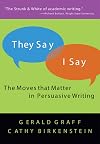
Very interesting premise, namely, looking at academic writing as participating in a dialogue. It's a fascinating idea that goes back to at least Greek roots in the Socratic dialogue. (Come to think of it, some Eastern teachers use that technique as well; I'm just not well-versed in non-Western history). I think it's a technique that helps a student place their work in a larger conversation, and elevate an academic essay above the "explanatory" work into a work that defends or promotes a show more viewpoint. The writers' mission can be summed up: "Yet despite this growing consensus that writing is a social, conversational act, helping student writers actually participate in these conversations remains a formidable challenge. This book aims to meet that challenge. Its goal is to demystify academic writing by isolating its basic moves, explaining them clearly and representing them in the form of templates."
Broken into four parts, the first part is called, "They Say," and gives students examples of how to take a position, then summarize and quote others in their works. The second section, "I Say," leads the writer how to respond to the "they say" arguments, and how to distinguish one's own position from differing ones. (Incidentally, my professor had us read Martin Luther King's "Letters from a Birmingham Jail" which uses nearly every instance of these techniques, and is a truly impressive essay. For that alone, I'm grateful to her). The third section addresses analysis and conclusions, and shows how to connect the parts, using one's own voice and metacommentary.
The last section addresses writing within specific settings, namely, writing for science, in the social sciences, entering class conversations and deciphering author viewpoints.
Each chapter ends with a few exercises which lead the reader through understanding the technique and how to implement it.
Contains templates to help beginning academic writers formulate ideas, and has a number of specific suggestions throughout to help writers integrate these techniques.
Overall, an interesting read for an academic book. It was required reading for an English Composition class. I wouldn't have mind having run into this in high school or college when I first started academic writing. Four stars for quality of ideas, approachability and useful techniques, if not actual enjoyment. show less
Broken into four parts, the first part is called, "They Say," and gives students examples of how to take a position, then summarize and quote others in their works. The second section, "I Say," leads the writer how to respond to the "they say" arguments, and how to distinguish one's own position from differing ones. (Incidentally, my professor had us read Martin Luther King's "Letters from a Birmingham Jail" which uses nearly every instance of these techniques, and is a truly impressive essay. For that alone, I'm grateful to her). The third section addresses analysis and conclusions, and shows how to connect the parts, using one's own voice and metacommentary.
The last section addresses writing within specific settings, namely, writing for science, in the social sciences, entering class conversations and deciphering author viewpoints.
Each chapter ends with a few exercises which lead the reader through understanding the technique and how to implement it.
Contains templates to help beginning academic writers formulate ideas, and has a number of specific suggestions throughout to help writers integrate these techniques.
Overall, an interesting read for an academic book. It was required reading for an English Composition class. I wouldn't have mind having run into this in high school or college when I first started academic writing. Four stars for quality of ideas, approachability and useful techniques, if not actual enjoyment. show less

Gerald Graff. Literature Against Itself. Literary Ideas in Modern Society. 1979.
Postmodern literature and critical theory have shattered and discarded the ancient metaphor that literature is a mirror held up to the world. Among some thinkers the figure itself is considered passe. They loathe not only the metaphor but the very belief that reality exists. Such fundamentally nihilistic thinking permeates many disciplines today. In literature this interpretation reveals itself mainly by evincing show more derision for the belief that literature is able to refer to external reality. Professor Gerald Graff’s Literature Against Itself analyzes this loss of referentiality and traces its development from romanticism through modernism and New Criticism and on to the current postmodernism. Although his book may be more perceptive about the problems than about the possibilities of restoration, it boldly rejects the solipsism of contemporary literature and calls for a return to an aesthetics centered in reality.
Graff accurately perceives that the major affliction of literature is its loss of referentiality. He locates the beginning of this loss in romanticism. Blake, Shelley, Wordsworth, Emerson, as well as many others, tended to exaggerate the “legislative” power of poetry while negating the utter dependence of poetry upon an external standard for justification and validation. As they moved away from an objective standard, they progressively substituted for it a literary creation–one for which no verifiable or believable authority existed. This weakened the claim of literature to truth and simultaneously began its social and intellectual alienation. Despite the extravagant claims of romanticism, it went awry. Far from creating more order in an increasingly materialistic civilization, it led to only a more rampant subjectivism.
Graff maintains that the next logical step was into the extreme autonomy of our century. Rilke and Yeats come readily to mind. They both developed esoteric systems to compensate for their inability to discern any coherent exterior reality, Yeats achieving by far the more arcane and idiosyncratic one. The presupposition of such a system is that there is no inherent design; the artist must contrive one. Rilke and Yeats differ from a few of the romantics in that their thinking is thoroughly secular, despite half-hearted assertions of some type of tenuous mysticism. Yet what differentiates the modernists (such as Rilke and Yeats) from postmodern writers is that the modernists remained, for the most part, humanists. They continued to believe, as the romantics did, that poetry gives order and meaning, somehow or another, to reality. Wallace Stevens’ idea that poetry is the “supreme fiction” exemplifies this position. He, along with Yeats, Rilke, and others, persisted in believing that a humanistic worldview was essential to poetry. In criticism, the New Critics were central to the loss of referentiality, for it was they who worked the autonomy of romanticism into a critical doctrine. T. S. Eliot and I. A. Richards were particularly responsible for the development of the seminal ideas of close textual reading and of disregarding the content of a literary work. The autotelic, self-sufficient text and the further trivialization of
literature were the offspring of the romantic inheritance of the period.
Postmodern literature indisputably “extends rather than overturns the premises of romanticism and modernism.” Most of Graff’s book is dedicated to proving the truth of this statement. He painstakingly documents that postmodern literature concludes “with better logic, that, if humanism is indeed a fiction, we ought to quit this pretense that it can be taken seriously.” Hence we have Barthes, Derrida, de Man, semiotics, reader-response criticism, and all of the writers who celebrate some vague form of energy–for example, Jerzy Kosinski and John Hawkes, along with the “Beat” poets.
However, to repudiate humanism is, as Graff recognizes, a slightly honorable position for these critics and writers. They at least are honest enough to accept the inevitable conclusion that must follow from their ungrounded thinking, something that most of the romantics andmodernists could not face:
Knowing and naming itself as fiction, literature becomes a vehicle for a nihilistic meta-physics, an anti-didactic form of preaching. In a world in which nobody can look outside the walls of the prison house of language, literature, with its built-in confession of its self-imprisonment, becomes once again the great oracle of truth, but now the truth is that there is no truth.
This is the postmodern “breakthrough”: the grim truth at last confronted. Drawing upon Vico, Saussure, Russian formalism, and modern linguistics in general, some postmodern thinkers and writers hold that linguistic elements cannot signify anything in the objective world and that, as a result, no intelligible reality exists. All is reduced to arbitrary codes of signifiers.
Although Graff does allow that linguistic signs are indeed arbitrary and that it is a valuable lesson for literature and criticism to learn this, he points out that it does not follow that the concepts referred to are arbitrary. External conventions, as well as internal, determine meaning. An example he gives is the ambiguous statement “Keep off the grass.” Without external indication of the intention of the writer or speaker, one does not know how to understand this simple statement. Does it mean to stay off someone’s lawn or off marijuana? Only an intentional, external sign can clarify the meaning. In the same way, writing demands intention by the author. Literature is not a Rorschach test, a contention that much of modern literary culture is dangerously close to holding.
Graff brilliantly exposes why “avant garde” ideologies fail to challenge contemporaneity: “They are the entrenched ideologies, or at least play into them.” The alienated psychology of the postmodern artist has been so thoroughly absorbed into the general society–or the postmodern artist has so thoroughly absorbed the alienation of modern, fragmented society–that there is no longer any fundamental difference between their thinking. The various coteries basically embrace the same values of irrationality and anti-intellectualism, skepticism, and nihilism that pervade contemporary world civilization. They mistakenly redefine their failure as a “breakthrough.” Much of the writing of contemporaneity, as Graff observes, is a symptom of the malady instead of an exploration of it. In a strange way, referentiality has almost been restored; the mirror is cracked, but it reflects the condition of our age.
Graff demonstrates that literature has conspired against itself to bring about its own loss of referentiality:
From the perception that “poetry makes nothing happen,” as Auden in our century has said, we move to the imperative that poetry ought to make nothing happen, and finally to the axiom that it is not real poetry if it aims at practical effect. By this logical route, the alienated position of literature ceases to be an aspect of a particular historical condition and becomes part of literature’s very definition.
Although he states that the reason for this deflating redefinition is due to literary thinkers having accepted a certain conceptual bill of goods, he still tends to locate the causes of it in the political arena, in the appearance of modern mass society, and in the pressure upon literature of scientific advancement. Nowhere in his book does Graff approach the understanding that for man to lose touch with true external authority means he has lost touch with objective reality.
Anomie, in the old sense of the word, is all that can possibly follow. And regardless of his beliefs that literature is dependent upon a convincing conceptual and theoretical understanding of the world and that literature has denied itself such an understanding, he himself fails to elucidate what one might be. Suffice it to say that the result of such a redefinition is not only the loss of referentiality but signficance as well. The writer turns to mythology, linguistic games.
This redefinition is not, however, a recent phenomenon. Literature has been, as Graff states at one point, “in the process of telling us how little it means for along time, as far back as the beginnings of romanticism.” That this redefinition of literature has found doctrinal expression in Auden and other writers and critics should come as no surprise. But poetry does and must make something happen; it repairs and polishes the mirror; it perceives the order that exists in reality;
it leads to practical effect; it opens our eyes to new possibilities of life and thought; it reflects man’s deepest sense of consciousness. As Robert Hayden wrote, “Poetry does make something happen, for it changes sensibility.” Such change, incontrovertibly spiritual in nature, is the prerequisite for any transformation in the objective, quotidian world.
As a remedy for the problems of referentiality and redefinition, Graff offers mimesis:
The writer’s problem is to find a standpoint from which to represent the diffuse, intransigent material of contemporary experience without surrendering critical perspective to it. Since critical perspective depends on historical sense, on seeing the present somehow as part of a coherent historical process, this task demands a difficult fusion of the sense of contemporaneity with the sense of the past that gives contemporaneity distinct definition.
Graff’s mimetic fusion” is indeed difficult given contemporary assumptions about history and society, assumptions that, in the end, Graff shares. Without an understanding of the major motivating events of history, any effort at “fusion” is doomed to failure. He primarily proposes that a new “fusion” be based on a view of history as degenerating into the mass society of today. That this has occurred during the last century is undeniable. Such a phenomenon has certainly, as he contends, vitiated the rational, critical capacity of society and replaced it with mass forms of thinking that are lacking in content. Yet such a fact is itself merely the symptom of a much larger problem. And his “fusion” would actually result only in another personal, willed mythology, which is precisely what he argues against throughout his book.
Nevertheless, Graff is definitely seeking to restore coherence to life. He cites Saul Bellow’s Mr. Sammler’s Planet as an attempt to reaffirm the meaning of such words as truth, honor, compassion, virtue. But ultimately such an attempt remains for Bellow and Graff as deprived of any respectable authority as the attempt by the romantics and modernists to affirm humanistic values. The religious ground for such verities has not been restored; rather, they are asserted solely out of a nostalgia that can command no more respect than earlier attempts by scholars and writers to impose, by themselves, order on existence. Similarly, in his chapter “English in America,” he claims that the collective efforts of scholars are required “to reconstruct our history.” This is presented after acknowledging the manner in which literary scholars and teachers have collaborated during the last century to drain literature of its referential ability. How this tendency may be reversed is not explained any more than the assertion that respectability must be returned to the “old words.”
Although Graff demystifies in a masterly way the thinking of many scholars and writers, he meets some of them in the end in a vague and ungrounded program of revision. At the same time, it seems that perhaps Graff understands the predicament in which he, modern literature, and contemporaneity find themselves. Between the lines of his book one would like to sense perhaps an awareness of the futility of political, academic, and literary solutions to the spiritual perplexities of today. In an age as disjointed as ours, to understand such a large part of the problem is a formidable
and admirable accomplishment.
Copyright (c) 1983 Frederick Glaysher. Reviewed in World Order.
http://www.fglaysher.com show less
Postmodern literature and critical theory have shattered and discarded the ancient metaphor that literature is a mirror held up to the world. Among some thinkers the figure itself is considered passe. They loathe not only the metaphor but the very belief that reality exists. Such fundamentally nihilistic thinking permeates many disciplines today. In literature this interpretation reveals itself mainly by evincing show more derision for the belief that literature is able to refer to external reality. Professor Gerald Graff’s Literature Against Itself analyzes this loss of referentiality and traces its development from romanticism through modernism and New Criticism and on to the current postmodernism. Although his book may be more perceptive about the problems than about the possibilities of restoration, it boldly rejects the solipsism of contemporary literature and calls for a return to an aesthetics centered in reality.
Graff accurately perceives that the major affliction of literature is its loss of referentiality. He locates the beginning of this loss in romanticism. Blake, Shelley, Wordsworth, Emerson, as well as many others, tended to exaggerate the “legislative” power of poetry while negating the utter dependence of poetry upon an external standard for justification and validation. As they moved away from an objective standard, they progressively substituted for it a literary creation–one for which no verifiable or believable authority existed. This weakened the claim of literature to truth and simultaneously began its social and intellectual alienation. Despite the extravagant claims of romanticism, it went awry. Far from creating more order in an increasingly materialistic civilization, it led to only a more rampant subjectivism.
Graff maintains that the next logical step was into the extreme autonomy of our century. Rilke and Yeats come readily to mind. They both developed esoteric systems to compensate for their inability to discern any coherent exterior reality, Yeats achieving by far the more arcane and idiosyncratic one. The presupposition of such a system is that there is no inherent design; the artist must contrive one. Rilke and Yeats differ from a few of the romantics in that their thinking is thoroughly secular, despite half-hearted assertions of some type of tenuous mysticism. Yet what differentiates the modernists (such as Rilke and Yeats) from postmodern writers is that the modernists remained, for the most part, humanists. They continued to believe, as the romantics did, that poetry gives order and meaning, somehow or another, to reality. Wallace Stevens’ idea that poetry is the “supreme fiction” exemplifies this position. He, along with Yeats, Rilke, and others, persisted in believing that a humanistic worldview was essential to poetry. In criticism, the New Critics were central to the loss of referentiality, for it was they who worked the autonomy of romanticism into a critical doctrine. T. S. Eliot and I. A. Richards were particularly responsible for the development of the seminal ideas of close textual reading and of disregarding the content of a literary work. The autotelic, self-sufficient text and the further trivialization of
literature were the offspring of the romantic inheritance of the period.
Postmodern literature indisputably “extends rather than overturns the premises of romanticism and modernism.” Most of Graff’s book is dedicated to proving the truth of this statement. He painstakingly documents that postmodern literature concludes “with better logic, that, if humanism is indeed a fiction, we ought to quit this pretense that it can be taken seriously.” Hence we have Barthes, Derrida, de Man, semiotics, reader-response criticism, and all of the writers who celebrate some vague form of energy–for example, Jerzy Kosinski and John Hawkes, along with the “Beat” poets.
However, to repudiate humanism is, as Graff recognizes, a slightly honorable position for these critics and writers. They at least are honest enough to accept the inevitable conclusion that must follow from their ungrounded thinking, something that most of the romantics andmodernists could not face:
Knowing and naming itself as fiction, literature becomes a vehicle for a nihilistic meta-physics, an anti-didactic form of preaching. In a world in which nobody can look outside the walls of the prison house of language, literature, with its built-in confession of its self-imprisonment, becomes once again the great oracle of truth, but now the truth is that there is no truth.
This is the postmodern “breakthrough”: the grim truth at last confronted. Drawing upon Vico, Saussure, Russian formalism, and modern linguistics in general, some postmodern thinkers and writers hold that linguistic elements cannot signify anything in the objective world and that, as a result, no intelligible reality exists. All is reduced to arbitrary codes of signifiers.
Although Graff does allow that linguistic signs are indeed arbitrary and that it is a valuable lesson for literature and criticism to learn this, he points out that it does not follow that the concepts referred to are arbitrary. External conventions, as well as internal, determine meaning. An example he gives is the ambiguous statement “Keep off the grass.” Without external indication of the intention of the writer or speaker, one does not know how to understand this simple statement. Does it mean to stay off someone’s lawn or off marijuana? Only an intentional, external sign can clarify the meaning. In the same way, writing demands intention by the author. Literature is not a Rorschach test, a contention that much of modern literary culture is dangerously close to holding.
Graff brilliantly exposes why “avant garde” ideologies fail to challenge contemporaneity: “They are the entrenched ideologies, or at least play into them.” The alienated psychology of the postmodern artist has been so thoroughly absorbed into the general society–or the postmodern artist has so thoroughly absorbed the alienation of modern, fragmented society–that there is no longer any fundamental difference between their thinking. The various coteries basically embrace the same values of irrationality and anti-intellectualism, skepticism, and nihilism that pervade contemporary world civilization. They mistakenly redefine their failure as a “breakthrough.” Much of the writing of contemporaneity, as Graff observes, is a symptom of the malady instead of an exploration of it. In a strange way, referentiality has almost been restored; the mirror is cracked, but it reflects the condition of our age.
Graff demonstrates that literature has conspired against itself to bring about its own loss of referentiality:
From the perception that “poetry makes nothing happen,” as Auden in our century has said, we move to the imperative that poetry ought to make nothing happen, and finally to the axiom that it is not real poetry if it aims at practical effect. By this logical route, the alienated position of literature ceases to be an aspect of a particular historical condition and becomes part of literature’s very definition.
Although he states that the reason for this deflating redefinition is due to literary thinkers having accepted a certain conceptual bill of goods, he still tends to locate the causes of it in the political arena, in the appearance of modern mass society, and in the pressure upon literature of scientific advancement. Nowhere in his book does Graff approach the understanding that for man to lose touch with true external authority means he has lost touch with objective reality.
Anomie, in the old sense of the word, is all that can possibly follow. And regardless of his beliefs that literature is dependent upon a convincing conceptual and theoretical understanding of the world and that literature has denied itself such an understanding, he himself fails to elucidate what one might be. Suffice it to say that the result of such a redefinition is not only the loss of referentiality but signficance as well. The writer turns to mythology, linguistic games.
This redefinition is not, however, a recent phenomenon. Literature has been, as Graff states at one point, “in the process of telling us how little it means for along time, as far back as the beginnings of romanticism.” That this redefinition of literature has found doctrinal expression in Auden and other writers and critics should come as no surprise. But poetry does and must make something happen; it repairs and polishes the mirror; it perceives the order that exists in reality;
it leads to practical effect; it opens our eyes to new possibilities of life and thought; it reflects man’s deepest sense of consciousness. As Robert Hayden wrote, “Poetry does make something happen, for it changes sensibility.” Such change, incontrovertibly spiritual in nature, is the prerequisite for any transformation in the objective, quotidian world.
As a remedy for the problems of referentiality and redefinition, Graff offers mimesis:
The writer’s problem is to find a standpoint from which to represent the diffuse, intransigent material of contemporary experience without surrendering critical perspective to it. Since critical perspective depends on historical sense, on seeing the present somehow as part of a coherent historical process, this task demands a difficult fusion of the sense of contemporaneity with the sense of the past that gives contemporaneity distinct definition.
Graff’s mimetic fusion” is indeed difficult given contemporary assumptions about history and society, assumptions that, in the end, Graff shares. Without an understanding of the major motivating events of history, any effort at “fusion” is doomed to failure. He primarily proposes that a new “fusion” be based on a view of history as degenerating into the mass society of today. That this has occurred during the last century is undeniable. Such a phenomenon has certainly, as he contends, vitiated the rational, critical capacity of society and replaced it with mass forms of thinking that are lacking in content. Yet such a fact is itself merely the symptom of a much larger problem. And his “fusion” would actually result only in another personal, willed mythology, which is precisely what he argues against throughout his book.
Nevertheless, Graff is definitely seeking to restore coherence to life. He cites Saul Bellow’s Mr. Sammler’s Planet as an attempt to reaffirm the meaning of such words as truth, honor, compassion, virtue. But ultimately such an attempt remains for Bellow and Graff as deprived of any respectable authority as the attempt by the romantics and modernists to affirm humanistic values. The religious ground for such verities has not been restored; rather, they are asserted solely out of a nostalgia that can command no more respect than earlier attempts by scholars and writers to impose, by themselves, order on existence. Similarly, in his chapter “English in America,” he claims that the collective efforts of scholars are required “to reconstruct our history.” This is presented after acknowledging the manner in which literary scholars and teachers have collaborated during the last century to drain literature of its referential ability. How this tendency may be reversed is not explained any more than the assertion that respectability must be returned to the “old words.”
Although Graff demystifies in a masterly way the thinking of many scholars and writers, he meets some of them in the end in a vague and ungrounded program of revision. At the same time, it seems that perhaps Graff understands the predicament in which he, modern literature, and contemporaneity find themselves. Between the lines of his book one would like to sense perhaps an awareness of the futility of political, academic, and literary solutions to the spiritual perplexities of today. In an age as disjointed as ours, to understand such a large part of the problem is a formidable
and admirable accomplishment.
Copyright (c) 1983 Frederick Glaysher. Reviewed in World Order.
http://www.fglaysher.com show less
They Say / I Say: The Moves That Matter in Academic Writing, with 2016 MLA Update (Third Edition) by Gerald Graff
It has become common today to dismiss this kind of books, especially from those who tend to have a poor perception of a genre they call self-help literature. It is often said that books promising to help you achieve success in your field are offering nothing more than delusions. If, on top of that, you consider how conventional wisdom has it that in order for one to produce good writing one has to be born with a special gift, you would think that there’s no way to take this particular book show more seriously. After all, I’ve always believed that myself, being raised to look at crafts not as something within reach of anyone who would learn the right techniques, but more as a rare happening where one would be blessed by his or her good fortune. So why would the contents of this book be of any relevance anyway?
However, after reading it, I thinkI and others like me were mistaken because we overlooked how a well organized method like the one offered in this book, where we are provided with plenty of explanations on the whys and hows of academic writing, can do wonders to our meek abilities in such craft. In fact, by practicing diligently on the many exercises provided throughout the book, not only we come to better understand what college writing demands from us, but also overcome many of the fears we all in some way or another have in having to come up with any cogent piece of writing on the various topics we are subjected to throughout college. To put it succinctly, and contrary to what I previously thought I agree that the authors’ proposal is not as far fetched as I once thought it were, because my experience with this method, as I am now putting it to practice, clearly confirms it.
Of course, many will probably disagree with this assertion [of mine] that this method is a game-changer if you’re a struggling college student having little to no idea on how to become proficient in the kind of writing universities demand from you. Skeptics, of course, may want to question whether this enthusiasm of mine has any grounds of evidence to support it. While it is true that my own anecdata is not of sufficient to provide the broad generalization I’m here making, it does not follow that my general assertion in completely groundless. Take, for example, the many positive reviews others have shared on this site (you can check them out at here: https://www.goodreads.com/book/show/31706999?rating=5). According to goodread’s user Dreama, “I assign this book to all of my college freshman ENG Composition students. The hype is real.” Shannon, another user of this site, also agrees when she writes, “Most helpful book on persuasive writing techniques I have ever read.” I wholeheartedly endorse what these users are saying and what Shannon calls “persuasive writing techniques”. My conclusion, then, is that, I’m not alone in thinking this is a great book, well deserving its positive reviews.
Another important thing to consider is that, although this book’s title may seem of concern to only a small group of readers, namely those attending college, it should in fact concern anyone who cares about writing as a general craft that is not only useful, but necessary for anyone who needs to communicate effectively and compellingly. In other words, this is not a book just for college undergraduates, but also a great guide for the general public as well. In this sense, this book matters because it deals with an essential craft that is even more needed today when much of the ever growing body of information sharing is done by writing. Ultimately, what is at stake here is the laying out of a solid foundation on which to make writing as tool more effective and productive to society as a whole.
So, as I hope you have by now understood, this exercise of mine leads credence to my assumption that this is in fact a much valuable book both for anxiety ridden college students who can’t make head or tails of how to write a text, but also those of the general public that want to become more clear and persuasive on their writings. Except for this paragraph, the main structure of this review was borrowed from the many templates this book offers as a guide to help you make your point across. To demonstrate this, I have indicated every template I used by putting it in italics, and adding the rest as content on a whim, knowing that I couldn’t fail much if I followed Gerald Graff’s and Cathy Birkenstein’s most valuable suggestions. This, then, I hope, serves as a good proof of this book’s efficacy. Should you read it? If writing is to be an important part of your life, most definitely! show less
This is a very useful guide that introduces students to the basic concepts of argumentative writing at the college level. Graff and Birkenstein stress that students remember they are not writing in a vacuum but rather to a particular audience as part of a larger ongoing conversation. Some of the templates they provide for students to incorporate into their writing are a little clichéd, sure ("On the one hand... On the other hand"), but they will help students who are only beginning to learn show more how to write critically.
(It's not, after all, necessarily an intuitive skill—one of the things that left me confused and anxious as an undergrad was getting back papers with comments that read, in their entirety, "More analysis." Now when I look back at my earliest work, I can see clearly what my professors meant; then, I thought that that was what I was doing and couldn't figure out how to do better.)
Graff and Birkenstein's templates are like training wheels for student writers, helping them to formulate ideas in ways that are new to them and hopefully to be discarded as composition and analytical skills improve. "They Say/I Say" is also a useful book for instructors to read, as it provides several reminders of the kinds of things that may now be second nature to us but which are likely to be stumbling blocks for students. show less
(It's not, after all, necessarily an intuitive skill—one of the things that left me confused and anxious as an undergrad was getting back papers with comments that read, in their entirety, "More analysis." Now when I look back at my earliest work, I can see clearly what my professors meant; then, I thought that that was what I was doing and couldn't figure out how to do better.)
Graff and Birkenstein's templates are like training wheels for student writers, helping them to formulate ideas in ways that are new to them and hopefully to be discarded as composition and analytical skills improve. "They Say/I Say" is also a useful book for instructors to read, as it provides several reminders of the kinds of things that may now be second nature to us but which are likely to be stumbling blocks for students. show less
Lists
Awards


You May Also Like


Associated Authors
Statistics
- Works
- 15
- Also by
- 2
- Members
- 4,167
- Popularity
- #6,043
- Rating
- 3.9
- Reviews
- 22
- ISBNs
- 79
- Languages
- 6
- Favorited
- 2