
Joseph M. Williams (1933–2008)
Author of The Craft of Research
About the Author
Works by Joseph M. Williams
Associated Works
A Manual for Writers of Term Papers, Theses, and Dissertations (1955) — some editions — 9,045 copies, 27 reviews
Tagged
Common Knowledge
- Canonical name
- Williams, Joseph M.
- Birthdate
- 1933-08-18
- Date of death
- 2008-02-22
- Gender
- male
- Education
- Miami University of Ohio (BA|1955|MA|1960)
University of Wisconsin-Madison (Ph.D|1966) - Occupations
- professor ( English Language and Literature)
- Organizations
- University of Chicago
Clearlines - Nationality
- USA
- Birthplace
- Cleveland, Ohio, USA
- Places of residence
- Chicago, Illinois, USA
- Place of death
- South Haven, Michigan, USA
- Associated Place (for map)
- USA
Members
Reviews

This book begins as if it were an anti-Strunk and White. Then Williams introduces terminology that at first glance obscures more than it illuminates. I’m glad I stuck with it, though. Williams’s aim is not to dictate rules, but to illustrate how to achieve clarity, cohesion, coherence, and other elements of graceful, readable prose.
By the time I reached the successive chapters on concision and length, I was convinced that this book offers valuable help I’d not found in other books on show more writing. I had never seen such good advice, for example, on constructing lengthy sentences that remain clear. These are particularly helpful in avoiding the monotone of invariable sentence length, and the chapter flowed logically to the next, on elegance. The book concludes with a common-sense discussion of usage.
Most books on writing are aimed at authors of imaginative prose. This book, by contrast, is aimed at those who write business reports, academic papers, or legal briefs. I wish I’d read it years ago. show less
By the time I reached the successive chapters on concision and length, I was convinced that this book offers valuable help I’d not found in other books on show more writing. I had never seen such good advice, for example, on constructing lengthy sentences that remain clear. These are particularly helpful in avoiding the monotone of invariable sentence length, and the chapter flowed logically to the next, on elegance. The book concludes with a common-sense discussion of usage.
Most books on writing are aimed at authors of imaginative prose. This book, by contrast, is aimed at those who write business reports, academic papers, or legal briefs. I wish I’d read it years ago. show less
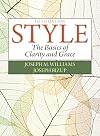
I picked up this book for an editing class, but after finishing the reading assignment, I devoured the rest. I've read a lot of writing and style manuals in my time, and this one is very different--and I think, much more practically useful--than any other one I've read. The principles are simple, elegant, and easy to internalize, but once you start applying them to your writing, or the work that you're editing, they result in instant and vast improvement. This techniques given here are show more intended primarily for writers of nonfiction--particularly academics and their ilk--but I think they could be applied to any kind of writing. I will say with certainty that this is a terrific manual for cutting through bureaucratic, pedantic writing that I think we're all way too familiar with. Finally, the last chapter analyzing Thomas Jefferson's pronoun choices in the Declaration of Independence from an ethical point of view was fascinating. I cannot recommend this book enough to writers and editors. show less
The Craft of Research, Fourth Edition (Chicago Guides to Writing, Editing, and Publishing) by Wayne C. Booth
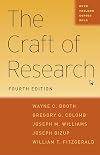
The act of research – whether in the natural sciences, social sciences, or humanities – undergirds so much of modern society. The skills help us think and then test those thoughts in light of outside information (data). Without a rigorous set of methods, this act can become mere people pleasing, but with a firm framework, it continues to transform the way the world lives. This book, an educational standard for almost three decades with five authors, clearly communicates research’s show more foundations to those learning the craft. It’s appropriate for the classroom and individuals starting careers.
All authors were or are professors of English, so this book has a natural leaning towards the humanities. Nonetheless, it attempts to address all facets of the academic enterprise. Because the authors are involved with language, it communicates cognitive nuances that might be missed by experts in a field. Its wording is eloquent, and organization, tight.
Like most academic works, this book heavily relies on concepts and classical works, yet it also uses relatable, conversational English to convey its message. It walks readers through steps including why to identify as a researcher, how to pursue the process, how to think carefully, and how to communicate findings. As easily imaginable, the authors do a superb job of enhancing readers’ personal writing style in the last chapter.
We live in an information age where thinking about the world has become the most important skill. Ironically, some question the value of an education even in an information-rich environment. If information is freely available, they ask, what do universities have to offer? This book offers a forthright answer. A college education and research training offer students the ability to think and process the world constructively. Especially suited for later later undergraduates and early graduate students, this book shines a clear path forward for individual careers and ultimately society’s advance. show less
All authors were or are professors of English, so this book has a natural leaning towards the humanities. Nonetheless, it attempts to address all facets of the academic enterprise. Because the authors are involved with language, it communicates cognitive nuances that might be missed by experts in a field. Its wording is eloquent, and organization, tight.
Like most academic works, this book heavily relies on concepts and classical works, yet it also uses relatable, conversational English to convey its message. It walks readers through steps including why to identify as a researcher, how to pursue the process, how to think carefully, and how to communicate findings. As easily imaginable, the authors do a superb job of enhancing readers’ personal writing style in the last chapter.
We live in an information age where thinking about the world has become the most important skill. Ironically, some question the value of an education even in an information-rich environment. If information is freely available, they ask, what do universities have to offer? This book offers a forthright answer. A college education and research training offer students the ability to think and process the world constructively. Especially suited for later later undergraduates and early graduate students, this book shines a clear path forward for individual careers and ultimately society’s advance. show less

I have a weakness for books about writing. Joseph Williams’ “Style: the basics of clarity and grace” is the shortest book on the topic I have read and, most importantly, is the best source for “nuts and bolts” writing instruction I have found. The book is an abbreviated version of Williams’ “Style: Ten Lessons in Clarity and Grace”. At the risk of hurting book sales, I do not see the need for a more detailed explanation than what is in this little, 150 page, book.
Williams show more first takes on the rules of grammar by pointing out that many of them are, in his words, folklore. He finds amazing examples to disprove these false rules. My favorite is for “You can not modify an absolute”, for which he quotes “We, the people of the United States, in order to form a more perfect union” With grammar covered Williams turns to the mechanics of writing. As simply and directly as possible he explains how to create clear and effective sentences, as well as paragraphs that guides the reader through the paper and to more complex ideas.
This book has earned a place in easy reach of my desk and I see it becoming dog eared from use. show less
Williams show more first takes on the rules of grammar by pointing out that many of them are, in his words, folklore. He finds amazing examples to disprove these false rules. My favorite is for “You can not modify an absolute”, for which he quotes “We, the people of the United States, in order to form a more perfect union” With grammar covered Williams turns to the mechanics of writing. As simply and directly as possible he explains how to create clear and effective sentences, as well as paragraphs that guides the reader through the paper and to more complex ideas.
This book has earned a place in easy reach of my desk and I see it becoming dog eared from use. show less
Lists
You May Also Like


Associated Authors
Statistics
- Works
- 11
- Also by
- 1
- Members
- 7,116
- Popularity
- #3,450
- Rating
- 3.9
- Reviews
- 44
- ISBNs
- 71
- Languages
- 3
- Favorited
- 1