
Patricia T. O'Conner
Author of Woe Is I: The Grammarphobe's Guide to Better English in Plain English
About the Author
Patricia T. O'Conner, a former editor at The New York Times Book Review, has written for many magazines and newspapers, and is a popular blogger and radio commentator. She is the author of four other books on language and writing; Words Fail Me, Woe Is I Jr., and, with Stewart Kellerman, You Send show more Me and Origins of the Specious: Myths and Misconceptions of the English Language. show less
Works by Patricia T. O'Conner
Woe Is I: The Grammarphobe's Guide to Better English in Plain English (1996) 2,697 copies, 19 reviews
Woe is I Jr.: The Younger Grammarphobe's Guide to Better English in Plain English (2007) 677 copies, 3 reviews
Origins of the Specious: Myths and Misconceptions of the English Language (2009) 292 copies, 15 reviews
NEW-Woe Is I 2 copies
Tagged
Common Knowledge
- Birthdate
- 1949-02-19
- Gender
- female
- Education
- Grinnell College (BA 1971)
- Occupations
- reporter
editor - Organizations
- The New York Times Book Review
- Relationships
- Kellerman, Stewart (husband)
- Nationality
- USA
- Associated Place (for map)
- USA
Members
Reviews
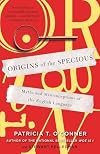
This book could not possibly not appeal to my confirmation bias. Disclosure: I've known for many years that Robert Lowth and his ilk are responsible for the unnecessary harm caused to grade school students all over the US - and probably elsewhere - when they tried to jam a Germanic language into Latin ... you can end a sentence in a preposition, have multiple negatives, and a host of other knuckle-rapping-thou-shalt-nots. Ms. O'Conner calls them out several times in this wonderful book. And show more much more.
Singular words that once were plural, plurals that were once singular, adverbs modifying whole sentences, origins of pronunciation, the drift between older modern British English (pre-19th century) and American English (turns out the New Englanders have been saying things right, with their dropped Rs...the Brits put them back in, ... and then lengthens their vowels (while doing their of dropping, syllabically that is.) She says "For one thing, we tend to use regular—and often older—past tenses (“burned,” “learned,” “spoiled,” “smelled”), while the British like irregular—and often newer—endings (“burnt,” “learnt,” “spoilt,” “smelt”). "
And grammar-Nazis abound, sometimes arguing both sides of the same infraction, because "English is often untidy, and we can find something in the disorder to support just about any position."
I like
And, a new one for me, "A mondegreen is a misunderstanding in which a familiar song lyric, bit of poetry, or popular expression is misinterpreted or misheard." Now I know what to call the " 'Scuse Me While I Kiss This Guy" unfortunate.
Anyway, now I want to read her other books. show less
Singular words that once were plural, plurals that were once singular, adverbs modifying whole sentences, origins of pronunciation, the drift between older modern British English (pre-19th century) and American English (turns out the New Englanders have been saying things right, with their dropped Rs...the Brits put them back in, ... and then lengthens their vowels (while doing their of dropping, syllabically that is.) She says "For one thing, we tend to use regular—and often older—past tenses (“burned,” “learned,” “spoiled,” “smelled”), while the British like irregular—and often newer—endings (“burnt,” “learnt,” “spoilt,” “smelt”). "
And grammar-Nazis abound, sometimes arguing both sides of the same infraction, because "English is often untidy, and we can find something in the disorder to support just about any position."
I like
It’s never been wrong to “split” an infinitive. That bogus rule is the most infamous member of a gang of myths that grammarians have been trying to rub out for a century and a half: Don’t end a sentence with a preposition! Don’t begin one with a conjunction! Don’t use a double negative! Don’t use “none” as a plural! Many of these don’ts were concocted in the eighteenth and nineteenth centuries by overzealous Latinists in a misguided attempt to force English to play by the rules of Latin.Yes!! Ms. O'Conner puts to bed peeves of mine, such as
The singular “octopus” comes from Greek and means eight-footed. The original plural, “octopodes,” was Anglicized over the years to “octopuses.” But in the mid-1800s some misguided Latinists (at it again!) tried to substitute the Latin plural ending -pi for the Greek -podes. It was an illegitimate idea that appealed to would-be pedants with weak classical educations.I did learn a few things...
A lot of hot air has also been expended over “bloviate,” which the word police regard as an ugly newcomer. But the word actually originated in mid-nineteenth century Ohio, when it meant what it means today—to blather on pompously. It’s one of those humorous mock-Latin formations (like “absquatulate,” “discombobulate,” and others), and it blew in around the same time as “bloviator” and “blowhard.”So Bill O'Reilly, Tucker Carlson, well...the whole "News"Channel entertainment cast, that apt term is more than 150 years old, as if anticipating you!
And, a new one for me, "A mondegreen is a misunderstanding in which a familiar song lyric, bit of poetry, or popular expression is misinterpreted or misheard." Now I know what to call the " 'Scuse Me While I Kiss This Guy" unfortunate.
Anyway, now I want to read her other books. show less
Woe Is I: The Grammarphobe's Guide to Better English in Plain English, Second Edition by Patricia T. O'Conner
I'll admit it: I feel grammar and punctuation-challenged, so I didn't groan when I saw this was assigned for my composition class. However, after making my way through most of the book, I have to say I'm disappointed. "National Bestseller" claims my edition. Really?! Really!? This must be one of the those books that people who don't read very much buy and throw on the shelf to show how well-read they are (or wish they were).
While it covers grammar, punctuation and word choice, the tone is show more breezy, the format outline-friendly, and there are enough sidebars and lists to make a "Dummies" book blush, so it feels more like a 'safe' introduction than a truly helpful text. If you look for rules, they're hidden in chatty examples of just how tricky rules can be. If you look for examples of how to apply the rules, you only get three or four before it's on to the next one. Thus, I'm not sure it is truly helpful for the reader who wants to improve their grammar in a long-lasting way. Too much of the writing is cluttered with silly humor that distracts from the point. For instance, one aside in the section on verb tense states, "that odd crackling noise you hear is the sound of a sentence short-circuiting!" Well, either that or my temper.
I found the format annoying and unhelpful towards actual comprehension. There's a tendency towards long lists in each section. One section on spelling has a long list of hard-to-spell words, so that the reader doesn't get caught pants down by spell-check. Great, I guess. But if I actually want help, I won't get it because I memorized a list of tough words--it'll be from using a dictionary. And yawn for readability, no matter how chatty your definition of "recede" is ("Three e's, and none of them together. Marc expects hemlines to recede next year (For hints about spelling "seedy" -sounding words, see above.)
As O'Conner uses just a couple of examples (almost never more than three) to illustrate her point/rule, the pace is keep moving, but at the expense of greater comprehension. I wouldn't have minded a few exercises or "test your comprehension" questions at the end of each chapter.
The second half on word choices is even more mixed in terms of usefulness. One chapter on "Verbal Abuse" will help dictionary-adverse users better understand a number of common words and phrases that are used incorrectly, such as "decimate," "hopefully," "irony," "literally," "lay/lie," "assume/presume," etc. It's a section for those who feel unsure of the meaning of the words they use. There is a chapter on common cliches that should be avoided, called, "Death Sentence: Do Cliches Deserve to Die?" I admire the intention, but sometimes corporate-speak is that way for a reason, and changing it up too much risks the readers/listeners thinking you don't speak their language or aren't responding to their ideas. Likewise, the chapter with ten tips on "How to Say What You Mean," would work best for a beginning writer. In fact, I think many of the tips would be contraindicated for a fiction writer.
Surprisingly, most of the chapter on punctuation was familiar to me. Thanks, ninth grade English!
Overall, a useful book if you feel very unsure about your writing skills, need to write semi-articulately in your profession and don't want to bother with a lot of hard-core rules and practice. I doubt that it will be helpful to a lot of advanced writers who want to improve their grammar. show less
While it covers grammar, punctuation and word choice, the tone is show more breezy, the format outline-friendly, and there are enough sidebars and lists to make a "Dummies" book blush, so it feels more like a 'safe' introduction than a truly helpful text. If you look for rules, they're hidden in chatty examples of just how tricky rules can be. If you look for examples of how to apply the rules, you only get three or four before it's on to the next one. Thus, I'm not sure it is truly helpful for the reader who wants to improve their grammar in a long-lasting way. Too much of the writing is cluttered with silly humor that distracts from the point. For instance, one aside in the section on verb tense states, "that odd crackling noise you hear is the sound of a sentence short-circuiting!" Well, either that or my temper.
I found the format annoying and unhelpful towards actual comprehension. There's a tendency towards long lists in each section. One section on spelling has a long list of hard-to-spell words, so that the reader doesn't get caught pants down by spell-check. Great, I guess. But if I actually want help, I won't get it because I memorized a list of tough words--it'll be from using a dictionary. And yawn for readability, no matter how chatty your definition of "recede" is ("Three e's, and none of them together. Marc expects hemlines to recede next year (For hints about spelling "seedy" -sounding words, see above.)
As O'Conner uses just a couple of examples (almost never more than three) to illustrate her point/rule, the pace is keep moving, but at the expense of greater comprehension. I wouldn't have minded a few exercises or "test your comprehension" questions at the end of each chapter.
The second half on word choices is even more mixed in terms of usefulness. One chapter on "Verbal Abuse" will help dictionary-adverse users better understand a number of common words and phrases that are used incorrectly, such as "decimate," "hopefully," "irony," "literally," "lay/lie," "assume/presume," etc. It's a section for those who feel unsure of the meaning of the words they use. There is a chapter on common cliches that should be avoided, called, "Death Sentence: Do Cliches Deserve to Die?" I admire the intention, but sometimes corporate-speak is that way for a reason, and changing it up too much risks the readers/listeners thinking you don't speak their language or aren't responding to their ideas. Likewise, the chapter with ten tips on "How to Say What You Mean," would work best for a beginning writer. In fact, I think many of the tips would be contraindicated for a fiction writer.
Surprisingly, most of the chapter on punctuation was familiar to me. Thanks, ninth grade English!
Overall, a useful book if you feel very unsure about your writing skills, need to write semi-articulately in your profession and don't want to bother with a lot of hard-core rules and practice. I doubt that it will be helpful to a lot of advanced writers who want to improve their grammar. show less
As the subtitle says -- or maybe even "like the subtitle says" -- this book explores various myths and misconceptions about English, from "rules" of grammar that are actually nothing of the sort, to stories about the origins of words and phrases that just aren't true, to French words we use in English that don't actually exist in French, to words and phrases that are often misunderstood (sometimes to the point where the "misunderstood" version is becoming standard), to common language show more nitpicks where it may be the nitpicker in the wrong, either because they're arguing for something that's irrecoverably changed or for something that never made much sense in the first place. Oh, and there's a chapter on dirty words, too.
I enjoyed the grammar parts best, I think, just because I always like an excuse to indulge my righteous anger against those who enjoy sniffing at others for splitting infinitive or dangling prepositions when that is how English actually works. The stuff about etymology was slightly less interesting to me, but I'm pretty sure that's just because I've already read one too many books on that subject, not because there was anything at all wrong with this one.
Indeed, it's a fun, breezy, easy read, full of clever puns and entertaining anecdotes. It also features some decent practical advice about when you might want to embrace or avoid controversial or disputed ways of using words. Much of that's a matter of opinion, of course, and I don't 100% agree with all of it, but it's generally sane and sensible opinion, which is more than you can say for a lot of opinions about language. show less
I enjoyed the grammar parts best, I think, just because I always like an excuse to indulge my righteous anger against those who enjoy sniffing at others for splitting infinitive or dangling prepositions when that is how English actually works. The stuff about etymology was slightly less interesting to me, but I'm pretty sure that's just because I've already read one too many books on that subject, not because there was anything at all wrong with this one.
Indeed, it's a fun, breezy, easy read, full of clever puns and entertaining anecdotes. It also features some decent practical advice about when you might want to embrace or avoid controversial or disputed ways of using words. Much of that's a matter of opinion, of course, and I don't 100% agree with all of it, but it's generally sane and sensible opinion, which is more than you can say for a lot of opinions about language. show less
Woe is I: The Grammarphobe's Guide to Better English in Plain English, 3rd Edition by Patricia T. O'Conner
Bought this for my mum for Christmas, had to get up to free shipping and decided to buy a copy for myself! I read the second edition from the library last year, so here is my review for that one:
A very instructive book, in particular the chapter on word usage, which pointed out a couple of words that I myself use wrongly (or whose definitions I do not entirely understand). I shall make careful note of those when I come across them in my work.
The book as a whole is very good. The example show more sentences are fun, especially the ones that refer to characters in literature. (Bertie and his aunts make a few appearances throughout the book.) I also liked the chapter on grammar rules that should just be allowed to die (e.g. not ending a sentence with a preposition, splitting infinitives).
One thing I did find grating at points was the tone. Sometimes the author came across as a bit condescending, or at least very vehement in defending her viewpoint, especially if she was discussing a grammar rule that could go either way, but SHE preferred one particular way. I can't remember any particular examples, but it was just in a couple of places and not really a widespread problem. I would still recommend this book for people who want to pick up some tricks regarding English grammar and usage. show less
A very instructive book, in particular the chapter on word usage, which pointed out a couple of words that I myself use wrongly (or whose definitions I do not entirely understand). I shall make careful note of those when I come across them in my work.
The book as a whole is very good. The example show more sentences are fun, especially the ones that refer to characters in literature. (Bertie and his aunts make a few appearances throughout the book.) I also liked the chapter on grammar rules that should just be allowed to die (e.g. not ending a sentence with a preposition, splitting infinitives).
One thing I did find grating at points was the tone. Sometimes the author came across as a bit condescending, or at least very vehement in defending her viewpoint, especially if she was discussing a grammar rule that could go either way, but SHE preferred one particular way. I can't remember any particular examples, but it was just in a couple of places and not really a widespread problem. I would still recommend this book for people who want to pick up some tricks regarding English grammar and usage. show less
Lists
Awards

You May Also Like


Associated Authors
Statistics
- Works
- 8
- Members
- 4,284
- Popularity
- #5,867
- Rating
- 3.8
- Reviews
- 44
- ISBNs
- 37
- Languages
- 1
- Favorited
- 1