
Arthur Plotnik (1937–2020)
Author of The Elements of Editing: A Modern Guide For Editors And Journalists
About the Author
Image credit: via author's website
Works by Arthur Plotnik
Better Than Great: A Plenitudinous Compendium of Wallopingly Fresh Superlatives (2011) 62 copies, 3 reviews
The Elements of Authorship: Unabashed Advice, Undiluted Experience, Unadulterated Inspiration for Writers and Writers-To (2000) 30 copies
Honk If You're a Writer: Unabashed Advice, Undiluted Experience, Unadulterated Inspiration (1992) 9 copies, 1 review
Jefferson-gate! 1 copy
Associated Works
Rosebud: 43 — Contributor, some editions — 2 copies
Tagged
Common Knowledge
- Other names
- Plotnik, Art
- Birthdate
- 1937
- Date of death
- 2020-08-28
- Gender
- male
- Education
- State University of New York, Binghamton (Harpur College|BA)
University of Iowa (MA|English) - Nationality
- USA
- Places of residence
- White Plains, New York, USA
- Associated Place (for map)
- New York, USA
Members
Reviews
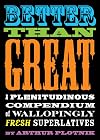
Over a career, author and editor Plotnik has urged writers to be more exciting and engaging with words. Now regarding superlatives, he writes, “We find ourselves defaulting to such habitual choices as good, great, and terrific, or substituting the weary synonyms that tumble out of a thesaurus...” And then we have to plump them up by underlining, italicizing, CAPITALIZing and punc.tu.ating!
So here he compiles 6000 “wallopingly fresh” adjectives, adverbs and multi-word expressions. show more They’re lively and imaginative, with a palpable pop-culture influence and mostly suited to writing that’s energetic not formal. Their organization is not typical-thesaurus alphabetical but rather in chapters by evocative intent, for example:
• degree of acclaim, e.g. great (“seize-the-day special”) vs sublime (“nirvanic”) vs exceptional (“certified rare”);
• physical/ mental/ emotional/ spiritual effect (“blistering,” “emotional eggbeater,” “aneurism-inducingly funny”);
• beauty or gastronomy (“Halle Berry 2.0,” “noshalicious”);
• size/ intensity (“hangar-sized,” “Wagnerian”); and
• degrees of cool and wicked cool (“cool in high-def,” “cold”).
All lists include a range from vintage terms to contemporary to ultra-trendy. Appendices include txt-ready abbreviations and a bibliography lists additional online and print sources.
As a reference work, it’s difficult to use; it was only in digging deeply for this review that I began to meaningfully differentiate among the chapter categories. And there are hundreds of expressions in each, not something to browse in a moment of need. Still, I agree that language needs freshness, and precision, so I'm following the approach Plotnik suggests in an appendix -- to compile a starter set of fresh words I'd actually use (he supplies one) and begin to get comfortable using them.
(Review based on an advance reading copy provided by the publisher.) show less
So here he compiles 6000 “wallopingly fresh” adjectives, adverbs and multi-word expressions. show more They’re lively and imaginative, with a palpable pop-culture influence and mostly suited to writing that’s energetic not formal. Their organization is not typical-thesaurus alphabetical but rather in chapters by evocative intent, for example:
• degree of acclaim, e.g. great (“seize-the-day special”) vs sublime (“nirvanic”) vs exceptional (“certified rare”);
• physical/ mental/ emotional/ spiritual effect (“blistering,” “emotional eggbeater,” “aneurism-inducingly funny”);
• beauty or gastronomy (“Halle Berry 2.0,” “noshalicious”);
• size/ intensity (“hangar-sized,” “Wagnerian”); and
• degrees of cool and wicked cool (“cool in high-def,” “cold”).
All lists include a range from vintage terms to contemporary to ultra-trendy. Appendices include txt-ready abbreviations and a bibliography lists additional online and print sources.
As a reference work, it’s difficult to use; it was only in digging deeply for this review that I began to meaningfully differentiate among the chapter categories. And there are hundreds of expressions in each, not something to browse in a moment of need. Still, I agree that language needs freshness, and precision, so I'm following the approach Plotnik suggests in an appendix -- to compile a starter set of fresh words I'd actually use (he supplies one) and begin to get comfortable using them.
(Review based on an advance reading copy provided by the publisher.) show less
This is a book about the English language. A small part of it, actually: superlatives. Like many writes, I enjoy playing with the language and I found delight in reading this book. Well, not reading exactly but skimming through its “wallopingly fresh” lists of superlatives. As any dictionary, it serves as a reference, to consult when needed.
Who is this book for? The author answers this question in his charming and funny introduction:
Plotnik offers his readers a thesaurus of “great” and “fabulous” in a book comprised of over 200 pages. It’s not surprising that a book on such a topic should sing dithyrambs to an adverb, a part of speech most writing teaches condemn as harmful for fiction. The prevalent dictum on the subject is that fiction narrative should be spare, consisting mostly of nouns and verbs. Otherwise it’s called ‘flowery,’ with definite derision in the tone. I think it took gumption for a writing professional to present an opinion contrary to so many MFAs in Creative Writing.
I love adverbs and adjectives too; I think of them as little words that add color and taste to a story. So Plotnik is definitely my kind of guy. He not only makes up his own superlatives but also quotes other writers, as well as critics and bloggers, who first came up with a whimsical expression or a funky word. He gives tribute where it’s due:
Plontik also quotes one of the most beloved American writers, Mark Twain: “Grief can take care of itself; but to get the full value of a joy you must have somebody to divide it with.” I’m in full agreement with the sentiment, and I want to share my joy in this book with my friends on GR.
If I had to use one word to describe this little volume, I’d employ one of the author’s superior superlatives: droolworthy!
Recommended to every writer and every language buff. show less
Who is this book for? The author answers this question in his charming and funny introduction:
In addressing “you,” I am picturing someone whoshow more
takes language seriously, even when using it to evoke giggles and gasps. You’re a novelist or a reporter reaching for an emphatic way of saying beautiful or big. You are a critic enchanted by a new work, but last week you used enchanting, haunting, and mesmerizing for the hundredth time. … You are everyperson, wishing to excite others about the things exciting you, or looking to energize such everyday civilities as “Have a ___ trip.”
Plotnik offers his readers a thesaurus of “great” and “fabulous” in a book comprised of over 200 pages. It’s not surprising that a book on such a topic should sing dithyrambs to an adverb, a part of speech most writing teaches condemn as harmful for fiction. The prevalent dictum on the subject is that fiction narrative should be spare, consisting mostly of nouns and verbs. Otherwise it’s called ‘flowery,’ with definite derision in the tone. I think it took gumption for a writing professional to present an opinion contrary to so many MFAs in Creative Writing.
I use tons of adverbs, and to those who still believe the old saw that all adverbs are bad, I say, heed the enlightened language experts: Adverbs are bad when they serve no purpose, when they add nothing but excess baggage to what they would modify. Otherwise, they serve to specify the degree or manner of the named quality, yielding information that is interesting, intensifying, and sometimes fun.
I have tried to use adverbs that energize and sharpen…
I love adverbs and adjectives too; I think of them as little words that add color and taste to a story. So Plotnik is definitely my kind of guy. He not only makes up his own superlatives but also quotes other writers, as well as critics and bloggers, who first came up with a whimsical expression or a funky word. He gives tribute where it’s due:
“If that advice makes your insides do the happy dance, may I suggest a writing book that will really get your belly in a polka.”
-- Bonnie Grove, fictionmatters.blogspot.com Oct 14, 2009
Plontik also quotes one of the most beloved American writers, Mark Twain: “Grief can take care of itself; but to get the full value of a joy you must have somebody to divide it with.” I’m in full agreement with the sentiment, and I want to share my joy in this book with my friends on GR.
If I had to use one word to describe this little volume, I’d employ one of the author’s superior superlatives: droolworthy!
Recommended to every writer and every language buff. show less
The Elements of Editing: A Modern Guide for Editors and Journalists (Elements of Series) by Arthur Plotnik
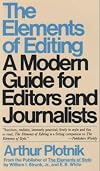
As a novel writer I found a few of the chapters really useful, some interesting, and about a third of it was either for newspaper editors or is outdated by technology.
The last book I read was The Elements Of Style, and while I would call that a book for writers, The Elements Of Editing is for editors. It's been useful to get into the mind of an editor for my own self-editing and also for working out how I want to proceed with the editing process.
It's also great to get another opinion on show more writing and I especially enjoyed reading Plotnick's defense of the passive sentence. show less
The last book I read was The Elements Of Style, and while I would call that a book for writers, The Elements Of Editing is for editors. It's been useful to get into the mind of an editor for my own self-editing and also for working out how I want to proceed with the editing process.
It's also great to get another opinion on show more writing and I especially enjoyed reading Plotnick's defense of the passive sentence. show less
I wish I could find a more current updated version of this book. The Elements of Editing is perfectly edited. Of all the books on writing I've read this one cuts the fat and is nothing but what I need. There are no long winded stories and analogies that go on for paragraphs and pages. Nope, every page of this book had a post it for notes and the notes were straight forward. Just think of when you read reviews that say, "They could of said it in half the pages."
Plotnik says it in half the show more pages...and it is still entertaining. show less
Plotnik says it in half the show more pages...and it is still entertaining. show less
Lists
Awards

You May Also Like


Statistics
- Works
- 11
- Also by
- 1
- Members
- 2,383
- Popularity
- #10,772
- Rating
- 3.7
- Reviews
- 16
- ISBNs
- 33
- Languages
- 1
- Favorited
- 1