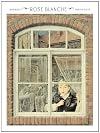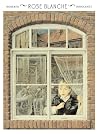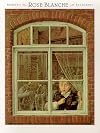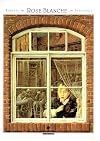
Rose Blanche
by Christophe Gallaz
On This Page
Description
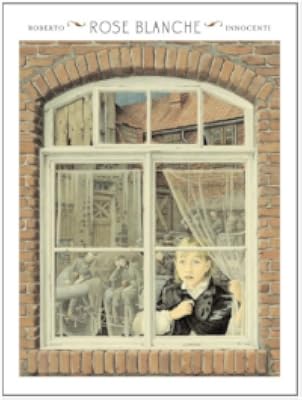
During World War II, a young German girl's curiosity leads her to discover something far more terrible than the day-to-day hardships and privations that she and her neighbors have experienced.Tags
Recommendations















Member Reviews
Heartbreaking, stark, focusing on the lack of empathy, actions of brutality of the Nazi occupation, and terror at the hands of soldiers who follow directions, without feeling from their soul.
Rose Blanche is based on the life of the author. In this story, Rose notices the tanks that hurry through what was a quiet, calm hometown. One day she witnesses a little boy who is taken abruptly by the Nazi soldiers.
Following him, she discovers him in a concentration camp located through the woods. She finds him and she bravely provides bread to him through the wire. While the book does not say that Rose is killed in helping him, the image of shots ringing out and Rose Blanche never returning to her home, lets the reader no that her assistance and show more caring cost her life.
This is an incredibly powerful book. show less
Rose Blanche is based on the life of the author. In this story, Rose notices the tanks that hurry through what was a quiet, calm hometown. One day she witnesses a little boy who is taken abruptly by the Nazi soldiers.
Following him, she discovers him in a concentration camp located through the woods. She finds him and she bravely provides bread to him through the wire. While the book does not say that Rose is killed in helping him, the image of shots ringing out and Rose Blanche never returning to her home, lets the reader no that her assistance and show more caring cost her life.
This is an incredibly powerful book. show less
Rose Blanche is a sobering tale of historical fiction set in Germany during World War II. The story begins with Rose Blanche narrating in the first person but after she stumbles upon the concentration camp, there is a foreshadowing voice change to the narrator.
The illustrations are vivid, realistic, and draw the reader into the story. On page 5, Rose Blanche is walking across a bridge and the reader sees her reflection in the river below. The reader is privy to more of the picture in the reflection as the barbed wire is visible in the reflection but not at the top of the page. The symbolism that she is a child going about her normal life with a war going on around her is evident in multiple passages. When she discovers the prisoners in show more the camp, she sees them as people like her, children do not worry themselves about beliefs that do not affect them and she decides to smuggle as much food to them as she can manage.
The end of the book is a little intense as she is trapped in thick fog with soldiers approaching and then the narrator says there is a shot. It is up to the reader to interpret the remaining pages. The narrator lets us know her mother waited for a very long time for her but does not say she came home. Also, there is also a flower in Rose's hand which is entwined into the barbed wire and on the remaining pages, the flower is shown to wither and on the very last page, the flower is completely dried and dead. I believe this was meant to represent the demise of poor little Rose Blanche. show less
The illustrations are vivid, realistic, and draw the reader into the story. On page 5, Rose Blanche is walking across a bridge and the reader sees her reflection in the river below. The reader is privy to more of the picture in the reflection as the barbed wire is visible in the reflection but not at the top of the page. The symbolism that she is a child going about her normal life with a war going on around her is evident in multiple passages. When she discovers the prisoners in show more the camp, she sees them as people like her, children do not worry themselves about beliefs that do not affect them and she decides to smuggle as much food to them as she can manage.
The end of the book is a little intense as she is trapped in thick fog with soldiers approaching and then the narrator says there is a shot. It is up to the reader to interpret the remaining pages. The narrator lets us know her mother waited for a very long time for her but does not say she came home. Also, there is also a flower in Rose's hand which is entwined into the barbed wire and on the remaining pages, the flower is shown to wither and on the very last page, the flower is completely dried and dead. I believe this was meant to represent the demise of poor little Rose Blanche. show less
The version that is published for America does not do the book justice. I think that it is stupid that they would minimize the pain and hurt of the people that went through the war in order to make it more "publishable". I also think that the American version does not have the same effect on people as the original version does. I think that the original version may be a little too dark for younger kids but once you start teaching about the topic to older kids, it is a great way to display the hurt that many people felt during this time. The American version is honestly just confusing and bare.
Although I thought this was a lovely and poignant story, I wonder whether children of picture-book age would find it as interesting. If you don't have a basic knowledge of the Holocaust you might well get confused, as so much in this narrative is implied rather than said directly, including the protagonist's death.
This is a short and heartbreaking story about a little girl living in a small German town in the midst of World War II. The schoolgirl witnesses a boy being apprehended and forcibly put in a truck by fascist soldiers one day. She decides to follow the vehicle and discovers it has led her to a concentration camp, where there are starving children behind the barbed wire. From then on, Rose Blanche secretly squirrels away food to bring to the Jewish inmates, even as she wastes away day by day. The images do most of the storytelling, with Roberto Innoncenti's gorgeous and astoundingly detailed watercolour illustrations, which seem to fairly leap off the page, even as they depict the grim reality of that place and time. Innocenti, who hails show more from Italy, was the recipient of the Hans Christian Andersen Award for illustration in 2008, an award which is presented every other year to both a living author and to an illustrator whose complete works have made a lasting contribution to children's literature. Of course, it's hard to say I enjoyed this book, but it manages to portray some harsh realities, yet with restraint and compassion, and would probably be an entirely appropriate introduction to children of age to an important part of our collective history. Available in both English and French. show less
Rose Blanche is a young girl living in Nazi Germany. Blinded by her childhood innocence, Rose is oblivious to what is happening around her until she follows a truck filled with children to a concentration camp. When she realizes everyone is starving, she sneaks them food up until the day she meets her tragic end. A heartbreaking tale about the consequences of war, I thought this book was great. The changes in point of view are impactful, especially after Rose's untimely death. I would read this book to any grade to give a different perspective on the Holocaust. I highly recommend this to people of any age and I think people who support war could benefit from reading it, as it shows how negatively and inevitably the innocent are impacted.
This story is told through the eyes of a young German girl, Rose Blanche, who is a witness to the immense changes occurring in Nazi Germany. Her curiosity leads her outside her town where she discovers a concentration camp. Rose Blanche secretly brings food to the children behind the barbed-wire fence. Warning, has sad ending.
Members
- Recently Added By
Lists

A Child's Book Tour of Germany
76 works; 5 members

Children's Books about World War II (1939-1945)
143 works; 12 members
Author Information
All Editions
Some Editions
Awards and Honors
Awards
Common Knowledge
- Canonical title
- Rose Blanche
- Original title
- Rosa Blanca
- Original publication date
- 1985
- People/Characters
- Rose Blanche
- Important places
- Germany
- Important events
- World War II; Holocaust
- First words
- When wars begin people often cheer.
My name is Rose Blanche. (from the U.S. edition, translator not identified) - Last words
- (Click to show. Warning: May contain spoilers.)Spring had triumphed.
(Click to show. Warning: May contain spoilers.)Spring sang. (from the U.S. edition, translator not identified)
Classifications
Statistics
- Members
- 719
- Popularity
- 39,563
- Reviews
- 89
- Rating
- (4.27)
- Languages
- 10 — Catalan, Danish, Dutch, English, French, German, Italian, Portuguese, Spanish, Swedish
- Media
- Paper, Ebook
- ISBNs
- 31
- ASINs
- 13