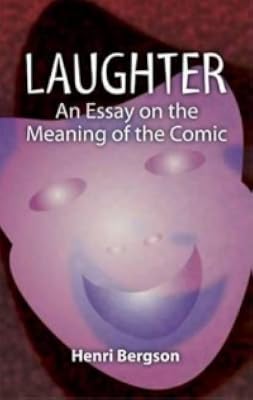
Laughter: An Essay on the Meaning of the Comic
by Henri Bergson
On This Page
Description
What does laughter mean? What type of circumstance or situation can provoke laughter? In this fascinating volume, famed French philosopher Henri Bergson tackles the notion of humor, and in the process, uncovers some of the elemental aspects of what it means to be human. Perfect for humor lovers, performers who want to take their act to the next level, or anyone who has ever wondered about the nature of what it means to be "funny.".
Tags
Recommendations










Member Reviews
Actually a pretty good theory on laughter and comedy, but it was hard to follow sometimes as Bergson relied on an extensive familiarity with a bunch of French plays, so,e of which I know nothing about. Fortunately he also referred to Shakespeare, but primarily as examples of tragedy, as a contrast to comedy.
This is unique in a way, not many philosophers wrote about laughter or humor. The most any notable thinker wrote - like Plato, Hobbes, and Kant - was an essay or a few paragraphs within a discussion of another topic. Henri Bergson’s 'Laughter' was the first book by a notable philosopher on humor!
Also, it should be noted that the word humor was not used in its current sense of funniness until the 18th century.
Read The Incongruity Theory here!
But that'd be too much to do on this!
But maybe you want to for some reason!
Or...just don't! Go and watch some telly goddammit!
Also, it should be noted that the word humor was not used in its current sense of funniness until the 18th century.
Humor arises from the incongruity between our notions of ourselves as humans, and the subversion of that notion by the mechanical nature of our lives.
Read The Incongruity Theory here!
But that'd be too much to do on this!
But maybe you want to for some reason!
Or...just don't! Go and watch some telly goddammit!
This is unique in a way, not many philosophers wrote about laughter or humor. The most any notable thinker wrote - like Plato, Hobbes, and Kant - was an essay or a few paragraphs within a discussion of another topic. Henri Bergson’s 'Laughter' was the first book by a notable philosopher on humor!
Also, it should be noted that the word humor was not used in its current sense of funniness until the 18th century.
Read The Incongruity Theory here!
But that'd be too much to do on this!
But maybe you want to for some reason!
Or...just don't! Go and watch some telly goddammit!
Also, it should be noted that the word humor was not used in its current sense of funniness until the 18th century.
Humor arises from the incongruity between our notions of ourselves as humans, and the subversion of that notion by the mechanical nature of our lives.
Read The Incongruity Theory here!
But that'd be too much to do on this!
But maybe you want to for some reason!
Or...just don't! Go and watch some telly goddammit!
This is unique in a way, not many philosophers wrote about laughter or humor. The most any notable thinker wrote - like Plato, Hobbes, and Kant - was an essay or a few paragraphs within a discussion of another topic. Henri Bergson’s 'Laughter' was the first book by a notable philosopher on humor!
Also, it should be noted that the word humor was not used in its current sense of funniness until the 18th century.
Read The Incongruity Theory here!
But that'd be too much to do on this!
But maybe you want to for some reason!
Or...just don't! Go and watch some telly goddammit!
Also, it should be noted that the word humor was not used in its current sense of funniness until the 18th century.
Humor arises from the incongruity between our notions of ourselves as humans, and the subversion of that notion by the mechanical nature of our lives.
Read The Incongruity Theory here!
But that'd be too much to do on this!
But maybe you want to for some reason!
Or...just don't! Go and watch some telly goddammit!
Në këtë ese të famshme, të përbërë nga tre artikuj të botuar më së pari në Revue de Paris, Bergson analizon fenomenin e së qeshurës, veçanërisht atë të shkaktuar nga komikja. Botohet për herë të parë e plotë në shqip, së bashku me një shtojcë të Sandor Ferencz-it dhe me një pasthënie të përkthyeses.
En este espléndido ensayo filosófico escrito en los albores del siglo XX, Henri Bergson se pregunta por qué la gente ríe y cuál es el significado de su risa. Se trata de tres textos encadenados tras las mismas preguntas: ¿qué hay en el lenguaje que hace que un chiste sea cómico?, ¿por qué lo cómico nos hace reír?
Feb 13, 2023Spanish
O que significa o riso? O que há no fundo do risível? O que há de comum entre uma careta de palhaço, um jogo de palavras e uma cena de comédia fina? Assim como os maiores pensadores desde Aristóteles, que estiveram às voltas com esse problema, Bergson tenta, nos três artigos que compõem "O riso", responder a essas e outras perguntas sobre o tema.
Dec 3, 2010Portuguese (Brazil)
Members
- Recently Added By
Lists

Trinity College Booklist (1951): Class Seven, Fine Arts and Music
46 works; 3 members
Author Information

132+ Works 5,425 Members
Born in Paris in 1859 of Jewish parents, Henri Bergson received his education there and subsequently taught at Angers and Clermont-Ferraud before returning to Paris. He was appointed professor of philosophy at the College de France in 1900 and elected a member of the French Academy in 1914. Bergson developed his philosophy by stressing the show more biological and evolutionary elements involved in thinking, reasoning, and creating. He saw the vitalistic dimension of the human species as being of the greatest importance. Bergson's writings were acclaimed not only in France and throughout the learned world. In 1927 he was awarded the Nobel Prize for literature. In defiance of the Nazis after their conquest of France, Bergson insisted on wearing a yellow star to show his solidarity with other French Jews. Shortly before his death in 1941, Bergson gave up all his positions and renounced his many honors in protest against the discrimination against Jews by the Nazis and the Vichy French regime. (Bowker Author Biography) show less
Some Editions
Awards and Honors
Series
Belongs to Publisher Series
Work Relationships
Is contained in
Common Knowledge
- Canonical title
- Laughter: An Essay on the Meaning of the Comic
- Original title
- Le rire
- Original publication date
- 1900
- First words
- What does laughter mean?
- Quotations
- The laughable element consists of a certain mechanical inelasticity, where one would expect to find the wideawake adaptability and living pliableness of a human being; brought about by external circumstance. A certain inborn ... (show all)lack of elasticity in senses and intelligence, so that we continue to see what is no longer visible, to hear what is no longer audible: to adapt ourselves to a past situation, when we ought to be shaping our conduct in accordance with the reality which is present. The rigidity of a fixed idea - failure to adapt.
The rigidity is the comic, and laughter is its corrective. Laughter is a sort of social gesture.
What life and society require of each of us is a constantly alert attention that discerns the outlines of the present situation, together with a certain elasticity of mind and body to enable us to adapt ourselves in consequen... (show all)ce. - Last words
- (Click to show. Warning: May contain spoilers.)But the philosopher who gathers a handful to taste may find that the substance is scanty, and the aftertaste bitter.
- Original language
- French
- Disambiguation notice*
- In diesem Bande sind drei Aufsätze über das Lachen vereinigt, die ursprünglich in der Revue de Paris erschienen sind.
*Some information comes from Common Knowledge in other languages. Click "Edit" for more information.
Classifications
- Genres
- Philosophy, Nonfiction, Literature Studies and Criticism
- DDC/MDS
- 809.917 — Literature & rhetoric Literature, rhetoric & criticism History, description, critical appraisal of more than two literatures Literature displaying specific features, miscellaneous writings Literature displaying specific qualities of style, mood, viewpoint Comedy
- LCC
- PN6149 .P5 — Language and Literature Literature (General) Literature (General) Collections of general literature Wit and humor
- BISAC
Statistics
- Members
- 693
- Popularity
- 41,429
- Reviews
- 11
- Rating
- (3.88)
- Languages
- 20 — Catalan, Czech, Danish, Dutch, English, Estonian, Finnish, French, German, Hungarian, Italian, Japanese, Norwegian (Bokmål), Norwegian, Portuguese (Portugal), Romanian, Russian, Spanish, Swedish, Turkish
- Media
- Paper, Ebook
- ISBNs
- 123
- ASINs
- 19