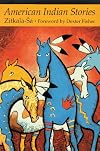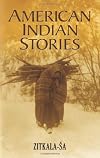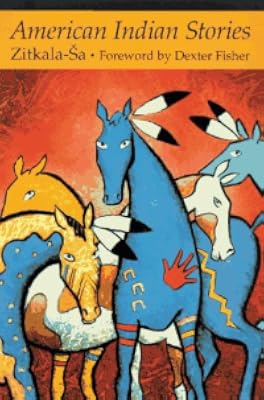
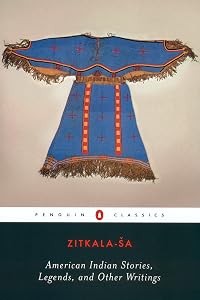
American Indian Stories
by Zitkala-Ša
On This Page
Description
"Bright and carefree, Zitkála-Sá grows up on the Yankton Sioux reservation in South Dakota with her mother until Quaker missionaries arrive, offering a free education to all Sioux children. The catch: the children must leave their parents behind and travel to Indiana. Curious about the world beyond the reservation, Zitkála-Sá begs her mother to let her go--and her mother, aware of the advantage that an education offers, reluctantly agrees. But the missionary school is not the adventure show more that Zitkála-Sá expected: the school is a strict one, her long hair is cut, and only English is spoken. She encounters racism and ridicule. Slowly, she adapts to her environment--excelling at her studies, winning prizes for essay-writing and oration. Vivid and poignant, this memoir is the story of an activist in the making, a woman whose extraordinary career partially inspired the events of Killers of the Flower Moon."-- show lessTags
Recommendations











Member Reviews
A mix of autobiographical sketches, traditional myths, no so traditional myths and an essay about the place of the Indians in the country make this book a bit weird. I enjoy all of those topics but the book does not differentiate between them - you do not know what exactly you are reading until you had started the essays/story.
It starts as expected - Zitkála-Šá recalls her early years and education - an almost common story of Native American children being carried away to be "civilized" in boarding schools. Or at least it is a pretty common one for this reader, more than 100 years after this book was first published. Despite its almost banality, it is still heartbreaking - writing later in life and after having taught in the schools show more herself, Zitkála-Šá manages to add a perspective while still keeping some of the innocence of the childhood memories and her early days as a teacher.
And then this memoir abruptly stops and she switches to tales and myths. These are all told from different perspectives and in different styles, drawing on the long oral traditions. In some ways they make the first part of the collection even more stark - for all the children like Zitkála-Šá who managed to preserve their own history and mythology, a lot of the kids who went to the boarding schools (and survived) ended up assimilated into the white culture - after all, that was what the education was all about.
The collection ends with a short essay about the interactions between the native population and the Spanish and English settlers which ends in an appeal for everyone to educate themselves about the Bureau of Indian Affairs and a report about it (which was not included - my guess is that it was widely available at the time - or foundable anyway).
Mint Editions had added a very short note about the author - I wish that they had commissioned a proper one. It helps understanding who Zitkála-Šá was and her work to appreciate some of what she has to say. So I looked elsewhere - the Wikipedia article is actually decent. show less
It starts as expected - Zitkála-Šá recalls her early years and education - an almost common story of Native American children being carried away to be "civilized" in boarding schools. Or at least it is a pretty common one for this reader, more than 100 years after this book was first published. Despite its almost banality, it is still heartbreaking - writing later in life and after having taught in the schools show more herself, Zitkála-Šá manages to add a perspective while still keeping some of the innocence of the childhood memories and her early days as a teacher.
And then this memoir abruptly stops and she switches to tales and myths. These are all told from different perspectives and in different styles, drawing on the long oral traditions. In some ways they make the first part of the collection even more stark - for all the children like Zitkála-Šá who managed to preserve their own history and mythology, a lot of the kids who went to the boarding schools (and survived) ended up assimilated into the white culture - after all, that was what the education was all about.
The collection ends with a short essay about the interactions between the native population and the Spanish and English settlers which ends in an appeal for everyone to educate themselves about the Bureau of Indian Affairs and a report about it (which was not included - my guess is that it was widely available at the time - or foundable anyway).
Mint Editions had added a very short note about the author - I wish that they had commissioned a proper one. It helps understanding who Zitkála-Šá was and her work to appreciate some of what she has to say. So I looked elsewhere - the Wikipedia article is actually decent. show less
 This review was written for LibraryThing Early Reviewers.
This is a very slim volume of stories, many of which are autobiographical, telling the common tale of a young Indian child taken from her family (with their consent) to be educated in white schools where (without their family's full knowledge) the "Indian" was systematically removed by denying them the use of their own language, changing their names, cutting their hair, substituting uncomfortable "American" garb for their familiar clothing (which had often been made specially for the journey with extra care), forcing them to adopt Christian religious practices, and through physical deprivation and abuse. The writing is often exquisite, with a 19th century feel to it, although the work was first published in 1926. There are also stories show more of coming of age, bravery, revenge and love in a more traditional story-telling style. There were one or two awkward transitions but mainly this was a highly approachable and enlightening read. The copy provided to me through Library Thing's Early Reviewers' program did not include the poems referred to by some earlier reviewers, and the final essay, "America's Indian Problem" seems to be missing some quoted material referenced by the author. Nor does this edition contain the essay "Why I am a Pagan", which I believe was part of the original publication. I have deducted a half-star from my rating for that reason.
The author came to understand the need to see her experiences as a gateway to a lifetime of trying to improve the lives of her own people. While she mourned the loss of native culture inherent in the system, she craved the education, and eventually attended both Earlham College and the New England Conservatory of Music. She became an accomplished musician and teacher, and a well known journalist and activist. She and her husband, Raymond Bonnin, founded the National Council of American Indians, and worked to gain full citizenship rights for people of all tribes. They are both buried in Arlington National Cemetery. show less
The author came to understand the need to see her experiences as a gateway to a lifetime of trying to improve the lives of her own people. While she mourned the loss of native culture inherent in the system, she craved the education, and eventually attended both Earlham College and the New England Conservatory of Music. She became an accomplished musician and teacher, and a well known journalist and activist. She and her husband, Raymond Bonnin, founded the National Council of American Indians, and worked to gain full citizenship rights for people of all tribes. They are both buried in Arlington National Cemetery. show less
This review was written for LibraryThing Early Reviewers.This is a reprint of a book originally published in 1921.
The cadence of the book reminds me of the cadence in which my Native father-in-law spoke.
The beginning of the book reads like an autobiography and I was startled when the book shifted to stories without any separation. It was confusing to be reading the life story of a young Indian girl and then start the next story where the main character is male. Also, the final story refers to a following quote. THe quote is missing.
Other than that the stories are very well written, you could almost hear the oral version in your head. The stories highlight the life of the Sioux and the truth about their treatment by the white man.
The cadence of the book reminds me of the cadence in which my Native father-in-law spoke.
The beginning of the book reads like an autobiography and I was startled when the book shifted to stories without any separation. It was confusing to be reading the life story of a young Indian girl and then start the next story where the main character is male. Also, the final story refers to a following quote. THe quote is missing.
Other than that the stories are very well written, you could almost hear the oral version in your head. The stories highlight the life of the Sioux and the truth about their treatment by the white man.
This review was written for LibraryThing Early Reviewers.This is a very moving collection of autobiographical stories and pieces that could be fictional or passed along from others. The beginning section of the book tells the author's story, and then it shifts into stories featuring others. There was no explanation for the change that I saw, so I'm not sure if these are stories that are biographical in nature, or more along the lines of fable. Regardless, the collection was a very enjoyable (and often poignant) read, with some eye-opening glimpses into what life was like in the Indian Schools.
Without any historical context, I was a little lost in this collection of stories and poetry that apparently first appeared in 1912 (there is nothing in the book itself to indicate this). There is an introduction, but it is focused primarily on the author's literary merits and controversies and does little to establish the setting or origin of these tales, some of which are (semi?) autobiographical and some of which are fiction.
The stories themselves are okay, if a little dull. The narrative voice is a bit remote, and sometimes the recitation of events don't really add up for me to a story per se.
There are also a few poems in the back, but I found those pretty opaque and had trouble getting through them.
Zitkála-Šá seems like a show more person who led an interesting life, but I think I would need a biography or some sort of annotated edition to get a full appreciation of her and her writing. show less
The stories themselves are okay, if a little dull. The narrative voice is a bit remote, and sometimes the recitation of events don't really add up for me to a story per se.
There are also a few poems in the back, but I found those pretty opaque and had trouble getting through them.
Zitkála-Šá seems like a show more person who led an interesting life, but I think I would need a biography or some sort of annotated edition to get a full appreciation of her and her writing. show less
A collection of short pieces, each one seemingly a careful distillation of various source materials. A result is that though the collection is short, it will take repeated and careful reading to fully appreciate the experiences documented, whether presented as personal memoir, narrative non-fiction, or essay.
While the gist is familiar from other readings, the particulars are significant. I'm more familiar with Oglala Lakota than Yankton Dakota, for instance.
//
Mint Editions reprints are unedited but newly typeset, unclear if this is the original title or if this is abridged in any way from prior edition(s). It does appear that a Bureau of Indian Affairs report cited and commented upon in the final essay, is itself omitted. USG reports show more are in the public domain, perhaps the original essay presumed ready accessibility to the report itself, but this is no longer true (a century after its publication). show less
While the gist is familiar from other readings, the particulars are significant. I'm more familiar with Oglala Lakota than Yankton Dakota, for instance.
//
Mint Editions reprints are unedited but newly typeset, unclear if this is the original title or if this is abridged in any way from prior edition(s). It does appear that a Bureau of Indian Affairs report cited and commented upon in the final essay, is itself omitted. USG reports show more are in the public domain, perhaps the original essay presumed ready accessibility to the report itself, but this is no longer true (a century after its publication). show less
This review was written for LibraryThing Early Reviewers.Both heart breaking and uplifting, Zitkala Su tells the story of her life with exquisite candor. From her days in a Sioux village, to her wider experience as an First Nations woman in a unfriendly world, Su give hers readers a chance to live her life with her. This is an invaluable collection of stories, perserveing for us the a time and a life and a nation long gone. Highly recommend.
This review was written for LibraryThing Early Reviewers.Members
- Recently Added By
Author Information

27+ Works 1,177 Members
Some Editions
Awards and Honors
Series
Belongs to Publisher Series
Work Relationships
Is contained in
Common Knowledge
- Canonical title
- American Indian stories, legends, and other writings; American Indian Stories
- Original publication date
- 1921
- People/Characters
- Zitkala-Ša (Gertrude Simmons Bonnin); Thaté Iyóhiwiŋ (Zitkala-Ša's mother, a/k/a Ellen Simmons); Warca-Ziwin; Wiyaka-Napbina (Wearer of a Feather Necklace); Dawée (Zitkala-Ša's brother a/k/a David Simmons); Judéwin (show all 12); Thowin; Devil; Tusee; Blue-Star Woman; High Flier (chief); Osseolo
- Important places
- Yankton Indian Reservation, South Dakota, USA; Wabash, Indiana, USA
- Epigraph
- There is no great; there is no small; in the mind that causeth all.
- First words
- Foreward
The nineteenth century marked a period of dramatic upheaval for many American Indian tribes, who, in the waks of America's great expansion westward, found themselves dispossessed of their ancestral lands, deplete... (show all)d in numbers, and confined to reservations.
A wigwam of weather-stained canvas stood at the base of some irregularly ascending hills. - Quotations
- As America has declared democracy abroad, so must we consistently practice it at home.
- Last words
- (Click to show. Warning: May contain spoilers.)He pressed his indelible thumb mark; his signature it was, upon the deed, and drove home with his son.
- Blurbers
- Fisher, Dexter
- Original language
- English
Classifications
Statistics
- Members
- 463
- Popularity
- 66,176
- Reviews
- 10
- Rating
- (3.68)
- Languages
- English, Spanish
- Media
- Paper, Audiobook, Ebook
- ISBNs
- 68
- ASINs
- 8