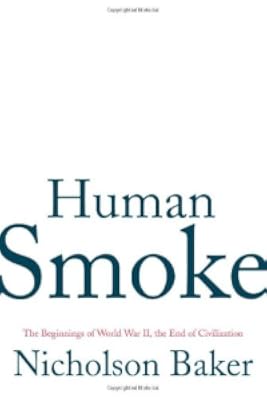
Human Smoke: The Beginnings of World War II, the End of Civilization
by Nicholson Baker
On This Page
Description
This wide-ranging, fresh perspective on the political and social landscape that gave rise to World War II delivers a moving indictment of the treasured myths that have romanticized much of the 1930s and 1940s. Incorporating meticulous research and well-documented sources--including newspaper and magazine articles, radio speeches, memoirs, and diaries--the book juxtaposes hundreds of interrelated moments of decision, brutality, suffering, and mercy. Vivid glimpses of political leaders and show more their dissenters illuminate the gradual, horrifying advance toward global war and holocaust. Baker's narrative unfolds gracefully, tragically, and persuasively, leaving a profound impact on our perceptions of historical events and mourning the unthinkable loss humanity has borne at its own hand.--From publisher description. show lessTags
Recommendations




Member Reviews
ZERO stars, actually, but there is no way to indicate that and I don't want anyone to think I didn't leave a rating!
This is the most maddening, dishonest book I have perhaps ever read--especially considering the importance of the subject. From a world of possible texts, Baker selects those that best demonize the British, such as accounts of apparently every bomb that missed its target, and leaves out essential facts, such as the Japanese invasion and occupation of Manchuria and the Hitler-Stalin pact, to somehow hint that Britain and America were mostly responsible for the length and horrors of WW2, including the Holocaust, which could have just been avoided by accepting peace with Germany and Japan.
A case in point: I'm disturbed at show more Baker's sections that describe China and Japan. They give the impression that somehow China was provoking Japan by having American assistance, by buying planes, etc. What is totally missing from Baker's book is that Japan had already invaded and occupied part of China--Manchuria--in 1932 and created the puppet state of Manchukuo (nominally ruled by Pu Yi, the now-grown Last Emperor as you may recall from the Bertolucci film). Therefore, it isn't any surprise that China might be a bit wary and looking to defend itself against the expansionist Japanese. To his credit, Baker does include the Japanese Rape of Nanking (Nanjing), but without the proper context, the truth of what happened is missing.
Context is a big issue throughout the book. This is not to say that it doesn't contain some interesting parts and some truth. I'm assuming that each entry is at least accurate in its depiction, so it lets us see what was being said by a variety of observers, including Western pacifists, a very naive Mahatma Gandhi, and people within the territory of the German Reich. Certainly, the sections that deal with Franklin Roosevelt's anti-Semitism are well-founded. And Baker loves to point out every folly of Winston Churchill, such as his initial admiration for Mussolini and Hitler. Churchill indeed got a lot wrong, but in the end, he helped save Britain and Western Civilization, as a much better book, Erik Larson's "The Splendid and the Vile" demonstrates. By any account, however, the Western indifference to the plight of the Jews that Baker highlights is appalling.
There is a second unforgivable omission: As he describes the lead-up to the German invasion of Poland, Baker totally neglects to mention the pact between Hitler and Stalin to divide the country up! I certainly hope no one is reading this book as their first introduction to World War II. Their understanding would be hopelessly muddled. Later, he mentions that Hitler talks about going to war against the Soviet Union because it is a potential ally of Britain--again without pointing out that up until the Nazi invasion, the Soviet Union was a nominal ally of Germany!
Ideally, one should separate politics from literature. Baker can be an interesting author; "The Mezzanine" is a classic of small details, for instance. But "Human Smoke" is such a treacherous, despicable pack of lies that I wouldn't be able to read anything else he has written with any amount of objectivity. show less
This is the most maddening, dishonest book I have perhaps ever read--especially considering the importance of the subject. From a world of possible texts, Baker selects those that best demonize the British, such as accounts of apparently every bomb that missed its target, and leaves out essential facts, such as the Japanese invasion and occupation of Manchuria and the Hitler-Stalin pact, to somehow hint that Britain and America were mostly responsible for the length and horrors of WW2, including the Holocaust, which could have just been avoided by accepting peace with Germany and Japan.
A case in point: I'm disturbed at show more Baker's sections that describe China and Japan. They give the impression that somehow China was provoking Japan by having American assistance, by buying planes, etc. What is totally missing from Baker's book is that Japan had already invaded and occupied part of China--Manchuria--in 1932 and created the puppet state of Manchukuo (nominally ruled by Pu Yi, the now-grown Last Emperor as you may recall from the Bertolucci film). Therefore, it isn't any surprise that China might be a bit wary and looking to defend itself against the expansionist Japanese. To his credit, Baker does include the Japanese Rape of Nanking (Nanjing), but without the proper context, the truth of what happened is missing.
Context is a big issue throughout the book. This is not to say that it doesn't contain some interesting parts and some truth. I'm assuming that each entry is at least accurate in its depiction, so it lets us see what was being said by a variety of observers, including Western pacifists, a very naive Mahatma Gandhi, and people within the territory of the German Reich. Certainly, the sections that deal with Franklin Roosevelt's anti-Semitism are well-founded. And Baker loves to point out every folly of Winston Churchill, such as his initial admiration for Mussolini and Hitler. Churchill indeed got a lot wrong, but in the end, he helped save Britain and Western Civilization, as a much better book, Erik Larson's "The Splendid and the Vile" demonstrates. By any account, however, the Western indifference to the plight of the Jews that Baker highlights is appalling.
There is a second unforgivable omission: As he describes the lead-up to the German invasion of Poland, Baker totally neglects to mention the pact between Hitler and Stalin to divide the country up! I certainly hope no one is reading this book as their first introduction to World War II. Their understanding would be hopelessly muddled. Later, he mentions that Hitler talks about going to war against the Soviet Union because it is a potential ally of Britain--again without pointing out that up until the Nazi invasion, the Soviet Union was a nominal ally of Germany!
Ideally, one should separate politics from literature. Baker can be an interesting author; "The Mezzanine" is a classic of small details, for instance. But "Human Smoke" is such a treacherous, despicable pack of lies that I wouldn't be able to read anything else he has written with any amount of objectivity. show less
This chronological collection of anecdotes documenting the lead-up into WWII adds up to a profound argument for pacifism. What emerges is not a Good War of Allies vs Axis but rather a global tragedy brought about by warmongers on all sides--Hitler's crazed aggression is joined by the distressingly Cheneyesque lies and manipulations of Churchill and even FDR.
There's the failure of the allies to allow more Jewish emigration out of Germany before it was too late, the multi-year British naval blockade to starve Germany and then occupied Europe, the American naval oil embargo on Japan and military collaboration with Japan's enemy China, FDR's decision to leave the entire American fleet holed up at Pearl Harbor despite numerous warnings that show more a Japanese attack was inevitable, and much more. There are also sane and reasonable pacifist voices, notably Gandhi, the American congresswoman Jeannette Rankin and numerous relief societies--even Herbert Hoover, who argued against the food embargos, sounds a note of humanity.
My one gripe is that the book wholly consists of discrete chunks, usually just a paragraph or so long, which are separated by far too much white space--probably half the paper surface in the paperback edition is blank. Seems like a waste and making the book about 40% bigger and heavier than it need be. show less
There's the failure of the allies to allow more Jewish emigration out of Germany before it was too late, the multi-year British naval blockade to starve Germany and then occupied Europe, the American naval oil embargo on Japan and military collaboration with Japan's enemy China, FDR's decision to leave the entire American fleet holed up at Pearl Harbor despite numerous warnings that show more a Japanese attack was inevitable, and much more. There are also sane and reasonable pacifist voices, notably Gandhi, the American congresswoman Jeannette Rankin and numerous relief societies--even Herbert Hoover, who argued against the food embargos, sounds a note of humanity.
My one gripe is that the book wholly consists of discrete chunks, usually just a paragraph or so long, which are separated by far too much white space--probably half the paper surface in the paperback edition is blank. Seems like a waste and making the book about 40% bigger and heavier than it need be. show less
An unusual and illuminating work. Personally I like the "snippet" approach as it gives a sense of relentless progression that fully rounded historical narratives rarely do. And as an alternative view of the march to war it is an eye opener. Personally I don't think Baker is trying to contend that "the pacificists were right", simply that there were possible paths to peace that were ignored, and the plans to subdue Japan way before Pearl Harbour is probably the most surprising theme. Of course its no surprise that some of the most venerated war leaders were hardly without flaws especially Churchill. And non of the bombing enthusiasts come out of the narrative well.
Imagine a history of World War II that dispensed with all the mythical afterglow and self-congratulatory propaganda and instead relied on contemporaneous newspaper articles and documents to build a fine-grained portrait of leaders and events. It's an attempt at objectivity, to be sure, but Baker isn't really interested in being "objective" because no one ever can be. Instead he's a pacifist who's interested in showing how nearly every leader involved was itching for war--more war and wider war and just more killing on a scale unknown beforehand. It's a compelling way to write an anti-war history, and an eye-opening one, where Churchill is more a bumbling drunken psychopath than a hero and all leaders are united in their antipathy to the show more anti-war movement. Written in short passages largely devoid of commentary, it's quite provocative, occasionally infuriating (fury at those involved in the war, not Baker), and at times virtually unput-downable. show less
Wow. I've read Baker before for everything from the musings about common objects and everyday life to what I think would be accurate to describe as pornographic works, but this is something else altogether. Baker pieces together information from news sources preceding and covering WWII. It really opened my eyes to see that while there were definitely really bad guys, there were very few good guys either. Roosevelt and Churchill were pretty racist and both it seems maneuvered to have America attacked by the Japanese in order to get American citizens to support the war. Whether the extent of the attack on Pearl Harbor was predicted isn't clear, but it does seem like it was an intentional sacrifice.
It also covers a lot of efforts by show more pacifists and while I think some of it was laudable, I think statements from Gandhi throughout were infuriating. Insisting that people should allow themselves to be slaughtered to defeat enemies through non-aggression seems like an easy thing to say when you're not the one in a concentration camp.
Baker doesn't inject much of his own writing in this or if he does he doesn't flavor it, it's mostly just a paragraph about something happening at a given time followed by the month date and year it happened. Some of it is a quote from someone alive at that time - a famous person's speech for example, other times it's an excerpt from a news release. But it's still very compelling reading and teaches you something that's not taught in history classes that are taught by the winners. show less
It also covers a lot of efforts by show more pacifists and while I think some of it was laudable, I think statements from Gandhi throughout were infuriating. Insisting that people should allow themselves to be slaughtered to defeat enemies through non-aggression seems like an easy thing to say when you're not the one in a concentration camp.
Baker doesn't inject much of his own writing in this or if he does he doesn't flavor it, it's mostly just a paragraph about something happening at a given time followed by the month date and year it happened. Some of it is a quote from someone alive at that time - a famous person's speech for example, other times it's an excerpt from a news release. But it's still very compelling reading and teaches you something that's not taught in history classes that are taught by the winners. show less
This is a unique work of history. It resembles a cut and paste job, with snippets arranged chronologically from prior to World War I to December 31, 1941. The short passages are made up of excerpts from correspondence, diaries, newspaper reporting, government documents, and transcripts, and the resulting mosaic reveals how nations and individuals--from pacifists to generals--coped with the onrush of the Second World War. Charles Lindbergh shows an affection from Nazi Germany and a reluctance to confront that is rather appalling. The author seems to be particularly fascinated by those who were against state violence, who were greater in number than previously reported. They, together with American isolationists (like Lindbergh), kept the show more United States from aiding Britain and France more fully as the world drifted to war, and there are a number of passages describing individuals who were convicted of not registering with the draft because of their philosophy. Ghandi also is quoted repeatedly, and he never sacrificed his non-violent views no matter how barbarous the war became. This is history as impressionism, and expescially sad are the comments of European Jews who did not seem to comprehend the awful fate that awaited them. What's clear though is that they were orphans, with no country willing to take them in as the great murder of a race picked up momentum. Also controversial, was Churchill's strategy of starving Europe immaterial of whether those who suffered were combatants or not. The pacifists sought to aid the hungry--including Herbert Hoover. Yet another facet that was presented was that prior to the "Battle of Britain," in which the Luftwaffe bombed British cities and civilians, England had been doing the same to German, Italian, and French cities for months. This detail seems hidden in the victory of the allies, but it confirms a pacifist truth: that in war no one comes away without blood on their hands and not much is accomplished. In this case, of course, without blood, Hitler and the Nazis would have survived, so sometimes non-violence can self-destructive. Ghandi would say that the lives of individuals who practice non-violence are less important than the principle. Also, that it might take decades to achieve a goal (and how many bodies?) So how rational is non-violence in the face of complete evil? show less
I found Nicholson Baker's unflinching presentation of the events leading up to America's entry into WWII a moving reminder that getting the facts is a slippery matter at the best of times; in war it is impossible. This makes me think that since we're always either leading up to war or in war, we can never hold onto the facts or apprehend the truth which seems to live forever on a metal table dying of multiple stab-wounds.
There were many moments in this book where I realized everything I knew was wrong. And this disturbed me, how newsreels seen in childhood with their plucky music and exploding skies could allow me to swallow the pattern whole; the template for many myths I never questioned. This book also helped me make sense of the show more Cold War, which I see now is a refinement of a half-century dedicated to making all out war against civilians acceptable.
I was also struck, while I read this book, by a sense of observing the barbarism of another time, like reading about a Roman general lining a wide dirt road with a thousand severed heads on sharp sticks. But I recognize this as a dangerous illusion fostered by living in a new century. We are no different. The dedicated pacifists and non-resistants (given rare tribute in this book) know this all too well as they work to convince us that our baser selves are not human nature. That is propaganda. We are better than that, and we are capable of doing less wrong.
Perhaps, like me, you have put yourself in that civilized club of the less wrong. You do not need such a lesson, and you would prefer such people stop their dull preaching. But pause a moment to count the explosions at the cineplex, and think about the raised middle fingers and audible fuck-yous that pepper any given day among your fellow consumers. The next war lives in those fingers. show less
There were many moments in this book where I realized everything I knew was wrong. And this disturbed me, how newsreels seen in childhood with their plucky music and exploding skies could allow me to swallow the pattern whole; the template for many myths I never questioned. This book also helped me make sense of the show more Cold War, which I see now is a refinement of a half-century dedicated to making all out war against civilians acceptable.
I was also struck, while I read this book, by a sense of observing the barbarism of another time, like reading about a Roman general lining a wide dirt road with a thousand severed heads on sharp sticks. But I recognize this as a dangerous illusion fostered by living in a new century. We are no different. The dedicated pacifists and non-resistants (given rare tribute in this book) know this all too well as they work to convince us that our baser selves are not human nature. That is propaganda. We are better than that, and we are capable of doing less wrong.
Perhaps, like me, you have put yourself in that civilized club of the less wrong. You do not need such a lesson, and you would prefer such people stop their dull preaching. But pause a moment to count the explosions at the cineplex, and think about the raised middle fingers and audible fuck-yous that pepper any given day among your fellow consumers. The next war lives in those fingers. show less
Members
- Recently Added By
Published Reviews
Was Sir Winston Churchill an oafish, bloodthirsty, sadistic, hypocritical, anti-Semitic alcoholic? The American novelist Nicholson Baker—whose previous works have been about phone sex and masturbation—certainly seems to think so, for Human Smoke is intended as nonfiction.
The book has been lauded by the Irish novelist Colm Tóibin in a New York Times review—“riveting and show more fascinating”—and even the normally sane Simon Winchester has described it as “a quite extraordinary book—impossible to put down, impossible to forget.” Yet once one works out the sly techniques by which the author tries to persuade the reader that Churchill was a foul warmonger, the book is anything but. It uses the technique of juxtaposing bald quotations, ripped out of context, to try to place Churchill on the same moral plane as Adolf Hitler. . . .
A curious torpor overcomes this reader about half way through this book, due to the sheer inexorability of the bias; if it had been more nuanced, better researched, or more intelligent, then interest might have been sustained, but no. Sometimes the sheer ignorance of some of Baker’s statements reignites interest: “If Hitler moved East, England would have no war to fight.” The author clearly believes that Britain should have accepted Hitler’s offer of peace with Britain in August 1940, not realizing that it was an obvious trap designed to facilitate his coming invasion of the USSR, for which he was contemporaneously ordering his senior Wehrmacht Staff to plan.
It is impossible to escape the conclusion that Baker would have done better to stick to phone sex and masturbation rather than to undertake this foray into nonfiction. The book ends in December 1941, after Japan attacked Pearl Harbor as a result of President Roosevelt’s supposed “provocations” of Tokyo. Needless to say Baker concentrates . . . on the “dozens” of Honolulu civilians who fell victim to “misfiring American anti-aircraft shells”. show less
The book has been lauded by the Irish novelist Colm Tóibin in a New York Times review—“riveting and show more fascinating”—and even the normally sane Simon Winchester has described it as “a quite extraordinary book—impossible to put down, impossible to forget.” Yet once one works out the sly techniques by which the author tries to persuade the reader that Churchill was a foul warmonger, the book is anything but. It uses the technique of juxtaposing bald quotations, ripped out of context, to try to place Churchill on the same moral plane as Adolf Hitler. . . .
A curious torpor overcomes this reader about half way through this book, due to the sheer inexorability of the bias; if it had been more nuanced, better researched, or more intelligent, then interest might have been sustained, but no. Sometimes the sheer ignorance of some of Baker’s statements reignites interest: “If Hitler moved East, England would have no war to fight.” The author clearly believes that Britain should have accepted Hitler’s offer of peace with Britain in August 1940, not realizing that it was an obvious trap designed to facilitate his coming invasion of the USSR, for which he was contemporaneously ordering his senior Wehrmacht Staff to plan.
It is impossible to escape the conclusion that Baker would have done better to stick to phone sex and masturbation rather than to undertake this foray into nonfiction. The book ends in December 1941, after Japan attacked Pearl Harbor as a result of President Roosevelt’s supposed “provocations” of Tokyo. Needless to say Baker concentrates . . . on the “dozens” of Honolulu civilians who fell victim to “misfiring American anti-aircraft shells”. show less
added by TomVeal
Author Information

30+ Works 14,350 Members
Nicholson Baker lives in Maine. Nicholson Baker was born in New York City on January 7, 1957. He briefly attended the Eastman School of Music before receiving a B.A. in philosophy from Haverford College. He is the author of both fiction and nonfiction works including The Mezzanine (1988); Room Temperature (1990); Vox (1992); The Fermata (1994); show more The Everlasting Story of Nory (1998); Checkpoint (2004); and The Anthologist (2009). His nonfiction work, Double Fold: Libraries and the Assault on Paper, won a National Book Critics Circle Award in 2001. (Bowker Author Biography) show less
Awards and Honors
Common Knowledge
- Canonical title*
- Menneskerøyk : Krigens fødsel, sivilisasjonens død
- Original title
- Human Smoke: The Beginnings of World War II, the End of Civilization
- Original publication date
- 2008
- People/Characters
- Winston Churchill; Adolf Hitler; Franklin Delano Roosevelt
- Important events
- World War II; Holocaust
- First words
- Alfred Nobel, the manufacturer of explosives, was talking to his friend the Baroness Bertha von Suttner, author of Lay Down Your Arms.
- Last words
- (Click to show. Warning: May contain spoilers.)"There is still time; we still have some time left."
- Blurbers
- Ellsberg, Daniel; Winchester, Simon; Johnson, Chalmers; Alperovitz, Gar
*Some information comes from Common Knowledge in other languages. Click "Edit" for more information.
Classifications
- Genres
- History, Nonfiction, General Nonfiction
- DDC/MDS
- 940.5311 — History & geography History of Europe History of Europe 1918- World War II, 1939-1945 Social, political, economic history; Holocaust Causes
- LCC
- D741 .B255 — History of Europe, Asia, Africa and Oceania History (General) World War II (1939-1945)
- BISAC
Statistics
- Members
- 1,000
- Popularity
- 26,172
- Reviews
- 34
- Rating
- (3.85)
- Languages
- 8 — English, French, German, Italian, Norwegian (Bokmål), Norwegian, Portuguese, Spanish
- Media
- Paper, Audiobook, Ebook
- ISBNs
- 20
- ASINs
- 11