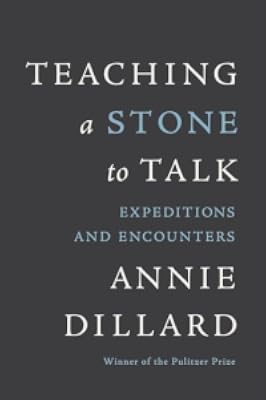
Teaching a Stone to Talk: Expeditions and Encounters
by Annie Dillard
On This Page
Description
Here, in this compelling assembly of writings, Pulitzer Prize-winning author Annie Dillard explores the world of natural facts and human meanings.Tags
Recommendations






Member Reviews
Annie Dillard sees things others don't see; she also sees things differently than the rest of us, sometimes. Her prose can be gorgeous, but it can also be baffling, and I just don't get what she's talking about all the time. That last bit is almost a direct quote from Eudora Welty, who said the same thing upon reading some of Dillard's early work. She was referring to Dillard's personification of inanimate objects, I believe, but I sort of get that part. (Rocks, after all. Seriously. "It is all, God help us, a matter of rocks." )
Where she loses me is in her deeper philosophical musings, which are sometimes so personal (like poetry) that I doubt if anyone understands all of them. But when she touches a chord, it vibrates right down to show more the soles of my feet. And she makes some very pertinent observations regarding God, spirituality and nature. This, in particular: "God does not demand that we ...lose ourselves and turn from all that is not him. God needs nothing, asks nothing, and demands nothing, like the stars....You do not have to sit outside in the dark. If, however, you want to look at the stars, you will find that darkness is necessary. But the stars neither require nor demand it."
This collection of essays, published several years after her Pulitzer Prize winning Pilgrim at Tinker Creek, is alternately brilliant, boring (I've had it with tales of polar expeditions---it's not really her fault), entertaining and enlightening. I loved her unexpected mind meld with a weasel; her inability to tear herself away from the spectacle of sea birds diving for the openings of their nests in crevices of a sheer lava cliff face in the Galapagos Islands (she missed the boat back); her description of the sense of disorientation even an educated 20th century human can experience in the face of a total solar eclipse. In fact, with the exception of "An Expedition to the Pole", there is not a single selection in this volume that I do not look forward to revisiting, often. show less
Where she loses me is in her deeper philosophical musings, which are sometimes so personal (like poetry) that I doubt if anyone understands all of them. But when she touches a chord, it vibrates right down to show more the soles of my feet. And she makes some very pertinent observations regarding God, spirituality and nature. This, in particular: "God does not demand that we ...lose ourselves and turn from all that is not him. God needs nothing, asks nothing, and demands nothing, like the stars....You do not have to sit outside in the dark. If, however, you want to look at the stars, you will find that darkness is necessary. But the stars neither require nor demand it."
This collection of essays, published several years after her Pulitzer Prize winning Pilgrim at Tinker Creek, is alternately brilliant, boring (I've had it with tales of polar expeditions---it's not really her fault), entertaining and enlightening. I loved her unexpected mind meld with a weasel; her inability to tear herself away from the spectacle of sea birds diving for the openings of their nests in crevices of a sheer lava cliff face in the Galapagos Islands (she missed the boat back); her description of the sense of disorientation even an educated 20th century human can experience in the face of a total solar eclipse. In fact, with the exception of "An Expedition to the Pole", there is not a single selection in this volume that I do not look forward to revisiting, often. show less
In this collection of fourteen essays Dillard brings her almost forensic observation of natural world as well as a keen perception of the smallest detail to a wide variety of subjects. Starting with her thoughts on a solar eclipse that she travels to see in Yakima, we accompany her on her a journey to the Appalachian Mountains and all the way to the Galapagos Islands. With her we see the world through the eyes of a weasel and take a walk from her home. We also meet the man who inspired the title of the book, who is Teaching a stone to speak; most will think this a futile gesture, but as Dillard explains, it is his way of communing with the natural world at the pace he desires.
The silence is all there is. It is the alpha and the show more omega.
There is a strong spiritual dimension to her sparse but eloquent prose. It is beyond me how she manages to pack so much meaning into so few words. Her childlike fascination with the world around is evident in the book and she manages to deftly entwine this with themes of exploration and discovery and how we can use it to watch and observe the things that happen around us. I particularly liked the essay on lenses, how it is something that you have to master before you can use it to see the far away and the near. Until now I have never read any of her books before, now will be working my way through her non-fiction back catalogue. show less
The silence is all there is. It is the alpha and the show more omega.
There is a strong spiritual dimension to her sparse but eloquent prose. It is beyond me how she manages to pack so much meaning into so few words. Her childlike fascination with the world around is evident in the book and she manages to deftly entwine this with themes of exploration and discovery and how we can use it to watch and observe the things that happen around us. I particularly liked the essay on lenses, how it is something that you have to master before you can use it to see the far away and the near. Until now I have never read any of her books before, now will be working my way through her non-fiction back catalogue. show less
"There is always some creature going about its beautiful business." Whether in the Roanoke Valley, the Galapagos Islands, a hilltop in the Yakima Valley, or the nave of a Catholic church, Annie Dillard always captures the essence of any experience and shares them in her unique and eloquent way. Teaching a Stone to Talk is laced with science, history, philosophy, and in Dillard fashion, a bit of humor. As author Ernest Zulia said of Dillard, "...This incredible mind and this incredible imagination and this incredible intellect that she [has]. She’s just something else, funny and raunchy.” It makes me sad that Dillard no longer writes due to short-term memory loss, but she has given us an amazing body of work that I will no doubt show more continue to enjoy. show less
"There is always some creature going about its beautiful business." Whether in the Roanoke Valley, the Galapagos Islands, a hilltop in the Yakima Valley, or the nave of a Catholic church, Annie Dillard always captures the essence of any experience and shares them in her unique and eloquent way. Teaching a Stone to Talk is laced with science, history, philosophy, and in Dillard fashion, a bit of humor. As author Ernest Zulia said of Dillard, "...This incredible mind and this incredible imagination and this incredible intellect that she [has]. She’s just something else, funny and raunchy.” It makes me sad that Dillard no longer writes due to short-term memory loss, but she has given us an amazing body of work that I will no doubt show more continue to enjoy. show less
Returning to Dillard awakens me. She reminds me of the interminable mystery of life and the power of careful observation that is stoic, measured, and graceful.
I choose to believe Annie Dillard understands something fundamentally beyond language that lies deep in the interstices and knitting of experience and reflection, and is trying to communicate it in all her writing. In Alexander Chee’s *How to Write an Autobiographical Novel*, he wrote that she said once in her writing seminar, something like: “Write what you would read to someone dying.”
There is some beautiful prose and imagery within each essay. And some of the connections between different things that Dillard makes are interesting and give insight into her thinking. But, there are also essays in the book where even by the end of the essay I have a hard time understanding the link between the two things.
While I can appreciate the jumping back and forth between things can give a sense of how our thought process can actually be at times, I did often find it hard to follow. That being said, some of the essays, especially the shorter ones, were not like this.
Looking at individual sentences or paragraphs, I love some of Dillard's writing, but looking at whole essays, I have mixed feelings about whether I want to read more show more of her work or not.
I give this book 2.5 stars on a first reading. show less
While I can appreciate the jumping back and forth between things can give a sense of how our thought process can actually be at times, I did often find it hard to follow. That being said, some of the essays, especially the shorter ones, were not like this.
Looking at individual sentences or paragraphs, I love some of Dillard's writing, but looking at whole essays, I have mixed feelings about whether I want to read more show more of her work or not.
I give this book 2.5 stars on a first reading. show less
Members
- Recently Added By
Lists

Sonlight Books
1,487 works; 25 members

Mo's Reading List
218 works; 1 member

Mo's Reading List (Abridged)
75 works; 1 member

Vlogbrothers Book Recommendations
307 works; 4 members
Author Information

32+ Works 22,163 Members
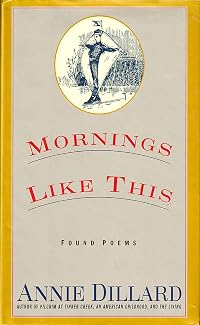
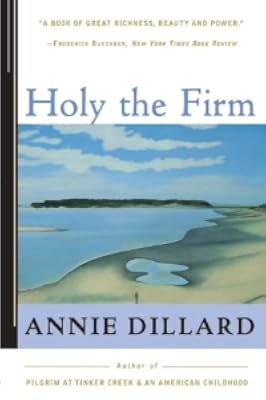
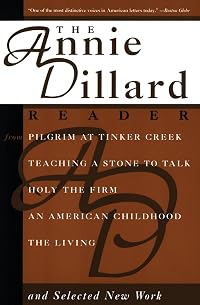
Annie Dillard was born Annie Doak in Pittsburgh, Pennsylvania on April 30, 1945. She received a B.A and an M.A. in English from Hollins College. She writes both fiction and nonfiction books including Tickets for a Prayer Wheel, Holy the Firm, Teaching a Stone to Talk, The Living, and Mornings Like This: Found Poems. She won the 1975 Pulitzer Prize show more for General Nonfiction for Pilgrim at Tinker Creek. She wrote an autobiography entitled An American Childhood. Her work also has appeared in such periodicals as The Atlantic, Harper's Magazine, The Christian Science Monitor, and Cosmopolitan. She taught for 21 years in the English department of Wesleyan University. (Bowker Author Biography) show less
Series
Belongs to Publisher Series
Perennial Library (CN1072)
Work Relationships
Contains
Is abridged in
Common Knowledge
- Canonical title
- Teaching a Stone to Talk: Expeditions and Encounters
- Original publication date
- 1982
- Dedication
- For Gary
- First words
- It had been like dying, that sliding down the mountain pass.
- Last words
- (Click to show. Warning: May contain spoilers.)The gust crosses the river and blackens the water where it passes, like a finger closing slats.
Classifications
Statistics
- Members
- 1,854
- Popularity
- 11,688
- Reviews
- 21
- Rating
- (4.07)
- Languages
- 7 — Dutch, English, French, German, Portuguese, Spanish, Swedish
- Media
- Paper, Audiobook, Ebook
- ISBNs
- 22
- ASINs
- 14