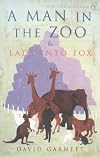
Lady Into Fox and a Man in the Zoo
by David Garnett
On This Page
Description
A classic duo from Garnett: after a quarrel with his lover, when she exclaims he should be kept in the zoo, John moves into a cage between an orang-utan and a chimpanzee, and becomes the zoo's star exhibit; and a Victorian vicar is aghast when his beloved new wife turns into a fox.Tags
Recommendations

















Member Reviews
The title and first couple of pages state the premise: a tragi-comic magical-realist fable about the consequences of the sudden and unexplained transformation of newlywed Silvia Tebrick (neé Fox), both for her, and her devoted and religiously devout husband, Richard.
“Wonderful or supernatural events are not so uncommon, rather they are irregular in their incidence. Thus there may be not one marvel to speak of in a century, and then often enough comes a plentiful crop of them; monsters of all sorts swarm suddenly upon the earth, comets blaze in the sky, eclipses frighten nature, meteors fall in rain, while mermaids and sirens beguile, and sea-serpents engulf every passing ship, and terrible cataclysms beset humanity.”
Garnett tells show more his tale almost prosaically and assures readers that it’s a true story, “fully proved”, which leaves sceptical readers with lots of interpretations. The most obvious parallels are caring for a loved-one who has a catastrophic injury of some kind, or a more gradual decline, like Alzheimer’s: how unconditional can love be? Richard tells himself, “memories will not help me here”, but then tells Silvia the opposite, “Try and remember the past, my darling”, as her vulpine nature comes to the fore and he wrestles with the idea of letting go of who he most loves.
Image: “Realising that the silly ducks thought his wife a fox indeed and were alarmed on that account he found painful that spectacle which to others might have been amusing.” Woodcut by Ray Garnett
Lots to ponder
“For when we are overcome with the greatest sorrow we act not like men or women but like children whose comfort in all their troubles is to press themselves against their mother's breast, or if she be not there to hold each other tight in one another's arms.”
Given the Bloomsbury connection (see below), there are animalistic, earthy, and sexual analogies as well as questions about the nature of womanhood:
“‘Are you a monster in your soul as well as in your body? Have you forgotten what it is to be a woman?’...
He could not bear to witness her pain and yet must take pleasure in it as it fed his hopes of her one day returning to be a woman.”
Or it could all be a delusion, born of shock and grief at his wife running off with someone else, as local gossip assumes.
I couldn't quite decide (invariably a good thing, imo) whether Richard's love was extraordinarily noble and unselfish, or a bit kinky - though what consenting adults do in private is a matter only for them.
And of course, it makes a case against fox-hunting (not that I needed persuading).
“‘True happiness,’ he said to himself, ‘is to be found in bestowing love.’”
Bloomsbury Group
Garnett was one of the Bloomsbury Group, who infamously “lived in squares, painted in circles, and loved in triangles”, as well as living at Charleston, Sussex. This novella was illustrated with woodcuts by his wife, Ray (Rachel) and dedicated to his former lover, Duncan Grant. When Duncan Grant and Vanessa Bell’s daughter, Angelica, was born, Garnett, then 26, joked about marrying her one day - and he did! When she was around four, he wrote this story, including:
“His favourite was Angelica (who reminded him so much of her mother in her pretty ways). ”
This was published in 1922, but set 1879-1880.
Image: Woodcut of fox and cubs by Ray Garnett
See also
Humans transforming to other creatures, and creatures who seem to have human understanding, feature in folklore, fairytales, through to contemporary fiction. A few examples that I’ve reviewed:
• DH Lawrence was well-known to the Bloomsbury Group, and critical of them. See his story, The Fox, which I reviewed HERE which, like this, uses eyes to tell much of the story.
• Inevitably, one thinks of Kafka’s The Metamorphosis, which I reviewed HERE: a similar starting point, but with very different results.
• Ian McEwan’s Brexit-themed inversion of Kafka, The Cockroach, which I reviewed HERE.
• Saki often features magical-realist animals. For example, in Laura, which I reviewed HERE. I’ve reviewed Saki more generally, with links to individual stories, HERE.
• Daisy Johnson's Fen is a collection of mythic, mystical short stories, focused on young women, and set in the Fens of contemporary England. One of the stories there has echoes of this. See my review HERE.
• The fact I read of eclipses in the opening paragraph, the day before a major one in north America, when I’m fondly remembering travelling to Oregon for the 2017 one (see my review HERE), was a delightful coincidence - or maybe a “wonderful or supernatural event”?
Short story club
I read this in Black Water: The Anthology of Fantastic Literature, by Alberto Manguel, from which I’m reading one story a week with The Short Story Club, starting 4 September 2023.
You can read this story here.
You can join the group here. show less
“Wonderful or supernatural events are not so uncommon, rather they are irregular in their incidence. Thus there may be not one marvel to speak of in a century, and then often enough comes a plentiful crop of them; monsters of all sorts swarm suddenly upon the earth, comets blaze in the sky, eclipses frighten nature, meteors fall in rain, while mermaids and sirens beguile, and sea-serpents engulf every passing ship, and terrible cataclysms beset humanity.”
Garnett tells show more his tale almost prosaically and assures readers that it’s a true story, “fully proved”, which leaves sceptical readers with lots of interpretations. The most obvious parallels are caring for a loved-one who has a catastrophic injury of some kind, or a more gradual decline, like Alzheimer’s: how unconditional can love be? Richard tells himself, “memories will not help me here”, but then tells Silvia the opposite, “Try and remember the past, my darling”, as her vulpine nature comes to the fore and he wrestles with the idea of letting go of who he most loves.
Image: “Realising that the silly ducks thought his wife a fox indeed and were alarmed on that account he found painful that spectacle which to others might have been amusing.” Woodcut by Ray Garnett
Lots to ponder
“For when we are overcome with the greatest sorrow we act not like men or women but like children whose comfort in all their troubles is to press themselves against their mother's breast, or if she be not there to hold each other tight in one another's arms.”
Given the Bloomsbury connection (see below), there are animalistic, earthy, and sexual analogies as well as questions about the nature of womanhood:
“‘Are you a monster in your soul as well as in your body? Have you forgotten what it is to be a woman?’...
He could not bear to witness her pain and yet must take pleasure in it as it fed his hopes of her one day returning to be a woman.”
Or it could all be a delusion, born of shock and grief at his wife running off with someone else, as local gossip assumes.
I couldn't quite decide (invariably a good thing, imo) whether Richard's love was extraordinarily noble and unselfish, or a bit kinky - though what consenting adults do in private is a matter only for them.
And of course, it makes a case against fox-hunting (not that I needed persuading).
“‘True happiness,’ he said to himself, ‘is to be found in bestowing love.’”
Bloomsbury Group
Garnett was one of the Bloomsbury Group, who infamously “lived in squares, painted in circles, and loved in triangles”, as well as living at Charleston, Sussex. This novella was illustrated with woodcuts by his wife, Ray (Rachel) and dedicated to his former lover, Duncan Grant. When Duncan Grant and Vanessa Bell’s daughter, Angelica, was born, Garnett, then 26, joked about marrying her one day - and he did! When she was around four, he wrote this story, including:
“His favourite was Angelica (who reminded him so much of her mother in her pretty ways). ”
This was published in 1922, but set 1879-1880.
Image: Woodcut of fox and cubs by Ray Garnett
See also
Humans transforming to other creatures, and creatures who seem to have human understanding, feature in folklore, fairytales, through to contemporary fiction. A few examples that I’ve reviewed:
• DH Lawrence was well-known to the Bloomsbury Group, and critical of them. See his story, The Fox, which I reviewed HERE which, like this, uses eyes to tell much of the story.
• Inevitably, one thinks of Kafka’s The Metamorphosis, which I reviewed HERE: a similar starting point, but with very different results.
• Ian McEwan’s Brexit-themed inversion of Kafka, The Cockroach, which I reviewed HERE.
• Saki often features magical-realist animals. For example, in Laura, which I reviewed HERE. I’ve reviewed Saki more generally, with links to individual stories, HERE.
• Daisy Johnson's Fen is a collection of mythic, mystical short stories, focused on young women, and set in the Fens of contemporary England. One of the stories there has echoes of this. See my review HERE.
• The fact I read of eclipses in the opening paragraph, the day before a major one in north America, when I’m fondly remembering travelling to Oregon for the 2017 one (see my review HERE), was a delightful coincidence - or maybe a “wonderful or supernatural event”?
Short story club
I read this in Black Water: The Anthology of Fantastic Literature, by Alberto Manguel, from which I’m reading one story a week with The Short Story Club, starting 4 September 2023.
You can read this story here.
You can join the group here. show less
'where once his wife had been the moment before, was a small fox of a very bright red'
By sally tarbox on 16 Jan. 2012
Format: Paperback
Lady into Fox, winner of the 1922 James Tait Black Prize, is an absolutely beautiful tale. Although the theme of a young newly wed woman metamorphosing into a fox sounds improbable, Garnett writes in a calm and factual manner without a trace of whimsy. From their first days together when Silvia still retains most of her human characteristics, to the first signs of her becoming a real vixen (watching her pet dove with a 'strange eagerness' when her husband is trying to read to her)...How will their relationship develop?
A Man at the Zoo is an interesting concept but lacks the magic of the other. When a show more young couple have a blazing row at London Zoo, the man decides to go and volunteer himself as an exhibit for the ape house where he becomes a great attraction... Perhaps the somewhat unlikeable young couple spoil the story (I felt John would do better in his cage than back with Josephine) also the silliness of some situations (notably Josephine offering to go and live in a cage with him). But certainly a story to make you think. show less
By sally tarbox on 16 Jan. 2012
Format: Paperback
Lady into Fox, winner of the 1922 James Tait Black Prize, is an absolutely beautiful tale. Although the theme of a young newly wed woman metamorphosing into a fox sounds improbable, Garnett writes in a calm and factual manner without a trace of whimsy. From their first days together when Silvia still retains most of her human characteristics, to the first signs of her becoming a real vixen (watching her pet dove with a 'strange eagerness' when her husband is trying to read to her)...How will their relationship develop?
A Man at the Zoo is an interesting concept but lacks the magic of the other. When a show more young couple have a blazing row at London Zoo, the man decides to go and volunteer himself as an exhibit for the ape house where he becomes a great attraction... Perhaps the somewhat unlikeable young couple spoil the story (I felt John would do better in his cage than back with Josephine) also the silliness of some situations (notably Josephine offering to go and live in a cage with him). But certainly a story to make you think. show less
"A quiet English couple's life is upended when the wife transforms, inexplicably, into a fox. As she grows wilder, her husband must confront the limits of love, loyalty, and civilized behavior. Blending fantasy and realism, this surreal tale explores the fragile boundary between human and animal, reason and instinct."
"Lady Into Fox" was pretty good. It makes you think a lot about being a fox in England when people did fox hunting with dogs. Both these novellas are really about love. If your person was turned into a fox, would you still love them? If your person was in a zoo, would you marry them anyway and go and live in the zoo with them? Entertaining, but a bit fluffy.
Two novellas. In the first a man's wife suddenly turns into a fox. He's quite upset about it. Apparently David Garnett was with his wife, Ray, in a woodland one day trying to see some fox cubs, and he said that it was no use, that the only way they would see any foxes was if she turned into a fox suddenly, and that this wouldn't surprise him. So she said he should write it. She was an illustrator, and made excellent woodcuts to go with the book, included in this edition. Nonetheless he dedicated it to his lover Duncan Grant -- oh those Bloomsburyites. The second story is about a man who moves into a zoo after an argument with his fiancee. It's very good stuff.
Silvia, la protagonista de esta novela tan singular como sabiamente alejada de la cursilería, se casa con el terrateniente Richard Tebrick, tras un breve noviazgo, y después de la luna de miel se instalan en la hermosa finca de Rylands, en el condado de Oxfordshire; la casa de los Tebrick es la única mansión en kilómetros a la redonda.
Pocos meses después, una tarde, salen a pasear por el bosquecillo de la colina cercana. Aún se comportan como enamorados: van a todas partes juntos y pasean de la mano. Ese día se oye a lo lejos una jauría de perros y, a continuación, la trompa de los cazadores; así que Richard acelera el paso hasta llegar a la linde del bosque, para no perderse el espectáculo. Desde allí dispondrán de show more una buena panorámica si los zorros aparecen.
Su esposa se queda atrás, y él, tomándola de la mano, casi la arrastra. Antes de que alcancen la linde, ella da un violento tirón acompañado de un alarido y, de inmediato, él vuelve la cabeza…
Las historias de transformaciones son una manera de dotar de sentido al mundo, de ver las conexiones que el materialismo de nuestra era pasa por alto, y que pertenecen a un universo ordenado no sólo por la razón, sino también por la imaginación, un universo en el que el cambio es la única constante. show less
Pocos meses después, una tarde, salen a pasear por el bosquecillo de la colina cercana. Aún se comportan como enamorados: van a todas partes juntos y pasean de la mano. Ese día se oye a lo lejos una jauría de perros y, a continuación, la trompa de los cazadores; así que Richard acelera el paso hasta llegar a la linde del bosque, para no perderse el espectáculo. Desde allí dispondrán de show more una buena panorámica si los zorros aparecen.
Su esposa se queda atrás, y él, tomándola de la mano, casi la arrastra. Antes de que alcancen la linde, ella da un violento tirón acompañado de un alarido y, de inmediato, él vuelve la cabeza…
Las historias de transformaciones son una manera de dotar de sentido al mundo, de ver las conexiones que el materialismo de nuestra era pasa por alto, y que pertenecen a un universo ordenado no sólo por la razón, sino también por la imaginación, un universo en el que el cambio es la única constante. show less
Sep 27, 2022Spanish
Ratings
Members
- Recently Added By
Author Information

44+ Works 1,324 Members
Some Editions
Awards and Honors
Awards
Notable Lists
Series
Belongs to Publisher Series
Work Relationships
Contains
Common Knowledge
- Original publication date
- 1922
- People/Characters
- Silvia Tebrick; Richard Tebrick; John Cromartie; Josephine Lackett
- First words
- Wonderful or supernatural events are not so uncommon, rather they are irregular in their incidence. (from 'Lady into Fox')
- Last words
- (Click to show. Warning: May contain spoilers.)The crowd was chiefly composed of couples like themselves. (from 'A Man in the Zoo')
- Disambiguation notice
- This is the anthology containing: Lady into Fox, and A ma in the zoo. Stand alone titles should be listed seperately.
Classifications
Statistics
- Members
- 116
- Popularity
- 279,081
- Reviews
- 6
- Rating
- (3.64)
- Languages
- English, German, Hungarian, Spanish
- Media
- Paper
- ISBNs
- 7
- ASINs
- 6