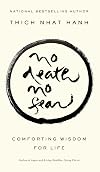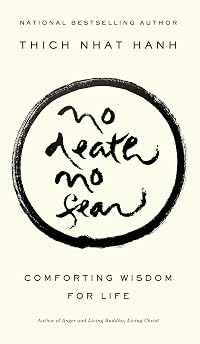
No Death, No Fear: Comforting Wisdom for Life
by Thich Nhat Hanh
On This Page
Description
"Our biggest fear," says poet and Zen master Thich Nhat Hanh, "is that we will become nothing when we die. If we think that we cease to exist when we die, we have not looked very deeply at ourselves. "It is possible to live every day without being afraid of what happens when we die. Through a close examination of who we are, how we exist, and how we live, we can conquer our fear to live a freer and happier life. Through stories and lucid teachings, Thich Naht Hanh brings peace of mind to a show more difficult subject, and shows is how to live a happier life, free of fear. show lessTags
Recommendations



Member Reviews
A series of short, profound, beautifully written, and inspiring pieces of prose that together illustrate how to live a rich and worthwhile life, while living in harmony with the world around us. From the internationally renowned and prolific Zen Master, the late Thich Nhất Hạnh (1926-2022), or “Thay”, the name by which the author is known to his followers (translation: “teacher”).
NO DEATH, NO FEAR is a primer on the religion/philosopy of Buddhism, valuable to both beginning and experienced practitioners, from one who lived up to the its beliefs for most of his long life. And whether you can adjust your own thinking and outlook to accept his tenets winds up being beside the point. I promise you that you will WANT to think as show more Thay does, you will WANT to believe what he believes, and you will WANT to live the way he lived.
In fewer than 200 pages, “Thay” explains how each one of us can recognize and internalize a bigger picture of life in this world, not just in the present moment, but also in connection with the past and future. As the book title suggests, he argues that we can all live without fear, guilt, anxiety, and sadness — if we are able to see THE larger truth that everything is connected and each of us is a continuing part of our universe at all times. Even after death.
The language is beautiful. Each passage is a nugget that merits deep reflection. If I had to choose a favorite part, it would be the last chapter, “Accompanying the Dying”, in which Thay provides specific and concrete ways to comfort someone who is the final days or hours of life. The book would make worthwhile reading for this section alone.
My only criticism of the book is that because it appears to be a collection of Thai’s thoughts and teachings, it begins to feel a bit repetitious reading it as a whole. Much of his wisdom is repeated multiple times. It might be better to read the book slowly, over a long period, taking the time to consider each passage individually. Perhaps with a partner to enrich discussion.
Bottom Line: if only everyone read this book and followed Thay’s path, the world would be in a much better place than it is. show less
NO DEATH, NO FEAR is a primer on the religion/philosopy of Buddhism, valuable to both beginning and experienced practitioners, from one who lived up to the its beliefs for most of his long life. And whether you can adjust your own thinking and outlook to accept his tenets winds up being beside the point. I promise you that you will WANT to think as show more Thay does, you will WANT to believe what he believes, and you will WANT to live the way he lived.
In fewer than 200 pages, “Thay” explains how each one of us can recognize and internalize a bigger picture of life in this world, not just in the present moment, but also in connection with the past and future. As the book title suggests, he argues that we can all live without fear, guilt, anxiety, and sadness — if we are able to see THE larger truth that everything is connected and each of us is a continuing part of our universe at all times. Even after death.
The language is beautiful. Each passage is a nugget that merits deep reflection. If I had to choose a favorite part, it would be the last chapter, “Accompanying the Dying”, in which Thay provides specific and concrete ways to comfort someone who is the final days or hours of life. The book would make worthwhile reading for this section alone.
My only criticism of the book is that because it appears to be a collection of Thai’s thoughts and teachings, it begins to feel a bit repetitious reading it as a whole. Much of his wisdom is repeated multiple times. It might be better to read the book slowly, over a long period, taking the time to consider each passage individually. Perhaps with a partner to enrich discussion.
Bottom Line: if only everyone read this book and followed Thay’s path, the world would be in a much better place than it is. show less
Enjoyable, short, targeted, and circularly written. This didn't speak to me as a whole -- lots of existing ideas repackaged -- but there were three areas of particular meaning to me:
1) A parallel between waves being birthed, living, having concerns about their role and where they were going, and dying -- with a change in perspective offered that if we remember the underlying waterness of them all, then that is enough.
2) Burning a candle so far that is gone. This does not mean that the candle is entirely gone. It has just changed in manifestation. Again, we can change perspective away from a time-based perspective into a horizontal, effects-on-other-things perspective, and we see that it became energy, light, and heat, and we could show more measure these effects going out arbitrary distances with the right equipment and science.
3) A guided meditation (which I am reproducing in this listing within the set of quotations from the book) that matches thoughts to breaths in clear patterns and forces attention on the unavoidability of old age, sickness, and death. We leave behind only the consequences behind our actions, which we cannot escape and which will persist despite old age, sickness, and death.
Sometimes I am bothered by the loose, metaphor-based philosophical arguments of Buddhism and Thich Nhat Hanh; they seem to rely a bit too heavily on rhetorical sleight of hand. But I am also taken by them, because I recognize that looking for perfect logical consistency when the teaching is designed to illustrate a bigger, impossible concept entirely misses the point, and because the nuggets of wisdom at the core do speak to me. show less
1) A parallel between waves being birthed, living, having concerns about their role and where they were going, and dying -- with a change in perspective offered that if we remember the underlying waterness of them all, then that is enough.
2) Burning a candle so far that is gone. This does not mean that the candle is entirely gone. It has just changed in manifestation. Again, we can change perspective away from a time-based perspective into a horizontal, effects-on-other-things perspective, and we see that it became energy, light, and heat, and we could show more measure these effects going out arbitrary distances with the right equipment and science.
3) A guided meditation (which I am reproducing in this listing within the set of quotations from the book) that matches thoughts to breaths in clear patterns and forces attention on the unavoidability of old age, sickness, and death. We leave behind only the consequences behind our actions, which we cannot escape and which will persist despite old age, sickness, and death.
Sometimes I am bothered by the loose, metaphor-based philosophical arguments of Buddhism and Thich Nhat Hanh; they seem to rely a bit too heavily on rhetorical sleight of hand. But I am also taken by them, because I recognize that looking for perfect logical consistency when the teaching is designed to illustrate a bigger, impossible concept entirely misses the point, and because the nuggets of wisdom at the core do speak to me. show less
A series of short, profound, beautifully written, and inspiring pieces of prose that together illustrate how to live a rich and worthwhile life, while living in harmony with the world around us. From the internationally renowned and prolific Zen Master, the late Thich Nhất Hạnh (1926-2022), or “Thay”, the name by which the author is known to his followers (translation: “teacher”).
NO DEATH, NO FEAR is a primer on the religion/philosopy of Buddhism, valuable to both beginning and experienced practitioners, from one who lived up to the its beliefs for most of his long life. And whether you can adjust your own thinking and outlook to accept his tenets winds up being beside the point. I promise you that you will WANT to think as show more Thay does, you will WANT to believe what he believes, and you will WANT to live the way he lived.
In fewer than 200 pages, “Thay” explains how each one of us can recognize and internalize a bigger picture of life in this world, not just in the present moment, but also in connection with the past and future. As the book title suggests, he argues that we can all live without fear, guilt, anxiety, and sadness — if we are able to see THE larger truth that everything is connected and each of us is a continuing part of our universe at all times. Even after death.
The language is beautiful. Each passage is a nugget that merits deep reflection. If I had to choose a favorite part, it would be the last chapter, “Accompanying the Dying”, in which Thay provides specific and concrete ways to comfort someone who is the final days or hours of life. The book would make worthwhile reading for this section alone.
My only criticism of the book is that because it appears to be a collection of Thai’s thoughts and teachings, it begins to feel a bit repetitious reading it as a whole. Much of his wisdom is repeated multiple times. It might be better to read the book slowly, over a long period, taking the time to consider each passage individually. Perhaps with a partner to enrich discussion.
Bottom Line: if only everyone read this book and followed Thay’s path, the world would be in a much better place than it is. show less
NO DEATH, NO FEAR is a primer on the religion/philosopy of Buddhism, valuable to both beginning and experienced practitioners, from one who lived up to the its beliefs for most of his long life. And whether you can adjust your own thinking and outlook to accept his tenets winds up being beside the point. I promise you that you will WANT to think as show more Thay does, you will WANT to believe what he believes, and you will WANT to live the way he lived.
In fewer than 200 pages, “Thay” explains how each one of us can recognize and internalize a bigger picture of life in this world, not just in the present moment, but also in connection with the past and future. As the book title suggests, he argues that we can all live without fear, guilt, anxiety, and sadness — if we are able to see THE larger truth that everything is connected and each of us is a continuing part of our universe at all times. Even after death.
The language is beautiful. Each passage is a nugget that merits deep reflection. If I had to choose a favorite part, it would be the last chapter, “Accompanying the Dying”, in which Thay provides specific and concrete ways to comfort someone who is the final days or hours of life. The book would make worthwhile reading for this section alone.
My only criticism of the book is that because it appears to be a collection of Thai’s thoughts and teachings, it begins to feel a bit repetitious reading it as a whole. Much of his wisdom is repeated multiple times. It might be better to read the book slowly, over a long period, taking the time to consider each passage individually. Perhaps with a partner to enrich discussion.
Bottom Line: if only everyone read this book and followed Thay’s path, the world would be in a much better place than it is. show less
I love and admire Thay, and the essential teaching in this book is a powerful one. In fact, it's a life changer if one can apply the philosophy into regular practice. However, it's a point that is made repeatedly, chapter after chapter, often using the same two or three recurrent metaphors. At 208 pages, I felt the message could've been conveyed in a book half the length...or perhaps the book could have been designed to be read in short, devotional-length chapters. Just the musings of someone who read the book quickly over 2-3 days and felt I was treading over the same content.
Of course, there's the old story about the preacher who gave the same sermon four Sundays in a row, and when questioned by a concerned parishioner, he replied, show more "Glad you noticed. Once everyone starts putting the sermon into practice, I'll stop giving it." Perhaps that's what Thay is gently offering up here. After all, it's a lesson that can change how we approach the biggest challenge we will ever face: accepting the inevitability of our - and our loved ones' - impermanence. show less
Of course, there's the old story about the preacher who gave the same sermon four Sundays in a row, and when questioned by a concerned parishioner, he replied, show more "Glad you noticed. Once everyone starts putting the sermon into practice, I'll stop giving it." Perhaps that's what Thay is gently offering up here. After all, it's a lesson that can change how we approach the biggest challenge we will ever face: accepting the inevitability of our - and our loved ones' - impermanence. show less
Thich Nhat Hanh has a gentle, compassionate spirituality. The book is full of a vision that looks deeply into the nature birth and death and offers a comforting, indeed invigorating, view of this life in which we find ourselves. There are beautiful stories culled from a lifetime of helping his fellow human beings. You do not have to be a Buddhist or nearing a death to find sage advice on how to live offered in simple, easily digestible stories.
Undoubtedly Thay’s book has a universe of wisdom for those approaching or experiencing an end, but, to someone picking up the book not living in so poignant a context, it’s halting style of writing and it’s broad-minded comforts can be tough going.
I started reading this after Mom died trying to find a way to help cope with the grief. I read it slowly at first because it does talk a lot about death. But it goes beyond that and talks about impermanence, no self, and nirvana, basic Buddhist concepts. My favorite analogies were about the wave and the water, the candle, and the clouds.
Members
- Recently Added By
Lists

Top Five Books of 2014
1,064 works; 398 members
Top Five Books of 2016
795 works; 228 members

spirituality and self growth
84 works; 1 member
Author Information

503+ Works 43,147 Members
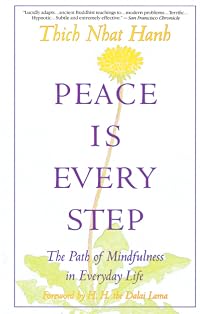
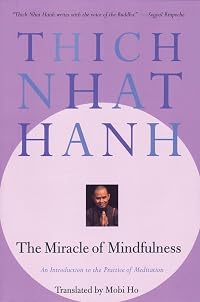
Thich Nhat Hanh was born in central Vietnam on October 11, 1926. He entered Tu Hieu Temple as a novice monk at the age of sixteen. During the Vietnam War, he was part of a movement called "engaged Buddhism", which combines traditional practices with nonviolent civil disobedience. For this, he was exiled by both the Communist and non-Communist show more governments and was nominated by Martin Luther King, Jr. for the Nobel Peace Prize in 1967 for his efforts to reconcile North and South Vietnam. He is a teacher, author, poet, and peace activist. He has written over 100 titles on meditation, mindfulness and Engaged Buddhism, as well as poems, children's stories, and commentaries on ancient Buddhist texts. His books include The Heart of the Buddha's Teaching: An Introduction to Buddhism, Peace Is Every Step, The Miracle of Mindfulness, The Art of Power, True Love and Anger, Vietnam: Lotus in a Sea of Fire, and Living Buddha, Living Christ. He founded a retreat in France called Plum Village. (Bowker Author Biography) show less
Some Editions
Common Knowledge
- Original title
- No Death, No Fear: Comforting Wisdom for Life
- Original publication date
- 2002
- First words
- In my hermitage in France is a bush of japonica, Japanese quince. The bush usually blooms in the spring, but one winter it had been quite warm and the flower buds had come early. During the night a cold snap arrived ...
- Quotations
- Breathing in, I am aware of my in-breath. / Breathing out, I am aware of my out-breath. // Breathing in, I am aware that I grow old. / Breathing out, I know I cannot escape old age. // Breathing in, I am aware of my nature to... (show all) have ill health. / Breathing out, I know I cannot escape ill health. // Breathing in, I know I shall die. / Breathing out, I know I cannot escape death. // Breathing in, I know that one day I shall have to abandon all I love and cherish. / Breathing out, I know I cannot escape abandoning all I cherish. // Breathing in, I know that my actions of body, speech and mind are my only true belongings. / Breathing out, I know I cannot escape the consequences of my actions. // Breathing in, I determine to live my days deeply in mindfulness. / Breathing out, I see the joy and benefit of living in the present moment. // Breathing in, I vow to offer joy each day to my beloved. / Breathing out, I vow to ease the pain of my beloved.
- Last words
- (Click to show. Warning: May contain spoilers.)If we know how to practice with the reality of no birth and death, we realize that coming and going are just ideas, and if our presence is solid and peaceful, we can help the dying person. We can help the person not be scared and not to suffer much. We can help the person die peacefully. We can help ourselves too understand there is no dying, To see that there is no death and no fear. There is only continuation.
- Original language
- English
Classifications
- Genres
- Religion & Spirituality, Nonfiction, General Nonfiction, Philosophy
- DDC/MDS
- 294.3444 — Religion Other religions Dharmic religions Buddhism Buddhism - practice Religious experience, life, practice Religious life and practice
- LCC
- BQ4302 .N43 — Philosophy, Psychology and Religion Buddhism Buddhism Doctrinal and systematic Buddhism Special doctrines
- BISAC
Statistics
- Members
- 921
- Popularity
- 29,209
- Reviews
- 16
- Rating
- (4.08)
- Languages
- 6 — Dutch, English, French, German, Spanish, Swedish
- Media
- Paper, Audiobook, Ebook
- ISBNs
- 17
- ASINs
- 7