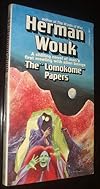
The "Lomokome" Papers
by Herman Wouk
On This Page
Description
Describes the construction and function of various parts of a bicycle and how they are combined into a finished product.Tags
Recommendations














Member Reviews
Herman Wouk has written some extremely good books. Everyone knows the Caine Mutiny and knows how good it is. And he has an often overlooked gem in Don't Stop the Carnival about a New Yorker who decides to ditch it all and run a tropical hotel. As with all but a very few authors, other books don't live up to the hype of the author's name. For Wouk, a recent example is A Hole in Texas which, while it had some entertaining characters, lacked a certain reality (I guess verisimilitude is the big word) and was just never as funny as it intended to be.
And, sometimes, the sound of failure is so resounding that few can ignore it.
As I'm sure you guessed, The "Lomokome" Papers falls in that last category. Now, in Wouk's defense, this was an early show more effort. It also represented his first and only (thankfully) foray into science fiction.
One of the things that any writer should recognize is that they should not attempt a genre with which they are not familiar and that seems to be the case as Wouk takes on science fiction. Now, I am taking a leap here that Wouk did not have much experience with science fiction when he wrote this. For all I know he was a voracious reader of the genre, but it does not show up in this book. And, a good writer (and Wouk is a good writer) would produce a better effort than this if they were so immersed.
But clichés abound. We have the conceit of discovered "papers" written by a man dying on the moon. We have accounts of a hollow moon with aliens inside. We have our protagonist unable to grasp the horror of local traditions and stepping in to "save" the potential sacrifice. And all told in a dry style that gives the reader no urgency.
And what we really have is a boring exercise that Wouk himself described as a novel starting "in the dry vein of a Defoe hoax, and gradually slip[ping] into the mirror satire of Reasonable War, and the modest proposal of Death Day." He goes on to say that "Essentially this tale derives from both A Modest Proposal and the chapter in Erewhon on musical banks."
If that doesn't scare the potential reader away, what would? I admit I didn't read the introduction until the book was officially in my possession. But I hoped Wouk would win the day. He didn't.
There is also one aspect that fascinated me throughout the book. I could not help but notice the similarity between the plot device of "Death Day" and "A Taste of Armageddon" from the first year of Star Trek; a similarity so striking I wonder if the scriptwriting wasn't influenced by this book.
Would my opinion of this book been better if I had not been distracted by the similarities with the Star Trek episode? No. It is still a mediocre effort at best. show less
And, sometimes, the sound of failure is so resounding that few can ignore it.
As I'm sure you guessed, The "Lomokome" Papers falls in that last category. Now, in Wouk's defense, this was an early show more effort. It also represented his first and only (thankfully) foray into science fiction.
One of the things that any writer should recognize is that they should not attempt a genre with which they are not familiar and that seems to be the case as Wouk takes on science fiction. Now, I am taking a leap here that Wouk did not have much experience with science fiction when he wrote this. For all I know he was a voracious reader of the genre, but it does not show up in this book. And, a good writer (and Wouk is a good writer) would produce a better effort than this if they were so immersed.
But clichés abound. We have the conceit of discovered "papers" written by a man dying on the moon. We have accounts of a hollow moon with aliens inside. We have our protagonist unable to grasp the horror of local traditions and stepping in to "save" the potential sacrifice. And all told in a dry style that gives the reader no urgency.
And what we really have is a boring exercise that Wouk himself described as a novel starting "in the dry vein of a Defoe hoax, and gradually slip[ping] into the mirror satire of Reasonable War, and the modest proposal of Death Day." He goes on to say that "Essentially this tale derives from both A Modest Proposal and the chapter in Erewhon on musical banks."
If that doesn't scare the potential reader away, what would? I admit I didn't read the introduction until the book was officially in my possession. But I hoped Wouk would win the day. He didn't.
There is also one aspect that fascinated me throughout the book. I could not help but notice the similarity between the plot device of "Death Day" and "A Taste of Armageddon" from the first year of Star Trek; a similarity so striking I wonder if the scriptwriting wasn't influenced by this book.
Would my opinion of this book been better if I had not been distracted by the similarities with the Star Trek episode? No. It is still a mediocre effort at best. show less
This is a dreadful book! I have it in my collection only because it was one of Wouk's earliest "novels" (at a mere 113 pages) and it was written in a hurry to fulfill a publication contract. As a result, it is Wouk's only attempt at science fiction, and for that reason it is a collectible. It is deservedly forgotten.
Fiction, Science fiction, Selenites, Selenites love war, death, and violence: “We must have enemies. We cannot be happy without them.”, According to Wouk the novel was written in 1949, First published in Collier's Magazine, February 17, 1956 and in book form by Pocket Books, New York, 1968, paperback, First Italian edition, Oscar Fantascienza, Mondadori, Milano, 1983
Ratings
Members
- Recently Added By
Author Information

81+ Works 19,171 Members
Herman Wouk was born in the Bronx, New York on May 27, 1915. He received a bachelor's degree in comparative literature and philosophy from Columbia University. In 1936, he became a staff writer for the radio comedian Fred Allen. He enlisted in the Navy immediately after Pearl Harbor and was posted as a radio officer in the South Pacific. His debut show more novel, Aurora Dawn, was published in 1947. His other novels included The City Boy, Marjorie Morningstar, Youngblood Hawke, Don't Stop the Carnival, The Winds of War, War and Remembrance, The Hope, The Gift, A Hole in Texas, and The Lawgiver. He received the Pulitzer Prize for fiction in 1952 for The Caine Mutiny. He received the first Library of Congress Lifetime Achievement Award for the Writing of Fiction in 2008. His nonfiction books included This Is My God, The Language God Talks, and Sailor and Fiddler: Reflections of a 100-Year-Old Author. Several of his books were adapted into movies including The Caine Mutiny and Marjorie Morningstar. He adapted the courtroom sections of The Caine Mutiny into the Broadway play The Caine Mutiny Court-Martial. His other Broadway shows included The Traitor and Nature's Way. He died on May 17, 2019 at the age of 103. (Bowker Author Biography) show less
Some Editions
Common Knowledge
- Original title
- Caine Munity
- Original publication date
- 1956
Classifications
Statistics
- Members
- 82
- Popularity
- 386,256
- Reviews
- 3
- Rating
- (2.86)
- Languages
- English, German
- Media
- Paper
- ISBNs
- 5
- ASINs
- 9