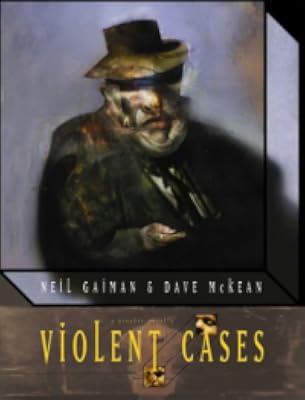
Violent Cases
by Neil Gaiman (Author), Dave McKean (Illustrator)
On This Page
Description
A perceptively sensitive and ingenious work, Violent Cases reveals the often murky nexus between memory and imagination through the narrator's cloudy childhood remembrance of a visit to Al Capone's osteopath and the impact of seedy stories on impressionable youth. Gradually, the England of the 1960s and the Chicago of the 1920s begin to merge into a beautifully drawn and hauntingly written tale of memory and evil.Tags
Recommendations






Member Recommendations

Member Reviews
Considering how big a fan I am of the Neil Gaiman-Dave McKean dream team, it's a bit of a surprise that it took me until now to read their first collaboration! It was worth the wait though, and it's clear from the outset that this duo was assured success. Gaiman's text tells a story within a story, laying memory from childhood onto adult perceptions of previous life events, and treading themes that would become more developed in novels like the Ocean at the End of the Lane and short stories like "Troll Bridge" - memory, changed thought patterns, the ravages of time and sense memory specifically. Violent Cases may not have as engaging a plot as later stories, but this strange trip down memory lane gives us food for thought alongside its show more shelter skelter pop-culture moments. McKean's artwork pairs beautifully with the story, giving us enough gritty realism to make believe the reality of Al Capone's violent cases and blurring the lines between story and truth. The lack of bright colours actually works well for the birthday party that plays host to the story's crucial scene: emphasizing the narrator's dislike of the event as a whole and belieing the cheap glamour of choldhood birthday parties in "fancy" hotels. As with most of Gaiman and McKean's short comics, we are left with questions at the finale of Violent Cases. The most obvious is, of course, what actually happened and is the bone doctor a real character, but I wonder more about the narrator. Obviously he's not really Neil Gaiman (for all that his pictoral representation resembles him), but besides this one set of memories we don't know much about him. show less
I stumbled upon Gaiman's earlier work through his novel "Coraline", which I really liked. But wow, this book really blew my mind and stuck with me.
It starts as an account by someone who recalls early childhood memories: birthday parties, his father, a doctor visit... But, just like memories, once you think about them, it all becomes blurred, fragmented, distorted, and yet some details are very clear. Dave McKean draws this brilliantly. His imagery for this tale fits the meaning perfectly.
Read it slowly, take it in, the colours, the words, the atmosphere... The last page will leave your breathless.
It starts as an account by someone who recalls early childhood memories: birthday parties, his father, a doctor visit... But, just like memories, once you think about them, it all becomes blurred, fragmented, distorted, and yet some details are very clear. Dave McKean draws this brilliantly. His imagery for this tale fits the meaning perfectly.
Read it slowly, take it in, the colours, the words, the atmosphere... The last page will leave your breathless.
‘Violent Cases’ is a graphic short story written by Neil Gaiman and drawn by Dave McKean. The first panel shows the narrator, a man in his thirties, lighting a cigarette. The illustrations that follow show the story he’s telling but occasionally cut back to him. On pages 5-6 it cuts to the present day and him asking his father to clarify something.
The events he is recounting took place in Portsmouth, England when the narrator was four years old. His father accidentally hurt the little boy’s arm and took him to see an osteopath, who turns out to have been Al Capone’s osteopath. He tells the four-year-old about the good old days and the splendid parties Al used to have. On the return visit, he tells the boy more about the show more American gangster. Later, there’s a children’s party at a seafront hotel and the narrator bumps into the old man again.
The theme is partly memory and how accurate it may be. That’s where the title comes from in a clever bit of misunderstanding. Dave McKean’s art is in the style of Bill Sienkiewicz, not my favourite, but to be fair many of the illustrations are beautifully done and the story is well told. I enjoyed the reading experience and was only let down by the ending which was either vague or incredible, depending on how you take it. That’s deliberate, I’m sure as Neil Gaiman knows what he’s doing with a story and quite common now. Definite conclusions are old hat. Unfortunately, I still like them and not having one kind of ruins the preceding for me.
The tale is interesting and well crafted but rather slight. I’m not sure it merits this deluxe format and hardcovers but clearly, the publishers think so. It has an interesting introduction by Paul Gravett about the burgeoning eighties British comic scene in which the story was created and an introduction from the 1987 edition by his eminence, Alan Moore, to whom it is dedicated ‘with thanks and gratitude and, after all these years, still with a smidgen of awe. There’s an introduction by Neil Gaiman from the 1991 reissue. There’s an afterword by Neil Gaiman from the 2003 reissue and there are short biographies of Neil Gaiman and artist Dave McKean. In general, it’s packaged as something awesome and wonderful.
I’ll have to read it again and have a rethink. I mean, if Alan Moore likes it…I have more than a smidgeon of awe for big Al. Much more.
Eamonn Murphy
This review first appeared at https://www.sfcrowsnest.info/ show less
The events he is recounting took place in Portsmouth, England when the narrator was four years old. His father accidentally hurt the little boy’s arm and took him to see an osteopath, who turns out to have been Al Capone’s osteopath. He tells the four-year-old about the good old days and the splendid parties Al used to have. On the return visit, he tells the boy more about the show more American gangster. Later, there’s a children’s party at a seafront hotel and the narrator bumps into the old man again.
The theme is partly memory and how accurate it may be. That’s where the title comes from in a clever bit of misunderstanding. Dave McKean’s art is in the style of Bill Sienkiewicz, not my favourite, but to be fair many of the illustrations are beautifully done and the story is well told. I enjoyed the reading experience and was only let down by the ending which was either vague or incredible, depending on how you take it. That’s deliberate, I’m sure as Neil Gaiman knows what he’s doing with a story and quite common now. Definite conclusions are old hat. Unfortunately, I still like them and not having one kind of ruins the preceding for me.
The tale is interesting and well crafted but rather slight. I’m not sure it merits this deluxe format and hardcovers but clearly, the publishers think so. It has an interesting introduction by Paul Gravett about the burgeoning eighties British comic scene in which the story was created and an introduction from the 1987 edition by his eminence, Alan Moore, to whom it is dedicated ‘with thanks and gratitude and, after all these years, still with a smidgen of awe. There’s an introduction by Neil Gaiman from the 1991 reissue. There’s an afterword by Neil Gaiman from the 2003 reissue and there are short biographies of Neil Gaiman and artist Dave McKean. In general, it’s packaged as something awesome and wonderful.
I’ll have to read it again and have a rethink. I mean, if Alan Moore likes it…I have more than a smidgeon of awe for big Al. Much more.
Eamonn Murphy
This review first appeared at https://www.sfcrowsnest.info/ show less
Well, it's not the worst thing Gaiman has done, in fact it's probably near the top of my list of his non-Sandman graphic works (with Coraline ranking above it). But that's not saying much. I keep reading them, because I think McKean does some amazing things, and because Sandman was so wonderful. So I keep hoping I will pick up another of his graphic endeavors and it will wind up being anywhere near that good. But they never are. And this one is no different. The story is rather morose (which is also fairly typical), and really not at all what I expected based on the blurb. Disappointing.
A good pick up for anyone and a must read for Gaiman fans. Telling the tale from a child's point of view while bringing out most of the adult bits in other ways, mostly through images, works extremely well here. McKean and Gaiman always seem to do wonderful work together.
La primerísima colaboración de Neil Gaiman y Dave Mckean. Hecha a mano, en una época en la que aún no se inventaba el photoshop. Y poniéndo envergüenza a la mayoría de las producciones digitales de ahora. Buena historia, y genial arte.
The art was great, but I had trouble following the story. I didn't really "get" it. Might change my mind after letting it sit for a bit.
Members
- Recently Added By
Lists

Recommended Comics / Graphic Novels
595 works; 122 members
Author Information

Neil Gaiman was born in Portchester, England on November 10, 1960. He worked as a journalist and freelance writer for a time, before deciding to try his hand at comic books. Some of his work has appeared in publications such as Time Out, The Sunday Times, Punch, and The Observer. His first comic endeavor was the graphic novel series The Sandman. show more The series has won every major industry award including nine Will Eisner Comic Industry Awards, three Harvey Awards, and the 1991 World Fantasy Award for best short story, making it the first comic ever to win a literary award. He writes both children and adult books. His adult books include The Ocean at the End of the Lane, which won a British National Book Awards, and the Locus Award for Best Fantasy Novel for 2014; Stardust, which won the Mythopoeic Award as best novel for adults in 1999; American Gods, which won the Hugo, Nebula, Bram Stoker, SFX, and Locus awards; Anansi Boys; Trigger Warning: Short Fictions and Disturbances; and The View from the Cheap Seats: Selected Nonfiction, which is a New York Times Bestseller. His children's books include The Day I Swapped My Dad for Two Goldfish; Coraline, which won the Elizabeth Burr/Worzalla, the BSFA, the Hugo, the Nebula, and the Bram Stoker awards; The Wolves in the Walls; Odd and the Frost Giants; The Graveyard Book, which won the Newbery Award in 2009 and The Sandman: Overture which won the 2016 Hugo Awards Best Graphic Story. (Bowker Author Biography) show less
Some Editions
Common Knowledge
- Canonical title
- Violent Cases
- Original title
- Violent Cases
- Original publication date
- 1991
- People/Characters*
- Al Capone
- Important places
- Chicago, Illinois, USA; Portsmouth, Hampshire, England, UK
- Dedication
- For Michael, and all the other little violent cases. --Neil Gaiman
For my teacher, Malcolm Hatton. You see? This is what I mean by comics --Dave McKean
For Alan Moore. With thanks and gratitude, and, after all t... (show all)hese years, still smidgen of awe --Neil and Dave - First words
- I would not want you to think that I was a battered child.
- Last words
- (Click to show. Warning: May contain spoilers.)Nobody seems to wear a hat these days.
- Blurbers
- Moore, Alan; Barker, Clive; Sienkiewicz, Bill
*Some information comes from Common Knowledge in other languages. Click "Edit" for more information.
Classifications
Statistics
- Members
- 1,076
- Popularity
- 23,771
- Reviews
- 12
- Rating
- (3.78)
- Languages
- 9 — Czech, Dutch, English, French, German, Italian, Japanese, Portuguese, Spanish
- Media
- Paper
- ISBNs
- 27
- ASINs
- 4
