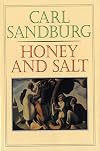
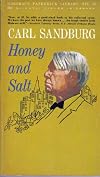
Honey and Salt
by Carl Sandburg 
On This Page
Description
A collection of seventy-seven "poems of the prairies, poems on the nature of love, poems about many other topics, and a. . . [long] chanting poem, 'Timesweep, ' about many incarnations of life over the ages."Tags
Recommendations

















Member Reviews
It’s obvious from this collection why Sandburg counts as one of the best-loved American poets of the mid-20th century. Uncompromising but very approachable poems tackling the Big Topics (love, death, etc.) in disarmingly simple language. His free verse veers into Whitmanesque rant in one or two places, notably the first-person list poem “Timesweep” that ends the collection, but that seems to be forgivable for an American poet, and he does also demonstrate quite clearly that he can do short and pithy when he wants to.
There are two wonderful takes on the old chestnut “what is love?” in the title poem and “Little word, little white bird”, there are a few glimpses of Lake Michigan scenery, and there is a surprising amount of show more mineral imagery going on — Sandburg clearly had a thing about metals and precious stones. Very enjoyable, and a book I will certainly dip into again in the future.
There are two wonderful takes on the old chestnut “what is love?” in the title poem and “Little word, little white bird”, there are a few glimpses of Lake Michigan scenery, and there is a surprising amount of show more mineral imagery going on — Sandburg clearly had a thing about metals and precious stones. Very enjoyable, and a book I will certainly dip into again in the future.
Is the key to love in passion, knowledge, affection?show less
All three—along with moonlight, roses, groceries,
givings and forgivings, gettings and forgettings,
keepsakes and room rent,
pearls of memory along with ham and eggs.
I believe this is the first Sandburg that I've read that's meant for adults, though I have enjoyed much of his work for children. I think I need to read his earlier works and then reread this. I admit, I was pretty clueless for most of the poems.
I did love four: the title poem, Moon Rondeau, High Moments, and Personalia. Unfortunately they need to be read as gestalt, and there are no lines or short bits that I can effectively quote here. Maybe they're online somewhere.
I did love four: the title poem, Moon Rondeau, High Moments, and Personalia. Unfortunately they need to be read as gestalt, and there are no lines or short bits that I can effectively quote here. Maybe they're online somewhere.
Sandburg's just not for me.
Ratings
Members
- Recently Added By
Lists

Poetry Corner
187 works; 15 members
Author Information

233+ Works 12,976 Members
The son of Swedish immigrants, Sandburg was born in Galesburg, Illinois. At age 13 he left school to roam the Midwest; he remained on the road for six years, working as a day laborer. Sandburg served in the Spanish-American War and then, from 1898 to 1902, attended Lombard College in Galesburg. After college, he went to Milwaukee, where he worked show more as a journalist; he also married Lillian Steichen there in 1908. During World War I, he served as a foreign correspondent in Stockholm; after the war he returned to Chicago and continued to write about America, especially the common people. Sandburg's first poems to gain wide recognition appeared in Poetry magazine in 1914. Two years later he published his Chicago Poems (1916), and Cornhuskers appeared in 1918. Meanwhile, Sandburg set out to become an authority on Abraham Lincoln (see Vol. 3). His exhaustive biography of the president, which took many years to complete, appeared as Abraham Lincoln: The Prairie Years (2 vols., 1926) and Abraham Lincoln: The War Years (4 vols., 1939), which won a Pulitzer Prize. Sandburg's poetry is untraditional in form. Drawing on Whitman as well as the imagists, its rhymeless and unmetered cadences reflect Midwestern speech, and its diction ranges from strong rhetoric to easygoing slang. Although he often wrote about the uncouth, the muscular, and the primitive, there was a pity and loving kindness that was a primary motive for his poetry. At Sandburg's death, Mark Van Doren, Archibald MacLeish, and President Lyndon Johnson delivered eulogies. In his tribute, President Johnson said that "Carl Sandburg was more than the voice of America, more than the poet of its strength and genius. He was America. . . . He gave us the truest and most enduring vision of our own greatness." The N.Y. Times described Sandburg as "poet, newspaper man, historian, wandering minstrel, collector of folk songs, spinner of tales for children, [whose] place in American letters is not easily categorized. But it is a niche that he has made uniquely his own." Sandburg was the labor laureate of the United States. Sandburg received the Pulitzer Prize for poetry in 1951 for his Complete Poems (1950). Among his many other awards were the gold medal for history and biography (1952) from the American Academy of Arts and Letters; the Poetry Society of America's gold medal (1953) for distinguished achievement; and the Boston Arts Festival Award (1955) in recognition of "continuous meritorious contribution to the art of American poetry." In 1959 he traveled under the auspices of the Department of State to the U.S. Trade Fair in Moscow, and to Stockholm, Paris, and London. In 1960 he received a citation from the U.S. Chamber of Commerce as a great living American for the "significant and lasting contribution which he has made to American literature." (Bowker Author Biography) show less
Carl Sandburg has a Legacy Library. Legacy libraries are the personal libraries of famous readers, entered by LibraryThing members from the Legacy Libraries group.
Common Knowledge
- Canonical title
- Honey and Salt
- Original publication date
- 1953
- First words
- A bag of tricks - is it?
- Last words
- (Click to show. Warning: May contain spoilers.)There is only one Maker in the world
and His children cover the earth
and they are named All God's Children. - Original language
- English
Classifications
Statistics
- Members
- 339
- Popularity
- 93,074
- Reviews
- 3
- Rating
- (4.24)
- Languages
- English
- Media
- Paper, Ebook
- ISBNs
- 5
- ASINs
- 11