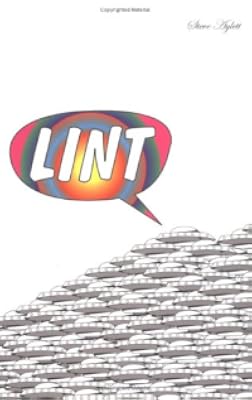
Lint
by Steve Aylett
On This Page
Description
"There was also a problem with the first edition of Rigor Mortis. The biographical notes on the back cover-- with the by now inevitable photo of Lint kissing a tortoise-- stated that Lint had died in 1972. The media, poised to praise him after his death, sprang in with lamentations that he had been tragically neglected by commercial enterprise and that it was baffling that his artistic genius had not been more appreciated. Their bitter embarrassment upon learning that he was still alive and show more open to their patronage drove a bigger wedge than ever between the media and Lint-- they had no recourse but to pretend he did not exist at all. 'So in terms of money, publicity and ease of progress,' Lint observed, 'all remains the same.'" Jeff Lint was author of some of the strangest and most inventive satirical SF of the twentieth century. He transcended genre in classics such as Jelly Result and The Stupid Conversation, becoming a cult figure and pariah. Like his contemporary Philip K. Dick, he was blithely ahead of his time. Aylett follows Lint through his Beat days; his immersion in pulp SF, psychedelia and resentment; his disastrous scripts for Star Trek and Patton; the controversies of The Caterer comic and the scariest kids' cartoon ever aired; and his belated Hollywood success in the 1990s. It was a career haunted by death, including the undetected death of his agent, the suspicious death of his rival Herzog, and the unshakable "Lint is dead" rumors, which persisted even after his death. show lessTags
Recommendations















Member Reviews
Bonkers. Stark raving bonkers. But also brilliant. From its opening epigraph to its closing acknowledgements, this fictional biography of science fiction “legend” Jeff Lint is a breathtaking tour-de-force. It traces Lint’s life from his birth in 1928 to his death in 1994. Typically, Lint’s death was immediately preceded by a near-death experience. He was that kind of guy.
Lint’s life, such as it was, really began when he sought to publish his first stories during the hey-day of pulp science fiction. Lint’s stories were beyond the edge of sensible. So much so that quoting from any of them would render this account senseless. And his periodic forays into other media — comics, film, even pop music — were equally bizarre and show more disastrous. It’s the kind of life you won’t struggle to remember.
Aylett’s attention to detail is astounding. There is a bibliography at the end that stretches to a hundred blissfully imagined publications. He provides pages of “Lint Quotations” with such memorable lines as, “When the abyss gazes into you, bill it.” And there is a comprehensive 11 page index. Did I mention it was bonkers?
The downside of all this inventiveness is that reading the book is exhausting. Even a few pages at a time. I kept wondering how exhausting it must have been for Steve Aylett to write. And why. Certainly he has created something utterly unique. We can only hope it remains that way.
Cautiously recommended to those who either already are bonkers, or are hoping to go there. show less
Lint’s life, such as it was, really began when he sought to publish his first stories during the hey-day of pulp science fiction. Lint’s stories were beyond the edge of sensible. So much so that quoting from any of them would render this account senseless. And his periodic forays into other media — comics, film, even pop music — were equally bizarre and show more disastrous. It’s the kind of life you won’t struggle to remember.
Aylett’s attention to detail is astounding. There is a bibliography at the end that stretches to a hundred blissfully imagined publications. He provides pages of “Lint Quotations” with such memorable lines as, “When the abyss gazes into you, bill it.” And there is a comprehensive 11 page index. Did I mention it was bonkers?
The downside of all this inventiveness is that reading the book is exhausting. Even a few pages at a time. I kept wondering how exhausting it must have been for Steve Aylett to write. And why. Certainly he has created something utterly unique. We can only hope it remains that way.
Cautiously recommended to those who either already are bonkers, or are hoping to go there. show less
Who the FUCK has been hiding Steve Aylett from me for thirty-nine years. I want answers. What is this, a conspiracy of librarians? A booksellers' union grudge? This rebarbative but very funny novel takes the form of a biography of the pulp writer Jeff Lint – a sort of mash-up of Phillip K Dick, Robert E Howard and Alan Moore – and it is filled with more surprising word-collocations and startling throwaway ideas than anything I've read for months. From the opening, I was hooked:
Pulp science fiction author Jeff Lint has loomed large as an influence on my own work since I found a scarred copy of I Blame Ferns in a Charing Cross basement, an apparently baffled chef staring down from the cover. After that I hunted down all the Lint stuff show more I could find and became a connoisseur of the subtly varying blank stares of booksellers throughout the world.
Um…yes, I'll have two hundred pages of that, please. Across twenty-seven chapters – whose academic style soon dissolves into a kind of lysergic incomprehensibility – we learn the details of Lint's eventful career, including not just his fictional output (such as ‘the trash novel Sadly Disappointed about a child who is not possessed by the devil’), but also his forays into television in the form of a Star Trek script (in which ‘the smug, unoriginal blandness aboard the Enterprise finally reaches such an unnatural pitch that it triggers an event horizon’), his brush with Hollywood, his role as a New Mexican guru, and his work as a lyricist with a prog-rock band, penning such tracks as ‘DNA Interruption Charm’, ‘Through the Keyhole I Saw the Funeral of a Duck’ and ‘Dead or Not, He Was Wearing Shades’.
The tone is synaesthetic and off-kilter, but nevertheless in a tradition of British comic writing that feels familiar in the oddest places. Near the end of the book comes one of its best lines:
On July 13, 1994, Lint had a near-death experience, followed immediately by death.
…which is pure Douglas Adams. But in other ways the voice is recognisably post-Chris Morris, except it's like all of Chris Morris's career concertinaed together, from the exact journalese of On The Hour (headlines mentioned in this book include WRITER IS MADE OF CHIMP MEAT and the misprint-result OBSCENE PLAY ATTRACTS MASSIVE CROW) through to the ambient, adrenal creepiness of Blue Jam, reflected here in the descriptions of Lint's terrifying cartoon series Catty and the Major.
Aylett's rococo non-sequiturs, and his tinges of weird fiction and body-horror, put him somewhere on the edge of the bizarro camp, except that unlike most bizarro authors Aylett can really write. Like Lint, he spends much of this book ‘rampaging through the English language like a buffalo’; at times his words seem like mere aesthetic objects, with no referents in the real world, and your eyes start to glaze over; but at others, they connect with a jolt. Again, a description of Lint's writing applies just as well to his creator's:
Every sentence expands in all directions at once and it becomes immersive to the point of hallucination. The story falls away into a heavy feverdream, a sort of constant metamorphosis parade. Ideas turn corners on themselves and thump axes in their own backs.
I found that you needed a run-up with the prose before you warmed up to it; then a certain cumulative effect kicked in, and every sentence became hilarious. But if I read too much, it overwhelmed me again. This is a book best consumed in medium doses.
I was in a strange place when I read Lint – working twenty-hour days and sleeping somewhere new every night. I would fall into bed at 1 a.m. with my alarm set for quarter to five, and read a few paragraphs of this before I passed out. In this drained, hypnotic state, I found that the gnomic pronouncements of Jeff Lint (‘Television is light filled with someone else's anxiety’) actually started to make a weird kind of sense. Worrying, perhaps. Part of me would like to see this talent reined in a little more by some formal discipline, but I will forgive a lot for a book that made me laugh out loud as often and as uncontrollably (like holding-in-giggles-during-school-assembly uncontrollable) as this one did. I emerged confused, but buffed into a creative hypersensitivity.
You can take these away with you:
● It was repeatedly rumoured that Lint's gonzo article ‘Mashed Drug Mutants’ had a subtext that was nothing to do with drugs, but Lint denied this.
● [during McCarthy's anti-Communist crackdowns] Lint was twitted the same year when three friends dressed as cops raided his apartment and found him forcing a bust of Lenin down the toilet.
● Lint had recently been hired to create a tourist slogan for the town, and came up with ‘Holiday parasites are welcome in a way, aren't they?’
● In response to astronomers' observations that the universe seemed to be rushing away from us, he remarked ‘Wouldn't you?’ show less
Pulp science fiction author Jeff Lint has loomed large as an influence on my own work since I found a scarred copy of I Blame Ferns in a Charing Cross basement, an apparently baffled chef staring down from the cover. After that I hunted down all the Lint stuff show more I could find and became a connoisseur of the subtly varying blank stares of booksellers throughout the world.
Um…yes, I'll have two hundred pages of that, please. Across twenty-seven chapters – whose academic style soon dissolves into a kind of lysergic incomprehensibility – we learn the details of Lint's eventful career, including not just his fictional output (such as ‘the trash novel Sadly Disappointed about a child who is not possessed by the devil’), but also his forays into television in the form of a Star Trek script (in which ‘the smug, unoriginal blandness aboard the Enterprise finally reaches such an unnatural pitch that it triggers an event horizon’), his brush with Hollywood, his role as a New Mexican guru, and his work as a lyricist with a prog-rock band, penning such tracks as ‘DNA Interruption Charm’, ‘Through the Keyhole I Saw the Funeral of a Duck’ and ‘Dead or Not, He Was Wearing Shades’.
The tone is synaesthetic and off-kilter, but nevertheless in a tradition of British comic writing that feels familiar in the oddest places. Near the end of the book comes one of its best lines:
On July 13, 1994, Lint had a near-death experience, followed immediately by death.
…which is pure Douglas Adams. But in other ways the voice is recognisably post-Chris Morris, except it's like all of Chris Morris's career concertinaed together, from the exact journalese of On The Hour (headlines mentioned in this book include WRITER IS MADE OF CHIMP MEAT and the misprint-result OBSCENE PLAY ATTRACTS MASSIVE CROW) through to the ambient, adrenal creepiness of Blue Jam, reflected here in the descriptions of Lint's terrifying cartoon series Catty and the Major.
Aylett's rococo non-sequiturs, and his tinges of weird fiction and body-horror, put him somewhere on the edge of the bizarro camp, except that unlike most bizarro authors Aylett can really write. Like Lint, he spends much of this book ‘rampaging through the English language like a buffalo’; at times his words seem like mere aesthetic objects, with no referents in the real world, and your eyes start to glaze over; but at others, they connect with a jolt. Again, a description of Lint's writing applies just as well to his creator's:
Every sentence expands in all directions at once and it becomes immersive to the point of hallucination. The story falls away into a heavy feverdream, a sort of constant metamorphosis parade. Ideas turn corners on themselves and thump axes in their own backs.
I found that you needed a run-up with the prose before you warmed up to it; then a certain cumulative effect kicked in, and every sentence became hilarious. But if I read too much, it overwhelmed me again. This is a book best consumed in medium doses.
I was in a strange place when I read Lint – working twenty-hour days and sleeping somewhere new every night. I would fall into bed at 1 a.m. with my alarm set for quarter to five, and read a few paragraphs of this before I passed out. In this drained, hypnotic state, I found that the gnomic pronouncements of Jeff Lint (‘Television is light filled with someone else's anxiety’) actually started to make a weird kind of sense. Worrying, perhaps. Part of me would like to see this talent reined in a little more by some formal discipline, but I will forgive a lot for a book that made me laugh out loud as often and as uncontrollably (like holding-in-giggles-during-school-assembly uncontrollable) as this one did. I emerged confused, but buffed into a creative hypersensitivity.
You can take these away with you:
● It was repeatedly rumoured that Lint's gonzo article ‘Mashed Drug Mutants’ had a subtext that was nothing to do with drugs, but Lint denied this.
● [during McCarthy's anti-Communist crackdowns] Lint was twitted the same year when three friends dressed as cops raided his apartment and found him forcing a bust of Lenin down the toilet.
● Lint had recently been hired to create a tourist slogan for the town, and came up with ‘Holiday parasites are welcome in a way, aren't they?’
● In response to astronomers' observations that the universe seemed to be rushing away from us, he remarked ‘Wouldn't you?’ show less
Ah Lint, Jeff Lint.
I remember when I first came across a book of his as an impressionable teenager wandering the aisles of Galaxy Books in old Sydney-town. There it was, in the bargain bin, "I Eat Fog"; well-creased, a smattering of coffee stains, a purple, distorted, displeased mans' face. A collection of early short stories so strange as to flip your brain lobes, so pulpy as to rub your teeth gritty. Brilliant stuff, really.
I hunted down as much of his work as I could, every ratty flea-market stall, every brightly lit box-bookshop, the classics: One Less Bastard, Jelly Result, I Blame Ferns, Turn Me Into a Parrot, The Caterer, and many others...
I must say, I've been kicked out of more bars for arguments started over the merits of show more Lint's work than I care to admit. Now, finally, rather that punching some bloke for questioning Lint's sexual-orientation (so what if a man kits up in a dress and wig to deliver his manuscripts? It was the 60s for crimminy's sake!), I can just give them a copy of Ayletts' brilliant biography. Bravo, Mr. Aylett. Next round's on me. show less
I remember when I first came across a book of his as an impressionable teenager wandering the aisles of Galaxy Books in old Sydney-town. There it was, in the bargain bin, "I Eat Fog"; well-creased, a smattering of coffee stains, a purple, distorted, displeased mans' face. A collection of early short stories so strange as to flip your brain lobes, so pulpy as to rub your teeth gritty. Brilliant stuff, really.
I hunted down as much of his work as I could, every ratty flea-market stall, every brightly lit box-bookshop, the classics: One Less Bastard, Jelly Result, I Blame Ferns, Turn Me Into a Parrot, The Caterer, and many others...
I must say, I've been kicked out of more bars for arguments started over the merits of show more Lint's work than I care to admit. Now, finally, rather that punching some bloke for questioning Lint's sexual-orientation (so what if a man kits up in a dress and wig to deliver his manuscripts? It was the 60s for crimminy's sake!), I can just give them a copy of Ayletts' brilliant biography. Bravo, Mr. Aylett. Next round's on me. show less
Wow...let me try to collect my thoughts. I was quite close to giving this 4 stars, or 2. This is a biography of a fictional writer. One of those fringe experimental types.
Take every parody you've ever seen of the kind of people who make one man shows, or do performance art. Mix in William S. Burroughs using his cut-up technique, a dash of Lovecraft, add a sprinkling of Andy Kaufman, maybe a touch of Alan Moore, Hunter S. Thompson or Michael Moorcock during his Jerry Cornelius writings. Oh and pour in some of Frank from the film 'Frank'.
So to try to find the point i lost somewhere above. This is a biography about a guy that writes complete bollocks. I mean it is the worst kind of 60's experimental garbage. Its a very well told bio, show more and is best when it interweaves with the real world.
The problem is that all the quotes from Lint are such nonsense, somehow even the fact that this is a satire doesn't lessen their annoyance... and yet and yet. After about a third of the way through i actually found some of the nonsense making sense. I can't tell whether the author was getting less obtuse or the text actually rewired my brain.
It helps that tv and film are mixed in, did you know Lint wrote an used script for the Star-Trek animated show? He didn't because he's fictional but still .
By the end i think i'm adding this to my reread list if only to see if the first third is still as annoying. If you've ever read any surreal or really artistic or experimental fiction, or experienced that kind of stuff in film, music or theatre then you might get a kick out this.
Or you might want to hunt down the author and club them to death with an imaginary wedge, or maybe both .
I think this might be the least insightful review i've ever written :lol. show less
Take every parody you've ever seen of the kind of people who make one man shows, or do performance art. Mix in William S. Burroughs using his cut-up technique, a dash of Lovecraft, add a sprinkling of Andy Kaufman, maybe a touch of Alan Moore, Hunter S. Thompson or Michael Moorcock during his Jerry Cornelius writings. Oh and pour in some of Frank from the film 'Frank'.
So to try to find the point i lost somewhere above. This is a biography about a guy that writes complete bollocks. I mean it is the worst kind of 60's experimental garbage. Its a very well told bio, show more and is best when it interweaves with the real world.
The problem is that all the quotes from Lint are such nonsense, somehow even the fact that this is a satire doesn't lessen their annoyance... and yet and yet. After about a third of the way through i actually found some of the nonsense making sense. I can't tell whether the author was getting less obtuse or the text actually rewired my brain.
It helps that tv and film are mixed in, did you know Lint wrote an used script for the Star-Trek animated show? He didn't because he's fictional but still .
By the end i think i'm adding this to my reread list if only to see if the first third is still as annoying. If you've ever read any surreal or really artistic or experimental fiction, or experienced that kind of stuff in film, music or theatre then you might get a kick out this.
Or you might want to hunt down the author and club them to death with an imaginary wedge, or maybe both .
I think this might be the least insightful review i've ever written :lol. show less
Absurdist fictional biography of an Asimovian Pulp writer without the talent.
The surrealist and intentionally underground tone of the book reminds me of Derek and Clive. And the 10th chapter *Catty and the Major* features a horrifying children's cartoon shared on recycled VHS by aficionados as with D&C.
Lint's fractured book synopses read like Aylett's real-life bedside table fragments. Half formed ideas for implausible and impossible stories. Summaries that work as trailers, but not features (a hotel with each floor is located in a different year). Lines too good to leave in a notebook and needing a form to be released.
The surrealist and intentionally underground tone of the book reminds me of Derek and Clive. And the 10th chapter *Catty and the Major* features a horrifying children's cartoon shared on recycled VHS by aficionados as with D&C.
Lint's fractured book synopses read like Aylett's real-life bedside table fragments. Half formed ideas for implausible and impossible stories. Summaries that work as trailers, but not features (a hotel with each floor is located in a different year). Lines too good to leave in a notebook and needing a form to be released.
I tried to like this book. I tried to read this book. I requested my library get it because I heard about it on NPR and it sounded hilarious. But I couldn't read it. It is boring, way too over-the-top, and if it's that over-the-top in the first chapter, where can it possibly go from there?
what. the. fuck.
I have no idea what to think of this book. in part it was the funniest thing I've ever read, at other points it was completely baffling bollocks.
confusing, hilarious and incomprehensible.
I have no idea what to think of this book. in part it was the funniest thing I've ever read, at other points it was completely baffling bollocks.
confusing, hilarious and incomprehensible.
Members
- Recently Added By
Lists

living room bookshelf
150 works; 1 member
Author Information

29+ Works 1,483 Members
Common Knowledge
- Original publication date
- 2005-05-23
- People/Characters
- Jeff Lint
- Epigraph
- 'When the abyss gazes into you, bill it.'
Jeff Lint - Dedication
- for Alan Moore
- First words
- Pulp science fiction author Jeff Lint has loomed large as an influence on my own work since I found a scarred copy of I Blame Ferns in a Charing Cross basement, an apparently baffled chef staring from the cover.
- Last words
- (Click to show. Warning: May contain spoilers.)To those who value these truths, Lint remains the child who tried to unearth the bruises underground.
- Blurbers
- Moorcock, Michael; Moore, Alan
Classifications
Statistics
- Members
- 203
- Popularity
- 161,252
- Reviews
- 11
- Rating
- (3.69)
- Languages
- English
- Media
- Paper, Ebook
- ISBNs
- 5
- ASINs
- 3