
The Great Depression and the New Deal: A Very Short Introduction
by Eric Rauchway
Very Short Introductions (166)
On This Page
Description
The Great Depression forced the United States to adopt policies at odds with its political traditions. This title looks at the background to the Depression, its social impact, and at the various governmental attempts to deal with the crisis.Tags
Recommendations

















Member Reviews
This is a 'very short introduction' in Oxford's useful series of that name. It is a simple guide to the defining event of the US' twentieth century - the New Deal that arose out of the Great Depression. It is also the story of a conservative politician [FDR] quite capable of radical rhetoric. His electoral achievement in 1936, taking every State except Maine and Vermont, was unparalleled since Munroe in 1820.
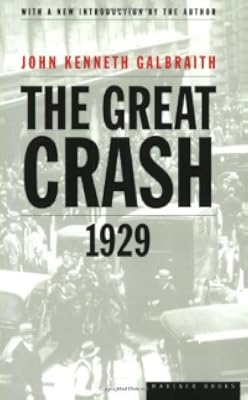
Rauchway references JK Galbraith once and Galbraith is not to be found in the Further Reading section. This in itself gives us a reason for reading it. Most of us of a certain age had our picture of the era formed by Galbraith but historiography has moved on. Rauchway's perspective is more clinical and, based in California, less show more subject to the East Coast liberal assumptions of JK that all matters were to be seen in a context somewhere between Washington and Wall Street.
Rauchway's thesis builds on the common view that the patrician FDR was determined on saving capitalism rather than building a state socialist version of America along contemporary European lines. But the story of the New Deal is complex.
There were radical voices but its essence came to be the replacement of a socialism for capitalists (which seems to be what post-Reaganite America has reverted to), i.e. the close association of private capital and the Federal Government in the opening up of new territories and the suppression of resistant ones such as the Deep South, with a new and softer version of corporatism in which farmers, labour and the consumer on the one hand and, geographically, the South and the West acted as counter-balances to industrial capital and the East respectively.
This theory of countervailing power, with the Federal Government as arbiter, is very different from state socialism but ultimately it accretes power in the same way. The account in the book of the Supreme Court’s conservative and partially successful struggle to crush the New Deal is an object lesson in the danger of a written constitution and of an over-mighty judiciary.
This is a lesson that needs to be learned by over-enthusiastic liberal constitutionalists in Europe but (in this reviewer’s opinion) the construction of Federal legalism as a means of effecting arbitrage reforms between countervailing powers in the context of Supreme Court conservatism has created a monster, of international proportions, that is at the root of much resentment about American extra-territorial claims. New York legalism globalised with capitalism …
The theory of countervailing power was merely a slightly more radical variation on Hoover’s ‘intelligent co-operation’. The ability of East Coast progressivism and East Coast-based capital to ‘sort things out’ between them was, in 1929, stretched beyond the limits of the old order. FDR’s New York-based network of progressive advisers were forced by economic necessity and political considerations (the demands of Democrats in the South and West) to develop a new approach.
Since the Supreme Court existed to crush radical intent, the strategy had to involve pulling the activist population into the recovery agenda and then deliver real benefits for key voters or failure would result in the return of traditionalists. The result in 1936 showed that the strategy was a good one politically.
The countervailing forces model still placed private enterprise at the forefront of economic recovery which was only sensible in a fully capitalist economy. The TVA and other public engagements in the economy were exemplary in order to encourage better capitalist practice and to kick-start the economies of the South and (later, in the late military-industrial era) the West but they did not represent a serious incursion of socialism into American economic life.
We see here the seeds of the formalisation of American corporatism as an alliance between large corporations and government, with a voice for labour, consumers, smallholders and, eventually, African-Americans, women, gays and ethnic communities, being laid in the NRA.
This is a model, we might call it neo-progressive, that is now normal across the Atlantic system. The downside was that major corporations, using the lobby system, not only gained advantages from closeness to Government (as under the old system with localized serious differences) but were to engage Washington as agent for overseas expansion and to set the conditions of trade and ensure that regulation could be used to raise costs for smaller business competitors in traditional industries.
Rauchway hints at rather than states developments beyond 1938 but there is little point in studying this era unless we can understand better our own. Obama seems to be no FDR but rather to have arrived, on the back of emotional rhetoric, at his own 'second term' (without a first) with no leeway or real interest in doing much more than patching up FDR’s original system where he can.
The health care programme that eventually was passed, much weaker than original proposals from Left-Democrats, seems to be the only major item of legislation that truly matches the scope of FDR’s first two years and most of the rest appears to be tinkering around the New Deal Settlement, perhaps because the Supreme Court really did set limits for any Presidential strategy of economic transformation.
Similarly, the American electorate would scarcely have 'got' socialism in 1932, let alone 2008 after sixty years of anti-communist indoctrination, instilled patriotic pride as the world’s top dog and, mostly, prosperity built on a perception of the virtues of hard work, individualism and (for a large proportion of the population) God.
The integration of the trades unions as junior corporate partners within the Washington lobby state in the 1930s was succeeded by a power struggle in the 1940s within the union movement that resulted in the destruction of all socialist and communist influence. By the 1950s, the AFL-CIO was, effectively, operating overseas through its indirect influence to assist anti-communist labour movement allies defeat local socialists and communists.
FDR achieved a great deal in his first four years, often despite his own conservatism, and he effected the first stage in a political revolution that would genuinely come to be inclusive of African-Americans and would permit federal action to meet social objectives. Without FDR, there could have been no Obama and the 1960s might have been nastier and more violent.
However, the New Deal was faltering by mid-second term. There is a disturbing sense (not fully accounted for by Rauchway because it is out of his period) that Roosevelt’s preoccupation with war after the 1938 Congressional Elections was a reaction not so much to domestic failure as to the boring slog of domestic policy-making in a vibrant democracy where Executive Power was severely delimited.
War has the virtue of being more fulfilling to an executive authority, generating economic demand quickly and uniting the nation – in this sense, FDR comes to look far more like his European fascistic counterparts than we may find comfortable to contemplate and, as Hitler expands, he starts to find an ideological cover for war that served equally for Churchill and which fulfilled the needs of what would become the Atlantic system.
The proof of the pudding is always in the numbers. By the end of 1943, the last of the major New Deal agencies has been closed down yet federal spending had increased from 8% of GDP in 1938 to a staggering 40% in 1943. Work relief was not now required because war increased the demand for labour - and it was in 1943 that the US unemployment rate finally fell to 1929 levels. In short, even a cursory connection with Keynesian ideas would have told any world leader that militarisation in a world of closing borders was a serious option for national economic recovery.
The conclusion is sinister but true enough – faced with constitutional limitations and democratic politics at home, radical permanent regeneration of the economy (as opposed to a simple turn-round so that the trend is slow improvement) within the American Imperium requires war.
War created both the military-industrial complex that so unnerved the traditional Republican Eisenhower in the 1950s and the need for ideological cover, represented by the discovery and promotion of a philosophically absurd but now globally dominant ‘rights agenda’ that mobilises the naïve young and ideologues on one side just as racial destiny and scientific materialism mobilised the young and the ideological on other sides.
FDR was creator of this agenda (eventually as international phenomenon) in his 1944 State of the Union Address. It would not be difficult to flip this over into an aggressive anti-Communist assault under his successor who nearly lost the election on the concerns of the South because of FDR’s perceived radicalism.
This eventual internationalisation of the New Deal is perhaps the defining aspect of the American period in the sun, whether we call it by the politically charged terms of New World Order or Washington Consensus or the more neutral Atlantic System.
Within half a century, the countervailing powers model had become the international soft power structures of the UN, IMF and World Bank and then, latterly, the link between the Atlantic system, multinationals and NGOs. Allies would become semi-autonomous states in the imperial union.
Federal legalism would come to impose one way demands in regard to corruption and extradition and, as the Wikileaks cables have exposed, politicians in satrapies as diverse as the UK and Yemen worry about their status in Washington and lie to their own populations in order to please the agents of an American President. Rights theory (somewhat shorn of its original socio-economic aspects) became so embedded in popular culture that it came, latterly, to distort aid-giving and risk super-power confrontation.
Rauchway deals with little of this. He describes and restricts himself to his period but we need to be prepared to think forward to where this would all lead one day.
The contentious interpretation that I have given above of the post-war American Imperium provides a solid reason for reading not only this and other histories of American domestic politics in the decade or so before it erupted fully on to the world stage as dominant global power. To understand the world today, it is vital to understand America itself between 1920 and 1950.
Most people will be looking into this era because of a desire to understand better the 2008 Crash (and, yes, such study has its uses) but no Crash is like any other and what happened in 2008 has to be seen as just the latest in a constant and recurring feature of capitalism – its progress through creative destruction.
It is brutal but it works, at least on these terms and amidst the same sort of suffering that nature also imposes on us. Taming nature and taming market are much the same - do nothing and you die, do too much and you die.
Just as the current crisis arose from excessive credit, so did the Crash of 1929 - and what happened in 2008 was, to a great extent, inevitable. The US Administration saved capitalism in the early 1930s and the challenge for Obama (on which the jury is out) is to do the same for Americanised global capitalism in the early 2010s. I am sure he will succeed but the costs to America itself may be so great that the coming decades could be among the most internally fractious in living memory.
Two years on from his election, State Governments are facing budgetary difficulties that have simply been pushed forward in time from their equivalent level in 1930. State defaults on debts were happening within months of the Stock Market Crash in 1929. The quantitative easing strategies of the Administration have merely pushed the state budgetary crises into 2011 much as international funding strategies keep pushing the potential for a sovereign debt meltdown into the same year.
FDR, as a conservative, was driven in part by the importance of sound money so inflationary strategies were not really driven hard until war broke out. The question remains across the West at what point will the suffering of some to the point of riot and revolt demand an acceptance of inflationary printing of money that will wipe out the wealth of the baby boomers.
If FDR was redistributing between regions to avoid redistributing between classes as Rauchway appears to suggest, will Obama distribute between classes to avoid distributing between generations (which is what is really required)?
Obama, oddly given his street activist and African-American base, appears to be following Hoover in worrying about the banking system’s recovery while the situation of a lot of the poor and middle class quietly degenerates.
Whereas, in 1930, the elite feared anarchy of the left and the right, Obama has neutered the left by his very presence in office. His failure has its potential answer in the slightly unhinged populist right of the Tea Party.
If the Federal Government, for all its power, cannot deliver the goods and yet keeps bankers in yachts, then the once-Democrat now-Republican ‘small man’ is inclined to throw the Government out of the door and leave the urban masses and the young to their fates. The Democrats still appear not to ‘get’ this rage and seem determined on patching up the system rather than rethinking it.
The real difference between then and now is that today’s creative destruction is not just accidentally global because no one had fully realised the central role of the American economy in the 1920s. It is centrally global because the American economy has been understood to be central to the world economy for sixty years or more and neither China nor the European Union have established themselves as ‘countervailing forces’.
The clever money in Washington knows that this crisis means bringing the EU and China into economic alignment but this is one more big step towards the populist fear of a world government that ignores the little man – a step first taken by FDR in his support for the UN.
If the New Deal settlement can now only be tinkered with and adjusted in slow motion and at huge expense (which is what the Obama Administration appears to be doing), then it means that the global system is highly vulnerable and others may start to question whether the US can be relied upon in the future.
Certainly there is no easy war on hand to regenerate the West - bunch of tribal Pathans and Muslim extremists might help keep some spending up but will scarcely mobilise a nation or a global system. And, in any case, American innovation has made war a matter of thermonuclear destruction not job-creating industrial enterprise and full employment.
So, all of us should seek to understand how the US came to be what it is today. This short book is a good start. The book also has a useful table of Hoover and New Deal legislation from 1932 (the initial banking aid) through to June 1938 when the programme might be said to have ended with a national minimum wage, maximum hours and child labour law. The New Deal was acronym-heavy so it is good to be prepared … show less
Rauchway references JK Galbraith once and Galbraith is not to be found in the Further Reading section. This in itself gives us a reason for reading it. Most of us of a certain age had our picture of the era formed by Galbraith but historiography has moved on. Rauchway's perspective is more clinical and, based in California, less show more subject to the East Coast liberal assumptions of JK that all matters were to be seen in a context somewhere between Washington and Wall Street.
Rauchway's thesis builds on the common view that the patrician FDR was determined on saving capitalism rather than building a state socialist version of America along contemporary European lines. But the story of the New Deal is complex.
There were radical voices but its essence came to be the replacement of a socialism for capitalists (which seems to be what post-Reaganite America has reverted to), i.e. the close association of private capital and the Federal Government in the opening up of new territories and the suppression of resistant ones such as the Deep South, with a new and softer version of corporatism in which farmers, labour and the consumer on the one hand and, geographically, the South and the West acted as counter-balances to industrial capital and the East respectively.
This theory of countervailing power, with the Federal Government as arbiter, is very different from state socialism but ultimately it accretes power in the same way. The account in the book of the Supreme Court’s conservative and partially successful struggle to crush the New Deal is an object lesson in the danger of a written constitution and of an over-mighty judiciary.
This is a lesson that needs to be learned by over-enthusiastic liberal constitutionalists in Europe but (in this reviewer’s opinion) the construction of Federal legalism as a means of effecting arbitrage reforms between countervailing powers in the context of Supreme Court conservatism has created a monster, of international proportions, that is at the root of much resentment about American extra-territorial claims. New York legalism globalised with capitalism …
The theory of countervailing power was merely a slightly more radical variation on Hoover’s ‘intelligent co-operation’. The ability of East Coast progressivism and East Coast-based capital to ‘sort things out’ between them was, in 1929, stretched beyond the limits of the old order. FDR’s New York-based network of progressive advisers were forced by economic necessity and political considerations (the demands of Democrats in the South and West) to develop a new approach.
Since the Supreme Court existed to crush radical intent, the strategy had to involve pulling the activist population into the recovery agenda and then deliver real benefits for key voters or failure would result in the return of traditionalists. The result in 1936 showed that the strategy was a good one politically.
The countervailing forces model still placed private enterprise at the forefront of economic recovery which was only sensible in a fully capitalist economy. The TVA and other public engagements in the economy were exemplary in order to encourage better capitalist practice and to kick-start the economies of the South and (later, in the late military-industrial era) the West but they did not represent a serious incursion of socialism into American economic life.
We see here the seeds of the formalisation of American corporatism as an alliance between large corporations and government, with a voice for labour, consumers, smallholders and, eventually, African-Americans, women, gays and ethnic communities, being laid in the NRA.
This is a model, we might call it neo-progressive, that is now normal across the Atlantic system. The downside was that major corporations, using the lobby system, not only gained advantages from closeness to Government (as under the old system with localized serious differences) but were to engage Washington as agent for overseas expansion and to set the conditions of trade and ensure that regulation could be used to raise costs for smaller business competitors in traditional industries.
Rauchway hints at rather than states developments beyond 1938 but there is little point in studying this era unless we can understand better our own. Obama seems to be no FDR but rather to have arrived, on the back of emotional rhetoric, at his own 'second term' (without a first) with no leeway or real interest in doing much more than patching up FDR’s original system where he can.
The health care programme that eventually was passed, much weaker than original proposals from Left-Democrats, seems to be the only major item of legislation that truly matches the scope of FDR’s first two years and most of the rest appears to be tinkering around the New Deal Settlement, perhaps because the Supreme Court really did set limits for any Presidential strategy of economic transformation.
Similarly, the American electorate would scarcely have 'got' socialism in 1932, let alone 2008 after sixty years of anti-communist indoctrination, instilled patriotic pride as the world’s top dog and, mostly, prosperity built on a perception of the virtues of hard work, individualism and (for a large proportion of the population) God.
The integration of the trades unions as junior corporate partners within the Washington lobby state in the 1930s was succeeded by a power struggle in the 1940s within the union movement that resulted in the destruction of all socialist and communist influence. By the 1950s, the AFL-CIO was, effectively, operating overseas through its indirect influence to assist anti-communist labour movement allies defeat local socialists and communists.
FDR achieved a great deal in his first four years, often despite his own conservatism, and he effected the first stage in a political revolution that would genuinely come to be inclusive of African-Americans and would permit federal action to meet social objectives. Without FDR, there could have been no Obama and the 1960s might have been nastier and more violent.
However, the New Deal was faltering by mid-second term. There is a disturbing sense (not fully accounted for by Rauchway because it is out of his period) that Roosevelt’s preoccupation with war after the 1938 Congressional Elections was a reaction not so much to domestic failure as to the boring slog of domestic policy-making in a vibrant democracy where Executive Power was severely delimited.
War has the virtue of being more fulfilling to an executive authority, generating economic demand quickly and uniting the nation – in this sense, FDR comes to look far more like his European fascistic counterparts than we may find comfortable to contemplate and, as Hitler expands, he starts to find an ideological cover for war that served equally for Churchill and which fulfilled the needs of what would become the Atlantic system.
The proof of the pudding is always in the numbers. By the end of 1943, the last of the major New Deal agencies has been closed down yet federal spending had increased from 8% of GDP in 1938 to a staggering 40% in 1943. Work relief was not now required because war increased the demand for labour - and it was in 1943 that the US unemployment rate finally fell to 1929 levels. In short, even a cursory connection with Keynesian ideas would have told any world leader that militarisation in a world of closing borders was a serious option for national economic recovery.
The conclusion is sinister but true enough – faced with constitutional limitations and democratic politics at home, radical permanent regeneration of the economy (as opposed to a simple turn-round so that the trend is slow improvement) within the American Imperium requires war.
War created both the military-industrial complex that so unnerved the traditional Republican Eisenhower in the 1950s and the need for ideological cover, represented by the discovery and promotion of a philosophically absurd but now globally dominant ‘rights agenda’ that mobilises the naïve young and ideologues on one side just as racial destiny and scientific materialism mobilised the young and the ideological on other sides.
FDR was creator of this agenda (eventually as international phenomenon) in his 1944 State of the Union Address. It would not be difficult to flip this over into an aggressive anti-Communist assault under his successor who nearly lost the election on the concerns of the South because of FDR’s perceived radicalism.
This eventual internationalisation of the New Deal is perhaps the defining aspect of the American period in the sun, whether we call it by the politically charged terms of New World Order or Washington Consensus or the more neutral Atlantic System.
Within half a century, the countervailing powers model had become the international soft power structures of the UN, IMF and World Bank and then, latterly, the link between the Atlantic system, multinationals and NGOs. Allies would become semi-autonomous states in the imperial union.
Federal legalism would come to impose one way demands in regard to corruption and extradition and, as the Wikileaks cables have exposed, politicians in satrapies as diverse as the UK and Yemen worry about their status in Washington and lie to their own populations in order to please the agents of an American President. Rights theory (somewhat shorn of its original socio-economic aspects) became so embedded in popular culture that it came, latterly, to distort aid-giving and risk super-power confrontation.
Rauchway deals with little of this. He describes and restricts himself to his period but we need to be prepared to think forward to where this would all lead one day.
The contentious interpretation that I have given above of the post-war American Imperium provides a solid reason for reading not only this and other histories of American domestic politics in the decade or so before it erupted fully on to the world stage as dominant global power. To understand the world today, it is vital to understand America itself between 1920 and 1950.
Most people will be looking into this era because of a desire to understand better the 2008 Crash (and, yes, such study has its uses) but no Crash is like any other and what happened in 2008 has to be seen as just the latest in a constant and recurring feature of capitalism – its progress through creative destruction.
It is brutal but it works, at least on these terms and amidst the same sort of suffering that nature also imposes on us. Taming nature and taming market are much the same - do nothing and you die, do too much and you die.
Just as the current crisis arose from excessive credit, so did the Crash of 1929 - and what happened in 2008 was, to a great extent, inevitable. The US Administration saved capitalism in the early 1930s and the challenge for Obama (on which the jury is out) is to do the same for Americanised global capitalism in the early 2010s. I am sure he will succeed but the costs to America itself may be so great that the coming decades could be among the most internally fractious in living memory.
Two years on from his election, State Governments are facing budgetary difficulties that have simply been pushed forward in time from their equivalent level in 1930. State defaults on debts were happening within months of the Stock Market Crash in 1929. The quantitative easing strategies of the Administration have merely pushed the state budgetary crises into 2011 much as international funding strategies keep pushing the potential for a sovereign debt meltdown into the same year.
FDR, as a conservative, was driven in part by the importance of sound money so inflationary strategies were not really driven hard until war broke out. The question remains across the West at what point will the suffering of some to the point of riot and revolt demand an acceptance of inflationary printing of money that will wipe out the wealth of the baby boomers.
If FDR was redistributing between regions to avoid redistributing between classes as Rauchway appears to suggest, will Obama distribute between classes to avoid distributing between generations (which is what is really required)?
Obama, oddly given his street activist and African-American base, appears to be following Hoover in worrying about the banking system’s recovery while the situation of a lot of the poor and middle class quietly degenerates.
Whereas, in 1930, the elite feared anarchy of the left and the right, Obama has neutered the left by his very presence in office. His failure has its potential answer in the slightly unhinged populist right of the Tea Party.
If the Federal Government, for all its power, cannot deliver the goods and yet keeps bankers in yachts, then the once-Democrat now-Republican ‘small man’ is inclined to throw the Government out of the door and leave the urban masses and the young to their fates. The Democrats still appear not to ‘get’ this rage and seem determined on patching up the system rather than rethinking it.
The real difference between then and now is that today’s creative destruction is not just accidentally global because no one had fully realised the central role of the American economy in the 1920s. It is centrally global because the American economy has been understood to be central to the world economy for sixty years or more and neither China nor the European Union have established themselves as ‘countervailing forces’.
The clever money in Washington knows that this crisis means bringing the EU and China into economic alignment but this is one more big step towards the populist fear of a world government that ignores the little man – a step first taken by FDR in his support for the UN.
If the New Deal settlement can now only be tinkered with and adjusted in slow motion and at huge expense (which is what the Obama Administration appears to be doing), then it means that the global system is highly vulnerable and others may start to question whether the US can be relied upon in the future.
Certainly there is no easy war on hand to regenerate the West - bunch of tribal Pathans and Muslim extremists might help keep some spending up but will scarcely mobilise a nation or a global system. And, in any case, American innovation has made war a matter of thermonuclear destruction not job-creating industrial enterprise and full employment.
So, all of us should seek to understand how the US came to be what it is today. This short book is a good start. The book also has a useful table of Hoover and New Deal legislation from 1932 (the initial banking aid) through to June 1938 when the programme might be said to have ended with a national minimum wage, maximum hours and child labour law. The New Deal was acronym-heavy so it is good to be prepared … show less
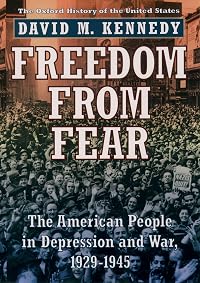
This is a helpful volume and a good place to start your reading on this subject. In so brief a volume, however, the author has focused mainly on the legislative history of The New Deal. If you want a narrative about how the Depression affected the day-to-day lives of Americans (and I did), you won't find it here, except in the briefest and most abstract terms, though you might try David M. Kennedy's FREEDOM FROM FEAR: THE AMERICAN PEOPLE IN DEPRESSION AND WAR, 1929-1945.
Good introduction to the topic of the 20s and 30s. I really like these Very Short Introductions.
This is a short and sweet introduction into the Great Depression and the New Deal. It is a great little reference book to have.
Ratings
Members
- Recently Added By
Author Information

Series

Common Knowledge
- Canonical title
- The Great Depression and the New Deal: A Very Short Introduction
- First words
- In 1932 the United States economy stood at its lowest ebb in modern history.
- Last words
- (Click to show. Warning: May contain spoilers.)The New Deal's evident imperfection invited criticism and further tinkering, making way for improvements to the American democracy in the years afterward and yet to come.
Classifications
- Genres
- Economics, History, Nonfiction, General Nonfiction
- DDC/MDS
- 973.91 — History & geography History of North America United States 1901- World Wars and Depression Era (1901-1953)
- LCC
- E806 .R38 — History of the United States United States Twentieth century Franklin Delano Roosevelt's administrations,
- BISAC
Statistics
- Members
- 284
- Popularity
- 113,403
- Reviews
- 5
- Rating
- (3.77)
- Languages
- English
- Media
- Paper, Audiobook, Ebook
- ISBNs
- 8
- ASINs
- 4