On This Page
Description
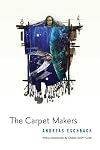
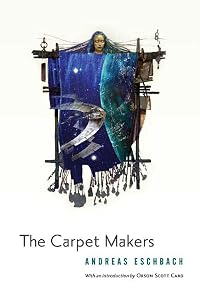
Since the time of pre-history, carpet makers tie intricate knots to form carpets for the court of the Emperor. These carpets are made from the hairs of wives and daughters; they are so detailed and fragile that each carpet maker finishes only one single carpet in his entire lifetime.This art descends from father to son, since the beginning of time itself.But one day the empire of the God Emperor vanishes, and strangers begin to arrive from the stars to follow the trace of the hair carpets. show more What these strangers discover is beyond all belief, more than anything they could have ever imagined...Brought to the attention of Tor Books by Orson Scott Card, this edition of The Carpet Makers contains a special introduction by Orson Scott Card. show lessTags
Recommendations






















Member Reviews
Eschbach has a way of creating worlds that makes them both magical and wonderfully mundane, to where you're exploring a world built by beautiful language while, at the same time, feeling that the people involved are utterly familiar, different as their cares and their world may be. You can say that this story is about passion or art or the meaning of life, or about exploration or revenge or religion or world views, or even about telling stories. It's all of this. It's also about the meaning found in the day-to-day survival of life and of belief, and about determination and hope.
In the beginning, it's something of an old-world fairy tale, and then it is a mastery of space and perspective, and finally, it is something beautiful, somewhere show more in between.
If you haven't figured it out already from this wandering review, Eschbach's stories rather defy description, but they are wonderful. They are utterly wonderful. And if you read science fiction or fantasy, you should read The Carpet Makers.
Absolutely recommended. show less
In the beginning, it's something of an old-world fairy tale, and then it is a mastery of space and perspective, and finally, it is something beautiful, somewhere show more in between.
If you haven't figured it out already from this wandering review, Eschbach's stories rather defy description, but they are wonderful. They are utterly wonderful. And if you read science fiction or fantasy, you should read The Carpet Makers.
Absolutely recommended. show less
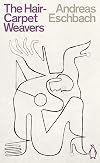
[b:The Hair-Carpet Weavers|49095672|The Hair-Carpet Weavers|Andreas Eschbach|https://i.gr-assets.com/images/S/compressed.photo.goodreads.com/books/1619343214l/49095672._SY75_.jpg|622728] was first published in German in 1995, yet this English translation read to me as if it was somewhat older. Had I been told it was 1960s or 70s scifi, I would have found that totally plausible. In a 1990s or 2020s context, it reads more like fantasy. Yet I am wary of reassigning it to that genre when the edition I read was a Penguin Science Fiction Classic! The narrative concerns a mysterious planet in a vast galactic empire where the economy and social structure is based on laboriously hand-knotting carpets made of human hair. These are produced for show more the distant godlike emperor.
The structure of the book pleasantly surprised me. At the very start, a character is introduced who appears to have protagonist written all over him. By the end of the first chapter he is dead and in fact there is no protagonist. The narration is polyphonic, building the reader's understanding of the hair-carpet weavers via a range of points of view. Even characters who recur in multiple chapters may suddenly vanish and their fate remain a mystery. This novel is an investigation into a strange phenomenon, rather than being character-centric. A challenging structure that is deployed well here. The mystery certainly kept my interest.
On the other hand, it was depressing as fuck. The worldbuilding in [b:The Hair-Carpet Weavers|49095672|The Hair-Carpet Weavers|Andreas Eschbach|https://i.gr-assets.com/images/S/compressed.photo.goodreads.com/books/1619343214l/49095672._SY75_.jpg|622728] seemed like a grim mirror of the optimistic [b:The Hands of the Emperor|43525897|The Hands of the Emperor (Lays of the Hearth-Fire, #1)|Victoria Goddard|https://i.gr-assets.com/images/S/compressed.photo.goodreads.com/books/1547081914l/43525897._SY75_.jpg|67696698]. Both explore seemingly immutable empires ruled by godlike men. Here, the suffering of the empire's subjects is shown in considerable detail; the course of their lives is dictated by the emperor's arbitrary requirement for hair carpets. After a gradual built up, the final revelation of why hair carpet weaving came about and what happens to the carpets is truly extraordinary. I did not see it coming. Ultimately [b:The Hair-Carpet Weavers|49095672|The Hair-Carpet Weavers|Andreas Eschbach|https://i.gr-assets.com/images/S/compressed.photo.goodreads.com/books/1619343214l/49095672._SY75_.jpg|622728] is a powerful and tragic parable about the destructive horrors of arbitrary systems. show less
The structure of the book pleasantly surprised me. At the very start, a character is introduced who appears to have protagonist written all over him. By the end of the first chapter he is dead and in fact there is no protagonist. The narration is polyphonic, building the reader's understanding of the hair-carpet weavers via a range of points of view. Even characters who recur in multiple chapters may suddenly vanish and their fate remain a mystery. This novel is an investigation into a strange phenomenon, rather than being character-centric. A challenging structure that is deployed well here. The mystery certainly kept my interest.
On the other hand, it was depressing as fuck. The worldbuilding in [b:The Hair-Carpet Weavers|49095672|The Hair-Carpet Weavers|Andreas Eschbach|https://i.gr-assets.com/images/S/compressed.photo.goodreads.com/books/1619343214l/49095672._SY75_.jpg|622728] seemed like a grim mirror of the optimistic [b:The Hands of the Emperor|43525897|The Hands of the Emperor (Lays of the Hearth-Fire, #1)|Victoria Goddard|https://i.gr-assets.com/images/S/compressed.photo.goodreads.com/books/1547081914l/43525897._SY75_.jpg|67696698]. Both explore seemingly immutable empires ruled by godlike men. Here, the suffering of the empire's subjects is shown in considerable detail; the course of their lives is dictated by the emperor's arbitrary requirement for hair carpets. After a gradual built up, the final revelation of why hair carpet weaving came about and what happens to the carpets is truly extraordinary. I did not see it coming. Ultimately [b:The Hair-Carpet Weavers|49095672|The Hair-Carpet Weavers|Andreas Eschbach|https://i.gr-assets.com/images/S/compressed.photo.goodreads.com/books/1619343214l/49095672._SY75_.jpg|622728] is a powerful and tragic parable about the destructive horrors of arbitrary systems. show less
(...)
While not fully perfect, the book is a gem that combines Le Guinish calm, mythical storytelling as in Earthsea, with a space opera plot that nods at Herbert and has the outrageous imagination of Iain M. Banks. I’d say this would appeal to both science fiction and fantasy readers, and the beginning of the book also reminded me a bit of Piranesi, another gem that was still fresh in my mind.
It also features a formal narrative approach I have rarely encountered, and definitely not as honed to perfection as it is here.
The Hair-Carpet Weavers starts with the story of Ostvan, a weaver whose sole occupation it is to weave a carpet using the hairs of his three wives, who each have a different hair-color. The weaving of the carpet is an show more intricate job, and it takes a lifetime to complete one carpet. The next chapter features a different viewpoint, focusing on a trader in hair-carpets. Each subsequent chapter has a different point-of-view, and while each chapter could be considered as a short story, they all are tied together closely – both in theme as in time. Eschbach manages to slowly unfold the mystery of the hair-carpet weavers, and the story zooms out as it evolves, but never losing touch with the people that populate it.
The different viewpoints – they are always different, not a single one is repeated – might hinder character development, but this is not really an issue, as each chapter has its own emotional conclusion, and the bigger story does develop – as does the society it is set in. I cannot stress the mastery Eschbach shows to pull something like this off, all in a fairly short novel for today’s standards. That narrative & emotional control is much more important than the fun, but ultimately superficial gimmick – a story about weavers that is woven out of different narrative threads itself.
(...)
Full review on Weighing A Pig show less
While not fully perfect, the book is a gem that combines Le Guinish calm, mythical storytelling as in Earthsea, with a space opera plot that nods at Herbert and has the outrageous imagination of Iain M. Banks. I’d say this would appeal to both science fiction and fantasy readers, and the beginning of the book also reminded me a bit of Piranesi, another gem that was still fresh in my mind.
It also features a formal narrative approach I have rarely encountered, and definitely not as honed to perfection as it is here.
The Hair-Carpet Weavers starts with the story of Ostvan, a weaver whose sole occupation it is to weave a carpet using the hairs of his three wives, who each have a different hair-color. The weaving of the carpet is an show more intricate job, and it takes a lifetime to complete one carpet. The next chapter features a different viewpoint, focusing on a trader in hair-carpets. Each subsequent chapter has a different point-of-view, and while each chapter could be considered as a short story, they all are tied together closely – both in theme as in time. Eschbach manages to slowly unfold the mystery of the hair-carpet weavers, and the story zooms out as it evolves, but never losing touch with the people that populate it.
The different viewpoints – they are always different, not a single one is repeated – might hinder character development, but this is not really an issue, as each chapter has its own emotional conclusion, and the bigger story does develop – as does the society it is set in. I cannot stress the mastery Eschbach shows to pull something like this off, all in a fairly short novel for today’s standards. That narrative & emotional control is much more important than the fun, but ultimately superficial gimmick – a story about weavers that is woven out of different narrative threads itself.
(...)
Full review on Weighing A Pig show less
It's interesting to read a book like this in German because I thought they didn't really have a lot of good old fashioned SF there. I was clearly wrong, because this is good, old-fashioned SF.
This is a collection of connected short stories unveiling the history of an intergalactic empire with a rotten piece of madness at its core. We are introduced to the empire via the "hair carpet weavers" of the title-a generational caste of men who spend their entire lives weaving a single, immensely intricate, carpet out of the hair of the women in their families. It sounds silly, but in context it is monstrous, and as the stories add context and background, it becomes almost horrific.
At the same time, there is a lot of heroic rebelling and show more dimensional bubbles and space-men among the primitives stuff reminiscent of "golden age" SF in the US. And just like that SF, there is a kernel of contemplation at the heart of this book: contemplation of empire, and colonization, and what it looks like when absolute rulers are truly corrupted.
I liked the book, even if some events leading up to the "reveal" are questionable. It's equal parts grim and fun, which is a rare combo. show less
This is a collection of connected short stories unveiling the history of an intergalactic empire with a rotten piece of madness at its core. We are introduced to the empire via the "hair carpet weavers" of the title-a generational caste of men who spend their entire lives weaving a single, immensely intricate, carpet out of the hair of the women in their families. It sounds silly, but in context it is monstrous, and as the stories add context and background, it becomes almost horrific.
At the same time, there is a lot of heroic rebelling and show more dimensional bubbles and space-men among the primitives stuff reminiscent of "golden age" SF in the US. And just like that SF, there is a kernel of contemplation at the heart of this book: contemplation of empire, and colonization, and what it looks like when absolute rulers are truly corrupted.
I liked the book, even if some events leading up to the "reveal" are questionable. It's equal parts grim and fun, which is a rare combo. show less
I’m not a huge authority on science fiction, confining my consumption to a narrow range of authors who catch my attention. Some favourites over the years have included Julian May, Iain M. Banks and Stephen R. Donaldson, which I guess puts my taste somewhere on the border between space age saga and fantasy. However, in my limited experience, no tale has had the range in either time (across hundreds of thousands of years) or distance (across entire galaxies) that this novel spans.
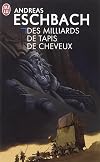
Eschbach is not well known to English-speaking readers but is beginning to be read following his discovery by no less than Orson Scott Card. I’ve found several of his works in French and enjoyed them all, most particularly The Last Of His Kind and The Jesus show more Video. I preferred the French title of this book which translates to “billions of hair carpets” as it better evokes the central idea of the book – a feudal society spread across thousands of planets where a major enterprise is the annual production of literally billions of carpets spun from human hair harvested from the heads of the weavers’ wives and concubines. Ostensibly these carpets are intended to decorate the palace of the emperor but the stunning scale of the enterprise is too grand and the book becomes an exploration of what purpose they really serve.
EschbachEschbach weaves a tangled web, jumping back and forth over the millenia, deceiving the reader up to the very end. Told as a series of short stories with no truly central characters, this is a puzzling book. Each story seems only loosely connected to the whole at first, but eventually we begin to pull the various threads together, not because they interconnect strongly but because they share a very strong context and what emerges is a staggeringly awful and very human explanation for the carpet weaving. It reminded me strongly of Iain M. Banks’ Inversions where an oddly feudal world emerges as belonging in a major galactical opera.
The book just begs to be read as an allegory for various human societies, steeped in religion and tradition.
German writers have always been among my favourites because of their highly cultivated and literary qualities and their very grand and sober themes. Eschbach is different; he has a lightness of touch that makes him easy to read and he is a truly good story teller with the ability to surprise the reader. show less
Eschbach is not well known to English-speaking readers but is beginning to be read following his discovery by no less than Orson Scott Card. I’ve found several of his works in French and enjoyed them all, most particularly The Last Of His Kind and The Jesus show more Video. I preferred the French title of this book which translates to “billions of hair carpets” as it better evokes the central idea of the book – a feudal society spread across thousands of planets where a major enterprise is the annual production of literally billions of carpets spun from human hair harvested from the heads of the weavers’ wives and concubines. Ostensibly these carpets are intended to decorate the palace of the emperor but the stunning scale of the enterprise is too grand and the book becomes an exploration of what purpose they really serve.
EschbachEschbach weaves a tangled web, jumping back and forth over the millenia, deceiving the reader up to the very end. Told as a series of short stories with no truly central characters, this is a puzzling book. Each story seems only loosely connected to the whole at first, but eventually we begin to pull the various threads together, not because they interconnect strongly but because they share a very strong context and what emerges is a staggeringly awful and very human explanation for the carpet weaving. It reminded me strongly of Iain M. Banks’ Inversions where an oddly feudal world emerges as belonging in a major galactical opera.
The book just begs to be read as an allegory for various human societies, steeped in religion and tradition.
German writers have always been among my favourites because of their highly cultivated and literary qualities and their very grand and sober themes. Eschbach is different; he has a lightness of touch that makes him easy to read and he is a truly good story teller with the ability to surprise the reader. show less
This book has a weird premise, which is why I bought it to begin with. On a planet, there is an entire system set up around one produced good: Carpets. Carpet-Makers are the most honored members of society. They spend their entire lives making a carpet out of human hair. They use the hair of their wives and daughters. They’re the only people in society allowed to have multiple wives - so they can have multiple colors from those wives as well as producing more colors/hair through their daughters. They are allowed one son, to continue the carpet making tradition. They toil away at this task day and night, every day; the work is so intricate that it takes their entire lives to produce one carpet. When the carpet is completed, it is sold, show more and the price of that hair carpet sets up the next generation (no really, it’s enough money for the family to live off on their entire lives), with the son of the carpet maker marrying and starting his carpet, to toil at until his son is ready to marry and begin the cycle all over again. That is their entire lives. And the economy and society of the entire planet revolves around these precious hair carpets. This is how it has been for untold generations.
They make these carpets to honor their God-Emperor, or at least that’s what they believe/know to be true. These carpets are supposedly shipped off world to adorn the palace of this immortal emperor who has all power and has ruled for however-many millenia.
And then it all changes. And the mystery of the hair carpets is discovered.
This book was interesting - not just in the actual story, but the way it is told. It has amazing writing - each chapter is a short story (so the book is basically a series of short stories) with a one or two (or whatever) character/thread link carrying you from one to the next. It’s usually a pretty tenuous link, but the book is about the story, about human nature - not the characters themselves.
But even without the book being about the characters, most of the chapters encompass something about the main character from the story that is so strong and shocking that at the end of the chapter, I’m left with a “WTF/Whoa/OMG” moment. Some of these chapters just break my heart.
Actually, this whole book pretty much kills me. Eschbach gets more said, more done, more story told, and more emotions out of my gut in 10-15 pages than most authors can get in whole trilogies. It’s a very short book, and it covers a story that takes place over 80,000 years and it’s absolutely amazing. show less
They make these carpets to honor their God-Emperor, or at least that’s what they believe/know to be true. These carpets are supposedly shipped off world to adorn the palace of this immortal emperor who has all power and has ruled for however-many millenia.
And then it all changes. And the mystery of the hair carpets is discovered.
This book was interesting - not just in the actual story, but the way it is told. It has amazing writing - each chapter is a short story (so the book is basically a series of short stories) with a one or two (or whatever) character/thread link carrying you from one to the next. It’s usually a pretty tenuous link, but the book is about the story, about human nature - not the characters themselves.
But even without the book being about the characters, most of the chapters encompass something about the main character from the story that is so strong and shocking that at the end of the chapter, I’m left with a “WTF/Whoa/OMG” moment. Some of these chapters just break my heart.
Actually, this whole book pretty much kills me. Eschbach gets more said, more done, more story told, and more emotions out of my gut in 10-15 pages than most authors can get in whole trilogies. It’s a very short book, and it covers a story that takes place over 80,000 years and it’s absolutely amazing. show less
(Small spoilers inside)
This book is one of the weirdest stories I've ever read. And I should be typing this in German, as I read the German version, also to improve my German. Either way: people making carpets out of human hair and spending their entire lifetimes doing so, all for the emperor, who is God for them. Even more so, because they've never seen him. In addition, for them, it's like paying a debt their father made and so it goes down each generation.
But when the story reaches its end and conclusion, that ending might seem weak and flat compared to the many happenings and descriptions preceding it. But, to me, it's not really the (original!) story itself that was important for A. Eschbach, but the moral behind it all. It shows show more that small issues can have massive impacts, even for those who have nothing to do with it.
And how the affected ones then hang on to certain beliefs and principles, without knowing how it came to be or if it all should be like this, whether it causes you pain/stress/fear. Until someone sees the light and so can (as good or as bad) convince the others. Maybe.
I'm not telling much about the stories themselves, because it's up to you to read them and find out for yourself how good this book really is.
In fact, as I liked it so much, I've ordered Eschach's other book, which takes place in the same universe, but is also stand-alone: Quest. show less
This book is one of the weirdest stories I've ever read. And I should be typing this in German, as I read the German version, also to improve my German. Either way: people making carpets out of human hair and spending their entire lifetimes doing so, all for the emperor, who is God for them. Even more so, because they've never seen him. In addition, for them, it's like paying a debt their father made and so it goes down each generation.
But when the story reaches its end and conclusion, that ending might seem weak and flat compared to the many happenings and descriptions preceding it. But, to me, it's not really the (original!) story itself that was important for A. Eschbach, but the moral behind it all. It shows show more that small issues can have massive impacts, even for those who have nothing to do with it.
And how the affected ones then hang on to certain beliefs and principles, without knowing how it came to be or if it all should be like this, whether it causes you pain/stress/fear. Until someone sees the light and so can (as good or as bad) convince the others. Maybe.
I'm not telling much about the stories themselves, because it's up to you to read them and find out for yourself how good this book really is.
In fact, as I liked it so much, I've ordered Eschach's other book, which takes place in the same universe, but is also stand-alone: Quest. show less
Members
- Recently Added By
Published Reviews
ThingScore 75
Je me plains souvent du manque d'originalité de livres qui sont par ailleurs passionnants. Cette fois, je dois reconnaître que ce livre est très original et empreint d'une étrangeté poétique étonnante.
added by grimm
Lists

Best Science Fiction Originally Published in a Language Other Than English
449 works; 34 members

Best Science Fiction Novels
816 works; 426 members
SF & Fantasy in Translation
95 works; 18 members

Recommend the 20 best books you've read in the last five years
2,168 works; 607 members

Pleasant Surprises: Books That Exceeded Our Expectations
418 works; 143 members

EU Fiction: 1950-2022
223 works; 70 members

fictional librarians
53 works; 19 members

Tagged Parallel Worlds
43 works; 11 members

Speculative Fiction from around the World
610 works; 18 members

Favourite Books
1,820 works; 316 members

Reading LIst
648 works; 1 member
Favorite Science Fiction
457 works; 220 members
Author Information

109+ Works 5,525 Members
Some Editions
Awards and Honors
Awards
Distinctions
Notable Lists
Series

Belongs to Publisher Series
Common Knowledge
- Canonical title
- The Carpet Makers
- Original title
- Die Haarteppichknüpfer
- Alternate titles
- The Hair-Carpet Weavers
- Original publication date
- 1995
- First words
- Knot after knot, day in, day out, for an entire lifetime, always the same hand movements, always looping the same knots in the fine hair, so fine and tiny that with time, the fingers trembled and the eyes became weak from str... (show all)ain -- and still the progress was hardly noticeable.
- Blurbers
- Oliver Faulhaber
- Original language
- German
Classifications
- Genres
- Fiction and Literature, Science Fiction
- DDC/MDS
- 833.914 — Literature & rhetoric German & related literatures German fiction 1900- 1900-1990 1945-1990
- LCC
- PT2665 .S34 .H313 — Language and Literature German, Dutch and Scandinavian literatures German literature Individual authors or works 1961-2000
- BISAC
Statistics
- Members
- 999
- Popularity
- 26,272
- Reviews
- 46
- Rating
- (4.09)
- Languages
- 8 — Czech, English, French, German, Hungarian, Italian, Polish, Spanish
- Media
- Paper, Audiobook, Ebook
- ISBNs
- 24
- ASINs
- 11