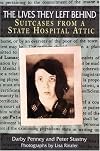
The Lives They Left Behind: Suitcases from a State Hospital Attic
by Darby Penney, Peter Stastny (Author)
On This Page
Description
“The Lives They Left Behind is a deeply moving testament to the human side of mental illness, and of the narrow margin which so often separates the sane from the mad. It is a remarkable portrait, too, of the life of a psychiatric asylum—the sort of community in which, for better and for worse, hundreds of thousands of people lived out their lives. Darby Penney and Peter Stastny's careful historical (almost archaeological) and biographical reconstructions give us unique insight into these show more lives which would otherwise be lost and, indeed, unimaginable to the rest of us." —Oliver Sacks“Fascinating. . . . The haunting thing about the suitcase owners is that it's so easy to identify with them." —Newsweek
When Willard State Hospital closed its doors in 1995, after operating as one of New York State's largest mental institutions for over 120 years, a forgotten attic filled with suitcases belonging to former patients was discovered. Using the possessions found in these suitcases along with institutional records and doctors' notes from patient sessions, Darby Penney, a leading advocate of patients' rights, and Peter Stastny, a psychiatrist and documentary filmmaker, were able to reconstruct the lives of ten patients who resided at Willard during the first half of the twentieth century.
The Lives They Left Behind tells their story. In addition to these human portraits, the book contains over 100 photographs as well as valuable historical background on how this state-funded institution operated. As it restores the humanity of the individuals it so poignantly evokes, The Lives They Left Behind reveals the vast historical inadequacies of a psychiatric system that has yet to heal itself.
. show less
Tags
Recommendations






































Member Recommendations

Member Reviews
What an amazing story of the lives of 10 people who ended up in the Willard Asylum in Ovid, New York, which ran from 1869 to 1995. When the facility was closed in 1995, four hundred and twenty-seven suitcases were discovered in the attic. Researchers got permission to those suitcases and their medical records, as long as they agreed to change their names to protect the patient’s identities. In this book, the first names are real, but the last names are not.
I absolutely loved how the research and their stories were put together. The author gives you a brief, but very important, part of each patient’s life leading up to the day they were admitted into the asylum, along with a picture or two of that person. Most were immigrants from show more the 20’s and 30’s with high hopes of making it here in America. Their younger photos will break your heart; they were so young and beautiful with a full life ahead of them. Their stories will make you question every psychiatrist’s knowledge of what he ‘thinks’ he really knows about human life because they never even considered the history of any of the individuals. They had one word for just about every patient, every potential free worker of the state, “paranoid schizophrenia”. How scary it must have been to have someone you had a riff with turn you in to be checked out mentally, and then you find yourself locked into the system with no way out.
If you compare their stories with what you hear about on the news today, you would think half of America should be locked up or need some kind of psychiatric help.
The images in the book are online, along with a few extra photos:
http://www.suitcaseexhibit.org/index.php?section=about&subsection=suitcases show less
I absolutely loved how the research and their stories were put together. The author gives you a brief, but very important, part of each patient’s life leading up to the day they were admitted into the asylum, along with a picture or two of that person. Most were immigrants from show more the 20’s and 30’s with high hopes of making it here in America. Their younger photos will break your heart; they were so young and beautiful with a full life ahead of them. Their stories will make you question every psychiatrist’s knowledge of what he ‘thinks’ he really knows about human life because they never even considered the history of any of the individuals. They had one word for just about every patient, every potential free worker of the state, “paranoid schizophrenia”. How scary it must have been to have someone you had a riff with turn you in to be checked out mentally, and then you find yourself locked into the system with no way out.
If you compare their stories with what you hear about on the news today, you would think half of America should be locked up or need some kind of psychiatric help.
The images in the book are online, along with a few extra photos:
http://www.suitcaseexhibit.org/index.php?section=about&subsection=suitcases show less
Fascinating look at mental health care in the early to mid 20th Century. I found the narratives a bit jumbled; they seemed to jump in time and skip around. But that was a minor irritation, and overall I found this book riveting.
I believe most of the people profiled in this book might not even be given any mental health treatment today, and was struck by the number of individuals (probably 3 or 4 of the 10) who had sustained a head injury at some time prior to their mental health "breakdown."
I like to think we do a better job with mental health care now, but the authors' afterword paints a fairly grim picture of the current state of things. Many of the people who would have been institutionalized in mental health facilities in the past show more now end up in the prison system, apparently.
I was left feeling grief for the people in the book and their lost lives/lost potential. People pushed to the periphery of society because they didn't fit into established norms or because they fell on hard times, or had a particularly emotional period. It's there but for the grace of God that I go, and probably many others as well. show less
I believe most of the people profiled in this book might not even be given any mental health treatment today, and was struck by the number of individuals (probably 3 or 4 of the 10) who had sustained a head injury at some time prior to their mental health "breakdown."
I like to think we do a better job with mental health care now, but the authors' afterword paints a fairly grim picture of the current state of things. Many of the people who would have been institutionalized in mental health facilities in the past show more now end up in the prison system, apparently.
I was left feeling grief for the people in the book and their lost lives/lost potential. People pushed to the periphery of society because they didn't fit into established norms or because they fell on hard times, or had a particularly emotional period. It's there but for the grace of God that I go, and probably many others as well. show less
The Willard Asylum for the Chronic Insane opened in upstate New York in 1869. It was thought to be a humane way to deal with those afflicted with mental illness, even though most of the people admitted received little in the way of care, and few were discharged once admitted. This hospital did not close its doors until 1995, and after it did, over 400 suitcases were found in an attic, containing the personal belongings of patients who had died while hospitalized. Given access, Darby Penney and Peter Stastny were able to curate and catalog their contents. This led to a photographic exhibition, and ultimately, this 2008 book in which the authors highlight the lives of ten of those suitcase owners.
By centering these life stories around the show more possessions the patients brought with them when hospitalized, Penney and Stastny are able to recreate a time when these individuals lived productive lives in their communities. While they seem to downplay the fact that these people did in fact suffer from mental illness, they do show that hospitalization, rather than helping, usually worsened their conditions. By presenting the full life histories of these suitcase owners, the authors highlight the human toll of 20th Century institutionalized mental care in this country. The photographs of the suitcase contents included in The Lives They Left Behind and of the patients themselves help to illustrate the heartbreaking stories. But even if these state hospitals were not the solution to caring for the mentally ill, one cannot help but wonder if we are doing a better job today, with so many afflicted individuals living homeless on our city streets. show less
By centering these life stories around the show more possessions the patients brought with them when hospitalized, Penney and Stastny are able to recreate a time when these individuals lived productive lives in their communities. While they seem to downplay the fact that these people did in fact suffer from mental illness, they do show that hospitalization, rather than helping, usually worsened their conditions. By presenting the full life histories of these suitcase owners, the authors highlight the human toll of 20th Century institutionalized mental care in this country. The photographs of the suitcase contents included in The Lives They Left Behind and of the patients themselves help to illustrate the heartbreaking stories. But even if these state hospitals were not the solution to caring for the mentally ill, one cannot help but wonder if we are doing a better job today, with so many afflicted individuals living homeless on our city streets. show less
This is a very difficult book to read because it shows the damage that can be done to people who have no resources to fight for themselves. Penney's theory is that when mental institutions became more humane, more people were committed to them. Add this fact to the eugenics movement which postulated that only the best sort of people should be encouraged to reproduce and mental institution populations were greatly increased so that mentally ill or mentally "defective" people could be removed from society for their reproductive lives. As the population of mental institutions grew larger the growth actually helped fuel its own increase because the patients themselves were used as free labor to perform the menial work necessitated to keep show more the institutions functioning. There were no psychopharmaceuticals for most of the time Willard State hospital was in operation. Essentially, the patients got no mental health care at all. They were observed at intervals but they were seldom released from custody because of their evaluations. Those who could work were encouraged to do so, those who couldn't or wouldn't just sat, for years and years and years. When early psychopharmaceuticals were introduced they were give to people long after the fact that they were shown to cause tardive dyskinesia. Electroconvulsive therapy was used as a form of patient control.
Lastly Penney shows how the modern method of dealing with mental illness is far from optimal. Hospitals have closed, and those who can't care for themselves have either become homeless or incarcerated or relegated to "adult care homes" that frequently offer as little care as Willard did. Peer therapy and interaction has been shown to be effective but is used far too infrequently in he age of little respect or finances to care for people facing mental health challenges. show less
Lastly Penney shows how the modern method of dealing with mental illness is far from optimal. Hospitals have closed, and those who can't care for themselves have either become homeless or incarcerated or relegated to "adult care homes" that frequently offer as little care as Willard did. Peer therapy and interaction has been shown to be effective but is used far too infrequently in he age of little respect or finances to care for people facing mental health challenges. show less
I had high hopes for this book, having wanted to acquire and read it since I heard of it, due to the photographic opportunities. However, on that front I was disappointed since the photos are few in number, small, and black and white. Still, the patient profiles are detailed and moving. It feels as if these Willard examples are poor unfortunates from an era when even an acute nervous breakdown or even oddball personality could shunt one off for hopeless decades or lifelong incarceration in an uncaring and depressing institution.
I have tremendously mixed feelings about this book.
I appreciate the effort the authors made to learn the history of these men and women. I was often deeply moved by their stories and their faces and their struggles.
At the same time, I absolutely hated their decision to use the hands of models, posing as the subjects in photos, and their choice not to use anyone's real last names. I thought the point of this book was the truth; these elements make it seem like theatre.
The laziest way to advance text is to list question after question: Where did she go after she left? Was anyone there to meet her? Did she find a job? Did she find happiness? (These are questions the reader is smart enough to consider him/herself, and invariably the answer show more is "We don't know." ) This book is filled with such questions.
I also didn't care for the authors' choice to juxtapose contemporary medical know-how with yesterday's assumptions. I certainly believe that mental institutions of years ago were often terrible places, but I also imagine that physicians and nurses of the time likely were doing their best, and genuinely wanted to help their patients.
This could have been an extremely powerful book had the writers simply told the story of the men and women in the asylum. Instead, they chose to lecture and conjecture.
A strange book - sad, melancholy, poignant. show less
I appreciate the effort the authors made to learn the history of these men and women. I was often deeply moved by their stories and their faces and their struggles.
At the same time, I absolutely hated their decision to use the hands of models, posing as the subjects in photos, and their choice not to use anyone's real last names. I thought the point of this book was the truth; these elements make it seem like theatre.
The laziest way to advance text is to list question after question: Where did she go after she left? Was anyone there to meet her? Did she find a job? Did she find happiness? (These are questions the reader is smart enough to consider him/herself, and invariably the answer show more is "We don't know." ) This book is filled with such questions.
I also didn't care for the authors' choice to juxtapose contemporary medical know-how with yesterday's assumptions. I certainly believe that mental institutions of years ago were often terrible places, but I also imagine that physicians and nurses of the time likely were doing their best, and genuinely wanted to help their patients.
This could have been an extremely powerful book had the writers simply told the story of the men and women in the asylum. Instead, they chose to lecture and conjecture.
A strange book - sad, melancholy, poignant. show less
Terribly disappointing because it could have been wonderful, but instead suffers from repetitive, barely-restrained vitriol. The book's ostensible focus is on reconstructing, from suitcases left in the attic, the lives of people who were patients at a residential psychiatric hospital. This is an interesting proposition, but it is not pursued hermeneutically or adequately. The problem is not that the authors have a point to make and use the case studies to support it. Rather, they are not sufficiently up-front about their agenda and present a veneer of scientific inquiry to convey their neutrality. However, they are not neutral, and their thesis is ill-served by not being explicitly described.
An otherwise-interesting topic is marred by show more heavy negative over-generalization, failure to stick to the topic it proposes to present, and failure to separate the issue of type and quality of care from the question of what to do when a person is unable to manage in society. Making the book worse is poor editing, both in terms of sometimes-confusing organization and flow, and unclear and repetitive statements. Some important information and explanation are also missing (for example, whose hands are holding the people's possessions in the photos, and is it journalistically suspect to have used hands that appear to match the person's demographics?). Another area that seems deceptive and detracts significantly is the authors' contradictory attitude about the patients' privacy. On the publishing information page, they report that they would have used patients' names but for privacy laws. I can understand this regret; my dissertation study participants wanted me to use their names and I was not permitted to do so. However, the authors' desire to use names stems from their own wishes, not their subjects', as their subjects are dead. Presumably if the patients' relatives had given permission, the authors could have used the patients' names (since the survivors hold the decedents' privilege). It is possible that the patients would not have wanted their names used. In this light, the authors' use of people's first names, full-face photos, and potentially identifying information seems both coy and unethical, as well as unnecessary and provocative. Who is it who was stripped of their autonomy and used for other people's ends by the bad legal/medical/psychiatric abusers? And whose privacy is abrogated by the authors, for their own purposes? Hmm.
I support the authors' contentions that psychiatry has been used as an instrument of social control and management, that patients were and are pathologized and disbelieved, and that they often receive inadequate care, especially in public institutions. This is widely documented and more effectively demonstrated elsewhere, though it bears repeating. The authors could have used this book more effectively for this purpose had they constrained their editorializing and not engaged in multiple instances of extreme and overgeneralized assertions. For example, they don't give any examples of people who they think need any kind of psychiatric intervention, yet also condemn the state and psychiatric/medical profession for not providing other services. Perhaps most egregiously problematic, they condemn the objectification of the patients and the loss of their complexity and humanity, yet by only portraying the parts of patients' histories that support the authors' perspective, they also treat the patients as objects that serve the authors' ends. show less
An otherwise-interesting topic is marred by show more heavy negative over-generalization, failure to stick to the topic it proposes to present, and failure to separate the issue of type and quality of care from the question of what to do when a person is unable to manage in society. Making the book worse is poor editing, both in terms of sometimes-confusing organization and flow, and unclear and repetitive statements. Some important information and explanation are also missing (for example, whose hands are holding the people's possessions in the photos, and is it journalistically suspect to have used hands that appear to match the person's demographics?). Another area that seems deceptive and detracts significantly is the authors' contradictory attitude about the patients' privacy. On the publishing information page, they report that they would have used patients' names but for privacy laws. I can understand this regret; my dissertation study participants wanted me to use their names and I was not permitted to do so. However, the authors' desire to use names stems from their own wishes, not their subjects', as their subjects are dead. Presumably if the patients' relatives had given permission, the authors could have used the patients' names (since the survivors hold the decedents' privilege). It is possible that the patients would not have wanted their names used. In this light, the authors' use of people's first names, full-face photos, and potentially identifying information seems both coy and unethical, as well as unnecessary and provocative. Who is it who was stripped of their autonomy and used for other people's ends by the bad legal/medical/psychiatric abusers? And whose privacy is abrogated by the authors, for their own purposes? Hmm.
I support the authors' contentions that psychiatry has been used as an instrument of social control and management, that patients were and are pathologized and disbelieved, and that they often receive inadequate care, especially in public institutions. This is widely documented and more effectively demonstrated elsewhere, though it bears repeating. The authors could have used this book more effectively for this purpose had they constrained their editorializing and not engaged in multiple instances of extreme and overgeneralized assertions. For example, they don't give any examples of people who they think need any kind of psychiatric intervention, yet also condemn the state and psychiatric/medical profession for not providing other services. Perhaps most egregiously problematic, they condemn the objectification of the patients and the loss of their complexity and humanity, yet by only portraying the parts of patients' histories that support the authors' perspective, they also treat the patients as objects that serve the authors' ends. show less
Members
- Recently Added By
Lists

books i wanna read
13 works; 1 member
Author Information

1 Work 472 Members
All Editions
Common Knowledge
- Canonical title
- The Lives They Left Behind: Suitcases from a State Hospital Attic
- Original publication date
- 2009
- Important places
- Willard Psychiatric Center; New York, USA
- Dedication
- This book is dedicated to the memories of the Willard suitcase owners, and to all others who have lived and died in mental institutions.
- First words
- The Sheltered Workshop Building stands alone on a hill overlooking Seneca Lake next to the empty lot that once held Chapin Hall, the massive central building of Willard State Hospital in New York. (Prologue)
The literature on the history o our country's treatment of people it considers mad basically consists of two types of book. (Foreword) - Last words
- (Click to show. Warning: May contain spoilers.)This process, which usually occurs outside the mental health system, can lead to a reconstruction of personal narratives in terms of healing and the possibility of a positive, self-determined future.
- Original language
- English
Classifications
- Genres
- Nonfiction, General Nonfiction, History, Biography & Memoir
- DDC/MDS
- 362.21097471 — Society, government, & culture Social problems and social services Social Welfare Mental illness Mental Health Facilities
- LCC
- RC445 .N7 .W614 — Medicine Internal medicine Internal medicine Neurosciences. Biological psychiatry. Neuropsychiatry Psychiatry
- BISAC
Statistics
- Members
- 473
- Popularity
- 64,474
- Reviews
- 17
- Rating
- (3.68)
- Languages
- English
- Media
- Paper, Audiobook, Ebook
- ISBNs
- 6
- ASINs
- 3