Bones of the Earth
by Michael Swanwick
On This Page
Description
Modern technology is pitted against ancient killers in this scientific thriller James Rollins calls "Jurassic Park set amid the paradox of time travel" Paleontologist Richard Leyster is perfectly content in his position with the Smithsonian excavating dinosaur fossil sites and publishing his findings . . . until the mysterious Harry Griffin appears in his office with a cooler containing the head of a freshly killed Stegosaurus. The enigmatic stranger offers Leyster the opportunity to travel show more back in time to study living dinosaurs in their original habitats-but with strings attached. Soon, the paleontologist finds himself, along with a select team of colleagues-including his chief rival, the ambitious and often ruthless Dr. Gertrude Salley-making discoveries that would prove impossible working from fossils alone. But when Leyster and his team are stranded in the Cretaceous, they must learn to survive while still keeping alive the joy of scientific discovery. This shocking novel spans hundreds of millions of years and deals with the ultimate fate not only of the dinosaurs but also of all humankind. Nominated for the Locus Award, the Hugo Award, the Campbell Award, and the Nebula Award for Best Novel, Bones of the Earth cements author Michael Swanwick as one of the best and most ambitious writers working in the genre. Perfect for fans of Michael Crichton and Greg Bear. show lessTags
Recommendations
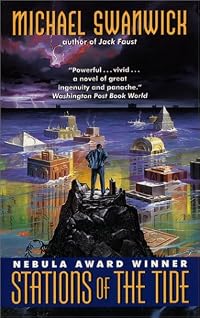
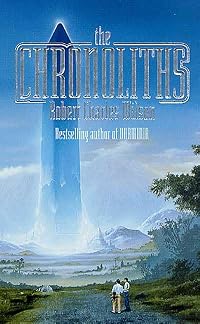
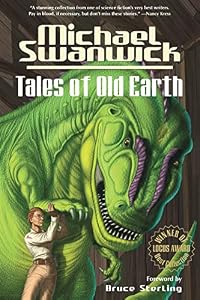


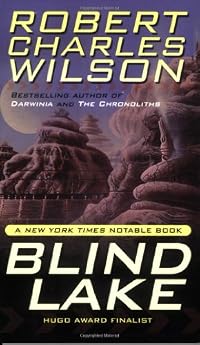
























Member Reviews
It is not often that I learn something new in the first line of a novel. But I now know that we are living in the Cenozoic era, the Quaternary period, and the Holocene epoch.
Bones of the Earth is a time travel story that begins in Michael Swanwick’s near future of 2010 when a Smithsonian paleontologist gets a chance to visit the Mesozoic era. The only catch is that he can’t reveal anything he learns there that can’t be corroborated by present-day research—paradoxes, you know.
He soon finds himself working with a team of researchers, including first-, second-, and third-generation time travelers. He and his fellow first-generation recruits are jealous of the third-generation researchers, who can publish what they want, because show more time travel has been made public in their time.
The plot has all the tangled loops you might expect. Along the way, you get some thoughtful science and some clever ideas, like worrying about Christian fundamentalists using time travel to fake the geologic record to support their religious views.
You would not know it from the current ratings, but Bones was nominated for the Hugo and Nebula awards. show less
Bones of the Earth is a time travel story that begins in Michael Swanwick’s near future of 2010 when a Smithsonian paleontologist gets a chance to visit the Mesozoic era. The only catch is that he can’t reveal anything he learns there that can’t be corroborated by present-day research—paradoxes, you know.
He soon finds himself working with a team of researchers, including first-, second-, and third-generation time travelers. He and his fellow first-generation recruits are jealous of the third-generation researchers, who can publish what they want, because show more time travel has been made public in their time.
The plot has all the tangled loops you might expect. Along the way, you get some thoughtful science and some clever ideas, like worrying about Christian fundamentalists using time travel to fake the geologic record to support their religious views.
You would not know it from the current ratings, but Bones was nominated for the Hugo and Nebula awards. show less
This actually turned out to be a wonderfully scientific time-travel SF that fairly shined in theories and all the species of dinosaurs, and we got a treat of actually living there for a time... with complications, of course.
I mean, we have the more pedestrian complications of bureaucracy and directors and academics scheduling a time to go time hopping, but we also have the little issue of religious nuts, too... and OF COURSE we never found a footprint of a human next to a dinosaur's then the time-travel never happened, right? LOL
And then there's Swanwick's interesting treatment of time-like loops and the interesting revelations of where the time travel tech came from, too, not to mention seeing the novel turn into a survivalist's dream, show more too, and that's just a cool feature of the novel.
I mentioned that I loved the scientific theories, the grounded and detailed and clear explanations for some wild, wild ideas about infrasonic communications among the dinosaurs, the way they could listen to the earth to find safe locations, and how all of that got screwed up after the world was beat like a gong that went on for a hundred years. :) Hell, he even says that it's impossible to prove, but what an idea! I may have to hunt down the original theorist and read more, if it isn't Swanwick.. :) All of this was probably my favorite part... but there were two other areas that really caught my attention.
There was the whole problem of extinction. Not the theories, but of our extinction. This was a seriously interesting tangent.
And then there was the whole reaction to it, too, as well as after we learned what the time-travel really was, or what happened to those people who step outside of time. :) And if that wasn't enough, there was also a beautiful introspective answer to the whole question.
Why are we here? Is it enough to just know and have experienced?
I love these kinds of novels that frame the little questions in the big ones and mirror it all back. :) I've always loved Swanwick's works, too, and while it's probably my least favorite, it's still damn worthy SF. :) This isn't some throw-away time-travel novel. It never even glosses over the awesome science bits. It is full of interesting people in awesome situations.
Now, oddly enough, I've been reading a lot of time-travel stuff this month, and this one is a mite more serious in tone and execution than the others, combined, but that doesn't mean it wasn't awesome in its own right. show less
I mean, we have the more pedestrian complications of bureaucracy and directors and academics scheduling a time to go time hopping, but we also have the little issue of religious nuts, too... and OF COURSE we never found a footprint of a human next to a dinosaur's then the time-travel never happened, right? LOL
And then there's Swanwick's interesting treatment of time-like loops and the interesting revelations of where the time travel tech came from, too, not to mention seeing the novel turn into a survivalist's dream, show more too, and that's just a cool feature of the novel.
I mentioned that I loved the scientific theories, the grounded and detailed and clear explanations for some wild, wild ideas about infrasonic communications among the dinosaurs, the way they could listen to the earth to find safe locations, and how all of that got screwed up after the world was beat like a gong that went on for a hundred years. :) Hell, he even says that it's impossible to prove, but what an idea! I may have to hunt down the original theorist and read more, if it isn't Swanwick.. :) All of this was probably my favorite part... but there were two other areas that really caught my attention.
There was the whole problem of extinction. Not the theories, but of our extinction. This was a seriously interesting tangent.
And then there was the whole reaction to it, too, as well as after we learned what the time-travel really was, or what happened to those people who step outside of time. :) And if that wasn't enough, there was also a beautiful introspective answer to the whole question.
Why are we here? Is it enough to just know and have experienced?
I love these kinds of novels that frame the little questions in the big ones and mirror it all back. :) I've always loved Swanwick's works, too, and while it's probably my least favorite, it's still damn worthy SF. :) This isn't some throw-away time-travel novel. It never even glosses over the awesome science bits. It is full of interesting people in awesome situations.
Now, oddly enough, I've been reading a lot of time-travel stuff this month, and this one is a mite more serious in tone and execution than the others, combined, but that doesn't mean it wasn't awesome in its own right. show less
While most time travel novels spend a lot of time avoiding causality issues, Swanwick’s Bones of the Earth revels in the contradictions inherent in the idea. The main characters bounce around in time so much that they simply leave memos for their other selves to pick up to carry out actions in the past or future.
(Full review at my blog)
(Full review at my blog)
I liked this book a lot, but felt it had a slightly shaky structure - the plot seemed to only get going halfway through, though the setting of course was very well done and the time-travelling palaeontologist characters memorable. It's an expansion of the same setting as his excellent short story "Scherzo with Tyrannosaur" which won the 2000 Hugo
3.5 stars Originally posted at FanLit.
Paleontologist Richard Leyster works for the Smithsonian. Itƒ??s his dream job, so naturally he scoffs when a strange man named Harry Griffin offers him a new job whose description and benefits are vague. But when Griffin leaves an Igloo cooler containing the head of a real dinosaur on LeysterÂ??s desk, Leyster is definitely intrigued. A couple of years later, when Griffin finally contacts him again, Leyster is ready to sign on to GriffinÂ??s crazy project. He and a team of scientists are sent back to the Mesozoic era to study, up close and personal, the animals that, previously, had only been known by their bones. When a Christian fundamentalist terror group disrupts the project, things get show more very dangerous for Leyster and his colleagues. There are also concerns about the whole time-travel technology. How does it work? Where did it come from? What is the government hiding?
Bones of the Earth gleefully revels in paleontology and paradoxes. Readers will go to science conferences, watch grad students do field work, and listen to lengthy discussions about the classification of dinosaurs, the evolution of fringe ecological niches, and the event that caused dinosaur extinction. Some of this gets a little dry. There�?s an entire chapter called �?Peer Review� in which several scientists work together to write up a paper that, due to being stuck in the Mesozoic era, they know will never be published. (Even though this went on too long, I loved this idea!) But it�?s not all stuffy science, because this is Michael Swanwick, so there�?s also a paleontologist orgy �? probably the first one ever.
Most people, if they had the chance to move around in time, would be tempted to use this ability to profit financially Â?? get the lottery numbers from the newspaper, find out who won a horse race and go back and bet on it... But not a paleontologist. Swanwick speculates that theyÂ??d prefer prestige over money (and I think heÂ??s right about that). Thus, Dr. Gertrude Salley, whoÂ??s both a hero and a villain in this story, gleans facts instead of dollars during her time travels. Later, when Salley creates a time paradox and is forced to meet herself, sheÂ??s chagrined to learn that sheÂ??s not much fun to be around. Swanwick also takes us to the far distant future and speculates about the future of the human species. HumanityÂ??s prospects are grim, but weÂ??re left with a deep admiration for the human mind, its insatiable curiosity, and the science that allows us to fulfill our desire to understand our world.
IÂ??ll mention, since IÂ??ve seen some negative reviews of Bones of the Earth, that some readers have accused the book of being anti-Christian because the terrorists are creationists. I am both a Christian and a scientist and I did not feel that the book was anti-Christian. Yes, there is a villain who identifies as a Christian creationist, but two of the small group of paleontologists are also specifically identified as practicing Christians. A Christian who refuses to consider the possibility that creation and evolution are not mutually exclusive probably wonÂ??t like this book. For everyone else, itÂ??s fine.
Bones of the Earth, originally published in 2002, is an expansion of Michael Swanwick�?s 1999 short story �?Scherzo with Tyrannosaur� which was published in Asimov�?s Science Fiction and won the Hugo Award for Best Short Story in 2000. Bones of the Earth was nominated for a Nebula, Hugo, Campbell, and Locus Award. Kevin Pariseau narrates Audible Frontier�?s version which has recently been released. He was a great choice for this book. During my life I�?ve listened to hundreds of scientists talking about their research. There�?s a certain reserved enthusiasm and eagerness they display and Mr. Pariseau has this down perfectly �? he would fit right in at any scientific conference. show less
Paleontologist Richard Leyster works for the Smithsonian. Itƒ??s his dream job, so naturally he scoffs when a strange man named Harry Griffin offers him a new job whose description and benefits are vague. But when Griffin leaves an Igloo cooler containing the head of a real dinosaur on LeysterÂ??s desk, Leyster is definitely intrigued. A couple of years later, when Griffin finally contacts him again, Leyster is ready to sign on to GriffinÂ??s crazy project. He and a team of scientists are sent back to the Mesozoic era to study, up close and personal, the animals that, previously, had only been known by their bones. When a Christian fundamentalist terror group disrupts the project, things get show more very dangerous for Leyster and his colleagues. There are also concerns about the whole time-travel technology. How does it work? Where did it come from? What is the government hiding?
Bones of the Earth gleefully revels in paleontology and paradoxes. Readers will go to science conferences, watch grad students do field work, and listen to lengthy discussions about the classification of dinosaurs, the evolution of fringe ecological niches, and the event that caused dinosaur extinction. Some of this gets a little dry. There�?s an entire chapter called �?Peer Review� in which several scientists work together to write up a paper that, due to being stuck in the Mesozoic era, they know will never be published. (Even though this went on too long, I loved this idea!) But it�?s not all stuffy science, because this is Michael Swanwick, so there�?s also a paleontologist orgy �? probably the first one ever.
Most people, if they had the chance to move around in time, would be tempted to use this ability to profit financially Â?? get the lottery numbers from the newspaper, find out who won a horse race and go back and bet on it... But not a paleontologist. Swanwick speculates that theyÂ??d prefer prestige over money (and I think heÂ??s right about that). Thus, Dr. Gertrude Salley, whoÂ??s both a hero and a villain in this story, gleans facts instead of dollars during her time travels. Later, when Salley creates a time paradox and is forced to meet herself, sheÂ??s chagrined to learn that sheÂ??s not much fun to be around. Swanwick also takes us to the far distant future and speculates about the future of the human species. HumanityÂ??s prospects are grim, but weÂ??re left with a deep admiration for the human mind, its insatiable curiosity, and the science that allows us to fulfill our desire to understand our world.
IÂ??ll mention, since IÂ??ve seen some negative reviews of Bones of the Earth, that some readers have accused the book of being anti-Christian because the terrorists are creationists. I am both a Christian and a scientist and I did not feel that the book was anti-Christian. Yes, there is a villain who identifies as a Christian creationist, but two of the small group of paleontologists are also specifically identified as practicing Christians. A Christian who refuses to consider the possibility that creation and evolution are not mutually exclusive probably wonÂ??t like this book. For everyone else, itÂ??s fine.
Bones of the Earth, originally published in 2002, is an expansion of Michael Swanwick�?s 1999 short story �?Scherzo with Tyrannosaur� which was published in Asimov�?s Science Fiction and won the Hugo Award for Best Short Story in 2000. Bones of the Earth was nominated for a Nebula, Hugo, Campbell, and Locus Award. Kevin Pariseau narrates Audible Frontier�?s version which has recently been released. He was a great choice for this book. During my life I�?ve listened to hundreds of scientists talking about their research. There�?s a certain reserved enthusiasm and eagerness they display and Mr. Pariseau has this down perfectly �? he would fit right in at any scientific conference. show less
Giving a cold slap in the face to the time-travel theories of 'Back to the Future' and 'The Sound of Thunder', Swanwick ably shows off the horrific and wondrous abilities of time-travel, albeit very limited time travel gifted to a select group in this day and age by a race of future beings who prefer to remain anonymous.
As always with his writing, Swanwick draws the reader to think and ponder on some of the ideas he presents, whether of his own devising or gleaned from some journal or other he might have read a sentence or two in passing over the years. The humour of watching people intereact with several different times of one person is nearly laugh-out-loud in hindsight while still creating a carefully crafted aura of foreboding and show more foreshadowing.
At this point in his career a master of both the long and short forms of story-telling, Swanwick brings out the dinosaur-loving child in his readers, giving them, for a brief time, the dream of seeing these great beasts in life, while as always slamming home the inevitable horror of what our decisions will cause us to see. show less
As always with his writing, Swanwick draws the reader to think and ponder on some of the ideas he presents, whether of his own devising or gleaned from some journal or other he might have read a sentence or two in passing over the years. The humour of watching people intereact with several different times of one person is nearly laugh-out-loud in hindsight while still creating a carefully crafted aura of foreboding and show more foreshadowing.
At this point in his career a master of both the long and short forms of story-telling, Swanwick brings out the dinosaur-loving child in his readers, giving them, for a brief time, the dream of seeing these great beasts in life, while as always slamming home the inevitable horror of what our decisions will cause us to see. show less
The premise of Bones of the Earth is an interesting one. Inhabitants of Earth’s distant future have established a system of time travel and have made it available for use to palaeontologists of the 21st century to study the Mesozoic era. In return, they are expected to use the system responsibly and avoid the creation of paradoxes that may tamper with time. It seems like a godsend to the scientific community, but this gift threatens to become a dangerous tool in the hands of mavericks looking to bolster their own reputations, and to fanatical ideologues looking to strike out at ‘Darwinian heresy’. And amidst all this, few think to ask just why their ‘benefactors’ from the future have established this system in the first show more place.
In terms of characterisation and quality of prose, Swanwick displays once again his inventiveness and literary ability. The structure of this tale of time travel is also interesting, with plot twists and surprising developments unfolding swiftly one after the other. Michael Swanwick juggles the complexities of cause and effect and time-travel paradoxes gracefully and intelligently, building an intriguing mystery and making for a compelling storyline. With different narrative threads featuring different characters at different times to follow, one might think that there is a danger of the author getting tangled in a cat’s cradle of narratives, but this never happens.
The book does however, seem to lose focus towards the end, with the author choosing one narrative thread to follow which, while having its high points, doesn’t quiet satisfy in terms of providing explanations in the most satisfying manner. Indeed it feels as if what should be the main climax of the story is brushed over quickly in order to move to the denouement.
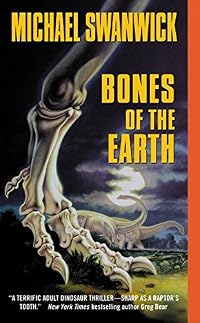
That said, Bones of the Earth is a compelling and well written novel. Any fears that a book that features dinosaurs so prominently on the cover will be “sci-fi lite” are unfounded. This is first and foremost a work of speculative fiction, rooted firmly in the great science fiction themes of time travel and evolution, with dinosaurs being a secondary (though also provocatively handled) feature. More generally, the book is also an impassioned defence of scientific endeavour, and on this level is succeeds most admirably. show less
In terms of characterisation and quality of prose, Swanwick displays once again his inventiveness and literary ability. The structure of this tale of time travel is also interesting, with plot twists and surprising developments unfolding swiftly one after the other. Michael Swanwick juggles the complexities of cause and effect and time-travel paradoxes gracefully and intelligently, building an intriguing mystery and making for a compelling storyline. With different narrative threads featuring different characters at different times to follow, one might think that there is a danger of the author getting tangled in a cat’s cradle of narratives, but this never happens.
The book does however, seem to lose focus towards the end, with the author choosing one narrative thread to follow which, while having its high points, doesn’t quiet satisfy in terms of providing explanations in the most satisfying manner. Indeed it feels as if what should be the main climax of the story is brushed over quickly in order to move to the denouement.
That said, Bones of the Earth is a compelling and well written novel. Any fears that a book that features dinosaurs so prominently on the cover will be “sci-fi lite” are unfounded. This is first and foremost a work of speculative fiction, rooted firmly in the great science fiction themes of time travel and evolution, with dinosaurs being a secondary (though also provocatively handled) feature. More generally, the book is also an impassioned defence of scientific endeavour, and on this level is succeeds most admirably. show less
Members
- Recently Added By
Lists

KayStJ's to-read list
1,616 works; 11 members
Author Information

455+ Works 8,468 Members
Michael Swanwick has received the Hugo, Nebula, Theodore Sturgeon, and World Fantasy Awards for his work
Some Editions
Awards and Honors
Awards
Distinctions
Series
Belongs to Publisher Series
Science Fiction Book Club (18845)
Work Relationships
Common Knowledge
- Original title
- Bones of the Earth
- Original publication date
- 2002-02
- People/Characters
- Richard Leyster
- Dedication
- This book is dedicated to all good teachers everywhere, most particularly those of the William Levering School and Central High School in Philadelphia, to whom more is owed than can ever be repaid.
- First words
- If the whole tangled affair could be said to have a beginning at all, it began on that cold, blustery afternoon in late October when the man with the Igloo cooler walked into Richard Leyster's office.
- Last words
- (Click to show. Warning: May contain spoilers.)"If we've ever had a nicer, I can't remember when."
- Blurbers
- Zindell, David; Cadigan, Pat; Vinge, Vernor; Clute, John; Brett-Surman, Michael; Bear, Greg (show all 7); Rollins, James
Classifications
Statistics
- Members
- 719
- Popularity
- 39,274
- Reviews
- 23
- Rating
- (3.44)
- Languages
- English, Lithuanian, Russian, Spanish
- Media
- Paper, Audiobook, Ebook
- ISBNs
- 7
- ASINs
- 4