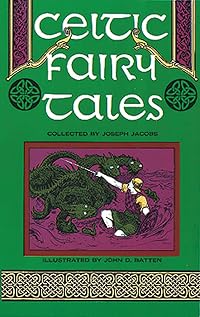
Celtic Fairy Tales
by Joseph Jacobs, Cuthbert Bede, J. F. Campbell, W. Carleton, T. Crofton Croker, Jeremiah Curtin, Douglas Hyde, Patrick Kennedy, Lady Wilde, S. Lover, Kenneth MacLeod, Alfred Nutt
On This Page
Description
Immerse yourself in these spine-tingling tales of banshees, goblins, and fairies from the Celtic and Gaelic traditions. Author Joseph Jacobs presents a comprehensive collection of stories, tales, and legends from the region. A must-read for fans of fairy tales, or for anyone with Irish heritage who is interested in learning more about the folk beliefs of their forefathers.Tags
Recommendations















Member Reviews
This is NOT written as a children's book. The language in this book is written in Old English and reads more like a Shakepearean sonnet. I bought this to add to my young son's library, but it is not appropriate for that. I'm sure however that adults who can read Old English with ease would find this book entertaining.
The fairy tale I read from this book is "The Wooing of Olwen." Before the imminent death of his wife, having bore his child, King Kilyth is instructed by her not to take another wife until “a briar with two blossoms” is seen upon her grave. At sight of such phenomena, King Kilyth marries the widow to King Doged. She then prophesizes to the young Kilhuch, son of King Kilyth, that it was his destiny to marry the maiden Olwen, “or no other.” Kilhuch then goes to his cousin, King Arthur, beseeching him to search for his destined love. Knowing of her father, Yspathaden Penkawr, but not of their whereabouts, King Arthur sends messengers to search for them. After a year of searching, not yielding any new information, Kilhuch takes it show more upon himself to search for Olwen. To journey with Kilhuch, Arthur sends his companions: Kay, who could hold his breath under water and go sleepless for nine days, and also retained an inner heat so great, that items in his hand would stay dry in rain, Bedwyr, a one-handed warrior who could kill faster than three warriors, Kynthelig, as guide, Ieithoedd knowing “all tongues,” Gwalchmai, who was always successful in quest, and Menw, a mage who could make the bunch invisible. Upon their journey they reach a castle in an open plain. Upon entering the house of a local herdsman, his wife instructs them that the maiden Olwen “came there every Saturday to wash.” Kilhuch meets Olwen and proclaims his love to her. She then instructs him to beseech her father in order that he may possess her love. Yspathadenm, her father then instructs Kilhuch to retrieve a comb and scissors “between the two ears of Turch Truith, son of Prince Tared.” He then instructs Kilhuch on how he may do so: they must hunt Turch Truith with Drudwyn, a dog who cannot be hunted with except by Mabon. First, the bunch come to the Ousel of Cilgwri, who takes them to where the Stag of Redynvre resides, who also joins them as guide to the Owl of Cwm Cawlwyd, in search of Mabon. The owl takes the bunch to the eagle of Gwern Abwy, who then takes the group to the Salmon of Llyn Llyw. The Salmon of Llyn Llyw allows them to ride upon his shoulders to the walls of a prison in Gloucester, and upon reaching, hear the wailing of Mabon from within the walls. Kay and Bedwyr break into the dungeon rescuing Mabon. Arthur, then summons all his warriors in search of Boar Truith. They hunt Boar, who flees to the ocean, but not before snatching the comb and scissors from his head. Yspathaden receives his request and Kilhuch receives his wife. I thought this folktale was ok. I wasn't enthralled by its prose, but I enjoyed the story. show less
Skill levels among the readers varied widely, generally stripping the stories of their intended humor or romance.
Collection of tales from various folklore collectors --as the introduction notes, it is dependent on early scholars and includes more Irish and Scottish tales than Welsh ones because there had been more collecting of Irish and Scottish tales up to that time (though I think he may have missed the tales incorporated in Burrows' Wild Wales). There is also one tale from the extinct Cornish language. Rather nice sub-pre-Raphaelite illustrations.
I believe this was also one of the exts of the Celtic and Germanic Folklore honors calls I had at Bowling Green in about 1968-69.
I believe this was also one of the exts of the Celtic and Germanic Folklore honors calls I had at Bowling Green in about 1968-69.
some interesting, some peculiar, not told perfectly but it is interesting that they are collected. i liked the illustrations
Overview of the Book: "Celtic Fairy Tales," published in 1892, is a compilation of 26 stories that draw from the folklore of Ireland, Scotland, and Wales. Joseph Jacobs, an influential folklorist, aimed to preserve and present these tales, highlighting their unique cultural significance and distinguishing them from English fairy tales. The collection includes well-known stories such as "Connla and the Fairy Maiden," "Guleesh," "The Horned Women," "King O'Toole and His Goose," and "The Sea-Maiden".
Some of the notable tales featured in the collection include:
"Munachar and Manachar": A tale of rivalry and cleverness.
"Brewery of Eggshells": A story that combines humor and fantasy.
"Fair, Brown, and Trembling": A classic tale of love and show more transformation.
"The Story of Deirdre": A tragic romance that is a staple of Irish mythology.
Source: Project Gutenberg show less
Some of the notable tales featured in the collection include:
"Munachar and Manachar": A tale of rivalry and cleverness.
"Brewery of Eggshells": A story that combines humor and fantasy.
"Fair, Brown, and Trembling": A classic tale of love and show more transformation.
"The Story of Deirdre": A tragic romance that is a staple of Irish mythology.
Source: Project Gutenberg show less
nice collection of stories from the celtic culture
Members
- Recently Added By
Lists

The Story of the World: History for the Classical Child: Activity Book One
291 works; 3 members

The Story of the World: History for the Classical Child: Activity Book Two
415 works; 2 members
Author Information

136+ Works 4,907 Members
Joseph Jacobs was born in Sydney, Australia on August 29, 1854. After graduating from Cambridge University in 1876, he pursued a full and varied career, writing many essays for various periodicals including a famous series in 1882 on the Russian persecutions of the Jews. He also made his influence felt as a Jew by editing the first issues of The show more Jewish Yearbook (1896--99), serving as president of the Jewish Historical Society, and editing The Jewish Encyclopedia. He later served as professor of English at the Jewish Theological Seminary in New York City. His interest in folklore grew out of his studies in anthropology. From 1890 to 1893, he edited Folk Lore, a British journal on the subject. He also edited the Arabian Nights and Aesop's Fables and produced a series of fairy tale books. These fairy tale collections were the result of regular research in folklore, literature, anthropology, and other fields, and they are, perhaps, the works for which he is best remembered today. While other collectors of English folk tales rewrote or left out the crude language of the originals, he brought the vigor of colloquial English into his folk tale collections, and such memorable phrases as Fee-fi-fo-fum and chinny chin chin remain the strength of his contributions. He died on January 30, 1916. (Bowker Author Biography) show less

22+ Works 1,494 Members

31+ Works 1,783 Members
1 Work 1,345 Members
11+ Works 1,450 Members

36+ Works 2,496 Members

42+ Works 1,714 Members
11+ Works 1,411 Members
1+ Work 1,337 Members
10 Works 1,372 Members
6+ Works 1,560 Members
Some Editions
Series
Belongs to Publisher Series
Work Relationships
Is contained in
Common Knowledge
- Original title
- Celtic Fairy Tales
- Original publication date
- 1892
- Dedication
- To Alfred Nutt
- First words
- Connla of the Fiery Hair was son of Conn of the Hundred Flights. (CONNLA AND THE FAIRY MAIDEN)
- Last words
- (Click to show. Warning: May contain spoilers.)The sheep was heavy with water, and he could not lift her, so he took off his coat and pulled! but it was too much for him, so he spit on his hands, and took a good hold of the tail and he PULLED! ! and the tail broke ! and if it had not been for that this tale would have been a great deal longer. (THE TAIL)
(Click to show. Warning: May contain spoilers.)Whether he ever lost his time learning them sciences, I'm not sure, but it's as sure as fate that his mother never more saw any want until the end of her days. - Original language
- English
Classifications
Statistics
- Members
- 1,346
- Popularity
- 17,841
- Reviews
- 8
- Rating
- (3.63)
- Languages
- English, Italian, Portuguese, Spanish
- Media
- Paper, Audiobook, Ebook
- ISBNs
- 87
- UPCs
- 2
- ASINs
- 31