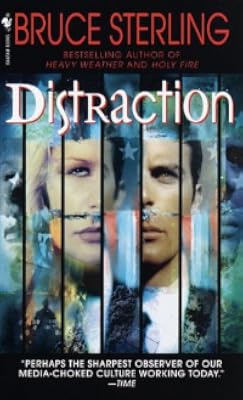
Distraction
by Bruce Sterling
On This Page
Description
2044 and the US is coming apart at the seams. The people live nomadic lives and the new cold war is with the Dutch, fought mostly over the Net. This is your future, and Oscar Valparaiso's too - or it would be if he wasn't half human, half genetically modified.Tags
Recommendations




Member Reviews
Politics is the art of the possible, the "doable", as Sterling's skewed hero, Oscar Valparaiso, keeps calling his wild improvised plans as if saying the word made them so. Oscar's usually successful schemes are as cobbled together as his own genetics--Oscar is not quite human. Investigating a genetic research facility for a Senate committee, he finds a potential power base, and an enemy worth his attention--the Governor of Louisiana has taken to conquering federal facilities using gangs of the homeless as his deniable mercenaries, and his interest in biotech makes the genetically anomalous Oscar, and the scientist he has fallen for, attractive acquisitions. Having a senator he has just help get elected go stark mad, and finding himself show more on the Net-wide hit list of every nut with a grudge, are the sort of things with which Oscar copes all the time--love and other altered states of consciousness are a bit more of a problem. Endless witty extrapolations of social and scientific paradoxes and a constant cheeky elaboration of already convoluted plot lines give this the brio of Sterling's best short fiction show less
This is my favorite book.
It's so much my favorite book that I wrote an article on its 20th anniversary for Slate. I interviewed Bruce Sterling on what inspired him while writing, and why this book is still relevant right before the 2018 midterms.
...
Okay, that's not a review. Let me explain why this is my favorite book. Distraction paints a picture of a world gone down the tubes in an all too familiar way, but unlike the usual dystopian moanings, Sterling has the guts to imagine a way out; a characteristically optimistic American faith in the endless frontier of science, technology, and freedom from any kind of notion of responsibility.
But there are three things that I really, truly love about Distraction. First is the setting, which show more after 15 years smells more like the future than when it was written. An American political system that has descended into an insane farce. An economy that no longer has jobs for half the people; most of whom have dropped out to join a perpetual nomad carnival run off of weird reputation servers. Ecological Cold War with the Dutch and a coalition of low-lying Third World nations. A lost economic war with the Chinese over intellectual property. And information warfare as the basic fact of life--a world where bugs can be bought in bulk at flea markets, spam email servers orchestrate assassinations, and the US Air Force has to hold a bake sale to keep the lights on. It's a rich tapestry, and all of it hangs together beautifully.
Second, the aphorisms. Bruce Sterling knows how to turn a phrase, and he has some great ones around science and politics in this book. I'm a science policy professional by a living, and personally, I think Sterling has a better understanding of how this all works than 90% of the boring scholarly types involved. You want a mind-expanding quote about science and society, this is your book. Sterling doesn't bash you over the head with abstruse STS theory, but you can feel it deep underneath the writing.
And third, I really enjoy the plot and the characters: the genetically altered political strategist, the Nobel prize winning scientist, the mad governor of Louisiana, and the intricate scheme of neural engineering and power machinations that draw them into collision. Sure, some of the more important plot points proceed by random happenstance, but history doesn't have good reasons. In the real world, strange stuff that nobody could've seen comes in and upsets the board all the time. Just sit back, relax, and let the ride take you.
Read it. show less
It's so much my favorite book that I wrote an article on its 20th anniversary for Slate. I interviewed Bruce Sterling on what inspired him while writing, and why this book is still relevant right before the 2018 midterms.
...
Okay, that's not a review. Let me explain why this is my favorite book. Distraction paints a picture of a world gone down the tubes in an all too familiar way, but unlike the usual dystopian moanings, Sterling has the guts to imagine a way out; a characteristically optimistic American faith in the endless frontier of science, technology, and freedom from any kind of notion of responsibility.
But there are three things that I really, truly love about Distraction. First is the setting, which show more after 15 years smells more like the future than when it was written. An American political system that has descended into an insane farce. An economy that no longer has jobs for half the people; most of whom have dropped out to join a perpetual nomad carnival run off of weird reputation servers. Ecological Cold War with the Dutch and a coalition of low-lying Third World nations. A lost economic war with the Chinese over intellectual property. And information warfare as the basic fact of life--a world where bugs can be bought in bulk at flea markets, spam email servers orchestrate assassinations, and the US Air Force has to hold a bake sale to keep the lights on. It's a rich tapestry, and all of it hangs together beautifully.
Second, the aphorisms. Bruce Sterling knows how to turn a phrase, and he has some great ones around science and politics in this book. I'm a science policy professional by a living, and personally, I think Sterling has a better understanding of how this all works than 90% of the boring scholarly types involved. You want a mind-expanding quote about science and society, this is your book. Sterling doesn't bash you over the head with abstruse STS theory, but you can feel it deep underneath the writing.
And third, I really enjoy the plot and the characters: the genetically altered political strategist, the Nobel prize winning scientist, the mad governor of Louisiana, and the intricate scheme of neural engineering and power machinations that draw them into collision. Sure, some of the more important plot points proceed by random happenstance, but history doesn't have good reasons. In the real world, strange stuff that nobody could've seen comes in and upsets the board all the time. Just sit back, relax, and let the ride take you.
Read it. show less
“It had never occurred to the lords of the consumer society that consumerism as a political philosophy might one day manifest the grave systemic instabilities that Communism had. But as those instabilities multiplied, the country had cracked. Civil society shriveled in the pitiless reign of cash. As the last public spaces were privatized, it became harder and harder for American culture to breathe. Not only were people broke, but they were taunted to madness by commercials, and pitilessly surveilled by privacy-invading hucksters. An ever more aggressive consumer-outreach apparatus caused large numbers of people to simply abandon their official identities. It was no longer any fun to be an American citizen. Bankruptcies multiplied show more beyond all reason, becoming a kind of commercial apostasy. Tax dodging became a spectator sport. The American people simply ceased to behave.” show less
This book was written in the 1990's but it seems more relevant to today than the first time I read it when it came out. It depicts the world of 2043 or 30 years from now. The Federal government is paralyzed by politics and indecision, permanently in a state of emergency. Louisiana has been devastated by floods and the whole country by unemployment (up around 33% not 8% but still. There is a huge disparity in wealth to the point that the only people with jobs work as private "krewes" of personal servants to rich people. People aren't starving in the streets and it is not Armageddon, it is just a country where nothing seems to be able to get done. WASPs are a minority. All these issues seem to be relevant to today's political scene except show more magnified. The book follows an unusual political consultant with a "personal background issue" and how he tries to single-handedly turn the country around by using various people he encounters, sometimes to their breaking limit. It is all amusing and well thought out. Sterling isn't a magic profit, he just extends statistics and trends out 50 years from when he wrote the book and follows where they are leading. It is a scary place, and more and more real each day. show less
I've read most of Bruce Sterling's books, and I think this is the best since Schismatrix. Many of his stories are about characters who find their situations in constant motion - not adventures as such, but adaption and evolution to events that coincide with them. This sees the pattern reach a kind of high-point - Oscar Valparaiso is essentially addicted to social change and crisis management.
Sterling uses Oscar as a lightning rod for the sorts of changes that he has speculated about in blogs and essays - biotech, IT, alternative social structures, environmental issues - in what is a romp through the almost total collapse of mid 21stC America. It's funny, weird and times breathtaking in the extremity of change envisaged. Reading it ten show more years later, many aspects seem almost familiar, proving Sterling once again to be an ace futurologist.
It is big, and a little daunting, best read slowly in little chunks. But it is bulging with imagination, and the author's clear concern about how the rapid changes surrounding us now will reap disaster or otherwise in the future. show less
Sterling uses Oscar as a lightning rod for the sorts of changes that he has speculated about in blogs and essays - biotech, IT, alternative social structures, environmental issues - in what is a romp through the almost total collapse of mid 21stC America. It's funny, weird and times breathtaking in the extremity of change envisaged. Reading it ten show more years later, many aspects seem almost familiar, proving Sterling once again to be an ace futurologist.
It is big, and a little daunting, best read slowly in little chunks. But it is bulging with imagination, and the author's clear concern about how the rapid changes surrounding us now will reap disaster or otherwise in the future. show less
Obviously loads of this doesn't hold up, so if you think the success of science fiction is measured in how well it predicts the future, you won't like this. Howerver there's loads to enjoy in this gnarly sci-fi novel about a young political operative in a moribund, environmentally wrecked future US sent in to sort out a massive research dome filled with extinct animals and scientists, earning himself the enmity of the local Governor, but allying himself with a driven genius neuro-scientist researcher, and together they launch a kind of revolution that may or may not save science and America.
Bruce sterlings books are always interesting and original. I find the ideas aren't familiar so you need to process what's going on a bit. Perhaps he's just not a very good writer but I find that I have to keep switching gears in order to keep up. He's not very descriptive of some things so you have to use your imagination a bit more. He does describe in detail certain elements of the story but other scenes are left for you to picture for yourself. Kind of like having tunnel vision.
In distraction, we meet a wierd junior politician of the future (Oscar) who is making a place for himself in the almost failed nation of america. He takes on an assignment to clean up a research centre that has suffered from years of corruption. It seems like show more a pretty boring story but things gradually heat up as Oscar makes friends and enemies with a rampaging psycho governer, various security spooks, a genius nuero-researcher, the president, a bunch of nomadic tech warlords and a talking brick.
The book is not so much about the action but about the psychology, ideas and values of the characters. It's about the inventions and things that might happen if we look at what's happening today and extrapolate in the extreme. The effect of todays ideas, trends and discoveries on the future as seen (and exagerated to make a story) by Sterling. I guess Sterling's appeal is a futurist and scifi trend setter rather than a smooth writer.
A few snippets:
In the future, the internet is remembered as the tool that the chinese used to break into all of america's software companies and break the economy.
In the future, anglos are a repressed minority.
In the future, scientists are bored with software, computers and genes. They are into hacking neurology. show less
In distraction, we meet a wierd junior politician of the future (Oscar) who is making a place for himself in the almost failed nation of america. He takes on an assignment to clean up a research centre that has suffered from years of corruption. It seems like show more a pretty boring story but things gradually heat up as Oscar makes friends and enemies with a rampaging psycho governer, various security spooks, a genius nuero-researcher, the president, a bunch of nomadic tech warlords and a talking brick.
The book is not so much about the action but about the psychology, ideas and values of the characters. It's about the inventions and things that might happen if we look at what's happening today and extrapolate in the extreme. The effect of todays ideas, trends and discoveries on the future as seen (and exagerated to make a story) by Sterling. I guess Sterling's appeal is a futurist and scifi trend setter rather than a smooth writer.
A few snippets:
In the future, the internet is remembered as the tool that the chinese used to break into all of america's software companies and break the economy.
In the future, anglos are a repressed minority.
In the future, scientists are bored with software, computers and genes. They are into hacking neurology. show less
Members
- Recently Added By
Published Reviews
ThingScore 100
Great science fiction is more than a gripping plot or interesting setting—it offers a densely textured, plausible alternative reality layered on top of our own. Few novels have done that more successfully than Bruce Sterling’s Distraction, a science-fiction novel that was released 20 years ago.
added by elenchus
It's a powerful concoction, this book, and now, ten years after its initial publication, it's possible to assess just how prescient, how visionary, Sterling is.
added by lampbane
Lists

Best Cyberpunk
41 works; 7 members

Exploration of alternative economical systems
40 works; 3 members

Arthur C. Clarke Award Winners and Shortlisted Books
219 works; 14 members

Books Read in 2019
4,052 works; 108 members
Author Information

131+ Works 20,994 Members
Bruce Sterling is a recent winner of the Nebula Award and the author of the nonfiction book "The Hacker Crackdown" as well as novels and short story collections. He co-authored, with William Gibson, the critically acclaimed novel "The Difference Engine." He lives in Austin, Texas, with his wife and daughter. (Publisher Provided)
Some Editions
Awards and Honors
Series
Belongs to Publisher Series
Work Relationships
Is contained in
Common Knowledge
- Original title
- Distraction
- Original publication date
- 1998
- People/Characters
- Oscar Valparaiso
- First words*
- Seinem Laptop zufolge sah Oscar sich das Video über die Unruhen in Worcester bereits zum einhundertfünfzigsten Mal an.
- Last words*
- (Click to show. Warning: May contain spoilers.)"Komm her und küss mich!"
*Some information comes from Common Knowledge in other languages. Click "Edit" for more information.
Classifications
Statistics
- Members
- 1,151
- Popularity
- 21,969
- Reviews
- 19
- Rating
- (3.41)
- Languages
- 5 — Danish, English, German, Italian, Spanish
- Media
- Paper, Ebook
- ISBNs
- 13
- ASINs
- 7