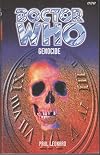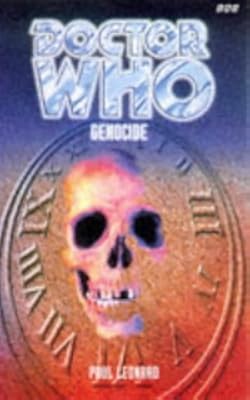
Genocide
by Paul Leonard
Doctor Who: Eighth Doctor Adventures (4), Doctor Who {non-TV} (Novels — EDA Novel)
On This Page
Description
Ten years after leaving UNIT, Jo Grant is asked to join a project to travel back in time and observe the evolution of the human race. The project goes wrong, and the Doctor has to find a way to save the human race from extinction.Tags
Recommendations













Member Reviews
I'm enjoying this series more than I expected based on contemporary feedback. (It's fun that this series is old enough - 25 years - to carry a weight of history and be dated, sometimes, yet young enough that some contemporary reviews exist on the internet.) It's fascinating to track the changes taking place in fandom during that time and the attempts to broaden out the series, and especially the characters, now freed of the weight of decade-old figures.
Unsurprisingly, some fans at the time (a certain subset) didn't much appreciate this Doctor and certainly didn't appreciate his companion, Sam. I think in both cases they're wrong - or at least looking at the issue from a rather different perspective to me. Sylvester McCoy's Doctor is one show more of my favourites but it's refreshing to have this figure who is less sure of himself, more openly emotive, and almost on par with his companion in terms of their relationship. And the decision to tell much of the story from Sam's point-of-view prefigures what the television series would do a decade later; she's flawed, still figuring herself out, and not always able to trust the Doctor, and it makes this a jolly good read.
It's not a great book, to be clear. Like many of them it feels like an attempt to turn a TV script into a novel, although that's less overt than in some recent stories. And I'm not sure how I feel about a certain character's actions in the final act. But overall, a good addition to the drama. show less
Unsurprisingly, some fans at the time (a certain subset) didn't much appreciate this Doctor and certainly didn't appreciate his companion, Sam. I think in both cases they're wrong - or at least looking at the issue from a rather different perspective to me. Sylvester McCoy's Doctor is one show more of my favourites but it's refreshing to have this figure who is less sure of himself, more openly emotive, and almost on par with his companion in terms of their relationship. And the decision to tell much of the story from Sam's point-of-view prefigures what the television series would do a decade later; she's flawed, still figuring herself out, and not always able to trust the Doctor, and it makes this a jolly good read.
It's not a great book, to be clear. Like many of them it feels like an attempt to turn a TV script into a novel, although that's less overt than in some recent stories. And I'm not sure how I feel about a certain character's actions in the final act. But overall, a good addition to the drama. show less
http://nhw.livejournal.com/525259.html
The central plot is a set of time paradoxes - will humanity survive, or will we be displaced by humane, environmentally conscious equine quadrupeds who are very reminiscent of Swift's Houyhnhnms? The Doctor has to choose one way or the other, and either way an entire race may be destroyed, hence the genocide of the title. I felt there were one or two problems with the internal chronology of the book which could not be smoothed over by time-travel, and too many cases of a) characters promising not to move from a safe location, then immediately doing so and b) "I'm going to kill you now!" "No you're not." "Okay, I won't kill you now but I might kill you later!" And one plot twist was foreshadowed many show more years ago by Douglas Adams, but I thought Paul Leonard invested it with a certain dignity (leaving a message in the basalt, surely inspired by the towel in the prehistoric volcano). Overall it was just about worth the £2 I paid for it. show less
The central plot is a set of time paradoxes - will humanity survive, or will we be displaced by humane, environmentally conscious equine quadrupeds who are very reminiscent of Swift's Houyhnhnms? The Doctor has to choose one way or the other, and either way an entire race may be destroyed, hence the genocide of the title. I felt there were one or two problems with the internal chronology of the book which could not be smoothed over by time-travel, and too many cases of a) characters promising not to move from a safe location, then immediately doing so and b) "I'm going to kill you now!" "No you're not." "Okay, I won't kill you now but I might kill you later!" And one plot twist was foreshadowed many show more years ago by Douglas Adams, but I thought Paul Leonard invested it with a certain dignity (leaving a message in the basalt, surely inspired by the towel in the prehistoric volcano). Overall it was just about worth the £2 I paid for it. show less
Ratings
Members
- Recently Added By
Author Information
13+ Works 1,721 Members
Series


Common Knowledge
- Canonical title
- Genocide
- Original publication date
- 1997-09-01
- People/Characters
- The Doctor (8th); Sam Jones; Jo Grant; John Benton; Cliff Jones
- Important places
- Africa; Tanzania; Los Angeles, California, USA; Hackney, London, England, UK; Tractis
Classifications
Statistics
- Members
- 198
- Popularity
- 166,062
- Reviews
- 2
- Rating
- (3.21)
- Languages
- English
- Media
- Paper
- ISBNs
- 1
- ASINs
- 1