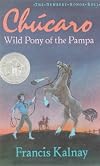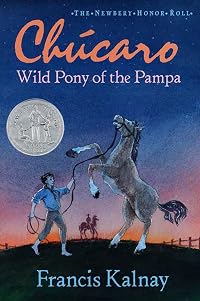
Chúcaro: Wild Pony of the Pampa
by Francis Kalnay
On This Page
Description
Adventures of a boy and his pony on the Argentine Pampa.Tags
Recommendations



Member Reviews
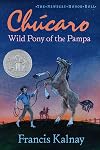
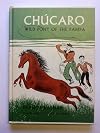
Pink certainly is an unusual color for a pony, and when Pedro spies Chúcaro grazing on the Pampa he can hardly believe his eyes. He just has to have that pony for himself. Unfortunately, the estancerio's spoiled son is equally determined to own the pony. But the wisest gauchos know that ponies as special as Chúcaro can never truly be owned. Chúcaro alone will decide for himself which gaucho will have the privilege of riding him.
A Newbery Honor book from the late 50s. It was the era when multiculturalism was big in the Newbery winners - at least if it was from a culture in the Americas or China... And teaching some trivia about Argentine ranch culture is about all this book has going for it. There is very little story, and what there is of one is pretty bland, with one dimensional characters that you don't really care about. And the titular horse isn't even a character at all - just a prop in the story. Recommend skipping this one.
Despite the fact that it won the Newbery Honor, I am not impressed with this book. The characters are very shallow, and there is practically no conflict.
So Pedro gets himself a wild pink pony, and yet the first time he gets on the horse, it is merely described as such: "Pedro got up earlier than usual one morning - long before Juan got up. In fact, he made quite certain that Juan was asleep. Then without the customary blind-folding or the use of the kicking strap, he jumped on Chucaro's back" (33). The following sentences jump to several days ahead. ... That's it?! No planning, no nervousness, no excitement, no worry, not to mention the fact that Chucaro's reaction is not described. So Pedro got up one day with a subconscience plan made show more up on the spot, practically, to get on his new, wild horse for the first time ever, and without any pertinent thoughts or feelings he jumps onto Chucaro... and did Chucaro buck or accept Pedro's being on him? And depending on which he did, what were Pedro's feelings about it? Determined or surprised? Did Pedro clamber back on or see his error after being bucked, or did he merely sit on complacent Chucaro or urge Chucaro to trot or gallop?
It explains at the beginning that Juan raised Pedro as opposed to the Vaquero, Pedro's own father, yet no reason is given. And when Juan and Pedro leave, so that Pedro can keep Chucaro, why is it that Pedro doesn't appear to feel any emotions when he and his father see each other for the last time? Pedro loves the Pampas more than his own father - "No, you can't say adios to each blade of grass" (110)
The descriptions of the Pampas have the heaviest tone and emotion in the entire book, and the setting is certainly described very well, especially geared to younger readers, yet the Pampas have no purpose related to plot, character, or theme, other than that the story is in a part of South America where wild horses live.
As a story about a wild, pink, South American pony, the story is sparsely done.
As a story about a boy named Pedro, whose mother is dead, who is being raised by a man other than his father, and who becomes the owner of a wild, pink pony, the story is flat.
As a story set in the Pampas, though, the reader is left knowing quite a bit about the Pampas and can see it in his mind's eye fairly well, even if... in fact especially if he is a younger reader. show less
So Pedro gets himself a wild pink pony, and yet the first time he gets on the horse, it is merely described as such: "Pedro got up earlier than usual one morning - long before Juan got up. In fact, he made quite certain that Juan was asleep. Then without the customary blind-folding or the use of the kicking strap, he jumped on Chucaro's back" (33). The following sentences jump to several days ahead. ... That's it?! No planning, no nervousness, no excitement, no worry, not to mention the fact that Chucaro's reaction is not described. So Pedro got up one day with a subconscience plan made show more up on the spot, practically, to get on his new, wild horse for the first time ever, and without any pertinent thoughts or feelings he jumps onto Chucaro... and did Chucaro buck or accept Pedro's being on him? And depending on which he did, what were Pedro's feelings about it? Determined or surprised? Did Pedro clamber back on or see his error after being bucked, or did he merely sit on complacent Chucaro or urge Chucaro to trot or gallop?
It explains at the beginning that Juan raised Pedro as opposed to the Vaquero, Pedro's own father, yet no reason is given. And when Juan and Pedro leave, so that Pedro can keep Chucaro, why is it that Pedro doesn't appear to feel any emotions when he and his father see each other for the last time? Pedro loves the Pampas more than his own father - "No, you can't say adios to each blade of grass" (110)
The descriptions of the Pampas have the heaviest tone and emotion in the entire book, and the setting is certainly described very well, especially geared to younger readers, yet the Pampas have no purpose related to plot, character, or theme, other than that the story is in a part of South America where wild horses live.
As a story about a wild, pink, South American pony, the story is sparsely done.
As a story about a boy named Pedro, whose mother is dead, who is being raised by a man other than his father, and who becomes the owner of a wild, pink pony, the story is flat.
As a story set in the Pampas, though, the reader is left knowing quite a bit about the Pampas and can see it in his mind's eye fairly well, even if... in fact especially if he is a younger reader. show less
Érdekes világ, jó leírások - egy kicsivel kevesebb szólt a lóról, mint amire számítottam. Regénynek nevezni túlzás, inkább egy hosszabb novella műfajilag. Egy sorsdöntő pillanat ember és állat életében.
Ratings
Members
- Recently Added By
Lists

A Child's Book Tour of the Andes ::: Argentina, Chile, Colombia, Ecuador
24 works; 3 members

Newbery Honor Books By Year - I - 1922-1980
199 works; 3 members

Sonlight Books
1,487 works; 25 members

Books Read in 2024
4,623 works; 126 members

EGBERTINA's List of Newbery books that I hated or found unnecessary
58 works; 3 members

Horse Books for Kids
376 works; 6 members
Author Information
5+ Works 587 Members
All Editions
Awards and Honors
Common Knowledge
- Canonical title
- Chúcaro: Wild Pony of the Pampa
- Original publication date
- 1958
- People/Characters
- Pedro; Juan; the Vaquero; Chucaro (horse); Gitana; Armando
- Important places
- The Argentine Pampa, Argentina; Argentina
- Dedication
- To Pedro Andres Jorge
- First words
- Some growing corn has golden hair, some yellow, some red, some brown.
- Last words
- (Click to show. Warning: May contain spoilers.)The sun was still washing his face when the gauchos were on the road again, heading north toward the falls of the Iguazu.
Classifications
Statistics
- Members
- 579
- Popularity
- 50,702
- Reviews
- 4
- Rating
- (3.25)
- Languages
- English
- Media
- Paper
- ISBNs
- 5
- ASINs
- 8