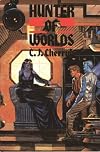
Hunter of Worlds
by C. J. Cherryh
Alliance-Union Universe: Publication (2), The Hanan Rebellion (02), Alliance-Union Universe (34 (Hanan Rebellion 02))
On This Page
Description
"In the story, a ship belonging to a terrifyingly dominant space-faring race, the iduve, arrives at a space station. They demand that a particular station resident, a blue-skinned Kallian, be sent to their ship and all record of him be erased. No defiance is possible or the space station will be destroyed. The human-like Kallian is handed over to the iduve who mind-link him to a female Kallian in their service and, later, to a human prisoner, forcing him to service his captors on three show more levels"--Wikipedia. show lessTags
Recommendations













Member Reviews
And for the first time in my read through of Cherryh's novels, here is a real SF novel, with no fantasy hiding behind the scenes. It is her 3rd novel and second in her long running Alliance-Union Universe although it can as well be considered a separate and non-related one - maybe a later novel will tie the lines together but it has no connection at all to the first one.
Somewhere across the stars, humanity had moved away from a whole system, leaving it to the locals - the kallia and the amaut and the iduve). There are some humans remaining and they do not fare very well - the amaut use them as slaves and everyone more or less despises them. Enter the iduve - a secretive race that lives on its ships and controls any race that they come show more into contact with, taking them as something similar enough to slaves - both the kallia and the amaut are taken into the ships and bred there - the kallia for servants, the amaut for soldiers. The iduve had been away for a bit and now they are back and they seem to be here to stay. A family matter makes one of the most powerful of them, Chimele, go for something unheard of - join together different races.
The iduve have a technology, that allows different people to be joined mentally in a way that makes them feel the same as the others - memories, feelings, fairs. And usually it is done with members of the same species. Chimele joins 3 of them - a human, Daniel, a planet born kallia, Aiela, and a slave-born female kallia, Isande. Half the novel is taken by the story of that joining and them getting used to it; the other one is resolving the family matter (which almost causes the destruction of a planet).
It is a novel about the different - everyone is forced to live in a world that is not their own, amongst people that are not their own. Cherryh builds 3 complete races and make them believable - with their languages and psychologies and their social norms. Her world building is as good as ever and this novel makes me look forward to her next novels even more. show less
Somewhere across the stars, humanity had moved away from a whole system, leaving it to the locals - the kallia and the amaut and the iduve). There are some humans remaining and they do not fare very well - the amaut use them as slaves and everyone more or less despises them. Enter the iduve - a secretive race that lives on its ships and controls any race that they come show more into contact with, taking them as something similar enough to slaves - both the kallia and the amaut are taken into the ships and bred there - the kallia for servants, the amaut for soldiers. The iduve had been away for a bit and now they are back and they seem to be here to stay. A family matter makes one of the most powerful of them, Chimele, go for something unheard of - join together different races.
The iduve have a technology, that allows different people to be joined mentally in a way that makes them feel the same as the others - memories, feelings, fairs. And usually it is done with members of the same species. Chimele joins 3 of them - a human, Daniel, a planet born kallia, Aiela, and a slave-born female kallia, Isande. Half the novel is taken by the story of that joining and them getting used to it; the other one is resolving the family matter (which almost causes the destruction of a planet).
It is a novel about the different - everyone is forced to live in a world that is not their own, amongst people that are not their own. Cherryh builds 3 complete races and make them believable - with their languages and psychologies and their social norms. Her world building is as good as ever and this novel makes me look forward to her next novels even more. show less
I've noticed how, in Cherryh's earlier works, she didn't explain much. she mentioned something a few times and it was up to the reader after that (if she gave you that much of a headstart). these stories tend to be shorter overall: more concise and self-containing.
I've noticed how, in Cherryh's latests works, the opposite is true. she explains the living daylights out of things---but not in a straightforward fashion! she hints and cajoles the reader down certain ways of thinking, towards the next revelation, and re-examines related key issues over and over and over from different aspects, but she never comes out and says what the reader is expecting her to say. that is, of course, one way to keep your readers in suspence. but I'm sure show more she is quite aware that when her many fans clamour for her attention and beg for more details, they mean they want a more straightforward look at the worlds she creates. the paradox is, if she gave that to them, the effect would be ruined and nobody would want to read the books. so, this giving of many explanations without actually revealing anything that she wouldn't traditionally reveal, is a compromise. an exacerbating compromise, because it puts the reader through the ringer even more so than her earlier works, and Cherryh is very good at putting the reader through the ringer. these stories tend to be longer, and divided into triologies (not three stories in a trilogy, but one story in a trilogy arc that includes three books). tend a bit more towards space opera.
Hunter of Worlds was published in 1977, and fits the first description. in it, we are introduced to an alien universe with three different alien species complete with their own cultures and languages and beliefs. Hunter of Worlds is a bit linguistics-heavy... it is what I call a concept book.
if in some sci-fi, the author coins a word for an alien animal (say, garblio), and we see this word used off and on throughout the book, well, it's expected. there aren't any creatures that look like a cross between an armadillo and a penguin here on Earth, so we don't have a name for that. of course the author has to make up the word garblio. it's best of course if they actually include a picture of a garblio or at least a very brilliant passage describing this creature, but this is all to be expected in much of sci-fi.
if we are asked to learn what a garblio is, that's not a real problem. we can remember that. what becomes confusing is if most or all of the animals there on planet/spaceship X have no Earthly comparisons. yes, it's when the characters make their way through and interact with a field full of garblios, nekwitetters, modoneds, and jesuviars that the reader starts getting lost. which was the man-eating carnivore again? which one was the long-lost pet of the mad scientist?
it's not impossible to learn the new words and keep them all sorted, and in fact for some of us it's rather fun lol, but it is quite a task.
especially when we're not talking about animals but instead symbolic things like justice, honour, beauty, truth, or some combination of those that only occurs in an alien culture (or, well, we might have it but we don't have a word for it, whereas that alien culture reveres it as much as we do our justice). those kind of symbolic words are hard to define and pin down when they're ones we actually know (truth, justice, the american way). but when it's supposed to be an innovative concept... oi vey! a whole new level of challenge.
for example: kastien - being oneself; virtue, wisdom; observing harmony with others and the universe by perfect centering in one's giyre toward all person and things.
oh, wait. what was giyre again? recognition of one's proper place in the cosmic Order of things; also, one's proper duty to another. it is ideally mutual.
but those are just two concepts here, and they're only representative of one species. there are three species (not counting humanity) in the book, remember?
so we've also got arastiethe, shakhshoph, vaikka, elethia... etc. those are (some of) the symbolic words, but we've also got new words for new technology (ex: chiabres), different relationship-types (ex: asuthe, kamethi, nasul, orithain, sra), different place names (ex: Esliph, Kesuat, Kej), and then of course the names of the species (Kalliran, Amaut, Iduve) and the ships and the characters!
there is a glossary at the back of this book. you will need it.
in her later works she is much more skillful about adding the new words in there at a more approachable pace... however, most everything that makes me love Cherryh's writing is there, if not developed to its full fruition. this is a book that you reread, and reread, and then when you realize you don't have to look anything up anymore, then its craft unfolds completely (and not in the satisfying yet broken way it did during all the previous reads). show less
I've noticed how, in Cherryh's latests works, the opposite is true. she explains the living daylights out of things---but not in a straightforward fashion! she hints and cajoles the reader down certain ways of thinking, towards the next revelation, and re-examines related key issues over and over and over from different aspects, but she never comes out and says what the reader is expecting her to say. that is, of course, one way to keep your readers in suspence. but I'm sure show more she is quite aware that when her many fans clamour for her attention and beg for more details, they mean they want a more straightforward look at the worlds she creates. the paradox is, if she gave that to them, the effect would be ruined and nobody would want to read the books. so, this giving of many explanations without actually revealing anything that she wouldn't traditionally reveal, is a compromise. an exacerbating compromise, because it puts the reader through the ringer even more so than her earlier works, and Cherryh is very good at putting the reader through the ringer. these stories tend to be longer, and divided into triologies (not three stories in a trilogy, but one story in a trilogy arc that includes three books). tend a bit more towards space opera.
Hunter of Worlds was published in 1977, and fits the first description. in it, we are introduced to an alien universe with three different alien species complete with their own cultures and languages and beliefs. Hunter of Worlds is a bit linguistics-heavy... it is what I call a concept book.
if in some sci-fi, the author coins a word for an alien animal (say, garblio), and we see this word used off and on throughout the book, well, it's expected. there aren't any creatures that look like a cross between an armadillo and a penguin here on Earth, so we don't have a name for that. of course the author has to make up the word garblio. it's best of course if they actually include a picture of a garblio or at least a very brilliant passage describing this creature, but this is all to be expected in much of sci-fi.
if we are asked to learn what a garblio is, that's not a real problem. we can remember that. what becomes confusing is if most or all of the animals there on planet/spaceship X have no Earthly comparisons. yes, it's when the characters make their way through and interact with a field full of garblios, nekwitetters, modoneds, and jesuviars that the reader starts getting lost. which was the man-eating carnivore again? which one was the long-lost pet of the mad scientist?
it's not impossible to learn the new words and keep them all sorted, and in fact for some of us it's rather fun lol, but it is quite a task.
especially when we're not talking about animals but instead symbolic things like justice, honour, beauty, truth, or some combination of those that only occurs in an alien culture (or, well, we might have it but we don't have a word for it, whereas that alien culture reveres it as much as we do our justice). those kind of symbolic words are hard to define and pin down when they're ones we actually know (truth, justice, the american way). but when it's supposed to be an innovative concept... oi vey! a whole new level of challenge.
for example: kastien - being oneself; virtue, wisdom; observing harmony with others and the universe by perfect centering in one's giyre toward all person and things.
oh, wait. what was giyre again? recognition of one's proper place in the cosmic Order of things; also, one's proper duty to another. it is ideally mutual.
but those are just two concepts here, and they're only representative of one species. there are three species (not counting humanity) in the book, remember?
so we've also got arastiethe, shakhshoph, vaikka, elethia... etc. those are (some of) the symbolic words, but we've also got new words for new technology (ex: chiabres), different relationship-types (ex: asuthe, kamethi, nasul, orithain, sra), different place names (ex: Esliph, Kesuat, Kej), and then of course the names of the species (Kalliran, Amaut, Iduve) and the ships and the characters!
there is a glossary at the back of this book. you will need it.
in her later works she is much more skillful about adding the new words in there at a more approachable pace... however, most everything that makes me love Cherryh's writing is there, if not developed to its full fruition. this is a book that you reread, and reread, and then when you realize you don't have to look anything up anymore, then its craft unfolds completely (and not in the satisfying yet broken way it did during all the previous reads). show less
I’m glad I read other reviews before I wrote mine. It seems that my problem with this book is my age and attitude toward the efforts necessary to learn the 3 alien languages that color the story. The plot is intriguing enough: super-mature(?) and -powerful aliens are fighting an internecine war because of a cultural faux pas by the “bad” guy. The bad guy must die…no matter who (or what) gets in the way. The humans manage to not get squished because they’re so “cute”? or ignorant or stupid…or something; and, after a lot of “collateral damage” things work out in the end. And a particular planet isn’t obliterated.
My problem seems to be my unwillingness to expend the effort to memorize the multitudinous alien words for show more their emotions and cultural (and inter-species) relationships—and then multiply that by the 3 alien species. I admit that the plot is bizarre enough to be interesting; and that Cherryh is a good enough writer—at least enough to keep me reading to the end, in spite of my reluctance to finish it, much less learn 3 alien languages.
With that said my 2.5 star rating should be seen as a quirk of my current state-of-mind, not necessarily a problem of the book. Please do not use me as measure of whether you should or should not read ‘Hunter of Worlds’. But rather as someone to forgive for lacking a true appreciation; or someone with whom you can sympathize for possessing a particular sensitivity. show less
My problem seems to be my unwillingness to expend the effort to memorize the multitudinous alien words for show more their emotions and cultural (and inter-species) relationships—and then multiply that by the 3 alien species. I admit that the plot is bizarre enough to be interesting; and that Cherryh is a good enough writer—at least enough to keep me reading to the end, in spite of my reluctance to finish it, much less learn 3 alien languages.
With that said my 2.5 star rating should be seen as a quirk of my current state-of-mind, not necessarily a problem of the book. Please do not use me as measure of whether you should or should not read ‘Hunter of Worlds’. But rather as someone to forgive for lacking a true appreciation; or someone with whom you can sympathize for possessing a particular sensitivity. show less
Cherryh has an amazing talent for defining alien people who are different, really different. In Hunter of Worlds she describes an alien civilization built on the instincts of the predator. The superficial picture is of a dark blue person into whose eyes one dare not look. Cherryh, with her usual skill, weaves a story of mutual incomprehension and learning, and of how a mere human must adapt to survive.
A solid (if rather dated) book, Hunter shares a lot of themes with the Chanur novels, though those seem much more polished: isolation, loyalty, identity, and the strangely prominent spectre of interspecies sex. Cherryh as usual has excellent aliens, though her liberal use of alien _terminology_ is a double-edged sword; it makes plain the differences among their patterns of thought and culture, but the reader has to pick up most of them from context (there is a glossary at the back, though), and their density can be sort of overwhelming.
I found the plot of this one a bit difficult. The central conflict has to do with events among the ruling aliens (iduve). There's a big chunk of explanatory backstory at point, but the causes are all in show more the past and hence rather abstract. The protagonists are only involved because the rulers want some tools; two of the three have no personal stake in the matter, except for being enslaved, and other than hoping for their survival, there's really no one to root for.
These problems in defining the conflict carried through a resolution I found unsatisfying. The characters don't get much of a development arc beyond acceptance of their situation. I get the feeling that we are supposed to feel sympathetic for the iduve at the end, but... these are people willing to destroy a planet to get one guy over an obscure-to-humans matter of saving face. I think I'd rather drink with a kif. show less
I found the plot of this one a bit difficult. The central conflict has to do with events among the ruling aliens (iduve). There's a big chunk of explanatory backstory at point, but the causes are all in show more the past and hence rather abstract. The protagonists are only involved because the rulers want some tools; two of the three have no personal stake in the matter, except for being enslaved, and other than hoping for their survival, there's really no one to root for.
These problems in defining the conflict carried through a resolution I found unsatisfying. The characters don't get much of a development arc beyond acceptance of their situation. I get the feeling that we are supposed to feel sympathetic for the iduve at the end, but... these are people willing to destroy a planet to get one guy over an obscure-to-humans matter of saving face. I think I'd rather drink with a kif. show less
...Halfway through the second watch the ship put into Kartos Station -- the largest thing ever seen in the zone, a gleaming silver agglomeration of vanes cradling an immense saucer body. It was an Orithian craft with no markings of nationality or identification: the Orithain disdained such conventions....
When the huge Iduve ship makes port at Kartos Station the people there learn the horrible truth about the ship's mission -- to destroy an entire human world if one of their own, a rebel, is not located on the world's surface.
Three people are forcibly brought into the Iduve's service to help find the dangerous rebel before the Iduve are forced to take the more drastic action -- three strangers, from three different worlds, who must show more overcome their own differences before they can help others... and they don't have much time.
And since they will be on the planet when it is destroyed, they have an added incentive to success.
This is one of C. J. Cherryh's early books (copyrighted in 1977 but reprinted in 1997), and she already shows her deft ability to create alien societies and exciting peril for her characters. Hunter of Worlds is also part of the complex and alien-filled Alliance-Union Universe.
I can't really tell you why this is one of my favorite Cherryh books, except that it was the first time I found myself so thoroughly drawn into an alien world that it didn't seem odd, by the end of the book, to understand words in several languages, and concepts that were filtered through human understanding -- but which were not, fully, human. It's a theme that she uses very well in the later Foreigner Sequences books (Foreigner, Invader, Inheritor, Precursor, Defender, Explorer, Destroyer and Pretender). show less
When the huge Iduve ship makes port at Kartos Station the people there learn the horrible truth about the ship's mission -- to destroy an entire human world if one of their own, a rebel, is not located on the world's surface.
Three people are forcibly brought into the Iduve's service to help find the dangerous rebel before the Iduve are forced to take the more drastic action -- three strangers, from three different worlds, who must show more overcome their own differences before they can help others... and they don't have much time.
And since they will be on the planet when it is destroyed, they have an added incentive to success.
This is one of C. J. Cherryh's early books (copyrighted in 1977 but reprinted in 1997), and she already shows her deft ability to create alien societies and exciting peril for her characters. Hunter of Worlds is also part of the complex and alien-filled Alliance-Union Universe.
I can't really tell you why this is one of my favorite Cherryh books, except that it was the first time I found myself so thoroughly drawn into an alien world that it didn't seem odd, by the end of the book, to understand words in several languages, and concepts that were filtered through human understanding -- but which were not, fully, human. It's a theme that she uses very well in the later Foreigner Sequences books (Foreigner, Invader, Inheritor, Precursor, Defender, Explorer, Destroyer and Pretender). show less
What I liked best about this book was the notion of meeting alien civilizations. And in this case-- What if they are so powerful that they just don't Care what you think? In most novels, Humans are the ascendant power in the galaxy. This story, we are the weak johnny-come-latelys who don't know how to stay out of the way
Members
- Recently Added By
Lists

Introduction to Fantasy and Science Fiction (Proposed Reading List)
28 works; 6 members

Future Green Dragon Group Read Books
80 works; 6 members

Books Read in 2017
4,249 works; 130 members
Talk Discussions
Past Discussions
Science Fiction, probably 1970s in Name that Book (April 2012)
Author Information

256+ Works 75,075 Members
A multiple award-winning author of more than thirty novels, C. J. Cherryh received her B.A. in Latin from the University of Oklahoma, and then went on to earn a M.A. in Classics from Johns Hopkins University. Cherryh's novels, including Tripoint, Cyteen, and The Pride of Chanur, are famous for their knife-edge suspense and complex, realistic show more characters. Cherryh won the John W. Campbell Award for Best New Writer in 1977. She was also awarded the Hugo Award for her short story Cassandra in 1979, and the novels Downbelow Station in 1982 and Cyteen in 1989. (Bowker Author Biography) show less
Some Editions
Series

Alliance-Union Universe: Publication
34 works (2)

The Hanan Rebellion
2 works (02)

Alliance-Union Universe
39 works (34 (Hanan Rebellion 02))
Belongs to Publisher Series
Work Relationships
Is contained in
Common Knowledge
- Original publication date
- 1977-03
- People/Characters
- Arle; Ashakh (iduve, Ashanome's Chief Navigator); Chaikhe (iduve, Artist, singer of songs); Chimele (the Orithain of Ashanome); Daniel Fitzhugh (human, asuthi to Aiela and Isande); Isande (kallia) (show all 16); Kharxanen (the Orithain of Tashavodh); Khasif (iduve, scientist, xeno-archaeologist); Aiela Lyailleue (kallia); Mejakh (iduve); Minakh (the Orithain of Chaganokh); Muishiph (security agent, amaut); Rakhi (iduve); Reha (kallia, Isande's late asuthi); Tejef; Thiane (iduve)
- Important places
- Kartos Station (space station); Ashanome (spaceship); Priamos (planet)
- Dedication
- To my mother, to my father, and to David.
- First words
- Halfway through the second watch the ship put into Kartos Station - the largest thing ever seen in the zone, a gleaming silver agglomeration of vanes cradling an immense saucer body.
- Last words
- (Click to show. Warning: May contain spoilers.)He began, quickly, to thread his way through the traffic; his asuthi in this moment gave him privacy.
Classifications
Statistics
- Members
- 795
- Popularity
- 35,165
- Reviews
- 14
- Rating
- (3.89)
- Languages
- English, French, German, Italian
- Media
- Paper
- ISBNs
- 9
- ASINs
- 16