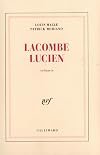
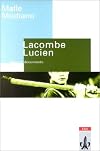
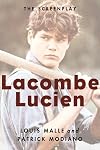
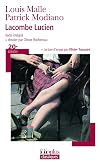
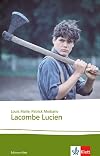
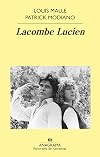
Lacombe, Lucien: The Complete Scenario of the Film
by Louis Malle, Patrick Modiano
On This Page
Description
This early work by the Nobel Prize winner Patrick Modiano relates the story of Lucien Lacombe: a poor boy in Nazi-occupied France who, rebuffed in his efforts to enter the Resistance for a taste of war, becomes a member of a sordid, pathetic group of Fascist collaborators who join the Gestapo in preying upon their countrymen. When Lucien encounters the Horns, a Jewish family from Paris hiding in his provincial town, he must choose between the coarse appeal of violence and his emerging show more feelings of tenderness for the family's daughter, France. show lessTags
Recommendations




















Member Reviews
Louis Malle and Patrick Modiano collaborated on a screenplay about the lives of a few individuals in 1944 during the German occupation in France. What is so remarkable about this small book is how so few words or body movements depict the devastating complexity of lives torn by war.
The screenplay opens with a seventeen-year-old boy, Lucien, diligently and thoroughly doing menial labor cleaning in a charitable nursing home. Our judgment of the boy changes much in the process of the play but this impression will be one we will be reluctant to divest.
Lucien comes from a small town in southeastern France that is a hotbed of resistance against the occupation. One day, standing on a limestone plateau with a flock of sheep, Lucien sees the show more wider world stretch out below him. He is just at the age when he realizes he can turn his bicycle in a different direction from the town where he works to seek out a different experience.
The world is full of danger, and one must be constantly vigilant not to fall into a trap, even though ultimately we cannot escape. The ease with which Lucien kills a small bird with his slingshot and leaves it lying in the courtyard is how, at the end, we view this work by Malle and Modiano. Filled with banality, tragedy, and senseless death, we recognize the underlying truth of war and the human condition.
This classic work of literature packs so much humanity into a glance, a phrase, a movement of the arm that it becomes the essential reading experience. It is only 100 pages, short enough to be read in an afternoon or evening, and yet its effects last forever. This is the way to describe people in extremis. It happened just like this.
Re-published by Other Press and due out this week, this is a book you must read to get a glimpse of how great literature manifests.
· show less
The screenplay opens with a seventeen-year-old boy, Lucien, diligently and thoroughly doing menial labor cleaning in a charitable nursing home. Our judgment of the boy changes much in the process of the play but this impression will be one we will be reluctant to divest.
Lucien comes from a small town in southeastern France that is a hotbed of resistance against the occupation. One day, standing on a limestone plateau with a flock of sheep, Lucien sees the show more wider world stretch out below him. He is just at the age when he realizes he can turn his bicycle in a different direction from the town where he works to seek out a different experience.
The world is full of danger, and one must be constantly vigilant not to fall into a trap, even though ultimately we cannot escape. The ease with which Lucien kills a small bird with his slingshot and leaves it lying in the courtyard is how, at the end, we view this work by Malle and Modiano. Filled with banality, tragedy, and senseless death, we recognize the underlying truth of war and the human condition.
This classic work of literature packs so much humanity into a glance, a phrase, a movement of the arm that it becomes the essential reading experience. It is only 100 pages, short enough to be read in an afternoon or evening, and yet its effects last forever. This is the way to describe people in extremis. It happened just like this.
Re-published by Other Press and due out this week, this is a book you must read to get a glimpse of how great literature manifests.
· show less
Ratings
Members
- Recently Added By
Author Information

47+ Works 1,081 Members
The most commercially successful of the New Wave French film directors of the 1950's is Louis Malle. He started directing in the early 1950's, but it was his 1958 erotic film "The Lovers" that gained him recognition. Since then, he has continued to make films that offer surprising, and occasionally shocking, perspectives on conventional morality. show more "Murmur of the Heart" (1971), is about mother-son incest, and the controversial "Pretty Baby" (1978), his first American film, is set in a New Orleans brothel and features a child. His second American film, the critically acclaimed "Atlantic City" (1980), compassionately depicts the romance between an old man and a young woman. Other notable Malle films are "Lacombe, Lucien" (1973), "My Dinner with Andre" (1981), and "Au Revoir les Enfants" (1987), his account of children growing up in Nazi-occupied France. "Damage" (1992) is another shocking story of a father's obsessive love affair with his son's fiancee, and the eventual destruction that results to all the characters. (Bowker Author Biography) show less

93+ Works 11,107 Members
Paul Modiano is a French writer who was born on July 30, 1945, in Boulogne-Billancourt. He won the Nobel Prize for Literature in 2014 for his lifetime body of work. He previously won the Austrian State Prize for European Literature in 2012 and the Prix mondial Cino Del Duca from the Institut de France for his lifetime achievement in 2010. His show more other awards include the Prix Goncourt in 1978 for his novel Rue des boutiques obscures and the Grand prix du roman de l'Académie française in 1972 for Les Boulevards de ceinture. Modiano's works explore the traumas of the Nazi occupation of France and the puzzle of identity. His preoccupation with the theme of identity can be seen throughout many of his works including his 2005 memoir entitled Un Pedigree. Modiano was greatly influenced by his parents' relationship. His mother and father began their clandestine relationship during occupied France. Growing up, his father was absent for most of his life and his mother was away frequently while on tour acting. He was alone much of the time and went to school because of government aid. His younger brother died of a disease at age 10 and this added to his "lost identity" feelings while growing up. Modiano first came to prominence in France when he wrote the 1968 book La Place de L'Étoile. He has published over 30 works which include novels, screenplays and children's books. His other works include: La Ronde de nuit (1969), English translation: Night Rounds; Rue des boutiques obscures (1978), English translation: Missing Person; and Quartier Perdu (1984), English translation: A Trace of Malice. Although he is well known in France, only about 12 of his works have been translated into English. (Bowker Author Biography) show less
Series
Belongs to Publisher Series
Gallimard, Folioplus (Classiques, 147)
Common Knowledge
- Canonical title*
- Lacombe Lucien
- Original title
- Lacombe Lucien
- Original publication date
- 1974-02-05 (1e édition originale française ∙ Blanche ∙ Gallimard) (1e édition originale française ∙ Blanche ∙ Gallimard); 2008-11-21 (Réédition française ∙ Folioplus Classiques ∙ Gallimard) (Réédition française ∙ Folioplus Classiques ∙ Gallimard)
- Related movies
- Lacombe, Lucien (1974 | IMDb)
- Original language*
- Français
- Disambiguation notice*
- L'édition de 2008 en collection Foliplus fait l'objet d'un complément.
Il s'agit d'un dossier réalisé par Olivier Rocheteau. Lecture d'image par Olivier Tomasini
*Some information comes from Common Knowledge in other languages. Click "Edit" for more information.
Classifications
Statistics
- Members
- 45
- Popularity
- 662,952
- Reviews
- 1
- Rating
- (2.83)
- Languages
- English, French, German, Spanish
- Media
- Paper, Ebook
- ISBNs
- 9
- ASINs
- 1