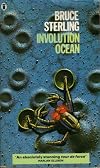
Involution Ocean
by Bruce Sterling
On This Page
Description
A far-future Moby-Dick by the author of Schismatrix: A desperate addict on a bleak, arid planet boards a whaling vessel to hunt the drug he craves. The powerful narcotic syncophine, commonly known as Flare, comes from only one source: the oil of the gargantuan whale-like beasts that swim the dust sea of Nullaqua. It was John Newhouse's addiction to the substance that made him a dealer and forced him to move to this airless, inhospitable planet But when the all-powerful galactic Confederacy show more declares Flare illegal, the needs of Newhouse and his clientele leave the desperate off-worlder no choice but to sign on as an able seaman aboard a dustwhaler and hunt the giant creatures himself. Joining a crew of junkies and misfits, including a mad captain with his own dark and secret agenda and a bewitching, batlike alien woman who is pained by human touch, Newhouse sets out across the silica ocean at the bottom of a seventy-mile-deep crater in search of release and redemption . . . and sails toward a fateful confrontation between man and beast that could lead to catastrophe. Bruce Sterling's debut novel is a remarkable feat of world building--imaginative, provocative, and smart, featuring an unforgettable cast of colorful characters. If Herman Melville's Moby-Dick unfolded on Frank Herbert's Dune, the result might be something akin to Sterling's extraordinary Involution Ocean. show lessTags
Recommendations



























Member Reviews
Harlan Ellison introduced Bruce Sterling to the world with his support for 'Involution Ocean' (1977), Sterling's first novel, praising it in his introduction with such hyperbole that Sterling must have cringed when he read it. Nothing, surely, could be that good!
In fact, the book is very good indeed. It is puzzling that it has disappeared from view since, perhaps because Sterling is so associated with the later movement of cyberpunk that re-selling something by him that was not cyberpunk might be difficult. Who knows how publishers think?
That Sterling wrote this book when he was only 21 (it took two years to publish) makes it all the more striking because what he has done is transform Moby Dick, one of the oft-cited candidates for the show more the 'Great American Novel', into a science fiction novel that is not mere pastiche.
Far from it. Sterling takes themes that come no doubt from a wider love of literature and culture - science fiction as genre, Melville of course, Frank Herbert's 'Dune, vampire lore, Jules Verne, perhaps William Burroughs - and creates something new.
There is even the insertion near the end of Golden Age Kuttnerian cosmic apocalypticism albeit as possible delirium. And does one detect the Voyage of the Beagle and Baron Frankenstein as well as Ahab in the exploits of Captain Nils Desperandum?
It manages to be fantastic and weird - most clearly in one of the most finely drawn and sensitive portrayals of an alien in the winged Dalusa, desperate to be accepted by humanity - and yet give an impression of realism once the fundamentals of the planet and its biology are accepted.
The world he creates, Nullaqua, is closed and yet part of a massively wider universe of trade relations. A very large crater with a million people on islands in a vast sea of sand with its own ecology mimicking the ecology of our oceans and, of course, reminiscent of the deserts of Dune.
The invention of its life forms, especially in Glimmer Bay, is realistic enough that one could see a future David Attenborough devoting a series to it. Everything hangs together from weather to geology to biology so that we take the implausible (the live crater on a dead planet) as plausible.
Its hero is not particularly likeable, self-centred (except in relation to Dalusa and perhaps only ambiguously not so) and slippery but believable. Sterling cleverly gives us clues to the psychology of an inter-planetary humanity that is not much different from ours.
Ellison's introduction is also worth reading (for all the ridiculous hyperbole at the beginning) if only to give us an idea of the environment in which the novel was created, an interesting shift from the world of pulp fiction for money to university-based 'literature'.
Yes, this is literary science fiction and no worse for that, born of a fertile and self-critical community of Texan science fiction writers. Science fiction that tries to be literature can collapse under its own portentous weight but Sterling manages to avoid that trap here.
In short, it is highly recommended whether you care about the graduate references or not. It stands on its own as a tale of the planetary weird and of a half-hearted and unstable redemption in a universe that remains as tough as it was on the planet, Earth, that seems to dominate that universe. show less
In fact, the book is very good indeed. It is puzzling that it has disappeared from view since, perhaps because Sterling is so associated with the later movement of cyberpunk that re-selling something by him that was not cyberpunk might be difficult. Who knows how publishers think?
That Sterling wrote this book when he was only 21 (it took two years to publish) makes it all the more striking because what he has done is transform Moby Dick, one of the oft-cited candidates for the show more the 'Great American Novel', into a science fiction novel that is not mere pastiche.
Far from it. Sterling takes themes that come no doubt from a wider love of literature and culture - science fiction as genre, Melville of course, Frank Herbert's 'Dune, vampire lore, Jules Verne, perhaps William Burroughs - and creates something new.
There is even the insertion near the end of Golden Age Kuttnerian cosmic apocalypticism albeit as possible delirium. And does one detect the Voyage of the Beagle and Baron Frankenstein as well as Ahab in the exploits of Captain Nils Desperandum?
It manages to be fantastic and weird - most clearly in one of the most finely drawn and sensitive portrayals of an alien in the winged Dalusa, desperate to be accepted by humanity - and yet give an impression of realism once the fundamentals of the planet and its biology are accepted.
The world he creates, Nullaqua, is closed and yet part of a massively wider universe of trade relations. A very large crater with a million people on islands in a vast sea of sand with its own ecology mimicking the ecology of our oceans and, of course, reminiscent of the deserts of Dune.
The invention of its life forms, especially in Glimmer Bay, is realistic enough that one could see a future David Attenborough devoting a series to it. Everything hangs together from weather to geology to biology so that we take the implausible (the live crater on a dead planet) as plausible.
Its hero is not particularly likeable, self-centred (except in relation to Dalusa and perhaps only ambiguously not so) and slippery but believable. Sterling cleverly gives us clues to the psychology of an inter-planetary humanity that is not much different from ours.
Ellison's introduction is also worth reading (for all the ridiculous hyperbole at the beginning) if only to give us an idea of the environment in which the novel was created, an interesting shift from the world of pulp fiction for money to university-based 'literature'.
Yes, this is literary science fiction and no worse for that, born of a fertile and self-critical community of Texan science fiction writers. Science fiction that tries to be literature can collapse under its own portentous weight but Sterling manages to avoid that trap here.
In short, it is highly recommended whether you care about the graduate references or not. It stands on its own as a tale of the planetary weird and of a half-hearted and unstable redemption in a universe that remains as tough as it was on the planet, Earth, that seems to dominate that universe. show less
The simplest way to describe Involution Ocean is Moby Dick meets Dune. A sybaritic drug user signs up with a whaling ship that sails on an ocean of dust to obtain a sure supply of the exotic drug Flare. No book could match up to greatness of those two, but Involution Ocean moves quickly, and sketches out a fascinating and mysterious world in the Great Dust Sea.
****
Reread 2021: Involution Ocean wears its homages on its sleeve, so much so that I wonder how much is below the surface. The style is great. While this is Sterling's first novel, and he hews closely to Melville's nautical anachronism, the bones of the patented cyberpunk eyeball kick style are still there. The protagonist John Newhouse's addiction and masochistic love for the show more bat-wing alien lookout Dalusa give the book an emotional urgency that leaps over otherwise simple characterization. And the alien ecology of the dust sea, with it whales and sharks and cannibal anemones delights in its opacity weirdness. The conclusion, a heretical voyage in a submarine made from a whale carcass and John's revelation of what lies under the sea, feels unearned and disconnected from the rest of the novel, but the journey is short, swift, and very interesting. show less
****
Reread 2021: Involution Ocean wears its homages on its sleeve, so much so that I wonder how much is below the surface. The style is great. While this is Sterling's first novel, and he hews closely to Melville's nautical anachronism, the bones of the patented cyberpunk eyeball kick style are still there. The protagonist John Newhouse's addiction and masochistic love for the show more bat-wing alien lookout Dalusa give the book an emotional urgency that leaps over otherwise simple characterization. And the alien ecology of the dust sea, with it whales and sharks and cannibal anemones delights in its opacity weirdness. The conclusion, a heretical voyage in a submarine made from a whale carcass and John's revelation of what lies under the sea, feels unearned and disconnected from the rest of the novel, but the journey is short, swift, and very interesting. show less
Involution Ocean draws inspiration from Moby Dick in it's setting on a whaling ship and in it's themes of obsession ,albeit the ocean is made up of dust and full of alien life forms. I found this book to be well written with great world building and interesting characters the main problem being the length.
I was looking forward to reading this but when the time came I found it disappointing!
Ratings
Members
- Recently Added By
Author Information

133+ Works 21,015 Members
Bruce Sterling is a recent winner of the Nebula Award and the author of the nonfiction book "The Hacker Crackdown" as well as novels and short story collections. He co-authored, with William Gibson, the critically acclaimed novel "The Difference Engine." He lives in Austin, Texas, with his wife and daughter. (Publisher Provided)
Some Editions
Awards and Honors
Notable Lists
Series
Belongs to Publisher Series
Work Relationships
Is contained in
Common Knowledge
- Canonical title
- Involution Ocean
- Original publication date
- 1977-01
Classifications
Statistics
- Members
- 382
- Popularity
- 82,397
- Reviews
- 6
- Rating
- (3.46)
- Languages
- 5 — Czech, English, French, German, Japanese
- Media
- Paper, Audiobook, Ebook
- ISBNs
- 13
- ASINs
- 6