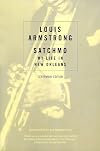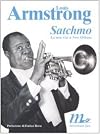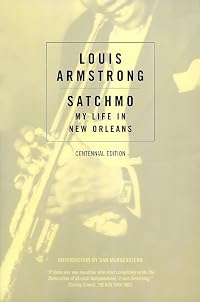
Satchmo: My Life in New Orleans
by Louis Armstrong 
On This Page
Description
”In all my whole career the Brick House was one of the toughest joints I ever played in. It was the honky-tonk where levee workers would congregate every Saturday night and trade with the gals who’d stroll up and down the floor and the bar. Those guys would drink and fight one another like circle saws. Bottles would come flying over the bandstand like crazy, and there was lots of just plain common shooting and cutting. But somehow all that jive didn’t faze me at all, I was so happy to show more have some place to blow my horn.” So says Louis Armstrong, a tough kid who just happened to be a musical genius, about one of the places where he performed and grew up. This raucous, rich tale of his early days in New Orleans concludes with his departure to Chicago at twenty-one to play with his boyhood idol King Oliver, and tells the story of a life that began, mythically, on July 4, 1900, in the city that sowed the seeds of jazz. show lessTags
Recommendations


















Member Reviews
This was fascinating, both as an autobiography and as uniquely filtered socio-economic essay of New Orleans circa 1900-1921, encompassing the 21 years that Louis Armstrong spent growing up in the city.
The first thing you notice is that this doesn't appear to have been edited in any way - not for grammar, not for consistency, and certainly not for "political correctness." Louis tells his story in his own words, stream of conscious-style, through the lens of the morals and ethics he learned growing up in the seediest neighborhoods of New Orleans. His casual acceptance of such things as institutionalized racism (cops who would knock blacks in the head with their "licorice sticks" if they were foolish enough to talk back), domestic show more violence (which went both ways - in Louis's world, the women were as dangerous as the men), prostitution (his mother and his first wife were working girls; he himself "ran" a girl for a while), and abject poverty (scavenging through trash for food and things to sell) are as important a part of the story as the events he is retelling.
The story also provides some fascinating insights into New Orleans culture at the time, from the institutionalized vice of Storyville (deliberately maintained by the city as a profit center) to the seedy honky-tonks that serviced levee workers, pimps, and whores; from the railroad tracks where his mom harvested herbs to combat TB and lockjaw (tetanus being a constant presence in a neighborhood where no one could afford shoes), to the turpentine factories that ripped away the linings of workers' lungs; from the "Colored Waifs Home" where Louis was incarcerated (no trial, no conviction - just an indefinite sentence until such time as his family could manage to round up a white person to vouch for him), to the endless stream of funerals, picnics, balls, and street parades that gave birth to a generation of brilliant jazz musicians.
Seriously, if you're interested in learning more about the life of Louis Armstrong, this should be included in your "must read" pile. While this self-serving autobiography almost surely sugar-coats or omits all manner of traumas, you won't want to miss out on this opportunity to hear Louis tell his story in his own words, though his own chosen filters. show less
The first thing you notice is that this doesn't appear to have been edited in any way - not for grammar, not for consistency, and certainly not for "political correctness." Louis tells his story in his own words, stream of conscious-style, through the lens of the morals and ethics he learned growing up in the seediest neighborhoods of New Orleans. His casual acceptance of such things as institutionalized racism (cops who would knock blacks in the head with their "licorice sticks" if they were foolish enough to talk back), domestic show more violence (which went both ways - in Louis's world, the women were as dangerous as the men), prostitution (his mother and his first wife were working girls; he himself "ran" a girl for a while), and abject poverty (scavenging through trash for food and things to sell) are as important a part of the story as the events he is retelling.
The story also provides some fascinating insights into New Orleans culture at the time, from the institutionalized vice of Storyville (deliberately maintained by the city as a profit center) to the seedy honky-tonks that serviced levee workers, pimps, and whores; from the railroad tracks where his mom harvested herbs to combat TB and lockjaw (tetanus being a constant presence in a neighborhood where no one could afford shoes), to the turpentine factories that ripped away the linings of workers' lungs; from the "Colored Waifs Home" where Louis was incarcerated (no trial, no conviction - just an indefinite sentence until such time as his family could manage to round up a white person to vouch for him), to the endless stream of funerals, picnics, balls, and street parades that gave birth to a generation of brilliant jazz musicians.
Seriously, if you're interested in learning more about the life of Louis Armstrong, this should be included in your "must read" pile. While this self-serving autobiography almost surely sugar-coats or omits all manner of traumas, you won't want to miss out on this opportunity to hear Louis tell his story in his own words, though his own chosen filters. show less
Reconhecimento, admiração e fama sempre efervescente acompanharam Louis Armstrong desde os vinte anos. Seu status de superstar era totalmente merecido, embora dificilmente suportável no dia-a-dia. O Orfeu moderno não precisava ser dilacerado pelas harpias.
Estas que eram batizadas com novos nomes na era moderna: fãs amontoadas na entrada e saída de cada clube; jornalistas, fotógrafos, caçadores de autógrafos, curiosos profissionais ou amadores, anfitriões de “amigos e parentes” que exigiam ajuda financeira e favores, chantagistas, psicopatas e até conspiradores.
Assim, o charmoso e afável Satchmo não teve escolha a não ser erguer um muro de secretárias e recorrer ao poderoso bíceps de um guarda-costas para se defender show more da própria popularidade e conseguir trabalhar em paz… aos olhos da maioria, isso tornava o indivíduo mais azedo; o mundo descobre e usa isso contra ele. Seus velhos amigos, aqueles que ainda se lembram do ídolo de outrora, acham totalmente imperdoável.
Eles balançam a cabeça tristemente e dizem: “o cara está cheio de si, subiu à cabeça dele”, em suma, a mesma velha história. Não posso deixar de pensar que Armstrong escreveu (ou melhor, ditou) suas memórias com os olhos voltados para todas essas pessoas e com a firme intenção de abrandá-las e bajulá-las. “Ei pessoal, escutem”, parece dizer desde a primeira página, “todos os que vivem em Nova Orleans, negros ou brancos, vivos ou mortos, eu nunca perdi a cabeça, nunca me esqueci de vocês: leiam e divirtam-se com estas boas palavras que guardei para cada um, embora no fundo saibam que não são verdadeiras. E para a maioria de vocês, meus amigos músicos para quem as coisas nem sempre correram bem, não só lembrarei seus nomes e apelidos, mas também prestarei uma solene homenagem aos seus dons musicais, às vezes até superiores aos meus, e digo que se eu sei alguma coisa, certamente aprendi com vocês. Tive apenas mais sorte, embora às vezes isso também seja um incômodo para mim; por isso peço humildemente o vosso perdão...”
Este é o tom de suas memórias.
Nobre e comovente.
Sincero? Não sejamos mesquinhos. Procurar sinceridade em um livro de memórias é sem sentido. Seria melhor perguntar qual visão de si e do mundo o autor escolheu representar — já que sempre há espaço para escolha.
Por exemplo, você poderia pegar sua caneta e não ter uma única palavra boa para falar sobre ninguém. É mais comum do que pensamos; mas dificilmente transforma-se em livros. — Projeto Tradução Wislawa show less
Louis Armstrong's story of growing up in New Orleans during the early 1900s. The man is interesting and the time and place likewise so. I was much surprised when I realized what a wild place the current Central Business District was with gangsters, gamblers, and prostitutes making up most of the population - Armstrong himself was actually a pimp for all of 15 minutes (until his "chick" stabbed him and he ran home to his mom so that she could get rid of the girl for him). Also interesting, from a contemporary standpoint is, of course, how casually the racism of the time was accepted (sort of an "oh, well" is all it gets from Armstrong) - luckily times have changed, but not enough, obviously.
Louis Armstrong's autobiography "Satchmo: My Life in New Orleans" (1954) was the first grown-up non-fiction I ever read, probably around 1964 or 1965, when I was 10. My father had it lying around and though he probably knew it had plenty of salty words in it, he didn’t put it on any index of forbidden writings. Anyway, this autobiography covers Armstrong's life from his birth around 1901 until his debut with King Oliver in Chicago in 1922. The autobiography is a fun read; though probably ghost-written, the tone is certainly that of Pops: energetic, enthusiastic, brimming with life.
Biografia colorita e "picaresca", che si ferma alla prima parte di vita di Armstrong e di fatto non ne tocca la musica. Offre al più qualche aneddoto sui alcuni musicisti dell'epoca.
Although school systems did nothing for the man, and he grew up in appalling poverty, Armstrong became a great trumpeter and "entertainer". He became rich without hurting anyone. (His competitor, the great Duke Ellington, makes this extraordinary observation.)
As an adult, Armstrong carried a dictionary around and typed almost every day on a typewriter. This is his autobiography.
As an adult, Armstrong carried a dictionary around and typed almost every day on a typewriter. This is his autobiography.
Ratings
Members
- Recently Added By
Author Information

516+ Works 1,583 Members
Louis "Satchmo" Armstrong is considered one of the most innovative American jazz trumpeters of his era and one of the great ambassadors of American jazz. Armstrong began his career in New Orleans, where, as a young boy, he was a street singer and learned to play the trumpet. In 1922 he moved to Chicago and joined the jazz orchestra of Joe "King" show more Oliver. He quickly became noted for his improvisational style and raised the importance of solo performances in jazz. By the late 1920s, Armstrong led his own jazz ensemble, called the Louis Armstrong Hot Five, which later became the Hot Seven. As he gained in popularity, Armstrong made numerous recordings and performed around the world. He had a number of hit records, including "Hello, Dolly" and "Mack the Knife." He also appeared in Broadway shows and in films. His raspy baritone voice and brilliant trumpet playing combined to make an unforgettable musical sound. (Bowker Author Biography) show less
Louis Armstrong has a Legacy Library. Legacy libraries are the personal libraries of famous readers, entered by LibraryThing members from the Legacy Libraries group.
Some Editions
Series
Belongs to Publisher Series
Common Knowledge
- Canonical title
- Satchmo: My Life in New Orleans
- Original title
- Satchmo - My Life in New Orleans
- Original publication date
- 1953
- People/Characters
- Louis Armstrong
- Important places
- Louisiana, USA; New Orleans, Louisiana, USA
Classifications
- Genres
- Music, Biography & Memoir, Nonfiction, General Nonfiction
- DDC/MDS
- 785.42 — Arts & recreation Music Ensembles with only one instrument per part [formerly: instrumental ensembles and their music] Ensembles without keyboard {formerly: Music for small ensembles} Ensembles of woodwind, brass, strings [formerly: Jazz]
- LCC
- ML419 .A75 .A3 — Music Literature on music Literature on music History and criticism Biography
- BISAC
Statistics
- Members
- 306
- Popularity
- 104,126
- Reviews
- 6
- Rating
- (3.91)
- Languages
- 9 — Danish, Dutch, English, Finnish, French, German, Italian, Polish, Swedish
- Media
- Paper, Ebook
- ISBNs
- 9
- UPCs
- 1
- ASINs
- 13