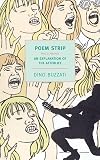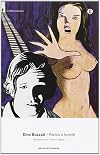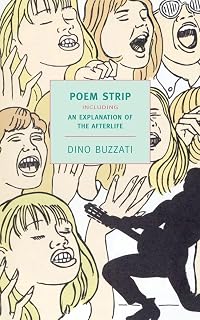
Poem Strip
by Dino Buzzati
On This Page
Description
"Featuring the Ashen Princess, the Line Inspector, trainloads of Devils, Trudy, Valentina, and the Talking Jacket, Poem Strip--a pathbreaking graphic novel from the 1960s--is a dark and alluring investigation into mysteries of love, lust, sex, and death by Dino Buzzati, a master of the Italian avant-garde"--Cover. p. [4].Tags
Recommendations

















Member Recommendations
Member Reviews
When the magically curious Poema a fumetti (A poem in comic strips) was published in 1969, the Italian master of the fantastic and metaphysical fiction, writer and painter Dino Buzzati was sixty-three years old. It is an unexpected but incontestable entry for the first ever "graphic novel", if we accept the terminology imposed by North American publishing.
At the time of publication, the format confounded critics, who by and large knew no better than to obtusely condemn Buzzati's "experiment". It didn't seem serious enough to them. It was demeaning to literature to enclose it into sequential images, bubbles and squares such as were usually seen around Donald Duck and Diabolik. And, it struck some as sort of obscene. In short, the show more critical reception was uncomprehending and cold, but the book sold very well.
The visual, literary, political and autobiographical references of this relatively short and incredibly rich work would take a tome to expound, beginning with Buzzati's life, and what follows are the broadest of strokes. Buzzati's imagination wedded pictures to words from the earliest age, so the question of origin of the idea for a literary story told in pictures is moot. His final decision and choice of the topic, however, had crystallised more than ten years before publication, in the aftermath of a shattering and revelatory love affair, thanks to which Buzzati, by his own testimony, had discovered love for the first time, "at the threshold of old age". The woman in question had been much younger than Buzzati, as was his wife, whom he met and married some years later. The erotic longing, despair and infinite regret that infuse Poema a fumetti are clearly autobiographical.
The plot is taken from the myth of Orpheus and Eurydice, here called Orfi and Eura, and translated to the 1960s Milan. Pop singer Orfi sees one night his beloved Eura disappear into the grounds of a mysterious house, which turns out to be the gateway to Hades. Desperate, he follows and looks for her among the dead (who "live" their death not that differently from how the living live life), beguiles the spirits with his music and song of what they have lost, and almost snatches Eura away… except that she refuses to follow him, telling him it's useless, that another great law reigns in Death, and that they would meet again some day. This is the major departure from the myth, making Eura a positive, independent agent, different from the wholly passive and passively lost Eurydice.
(The reason for this departure, I think, is that Buzzati HAD to abide by the truth of the experience he was conveying. The girl ditched him. Love abandoned him. I can't help wondering what Buzzati's output would have looked like had he known Eros for as long as he had known Thanatos. Oh, he certainly knew, as he wrote to a friend, what it meant to "go to bed with a woman", but it is interesting that his protagonists' main relationships are always with their own and others' death. The joy of living in Buzzati is concentrated in his magnificent appreciation of nature and animals, most poignantly, that of mountains.)
A little on the visual style of the book. Buzzati collected images all his life. He drew and painted in different styles. For Poema a fumetti he adopted a collagistic and "sampling" approach. Some images were drawn from life, including models, such as the young friend who posed for Orfi (Buzzati's wife posed for Eura, a detail which was discreetly overlooked at publication), but others were references to famous illustrations or illustrators, reworkings of photographs, homages to other artists, and concoctions in various styles of the day, influenced by Pop Art and the commercial fumetti. Buzzati's references (according to Lorenzo Vigano) include the image of a hanged man from a medical atlas, architectural plans of buildings in Milano, Salvador Dali's Lobster telephone, photographs of Irving Klaw (famous for his Bettie Page and striptease photos), Caspar David Friedrich, the German Romantic painter, Arthur Rackham, famous illustrator of fairy tales, Otto Greiner, a Symbolist painter, F. W. Murnau, the director of Nosferatu, Wilhelm Busch, German humorist and cartoonist, the creator of Max und Moritz, Hans Bellmer, of the famous quartered Doll, Fellini etc. etc. etc.
This mix creates a strangely dreamlike, surrealist atmosphere, as these diverse visual signals tug at memory and elicit streams of associations. Reading the Poema a fumetti is like lucid dreaming, with eyes open. show less
At the time of publication, the format confounded critics, who by and large knew no better than to obtusely condemn Buzzati's "experiment". It didn't seem serious enough to them. It was demeaning to literature to enclose it into sequential images, bubbles and squares such as were usually seen around Donald Duck and Diabolik. And, it struck some as sort of obscene. In short, the show more critical reception was uncomprehending and cold, but the book sold very well.
The visual, literary, political and autobiographical references of this relatively short and incredibly rich work would take a tome to expound, beginning with Buzzati's life, and what follows are the broadest of strokes. Buzzati's imagination wedded pictures to words from the earliest age, so the question of origin of the idea for a literary story told in pictures is moot. His final decision and choice of the topic, however, had crystallised more than ten years before publication, in the aftermath of a shattering and revelatory love affair, thanks to which Buzzati, by his own testimony, had discovered love for the first time, "at the threshold of old age". The woman in question had been much younger than Buzzati, as was his wife, whom he met and married some years later. The erotic longing, despair and infinite regret that infuse Poema a fumetti are clearly autobiographical.
The plot is taken from the myth of Orpheus and Eurydice, here called Orfi and Eura, and translated to the 1960s Milan. Pop singer Orfi sees one night his beloved Eura disappear into the grounds of a mysterious house, which turns out to be the gateway to Hades. Desperate, he follows and looks for her among the dead (who "live" their death not that differently from how the living live life), beguiles the spirits with his music and song of what they have lost, and almost snatches Eura away… except that she refuses to follow him, telling him it's useless, that another great law reigns in Death, and that they would meet again some day. This is the major departure from the myth, making Eura a positive, independent agent, different from the wholly passive and passively lost Eurydice.
(The reason for this departure, I think, is that Buzzati HAD to abide by the truth of the experience he was conveying. The girl ditched him. Love abandoned him. I can't help wondering what Buzzati's output would have looked like had he known Eros for as long as he had known Thanatos. Oh, he certainly knew, as he wrote to a friend, what it meant to "go to bed with a woman", but it is interesting that his protagonists' main relationships are always with their own and others' death. The joy of living in Buzzati is concentrated in his magnificent appreciation of nature and animals, most poignantly, that of mountains.)
A little on the visual style of the book. Buzzati collected images all his life. He drew and painted in different styles. For Poema a fumetti he adopted a collagistic and "sampling" approach. Some images were drawn from life, including models, such as the young friend who posed for Orfi (Buzzati's wife posed for Eura, a detail which was discreetly overlooked at publication), but others were references to famous illustrations or illustrators, reworkings of photographs, homages to other artists, and concoctions in various styles of the day, influenced by Pop Art and the commercial fumetti. Buzzati's references (according to Lorenzo Vigano) include the image of a hanged man from a medical atlas, architectural plans of buildings in Milano, Salvador Dali's Lobster telephone, photographs of Irving Klaw (famous for his Bettie Page and striptease photos), Caspar David Friedrich, the German Romantic painter, Arthur Rackham, famous illustrator of fairy tales, Otto Greiner, a Symbolist painter, F. W. Murnau, the director of Nosferatu, Wilhelm Busch, German humorist and cartoonist, the creator of Max und Moritz, Hans Bellmer, of the famous quartered Doll, Fellini etc. etc. etc.
This mix creates a strangely dreamlike, surrealist atmosphere, as these diverse visual signals tug at memory and elicit streams of associations. Reading the Poema a fumetti is like lucid dreaming, with eyes open. show less
Poem Strip serves as proof of Buzzati's range as not just an author, but as a creator in general. He can write phenomenally and he's not too shabby as an artist either, not to mention he's capable of reimagining classic stories in new and interesting ways.
Buzzati gives us a punk rock comic strip take on the Orpheus and Eurydice myth, where our rock star main character descends into an underworld that's more lascivious than the underworld of old, perhaps, and where the challenges he faces are of a different nature as well. Thanks to a poetry club in college I've read at least the very least half a dozen takes on the Orpheus and Eurydice myth, and the simple story can be made to convey an amazing range of messages and emotions with only a show more few subtle tweaks. Among the many versions of the myth Buzzati's can stand proudly among them, with a message about letting go that serves as a natural, but still poignant twist on the story.
So long you're okay with the graphic novel format I'd recommend you check out Poem Strip, even if you haven't had much exposure to the Orpheus and Eurydice myth before. show less
Buzzati gives us a punk rock comic strip take on the Orpheus and Eurydice myth, where our rock star main character descends into an underworld that's more lascivious than the underworld of old, perhaps, and where the challenges he faces are of a different nature as well. Thanks to a poetry club in college I've read at least the very least half a dozen takes on the Orpheus and Eurydice myth, and the simple story can be made to convey an amazing range of messages and emotions with only a show more few subtle tweaks. Among the many versions of the myth Buzzati's can stand proudly among them, with a message about letting go that serves as a natural, but still poignant twist on the story.
So long you're okay with the graphic novel format I'd recommend you check out Poem Strip, even if you haven't had much exposure to the Orpheus and Eurydice myth before. show less
Dino Buzzati's Poem Strip is great stuff; a distinctly psychedelic re-telling of the myth of Orpheus which explores some unique angels that (to my knowledge) were not part of the original legend. The artwork is simple and occasionally amateurish, but appropriate nonetheless to the trippy tale that Buzzati is weaving. Even in translation from the original Italian, the poetry is rich, fluid and highly complementary to the drawings on each page. Buzzati loves devils, buxom women, and general surreal weirdness, and all of these elements work in his favor to make Poem Strip a highly original creation that succeeds on every level.
Do you like lots of drawings of boobs? Are you a young boy going through puberty? Then you'll love this! There are so many boobs in this! Everywhere! It's very distracting.
I can't say that I really get comic books (although I will go see every Marvel movie in existence), but I love the myth of Orpheus. This isn't my favorite interpretation, but it is an interesting one. It's very surreal and very 1960s Italian, and the artwork can be pretty great. The book seems to be after those small glimpses in life that look under the everyday glamor and into a world of eternity, where "the last kings of myth [are] setting out toward exile" and everything is a mystery. Look at this world all you like, but in the end you are still going to be swept show more away by it with little understanding of what it is. It's beautiful, sad, and painful fact of life, but there is so much time in existence to cover that up. You better just enjoy the mysteries while you can.
Also, I am not sure why this book says it includes "An Explanation of the Afterlife," since that appears to be a legitimate chapter and not a separate work. show less
I can't say that I really get comic books (although I will go see every Marvel movie in existence), but I love the myth of Orpheus. This isn't my favorite interpretation, but it is an interesting one. It's very surreal and very 1960s Italian, and the artwork can be pretty great. The book seems to be after those small glimpses in life that look under the everyday glamor and into a world of eternity, where "the last kings of myth [are] setting out toward exile" and everything is a mystery. Look at this world all you like, but in the end you are still going to be swept show more away by it with little understanding of what it is. It's beautiful, sad, and painful fact of life, but there is so much time in existence to cover that up. You better just enjoy the mysteries while you can.
Also, I am not sure why this book says it includes "An Explanation of the Afterlife," since that appears to be a legitimate chapter and not a separate work. show less
Nel 1969 Buzzati ripensa il mito di Orfeo ed Euridice ambientandolo nel suo tempo, sostituendo la lira con la chitarra e la mitologia greca con il "mito" flower power che sta vivendo. Spesso fin troppo delirante, sicuramente con troppe donne nude gratuite (ma rientrano nel gusto estetico degli anni 60), a tratti sublime soprattutto grazie agli innesti testuali. In ogni caso, esperimento riuscito e libro - di gran successo - precursore di molto altro a venire.
Lettura veloce, da ripassare con calma per apprezzare la pop-art di Buzzati e la sua nascosta semantica. Tavole e tratto molto legati al suo tempo - e ci mancherebbe; potrebbe risultare legnoso, graficamente. In realta' dietro c'e' cosi' tanta poesia e vita che nessun illustratore saprebbe insufflare automaticamente nei propri lavori. Prosa 'normografata' che presenta le stesse problematiche - e virtu' - delle tavole.
Interesting and a fast read but doesn’t compare to some graphic novels that I’ve read. Buzzati does a take on the Orpheus and Eurydice story set in 60’s Milan. The text is just okay and I didn’t love the drawing style. The composition, however, was fascinating – pictures are shown from odd angles with strange viewpoints. Sometimes the perspective will be from a distance, sometimes at an interesting close-up. There are some creative afterworld ideas. There are also way too many naked women and breasts with not even a shirtless man for balance. It got pretty groan-inducing after awhile.
The story follows Orfi, a talented singer, who one day sees his beloved Eura going into the reputedly haunted house across the street. The next show more day, he learns of her death and decides he has to find her. His guide to the underworld is a sentient jacket and he learns that the denizens of the land of the dead are dully content but devoid of passion. Orfi sings a song of what they’re missing from the living world and is then able to find Eura in a train station. The ending is a version on the usual story of loss. show less
The story follows Orfi, a talented singer, who one day sees his beloved Eura going into the reputedly haunted house across the street. The next show more day, he learns of her death and decides he has to find her. His guide to the underworld is a sentient jacket and he learns that the denizens of the land of the dead are dully content but devoid of passion. Orfi sings a song of what they’re missing from the living world and is then able to find Eura in a train station. The ending is a version on the usual story of loss. show less
Members
- Recently Added By
Lists

Myth (Reuse and Retelling)
188 works; 24 members
Author Information

243+ Works 8,155 Members
Born in Belluno in the region of Veneto, in northern Italy, Dino Buzzati received his law degree from the University of Milan, but never practiced law. Beginning in 1928, he worked as an editor and journalist for the Milanese daily newspaper Il Corriere della Sera. His first work of fiction, Barnabo delle montagne (Barnaby of the Mountains) show more (1933), established Buzzati as an inventive writer who evoked the mysteries of ordinary life. Buzzati never linked himself to any literary movement or style, preferring to seek the fantastic and the extraordinary in his often commonplace characters and locales. A talented short story writer, Buzzati published most of his short fiction in Sessanta Racconti (1958), which was partially translated into English as Catastrophe. Here, Buzzati increasingly employs urban settings where machines, instead of quasi-mythical monstrous beings, populate a supernatural world. Buzzati died in 1972. (Bowker Author Biography) show less
Series
Belongs to Publisher Series
Common Knowledge
- Canonical title
- Poem Strip
- Original title
- Poema a fumetti
- Original publication date
- 1969
- People/Characters
- Orfi; Eura
- Important places
- Milan, Lombardy, Italy; Hades
- Original language*
- Italiano
*Some information comes from Common Knowledge in other languages. Click "Edit" for more information.
Classifications
- Genre
- Graphic Novels & Comics
- DDC/MDS
- 741.5945 — Arts & recreation Drawing & decorative arts Drawing Comic books, graphic novels, fotonovelas, cartoons, caricatures, comic strips History, geographic treatment, biography European Italy, San Marino, Vatican City, Malta
- LCC
- PN6767 .B89 .P64 — Language and Literature Literature (General) Literature (General) Collections of general literature Comic books, strips, etc.
- BISAC
Statistics
- Members
- 256
- Popularity
- 126,498
- Reviews
- 11
- Rating
- (3.66)
- Languages
- 5 — English, Hungarian, Italian, Portuguese (Brazil), Spanish
- Media
- Paper
- ISBNs
- 10
- ASINs
- 2