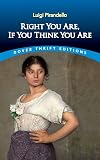
Right You Are, If You Think You Are
by Luigi Pirandello
On This Page
Description
Winner of the Nobel Prize for Literature in 1934, Italian playwright Luigi Pirandello (1867-1936) explored such themes as the relativity of truth, the vanity and necessity of illusion, and the instability of human personality. In this famous play, an expressionistic parable set in a small Italian town in the early twentieth century, Pirandello skillfully dramatizes these issues. The observer Laudisi derides the townspeople for their insistence on knowing the secrets of Mrs. Frola and her show more married daughter: Why does Mrs. Frola live alone and not with her daughter? Why do the two never visit each other? The answers to these questions lie at the heart of this play and at the center of Pirandello's artistic vision. Presented in an excellent new English translation, this inexpensive edition will delight students and lovers of modern drama. show lessTags
Recommendations


















Member Reviews
In this play, Pirandello continues to explore the theater within the theater, evoking realities that intertwine and differ despite appearances. Diego's discourse on this subject is particularly ingenious because it shows how truths can be dismantled and remade. This play of mirrors seems perfect for our time, and the message ditto. While cultures blend and interpretations vary, the essence of this play remains relevant. The ending is a bit disappointing, but the stage performance must be astonishing: definitely something to see in a theater!
Uma cidade de província na Itália fica abalada com a história da recém chegada senhora Frola, que não vê a filha por uma proibição do genro, o também recém chegado senhor Ponza. O senhor Ponza, porém, conta que a filha da senhora Frola morreu há quatro anos e que ela, enlouquecida pela dor, crê que a sua segunda mulher é a filha e que o marido a proíbe de sair de casa. O caso é o contrário segundo a senhora Frola: ela diz que o genro enlouqueceu e pensa que ficou viúvo e se casou de novo, por isso a proíbe de ver a filha pensando que é sua segunda mulher.
Pirandello escreveu essa "farsa filosófica" para zombar de uma realidade que possa ser interpretada racionalmente. O povo da cidade fica obcecado em descobrir quem show more está dizendo a verdade e quem enlouqueceu, já que ambos parecem tão normais [sic], e descobrirão a ilusão de uma verdade absoluta mesmo no confronto clímax. show less
Pirandello escreveu essa "farsa filosófica" para zombar de uma realidade que possa ser interpretada racionalmente. O povo da cidade fica obcecado em descobrir quem show more está dizendo a verdade e quem enlouqueceu, já que ambos parecem tão normais [sic], e descobrirão a ilusão de uma verdade absoluta mesmo no confronto clímax. show less
Thought-provoking play about varying perspectives and the impossibility of knowing absolute truth. I liked how Pirandello described the characters' dress and personality in the stage directions.
This play struck me as a good one to read as it is mostly talk. I'd still watch a performance but I had less feeling of missing something with this one than typical.
This play struck me as a good one to read as it is mostly talk. I'd still watch a performance but I had less feeling of missing something with this one than typical.
Dans cette pièce, Pirandello continue à explorer le théâtre dans le théâtre, évoquant par là les réalités qui s'imbriquent et qui ne se ressemblent pas malgré les apparences. Le discours de Diégo à ce sujet est particulièrement ingénieux car il montre à quel point les vérité peuvent être démontées et refabriquées.
Ce jeu de miroirs peut paraître un peu désuet à notre époque, mais le message ne l'est pas. Alors que les cultures se mélangent et que les interprétations varient, l'essence de cette pièce est toujours pertinente.
La fin est un peu décevante, mais la représentation sur scène doit être étonnante : définitivement quelque chose à voir en théâtre!
Ce jeu de miroirs peut paraître un peu désuet à notre époque, mais le message ne l'est pas. Alors que les cultures se mélangent et que les interprétations varient, l'essence de cette pièce est toujours pertinente.
La fin est un peu décevante, mais la représentation sur scène doit être étonnante : définitivement quelque chose à voir en théâtre!
Jan 26, 2014French
Prachtige enscenering die voortdurend de spelers en ook het publiek uit hun evenwicht brengt: het gezichtsveld van de "waarheid" wisselt voortdurend, dat wil zeggen voor diegene die de waarheid ziet als wit of zwart.
Betere illustratie van Pirandello's thema's dan in de romanvorm, want vasthakend op simpele ideeën, die eens aan het licht gebracht niet echt veel uitwerking behoeven.
Betere illustratie van Pirandello's thema's dan in de romanvorm, want vasthakend op simpele ideeën, die eens aan het licht gebracht niet echt veel uitwerking behoeven.
Jul 9, 2010Dutch
CX15
Nov 25, 2019Portuguese (Brazil)
Ratings
Members
- Recently Added By
Lists

Italian Literature
556 works; 41 members

1910s
90 works; 16 members
Author Information

736+ Works 13,680 Members
Born in Sicily, Pirandello attended the universities of Palermo, Rome, and Bonn. He obtained his doctorate in philology with a thesis on the dialect of his native town, Agrigento before settling in Rome to teach and write. In 1894, he married a Sicilian girl, Antonietta Portulano, who bore him three children before she went mad and afterwards show more provided the inspiration for many of his stories and plays. In all, Pirandello wrote 6 novels, some 250 short stories, and about 50 plays. It was a novel, Il fu Mattia Pascal (1904), that first brought him fame. Only in 1920, when he was past 50, did he turn seriously to playwriting. His first stage success had been a comedy, Liola (1917), written in the Agrigento dialect. It took its theme, if not its mood, from the Mandragola of Machiavelli (see Vols. 3 and 4). In 1921, Pirandello presented his most famous play Six Characters in Search of an Author. Here he seeks to confuse his spectators, who are forced into a paradox of reality and illusion when six "characters" search out the actors of a theatrical troupe to play out their inexorable story. The play exemplifies the Pirandellian conflict between art, which is unchanging and constant, and life, which is a continuous succession of mutations. Pirandello deliberately destroyed the traditional boundaries between audience and spectacle, reflecting the relativity and subjectivity of human existence. The play's unconventional format, which resulted in a riot, established Pirandello as Europe's leading avant-garde dramatist. The main body of Pirandello's plays falls into three overlapping categories, the first exploring the nature of the theater, the second the complexities of personality in the etymological or dramatic sense of the term, and the third rising to dramatic representation of the categorical imperatives of social, religious, and artistic community. Besides the world-famous Six Characters in Search of an Author (1918), his best plays in the three categories include Each in His Own Way (1924), It Is So (If You Think So) (1917), Henry IV (1922), The New Colony (1925), Lazarus, As You Desire Me (1930), and The Mountain Giants (1937), written after he had been awarded the Nobel Prize in 1934 and left incomplete. Pirandello is the forerunner of much modern theater and literature; among the figures who owe their roots to the innovations of Pirandello are Bertolt Brecht, Jean Genet, Jean-Paul Sartre, and Samuel Beckett (see Vol. 1). (Bowker Author Biography) show less
Series
Belongs to Publisher Series
Work Relationships
Is contained in
Has as a student's study guide
Common Knowledge
- Canonical title
- Right You Are, If You Think You Are
- Original title
- Così è (se vi pare) (se vi pare)
- Original publication date
- 1917 (produced in Italian) (produced in Italian); 1917; 1918 (published in Italian) (published in Italian); 1997 (English: Appelbaum) (English: Appelbaum)
Classifications
Statistics
- Members
- 181
- Popularity
- 180,790
- Reviews
- 6
- Rating
- (3.76)
- Languages
- 7 — English, French, German, Greek, Italian, Portuguese, Spanish
- Media
- Paper, Ebook
- ISBNs
- 26
- UPCs
- 1
- ASINs
- 14