
Federigo Tozzi (1883–1920)
Author of Eyes Shut
About the Author
Works by Federigo Tozzi
Con gli occhi chiusi ;: Riccordi di un impiegato (Universale economica Feltrinelli. I classici) (1986) 16 copies
Opere 3 copies
I romanzi 3 copies
Novale: diario 2 copies
Con gli occhi chiusi - Tre croci 2 copies
Tre croci Giovani 1 copy
Opere di Federigo Tozzi 1 copy
Realtà di ieri e di oggi 1 copy
Opere. Il teatro 1 copy
Három kereszt 1 copy
Three crosses 1 copy
Beesten 1 copy
L'uva 1 copy
Három kereszt ; A birtok 1 copy
Anima 1 copy
Opere complete: Volume 3 1 copy
Il podere. L'amore 1 copy
Ghisola 1 copy
Cose e persona 1 copy
Federico Ulivi 1 copy
Associated Works
Tagged
Common Knowledge
- Birthdate
- 1883-01-01
- Date of death
- 1920-03-21
- Gender
- male
- Nationality
- Italy
- Birthplace
- Siena, Italy
- Place of death
- Rome, Italy
- Associated Place (for map)
- Italy
Members
Reviews
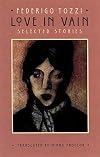
Tozzi's name won't be found heading many encyclopedia articles, but he was by all accounts a prolific and significant figure in premodern Italian literature. Although he didn't survive into his forties, his relatively few years of authorial productivity resulted in five novels and over one hundred short stories, among other works of poetry and drama. Of these considerable efforts, only the twenty tales in this volume are readily available in English. They range in date of composition from show more 1910 through 1919, and the highlight of the collection is the opportunity to trace Tozzi's growing facility with the story form. The early stories are barely more than vignettes, but the later ones show an increasing degree of sophistication, employing varying narrative techniques and more involved plots to explore a consistent thematic preoccupation: the confused psychology of semirural characters. In Tozzi's world, emotions swirl implacably, and motives are barely more intelligible to the reader than they are to the protagonists. Typically, in "First Love," Giacomo is "dizzy with youthful ecstasy" for Emilia but can't find words or even actions to express himself. Her kindly replies to his vague worries are met only with thoughts: "You? I'm ashamed of you. I don't like you. I don't believe you." Here, as in every story, a character experiences conflicting impulses in a single moment. In this example, Tozzi yokes disparate emotions together with the abruptness of a clumsy lover, but with time, he learns to interlace them with an almost Chekhovian delicacy. show less
I found this book and this author through an Italian exercise book (it creates exercises from literature excerpts; how cool is that?!) Anyway, I then read on an Italian internet book site that this author is "Dostoevskian". My interest was definitely piqued!
But now that I've read it, I'm not sure what to think. I'd almost call it Bressonian (if you'll allow a cinematographic comparison), but then Bresson was definitely into Dostoevsky.
Here's what Ortega y Gasset says about Dostoevsky:
"[His:] show more books are almost all extremely long. But the story that is told is usually quite short."
And then later in the same essay [1:]:
"[He:] is a 'realist' not because he uses the material of life but because he uses the form of life."
In other words, reading a Dostoevsky novel is like participating in the events in real life, form-wise.
Here, Tozzi's characters are definitely Dostoevskian, but is the form? I'd say no (this particular novel is only 100 pages long). Again, it's more like a distillation of Dostoevsky, in the manner of Bresson.
But now I'll have to read more Tozzi....
[1:] "Dostoevski and Proust" in _The Dehumanization of Art_, by José Ortega y Gasset, translated by Helene Weyl. show less
But now that I've read it, I'm not sure what to think. I'd almost call it Bressonian (if you'll allow a cinematographic comparison), but then Bresson was definitely into Dostoevsky.
Here's what Ortega y Gasset says about Dostoevsky:
"[His:] show more books are almost all extremely long. But the story that is told is usually quite short."
And then later in the same essay [1:]:
"[He:] is a 'realist' not because he uses the material of life but because he uses the form of life."
In other words, reading a Dostoevsky novel is like participating in the events in real life, form-wise.
Here, Tozzi's characters are definitely Dostoevskian, but is the form? I'd say no (this particular novel is only 100 pages long). Again, it's more like a distillation of Dostoevsky, in the manner of Bresson.
But now I'll have to read more Tozzi....
[1:] "Dostoevski and Proust" in _The Dehumanization of Art_, by José Ortega y Gasset, translated by Helene Weyl. show less
I didn't like this at all. It read like the outline of a novel and not a novel itself. Spareness of language is good, but spareness of flow -- not so much. It just doesn't flow.
I was disappointed because it could have been good. Bressonian, even (see my review of Tozzi's _Tre croci_).
It opens with the main character's father counting his money at closing time of his trattoria. But in the end it's not about money, although it's definitely about how we are shaped by our familial culture and show more how we close our eyes to many things ("con gli occhi chiusi").
But just theme doesn't cut it. It's gotta have flow! show less
I was disappointed because it could have been good. Bressonian, even (see my review of Tozzi's _Tre croci_).
It opens with the main character's father counting his money at closing time of his trattoria. But in the end it's not about money, although it's definitely about how we are shaped by our familial culture and show more how we close our eyes to many things ("con gli occhi chiusi").
But just theme doesn't cut it. It's gotta have flow! show less

Lists
Awards


You May Also Like


Associated Authors
Statistics
- Works
- 59
- Also by
- 2
- Members
- 472
- Popularity
- #52,189
- Rating
- 3.4
- Reviews
- 11
- ISBNs
- 103
- Languages
- 7