

Elio Vittorini (1908–1966)
Author of Conversations in Sicily
About the Author
Series
Works by Elio Vittorini
A Vittorini Omnibus: In Sicily, the Twilight of the Elephant, La Garibaldina: In Sicily and Other Novels (New Directions Books) (1973) 29 copies
Vrouwen langs de weg 8 copies
Il Menabò di letteratura 3 copies
Le opere narrative Vol. 1 3 copies
Il Politecnico 3 copies
Tears and Wine 2 copies
Emberek és farkasok [regény] 1 copy
la città del mondo 1 copy
Gente da Sicília 1 copy
Sardinien — Author — 1 copy
O cravo vermelho 1 copy
Vrouwen langs de weg 1 copy
Vittorini Elio 1 copy
Le opere narrative : II 1 copy
Le opere narrative 1 copy
Parlato e metafora 1 copy
Uomini e isole 1 copy
Tränen im Wein. Roman 1 copy
Vinter i Milano 1 copy
Associated Works
Racconti del terrore — Translator, some editions — 3 copies
The Barber Whose Uncle Had His Head Bitten Off by a Circus Tiger [short story] (2017) — Traduction, some editions — 2 copies
Tagged
Common Knowledge
- Canonical name
- Vittorini, Elio
- Legal name
- Vittorini, Elio
- Birthdate
- 1908-07-23
- Date of death
- 1966-02-13
- Gender
- male
- Education
- Scuola di ragionieria
- Occupations
- novelist
translator
literary critic - Organizations
- Italian Resistance
Italian Communist Party - Relationships
- Sgandurra, Lucia (mother)
Vittorini, Sebastiano (father)
Quasimodo, Rosa (wife)
Vittorini, Giusto Curzio (son)
Vittorini, Demetrio (son)
Vittorini, Giacomo (brother) (show all 7)
Quasimodo, Salvatore (brother in law) - Nationality
- Italy
- Birthplace
- Syracuse, Sicily, Italy
- Places of residence
- Syracuse, Sicily, Italy (birth)
Milan, Italy (death)
Florence, Italy - Place of death
- Milan, Italy
- Burial location
- Cimitero di Concorezzo, Lombardy, Italy
- Map Location
- Italy
Members
Reviews

A strange quasi-memoir set in 1930s Italy, during its Fascist years. It ostensibly tells the tale of a son going back to briefly visit his mother in Sicily, after being away for 15 years. What prompts this is his receiving a letter from his father, informing him that he has left her and gone away with another woman.
Melancholy, symbolist, poetic, frank, philosophical, world-weary, rejoicing – it is all of these things alternately then simultaneously, throughout. The characters our show more protagonist meets are the most human of caricatures, exaggerated perhaps in their individuality in the re-telling, but fundamentally solid flesh and minds and hearts still beneath that. There is little explicit mention of politics, but it lies as an undercurrent – a deep running concern over the suffering of humanity, its simple pleasures, personal quirks, and traditional ways of life.
It is a paean to everything humanity was and is, a cathartic setting down and unburdening (is that possible) of the conflicting feelings of a soul at once tormented and enchanted by the world. show less
Melancholy, symbolist, poetic, frank, philosophical, world-weary, rejoicing – it is all of these things alternately then simultaneously, throughout. The characters our show more protagonist meets are the most human of caricatures, exaggerated perhaps in their individuality in the re-telling, but fundamentally solid flesh and minds and hearts still beneath that. There is little explicit mention of politics, but it lies as an undercurrent – a deep running concern over the suffering of humanity, its simple pleasures, personal quirks, and traditional ways of life.
It is a paean to everything humanity was and is, a cathartic setting down and unburdening (is that possible) of the conflicting feelings of a soul at once tormented and enchanted by the world. show less

I'm not going to pretend that I get all the allusions and layers of this allegorical post-war Italian novel, but I definitely enjoyed it and understood at least some of the metaphors woven into the story. This has the feeling to me of post-war Italian movies, lit by stark sunlight and framed with half-fallen walls and women pushing wheelbarrows. The author shows an obvious love for his country and his Communist ideals here, as well as some harsh criticism of the fallen Facist government and show more encroaching capitalism. While the themes and the metaphors are pretty dated and temporal, there is also an affection and interest in humanity and the ways we reach out to and interact with each other that gives this novel a freshness and universality that it might not otherwise have. It's also often very funny! A somewhat challenging read, but absolutely worth it.
[full review here: http://spacebeer.blogspot.com/2015/03/women-of-messina-by-elio-vittorni-1949.htm... ] show less
[full review here: http://spacebeer.blogspot.com/2015/03/women-of-messina-by-elio-vittorni-1949.htm... ] show less

I read Conversation in Sicily when I was a sophomore in college and really enjoyed it. That's getting long enough ago that I can't always remember exactly why I enjoyed certain books, but I'm starting to realize that if the book still stands out in my mind, it's probably because I really liked it. I remembered was that it was the story of a man who goes back to his childhood home in Sicily and talks to a series of people, and I thought since it had a lot of conversation, it would be a good show more book for me to read as I learn Italian. So, this time I read Conversazione in Sicilia, in italiano! It was a joy to read in its original language.
Vittorini writes of a man, Salvatore, who returns to his Sicilian home after 15 years in the north to visit his mother, who has recently been abandoned by his Shakespeare-loving father. He talks to some people on the train, including a poor farm laborer who mistakes him for an American. He also sees two police officers, referred to in the text as "Coi baffi" and "Senza baffi" (With and Without moustaches), who are derided by the other passengers. When he arrives to his mother's town, he finds her and eats a herring with her. They talk about the past, with his romantic memories of childhood contrasting with her recollection of poverty and hunger in railroad houses of southern Italy. She takes him along with her on her rounds as she goes from house to house giving injections to sick people. They visit a series of poor families with very little to eat and then visit the homes of two wealthier women, who joke with Salvatore and his mother and pretend to be afraid of letting Salvatore see them receive their shots. He then grows restless and decides to walk off, meeting a series of men whom he befriends, repetitively talking about "il mondo offeso" with each new interlocutor. The group ends up getting quite drunk on wine at the bar and Salvatore stumbles away, having a strange encounter with a ghost-like man who lurks in the shadows of the graveyard before waking up the next morning back at his mother's house. He walks through town crying, then comes back home once more before leaving Sicily.
One of the things that I admired most about this book was its vivid depiction of Sicily as a tremendously beautiful place, but also as a place full of poverty and suffering. On the one hand, the mountainous rural landscape, the sounds of music and ringing bells floating through the air, and the natural beauty of the women contribute to a rather wonderful and romantic image of southern Italy. This beauty is contrasted with the struggles of the Sicilians with whom Salvatore converses. There is a lot of talk of hunger, and the people that Salvatore meets often eat scavenged food such as snails and herbs from the countryside, if they have food to eat at all. The man he meets on the train talks about how nobody has money to buy his oranges, which is why he has nothing to eat except these same oranges that he can't sell. Salvatore, as an outsider in his homeland, struggles to make sense of the suffering that he sees, and wonders, along with his partners in conversation, why the world is the way it is. I thought the balance between the two extremes of beauty and suffering was excellent. Many depictions of the third world (because this Sicily of the 1930s certainly felt like the third world) seem to either emphasize either the romance and exotic beauty of foreign lands or dwell on the horrible suffering and oppression of the lower classes. This account of Sicily felt very, very realistic because it included both sides of the coin. Salvatore, in his return to his homeland, is especially attuned to the beauty of the land because it is intertwined with childhood memories. He is also especially attuned to the suffering because, as a man who has moved to a different and more prosperous place, he is now seeing the struggles that he was perhaps not fully aware of as a child.
More than half a century removed from the events of World War II in Italy and in Europe as a whole, the political message of the text floated somewhat above my head until the later stages of the book, when Silvestro leaves his mother and meets the individuals who represent different political archetypes of the period. I enjoyed this part of the book, where the interlocutors revolved around statements about the world and how "è grande ed è bello, ma è molto offeso." I enjoyed how each of the characters that Salvatore meets represent different views (the revolutionary Calogero, the consolatory Ezechiele, the Catholic Porfirio and the intellectual Colombo), but their conversation is made up of repeated and agreed-upon statements on the ways of the world. Their differences were not in how they saw the world, but in how they felt about it, and where they thought redemption or change might be found.
Finally, I might mention that this book was entirely appropriate for an Italian language learner. The language was simple and forceful, with a great deal of repetition of both names, descriptions and statements. The words that I learned through reading this book, I learned well, because they kept on reappearing throughout the text. So as a learning tool, it was excellent, and I would recommend it to anyone who is learning Italian. show less
Vittorini writes of a man, Salvatore, who returns to his Sicilian home after 15 years in the north to visit his mother, who has recently been abandoned by his Shakespeare-loving father. He talks to some people on the train, including a poor farm laborer who mistakes him for an American. He also sees two police officers, referred to in the text as "Coi baffi" and "Senza baffi" (With and Without moustaches), who are derided by the other passengers. When he arrives to his mother's town, he finds her and eats a herring with her. They talk about the past, with his romantic memories of childhood contrasting with her recollection of poverty and hunger in railroad houses of southern Italy. She takes him along with her on her rounds as she goes from house to house giving injections to sick people. They visit a series of poor families with very little to eat and then visit the homes of two wealthier women, who joke with Salvatore and his mother and pretend to be afraid of letting Salvatore see them receive their shots. He then grows restless and decides to walk off, meeting a series of men whom he befriends, repetitively talking about "il mondo offeso" with each new interlocutor. The group ends up getting quite drunk on wine at the bar and Salvatore stumbles away, having a strange encounter with a ghost-like man who lurks in the shadows of the graveyard before waking up the next morning back at his mother's house. He walks through town crying, then comes back home once more before leaving Sicily.
One of the things that I admired most about this book was its vivid depiction of Sicily as a tremendously beautiful place, but also as a place full of poverty and suffering. On the one hand, the mountainous rural landscape, the sounds of music and ringing bells floating through the air, and the natural beauty of the women contribute to a rather wonderful and romantic image of southern Italy. This beauty is contrasted with the struggles of the Sicilians with whom Salvatore converses. There is a lot of talk of hunger, and the people that Salvatore meets often eat scavenged food such as snails and herbs from the countryside, if they have food to eat at all. The man he meets on the train talks about how nobody has money to buy his oranges, which is why he has nothing to eat except these same oranges that he can't sell. Salvatore, as an outsider in his homeland, struggles to make sense of the suffering that he sees, and wonders, along with his partners in conversation, why the world is the way it is. I thought the balance between the two extremes of beauty and suffering was excellent. Many depictions of the third world (because this Sicily of the 1930s certainly felt like the third world) seem to either emphasize either the romance and exotic beauty of foreign lands or dwell on the horrible suffering and oppression of the lower classes. This account of Sicily felt very, very realistic because it included both sides of the coin. Salvatore, in his return to his homeland, is especially attuned to the beauty of the land because it is intertwined with childhood memories. He is also especially attuned to the suffering because, as a man who has moved to a different and more prosperous place, he is now seeing the struggles that he was perhaps not fully aware of as a child.
More than half a century removed from the events of World War II in Italy and in Europe as a whole, the political message of the text floated somewhat above my head until the later stages of the book, when Silvestro leaves his mother and meets the individuals who represent different political archetypes of the period. I enjoyed this part of the book, where the interlocutors revolved around statements about the world and how "è grande ed è bello, ma è molto offeso." I enjoyed how each of the characters that Salvatore meets represent different views (the revolutionary Calogero, the consolatory Ezechiele, the Catholic Porfirio and the intellectual Colombo), but their conversation is made up of repeated and agreed-upon statements on the ways of the world. Their differences were not in how they saw the world, but in how they felt about it, and where they thought redemption or change might be found.
Finally, I might mention that this book was entirely appropriate for an Italian language learner. The language was simple and forceful, with a great deal of repetition of both names, descriptions and statements. The words that I learned through reading this book, I learned well, because they kept on reappearing throughout the text. So as a learning tool, it was excellent, and I would recommend it to anyone who is learning Italian. show less
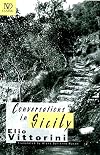
When you are reading this at a far-remove from 1930's Italy it is probably easy to just take it as a quirky travelogue rather than as "one of the great novels of Italian anti-fascism" as it is described in the book's English translation promo.
As a first-time reader I was constantly second-guessing the various statements and incidents for their possible meanings, some of which were more blatant than others e.g. [Not so obvious] when the narrator says that he can only read dictionaries now is show more that meant to imply that all other books have been censored by the regime?; why does the narrator pretend to be from New York City when he is on the ferryboat?; when the little Sicilian on the ferry and at the wharf says that Sicilian oranges are treated on the international markets as if they are poisoned is the fruit meant as a symbol of the regime?; [More obvious] the whiskered and non-whiskered policemen standing in the train corridor, having overheard the little Sicilian talk about oranges, discuss whether he should have been arrested; when the big Lombard enters the train compartment he shuts the door while complaining of the "stink" from the corridor (where the policemen are); etc.
The fascist censors had difficulty as well, as they let it pass in its original serialized magazine printings from 1936-1938 and allowed its original book publication in 1941, until finally arresting and imprisoning the author in 1942.
Hemingway's attraction to its modernist stylings esp. the Gertrude Stein-like repetition effects, is more obvious. His foreword has been used in the English translation publications since 1949 including in this 2000 translation by Alane Salierno Mason.
Trivia:
- the unspecified war that is often referred to is presumably the 2nd Italo-Ethiopian War of 1934-36 based on the book having been written in 1936-38: https://en.wikipedia.org/wiki/Second_Italo-Ethiopian_War
- the book was filmed in 1999 as "Sicilia!", some non-subtitled excerpts are available on YouTube such as the "La Puzza" (The Stink) train scene at https://www.youtube.com/watch?v=EnuVIWOrGDg show less
As a first-time reader I was constantly second-guessing the various statements and incidents for their possible meanings, some of which were more blatant than others e.g. [Not so obvious] when the narrator says that he can only read dictionaries now is show more that meant to imply that all other books have been censored by the regime?; why does the narrator pretend to be from New York City when he is on the ferryboat?; when the little Sicilian on the ferry and at the wharf says that Sicilian oranges are treated on the international markets as if they are poisoned is the fruit meant as a symbol of the regime?; [More obvious] the whiskered and non-whiskered policemen standing in the train corridor, having overheard the little Sicilian talk about oranges, discuss whether he should have been arrested; when the big Lombard enters the train compartment he shuts the door while complaining of the "stink" from the corridor (where the policemen are); etc.
The fascist censors had difficulty as well, as they let it pass in its original serialized magazine printings from 1936-1938 and allowed its original book publication in 1941, until finally arresting and imprisoning the author in 1942.
Hemingway's attraction to its modernist stylings esp. the Gertrude Stein-like repetition effects, is more obvious. His foreword has been used in the English translation publications since 1949 including in this 2000 translation by Alane Salierno Mason.
Trivia:
- the unspecified war that is often referred to is presumably the 2nd Italo-Ethiopian War of 1934-36 based on the book having been written in 1936-38: https://en.wikipedia.org/wiki/Second_Italo-Ethiopian_War
- the book was filmed in 1999 as "Sicilia!", some non-subtitled excerpts are available on YouTube such as the "La Puzza" (The Stink) train scene at https://www.youtube.com/watch?v=EnuVIWOrGDg show less
Lists
Awards


You May Also Like


Associated Authors
Statistics
- Works
- 76
- Also by
- 14
- Members
- 1,925
- Popularity
- #13,370
- Rating
- 3.8
- Reviews
- 23
- ISBNs
- 149
- Languages
- 17
- Favorited
- 5
