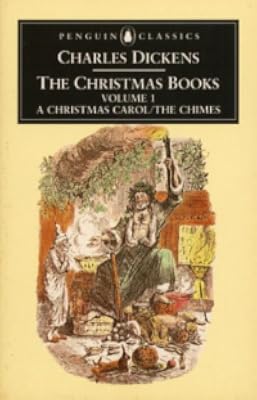
A Christmas Carol / The Chimes
by Charles Dickens
On This Page
Description
In October 1843, Dickens hit upon the idea of writing a story that would not only celebrate Christmas but alert people to the desperate needs of England's poor. The Christmas Carol was the result. The Chimes is a topical satire set on New Year's Eve.Tags
Recommendations













Member Reviews
This was so much better than I was expecting, better than any adaptation I've ever watched at least. There is a lot of humor in the narration that gets lost when the story is translated to film. This was really a 5 star read for me for the first half, but as it progressed, I kind of felt like Dickens spent too much time describing every little detail in the rooms Scrooge visited. I've also always hated that Scrooge becomes a better man in the end. Even in this, it feels too easily won. Scrooge decides to do better as soon as he's exposed to how his actions have impacted others and it feels completely unrealistic. A good story for kids, but less interesting for adults.
This was a somewhat unusual read for me (though I suspect this is so for many readers of this novella) in that I'd seen countless film adaptions before finally picking it up.
What struck me is how light and conversational the tone is at parts. This story (as often happens in film) can so easily slip into melodrama, with the dour Scrooge having a holiday epiphany. Since the story is also so well ingrained in public imagination, parts of it can seem cliche and tired.
Yet, it was an absolute delight to read, not only because Dickens is a masterful writer, but because it is funny and witty in all the right places. Though I should not have been surprised to enjoy Dickens' writing as much as I did, I was still pleasantly surprised with how show more enjoyable the work was. show less
What struck me is how light and conversational the tone is at parts. This story (as often happens in film) can so easily slip into melodrama, with the dour Scrooge having a holiday epiphany. Since the story is also so well ingrained in public imagination, parts of it can seem cliche and tired.
Yet, it was an absolute delight to read, not only because Dickens is a masterful writer, but because it is funny and witty in all the right places. Though I should not have been surprised to enjoy Dickens' writing as much as I did, I was still pleasantly surprised with how show more enjoyable the work was. show less
The Chimes: A Goblin Story of Some Bells that Rang an Old Year Out and a New Year In is Charles Dickens' second Christmas story and was published in 1844, a year after A Christmas Carol. This story has a sharper satirical edge than its predecessor, and directly addresses many of the prevailing ideas in the 1840s regarding the poor. I've already reviewed the first story in this volume, A Christmas Carol, so this review will focus on The Chimes. It was a nice way to assuage a sudden hunger for Dickens (brought on, no doubt, by seeing a performance of A Christmas Carol), but it left me unsatisfied on several counts.
Dickens is so warmly affectionate to his characters. Did ever an author love his creations more? I relished his sketches of show more Toby (called Trotty) Veck, who is fully convinced that he is a very strong, vigorous man who can carry anything and go anywhere. In reality he is a frail, simple little old man who is worn out with long years, poor food, and hard work as a messenger in all weather. This kind of self delusion is lovable somehow.
The Chimes are the bells that Trotty hears all day as he stands outside and waits for commissions. One night, after a disheartening encounter with some local rich men who either pose as a condescending Friend and Father of the poor, reduce humanity to calculations, or believe the poor have no right to exist (much less to be cared for), Trotty wanders up to the bell tower and is visited by the spirits of the Chimes. These spirits berate him bitterly for ever doubting that mankind would rise up and improve itself, and as a punishment Trotty is forced to see visions of his daughter Meg's coming years of misery and degradation. In the end, Meg tries to kill herself and her baby (a plot thread based on a real case, in which a mother tried to drown herself and her child, failed in killing herself, but did drown her child). I don't want to spoil it, but Dickens does manage to wrest a happy ending out of this wreck. It is, after all, just a vision.
Unfortunately I can't agree with part of Dickens' message, that it is man's destiny to pull himself up out of the mire of poverty, ignorance, and sin. The villains all say that the poor are "born Bad," and Dickens uses this effectively in poor Trotty's inner monologues with himself, to argue that it isn't true. Wikipedia puts it well: "The Chimes' intention is to teach Trotty that, far from being naturally wicked, mankind is formed to strive for nobler things, and will fall only when crushed and repressed beyond bearing." But the problem is, humanity has already Fallen. I don't want to disparage for a minute the bitter realities of the Hungry Forties in Britain, and terrible circumstances certainly provide opportunity and impetus for terrible deeds. But, unlike Dickens, I do believe in universal human depravity, and though we were "made to strive for nobler things," we never will reach them or even desire them apart from divine intervention. We can't save ourselves, and our long history of trying and failing only bears this out.
Short as this story is, Dickens still infuses it skillfully with metaphors and memorable descriptions. I loved the idea of Trotty's mittens being like an inn, with a "private apartment only for the thumb, and a common room or tap for the rest of the fingers" (155). Or his description of the almost indecent way we celebrate the coming of the New Year before the Old is even dead.
It isn't hard to see why this story never reached the acclaim of its predecessor, A Christmas Carol, despite the memorable and lovable Trotty Veck. It doesn't really have much to do with Christmas, for one, and it lacks the warmth of the Cratchits to give it humanity and the message of the three spirits of Christmas past, present, and future to give it clarity. I had to reread the Chimes' reproaches several times to even understand what they were accusing poor Trotty of, and even then it was (I confess) really Wikipedia that shed some light on the exchange. Overall, this was an interesting though not completely engaging read, and I think I will need to open one of the full-length novels to get my Dickens fix. show less
Dickens is so warmly affectionate to his characters. Did ever an author love his creations more? I relished his sketches of show more Toby (called Trotty) Veck, who is fully convinced that he is a very strong, vigorous man who can carry anything and go anywhere. In reality he is a frail, simple little old man who is worn out with long years, poor food, and hard work as a messenger in all weather. This kind of self delusion is lovable somehow.
The Chimes are the bells that Trotty hears all day as he stands outside and waits for commissions. One night, after a disheartening encounter with some local rich men who either pose as a condescending Friend and Father of the poor, reduce humanity to calculations, or believe the poor have no right to exist (much less to be cared for), Trotty wanders up to the bell tower and is visited by the spirits of the Chimes. These spirits berate him bitterly for ever doubting that mankind would rise up and improve itself, and as a punishment Trotty is forced to see visions of his daughter Meg's coming years of misery and degradation. In the end, Meg tries to kill herself and her baby (a plot thread based on a real case, in which a mother tried to drown herself and her child, failed in killing herself, but did drown her child). I don't want to spoil it, but Dickens does manage to wrest a happy ending out of this wreck. It is, after all, just a vision.
Unfortunately I can't agree with part of Dickens' message, that it is man's destiny to pull himself up out of the mire of poverty, ignorance, and sin. The villains all say that the poor are "born Bad," and Dickens uses this effectively in poor Trotty's inner monologues with himself, to argue that it isn't true. Wikipedia puts it well: "The Chimes' intention is to teach Trotty that, far from being naturally wicked, mankind is formed to strive for nobler things, and will fall only when crushed and repressed beyond bearing." But the problem is, humanity has already Fallen. I don't want to disparage for a minute the bitter realities of the Hungry Forties in Britain, and terrible circumstances certainly provide opportunity and impetus for terrible deeds. But, unlike Dickens, I do believe in universal human depravity, and though we were "made to strive for nobler things," we never will reach them or even desire them apart from divine intervention. We can't save ourselves, and our long history of trying and failing only bears this out.
Short as this story is, Dickens still infuses it skillfully with metaphors and memorable descriptions. I loved the idea of Trotty's mittens being like an inn, with a "private apartment only for the thumb, and a common room or tap for the rest of the fingers" (155). Or his description of the almost indecent way we celebrate the coming of the New Year before the Old is even dead.
It isn't hard to see why this story never reached the acclaim of its predecessor, A Christmas Carol, despite the memorable and lovable Trotty Veck. It doesn't really have much to do with Christmas, for one, and it lacks the warmth of the Cratchits to give it humanity and the message of the three spirits of Christmas past, present, and future to give it clarity. I had to reread the Chimes' reproaches several times to even understand what they were accusing poor Trotty of, and even then it was (I confess) really Wikipedia that shed some light on the exchange. Overall, this was an interesting though not completely engaging read, and I think I will need to open one of the full-length novels to get my Dickens fix. show less
Nehézkes volt ráhangolódnom a gondolatmenetére, a didaktikusság rontott a történeten, a karácsony és az újév misztériuma azonban gazdagodott.
Containing A Christmass Carol and The Chimes, this is arguably a Dickens classic. Though sometimes a bit overdramatic and cliché, it's still hard not to e moved by these stories.
Aproveitei esta manhã (25/12/2010) para desempoeirar um livrinho esquecido num canto da estante — O Natal do Sr. Scrooge do Dickens — que nunca lera. Vinha a propósito. Só não veio muito a propósito certo naco da tradução. Afinal no original era tão claro... (A Christmas Carol, Hodder & Stocughton, London, p. 81: «After it had passed away...») — "Five and sixpence" no original. Se não me engano são 5 xelins e meio (5/6 ou 5s-6d, i.e. 5 xelins e 6 pence).
Ou 1 coroa (=5 xelins) e 6 pence.
Como se vê é muito mais do que os «cinco ou seis 'pénis'» que a tradutora arranjou e traduzir-se-ia fácil e graciosamente duma das maneiras acima sem recurso a 'phalli'.
Ou 1 coroa (=5 xelins) e 6 pence.
Como se vê é muito mais do que os «cinco ou seis 'pénis'» que a tradutora arranjou e traduzir-se-ia fácil e graciosamente duma das maneiras acima sem recurso a 'phalli'.
Virtual annual reading of A Christmas Carol as 5-star; The Chimes 4-star. Had not read it before and enjoyed it
Members
- Recently Added By
Author Information

Charles Dickens, perhaps the best British novelist of the Victorian era, was born in Portsmouth, Hampshire, England on February 7, 1812. His happy early childhood was interrupted when his father was sent to debtors' prison, and young Dickens had to go to work in a factory at age twelve. Later, he took jobs as an office boy and journalist before show more publishing essays and stories in the 1830s. His first novel, The Pickwick Papers, made him a famous and popular author at the age of twenty-five. Subsequent works were published serially in periodicals and cemented his reputation as a master of colorful characterization, and as a harsh critic of social evils and corrupt institutions. His many books include Oliver Twist, David Copperfield, Bleak House, Great Expectations, Little Dorrit, A Christmas Carol, and A Tale of Two Cities. Dickens married Catherine Hogarth in 1836, and the couple had nine children before separating in 1858 when he began a long affair with Ellen Ternan, a young actress. Despite the scandal, Dickens remained a public figure, appearing often to read his fiction. He died in 1870, leaving his final novel, The Mystery of Edwin Drood, unfinished. (Bowker Author Biography) show less
All Editions
Series
Belongs to Publisher Series
Work Relationships
Common Knowledge
- Canonical title
- A Christmas Carol / The Chimes
- Original publication date
- 1843 A Christmas Carol; 1844 The Chimes
- First words
- Marley was dead, to begin with.
- Last words
- (Click to show. Warning: May contain spoilers.)So may each year be happier than the last, and not the meanest of our brethren or sisterhood debarred their rightful share, in what our Great Creator formed them to enjoy.
- Disambiguation notice
- Includes 2 novels: A Christmas Carol, The Chimes. It's unclear if all these books listed as V.1 actually contain the same works - particularly in the case where books don't include isbn info.
This isbn is for the work "The Christmas Books: V.1 - A Christmas Carol, The Chimes"
Classifications
Statistics
- Members
- 632
- Popularity
- 45,907
- Reviews
- 10
- Rating
- (4.00)
- Languages
- 6 — English, Finnish, French, German, Portuguese, Spanish
- Media
- Paper, Audiobook, Ebook
- ISBNs
- 18
- ASINs
- 23